

A UK representative person is the named contact in the United Kingdom that a vessel owner must appoint when they register a ship on the UK Part 1 register and no qualifying owner lives in the UK. It is a legal role. The person or company you appoint receives official documents on the owner’s behalf and must stay in place for as long as the vessel is registered. If you own a yacht through a foreign company, live abroad, or broker a sale to a non-resident buyer, this is one of the first things to settle before you file.
This guide is about the shipping role under the Merchant Shipping (Registration of Ships) Regulations 1993. It is not the “UK Responsible Person” used for cosmetics or medical devices, which is a different legal concept in a different regime. At Vessel Flag we prepare and file UK Part 1 applications and offer a UK local representative service, so the points below are the ones that decide whether an application goes in cleanly.
Özetle
- A representative person is needed on UK Part 1 when none of the owners holding the majority interest is resident in the UK.
- It must be a UK-resident individual, or a company incorporated in a qualifying country with a place of business in the UK.
- The appointment goes in with the application, and any change of name or address must reach the Registrar within 7 days.
- The representative is where official documents are served, so they must be reachable and reliable for the whole life of the registration.
- Vessel Flag files UK Part 1 applications from €550 one-off and offers a UK local representative service.
İçindekiler
- What a UK representative person is
- When you need one
- Who can act as the representative
- How the appointment works
- What to check before you appoint one
- Representative person or Part 3: choosing the register
- How Vessel Flag handles it
- Our view
- SSS
- Kaynaklar
What a UK representative person is
Altında regulation 18 of the 1993 Regulations, a representative person is either an individual resident in the United Kingdom, or a body corporate incorporated in a member State that has a place of business in the UK. Where your entitlement to register depends on appointing one, you must appoint them before you apply, and you must make sure a qualifying person stays appointed while the ship remains on the register.
In plain terms: the UK register needs someone on UK soil who can be contacted and who can accept legal paperwork when the owner is elsewhere. The representative does not become the owner. Title stays with the registered owners. The role is administrative and legal, not commercial.
When you need one
Part 1 is the register for merchant and pleasure vessels. Property in a ship is divided into 64 shares, and a vessel can be registered when the majority interest, 33 shares, is held by qualified persons, according to the MCA’s Declaration of Eligibility form (MSF 4727). The same form tells applicants that if none of the owners making up the majority interest is resident in the UK, a representative person must be appointed. The UK Ship Register’s eligibility page says the same for Part 1 and for Part 4 bareboat charter registrations.
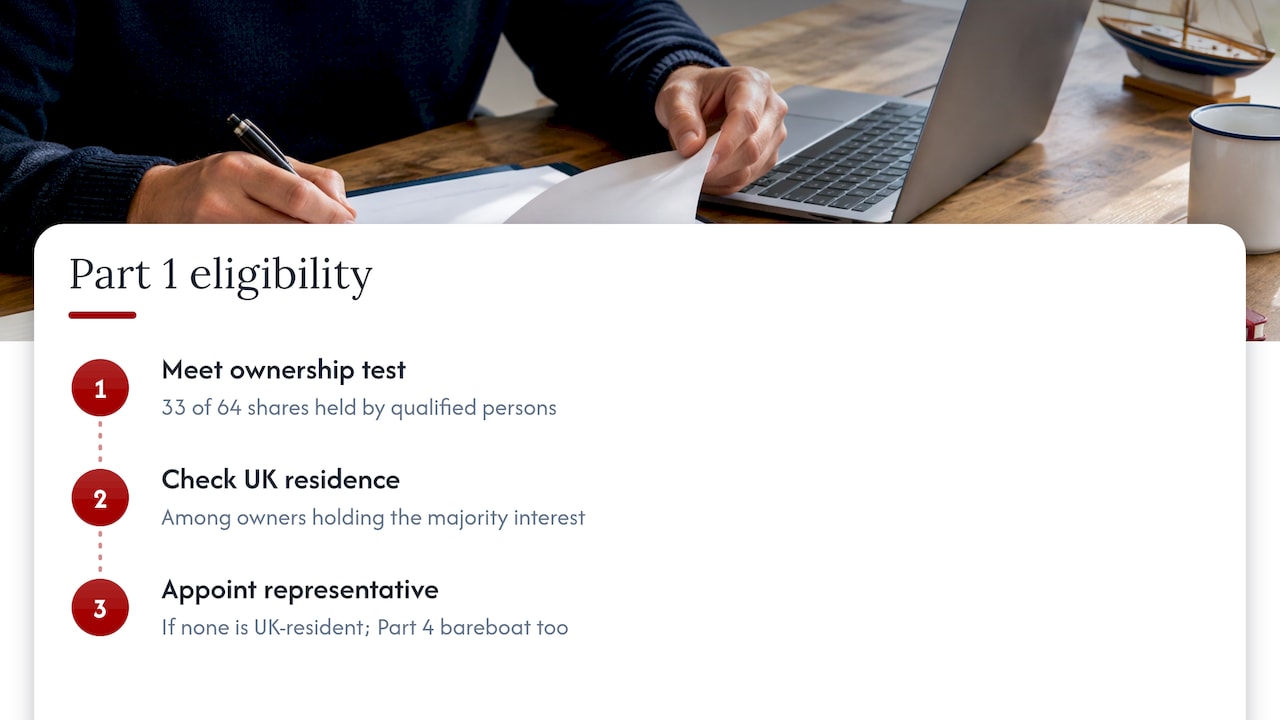
The practical consequence is that living abroad does not stop you registering. The RYA’s guidance on boating paperwork explains that a British citizen can register on Part 1 even when they live overseas or spend limited time in the UK; if they are not normally resident, they appoint a UK-resident representative.
Common ownership set-ups
| Ownership set-up | Representative person needed? |
|---|---|
| UK-resident individual owner | Not for residence reasons: the owner is UK-resident |
| Several owners, more than one UK-resident | No, but one UK-resident owner is named managing owner |
| Qualified owner living abroad | Evet |
| Qualifying company with a UK place of business | A body corporate counts as UK-resident if it has a UK place of business, so usually no |
| Qualifying company with no UK place of business | Evet |
The rules behind this table come from regulations 8, 9 and 23, as set out in the full text of SI 1993/3138. Regulation 9 treats 33 or more shares as a majority, and treats a company as UK-resident when it has a place of business in the UK. Regulation 23 covers the case where there are several owners and no representative: a UK-resident owner must be nominated as managing owner, the register is marked accordingly, and all correspondence goes to that person.
Who qualifies to own
A representative person does not fix an ownership problem. The owners still have to be qualified. Since the 2019 EU Exit amendments, eligibility was widened to include Commonwealth citizens and countries, persons settled in the UK and citizens and companies of listed countries, as HFW’s ship finance guide explains. The same guide confirms the rule on representatives: if no qualifying owner is UK-resident, a UK-resident individual or a company with a UK place of business must be appointed.
For private owners, the owner-side routes are often described like this: you can register personally if you are eligible, through an existing company (UK, or an eligible foreign one such as a Delaware corporation), or through a new UK LTD. A UK company is not always required. Which route suits you depends on your tax, liability and ownership plans, and a company that sits outside the UK with no UK place of business still needs a representative.
Who can act as the representative
The legal test is short: a UK-resident individual, or a qualifying body corporate with a UK place of business. Beyond that, the choice is yours, and it matters more than the test suggests. Consider what the role means in practice.
- Service of documents. Under regulation 19, a document that must be served on the owner is treated as properly served if it is delivered to the representative person, posted to the address last notified to the Registrar, or left for the representative at that address (SI 1993/3138). A missed letter at that address can be treated as received by you.
- Continuity. The appointment must last as long as the registration. An individual who moves house, retires or becomes unreachable creates a gap you then have to fix.
- Change reporting. If the representative’s identity or address changes, the Registrar must be told within 7 days.
For a yacht owner or a charter operator with a fleet, these points favour a company with a fixed UK business address over a friend or colleague. A person can leave; an office with a service behind it is easier to rely on. Brokers closing a sale for a non-resident buyer should settle the representative before the buyer signs, so the file is complete when the application goes in.
How the appointment works
Regulation 18(3) and (4) set out the mechanics. The appointment is made on a form approved by the Secretary of State, containing the representative’s name and address. It is sent to the Registrar with the registration application. Later changes of identity or address are notified to the Registrar within 7 days, and the Registrar records the new details.
On the MCA’s MSF 4727, the representative section asks for the full name or company name and the UK address or place of business. That form goes to the Registry of Shipping and Seamen in Cardiff. The same form requires the Registry to be told within 7 days if the details change.
What to prepare
- Ownership split. Who holds the 64 shares, and whether the qualified owners hold at least 33.
- Residence of the majority owners. Individual residence, or whether each company has a UK place of business.
- Representative details. Full legal name and a UK address that will be staffed and monitored.
- Supporting identity and address evidence. Registries are strict on proof of address. Our guide on Yat tescili için adres kanıtı explains what is usually accepted.
- The wider document set. Bizim yat tescil belgeleri kontrol listesi covers the rest.
A mismatch between the declared ownership and the representative section is a common reason for a file to be sent back. Check that the company names on the declaration match the name on the bill of sale exactly.
What to check before you appoint one
The law fixes who qualifies. It does not tell you whether a particular appointee is a sound choice. Before naming someone, work through this list:
- Is a representative needed at all? If one owner in the majority interest is UK-resident, or your company has a UK place of business, you may not need to appoint anyone.
- Will the address stay valid? A virtual or shared address that changes tenant is a risk, because documents are treated as served there.
- Who monitors the post and email? Someone must read official letters and tell you quickly.
- Can they report changes within 7 days? Ask how a change of address or company name will be handled.
- What happens if you sell? A change of ownership alters who qualifies and may change who must be appointed, so plan the representative around the sale, not after it.
- Is the role in writing? The appointment is a formal form signed and filed, not a verbal arrangement.
If you are moving a vessel from another flag, the representative sits alongside deletion and transfer steps. For an owner bringing a boat into the UK from outside, our guide to importing a yacht into the UK covers VAT, duty and registration together. US-based owners should read foreign yacht registration for US owners.
Representative person or Part 3: choosing the register
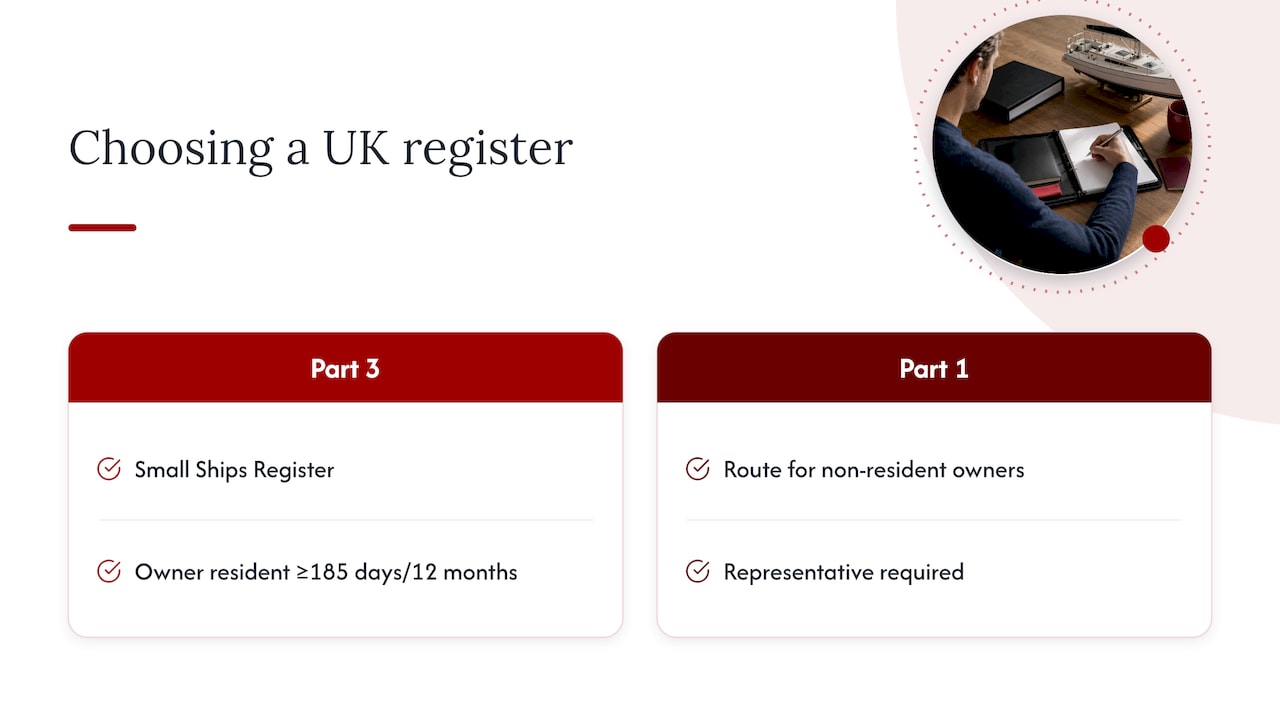
The RYA notes that Part 3, the Small Ships Register, is reserved for owners ordinarily resident in the UK for at least 185 days in a 12-month period, while Part 1 is the route for owners not normally resident, with a representative (RYA). So for a non-resident owner, the question is rarely “Part 1 or Part 3”, but “Part 1 with which representative, and under which ownership structure”.
If you are comparing UK Part 1 with other flags, our comparison of Poland, San Marino and UK Part 1 sets the routes side by side, including how each treats non-resident owners. If the ownership structure itself is the open question, our şirket kurma hizmeti covers UK LTD at €485 and Delaware LLC from €455 (€605 with apostille).
How Vessel Flag handles it
Vessel Flag is a private consultancy, not a registry or government body. We prepare and file the UK Part 1 application, and the certificate is issued by the UK Ship Register. Our service is fully remote, so an owner abroad does not need to travel to start the file. We offer a UK local representative service, and UK Part 1 registration is priced from €550 one-off. A UK MMSI licence from OFCOM is €150, VAT included with no annual fees, and the licence takes 1 day.
A representative appointed alongside a filing we prepared means the ownership declaration, the representative section and the supporting documents are prepared together, not stitched together after a query from Cardiff.
If you want the representative and the application handled in one remote process, see our UK Part 1 yacht registration service or book a consultation to confirm which ownership route fits your vessel.
Our view
Most delays we see on UK Part 1 files come from the ownership section, not from the vessel. Owners assume that because they are British, or because their company is eligible, the representative question answers itself. It does not. The test is who holds the majority interest and where they are resident, and that has to be settled before anything is signed.
Our advice to owners and brokers is to decide the structure first: personal ownership, an existing company, or a new UK LTD. Then decide whether a representative is needed. If it is, choose one with a staffed UK address, because the representative is where official documents are served for as long as the vessel is registered.
That is why we offer a UK local representative service alongside the filing, and why we prepare the ownership declaration and the representative details together. One consultancy, one remote process, a clear published starting price, and no loose ends between the structure, the application and the radio licence.
Gemi Bayrağı
SSS
Can I be my own UK representative person?
Yes, if you are an individual resident in the UK. The role exists for owners who are not, so a non-resident owner cannot fill it themselves. Where you live is what matters, not your nationality.
Does a UK company need a representative person?
Not if it qualifies as UK-resident, which a company does when it has a place of business in the UK. A company with no UK place of business, such as a foreign holding company, needs a representative appointed. The rules are in SI 1993/3138.
How quickly must I report a change of representative?
Within 7 days. Both regulation 18 and the MCA’s MSF 4727 form set that limit for a change in the representative’s identity or address, so keep a named person responsible for it.
Is this the same as a UK Responsible Person for medical devices or cosmetics?
No. Those are product-compliance roles for manufacturers selling into Great Britain. The representative person in yacht registration comes from the Merchant Shipping (Registration of Ships) Regulations 1993 and concerns who the registry can contact and serve documents on.
Do I need a representative for a small boat on the Small Ships Register?
Part 3 is for owners who are ordinarily resident in the UK for at least 185 days in a 12-month period, so the question normally does not arise there. Non-resident owners use Part 1, as the RYA explains.
Kaynaklar
- The Merchant Shipping (Registration of Ships) Regulations 1993, regulation 18
- SI 1993/3138 full text, regulations 8, 9, 19 and 23
- MCA Declaration of Eligibility, form MSF 4727
- UK Ship Register eligibility
- RYA: Boating abroad paperwork
- HFW Ship Finance guide, United Kingdom, 2023
Tavsiye edilir
VesselFlag is a private consultancy that prepares and files yacht registration applications for owners. We are not a government body or flag registry; certificates are issued by the relevant registry. This article is general information, not legal advice.