
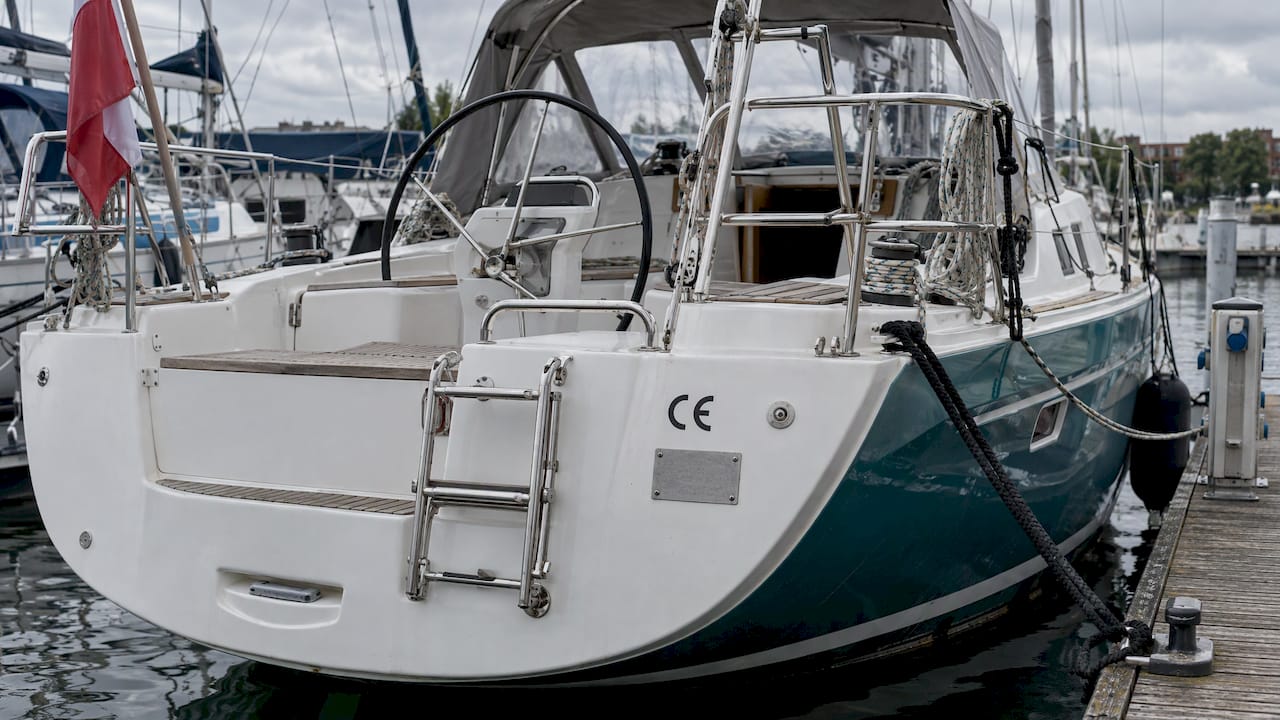
RCD compliance means a recreational yacht between 2.5 m and 24 m carries proof that it met the EU Recreational Craft Directive when it was first sold or put into service: a CE mark, a builder’s plate, a hull identification number and a signed Declaration of Conformity. A boat without that proof, such as an imported or non-CE-marked yacht, needs a post-construction assessment before it can be sold or used in the EU or Great Britain. Flag registration is a separate step. It gives the yacht its nationality and registry certificate, and the registry issues it, not the RCD paperwork. Vessel Flag, a private consultancy, prepares and files registration applications under eight flags, so you can run the two tracks side by side instead of discovering a gap at the point of sale.
Özetle
- The RCD covers most recreational craft of 2.5 m to 24 m placed on the EU market. Great Britain applies the same rules through the Recreational Craft Regulations 2017.
- A compliant post-1998 yacht has a builder’s plate, a correctly formatted identification number on the starboard transom and a signed Declaration of Conformity.
- The rule that decides most cases: a boat must comply at the point it is first placed on the market or put into service in a territory. Boats merely cruising in the EU are in transit.
- A non-CE-marked or never-EEA-sold import needs a post-construction assessment by a notified body, or a UK Approved Body for Great Britain.
- RCD compliance and flag registration are different processes. Plan both before you buy, sell or re-flag.
İçindekiler
- What RCD compliance actually covers
- The markings and documents to look for
- Design category and who assesses the boat
- The rule that decides most cases
- Imported and non-CE-marked yachts
- UK and EU marking today
- RCD compliance is not yacht registration
- A worked example
- Mistakes that cost money
- How Vessel Flag fits in
- Registration prices and set-up
- SSS
- Kaynaklar
What RCD compliance actually covers
The Recreational Craft Directive (2013/53/EU) sets safety, emissions and noise requirements for pleasure craft. Great Britain applies its own version, the Recreational Craft Regulations 2017. GOV.UK guidance gives the scope as craft of 2.5 to 24 m, personal watercraft under 4 m, and certain components and propulsion engines.
The same guidance lists exclusions, among them racing craft, human-powered canoes and kayaks, gondolas, pedalos, surfboards, submersibles, hovercraft, hydrofoils and amphibious vehicles.
Two points matter for owners and brokers:
- It is a product rule, not an annual inspection. Compliance is assessed when the boat first enters a market. It is not renewed like an MOT, as one brokerage guide puts it.
- Length is measured as the hull length defined in the standards, so a yacht just under or over 24 m should have its measurements confirmed by the builder or a surveyor before anyone assumes which regime applies. Craft above 24 m fall under commercial or large-yacht codes and flag-state rules instead.
The markings and documents to look for
A yacht built since 1998 and properly placed on the market should have the following. The European boating industry’s compliance guide lists them:
- A builder’s plate showing the manufacturer, CE mark, design category, maximum recommended load and number of persons.
- A 14-character hull identification number at the transom, with a second hidden location.
- Engine identification.
- An owner’s manual in the official language of the country where it is marketed.
- A written Declaration of Conformity signed by the manufacturer or its authorised representative.
Under Article 18 of the Directive, the CE mark must be visible, legible and indelible on the builder’s plate, mounted separately from the identification number. Where a notified body was involved, its number follows the mark.
A quick due-diligence test for brokers
For a post-1998 vessel, one due-diligence guide suggests checking for three things: a correctly formatted identification number on the starboard transom, a builder’s plate naming the builder, and a signed and dated Declaration of Conformity quoting that number, or an owner’s manual with the vessel’s details. If all three are present, it is reasonable to assume the boat is correctly marked, provided it has not had a major craft conversion since 2017.
Keep copies of all three in the sale file. They are also the documents a buyer’s surveyor, insurer and financier will ask for.
Design category and who assesses the boat
The route to conformity depends on size and design category (A ocean, B offshore, C inshore, D sheltered waters). Under Articles 19 to 23 of the Directive, the manufacturer must apply the relevant conformity modules before placing a product on the EU market. For craft of 12 to 24 m in design categories A and B, an independent notified body must be involved. Smaller or more sheltered craft can use routes where the builder self-certifies certain elements.
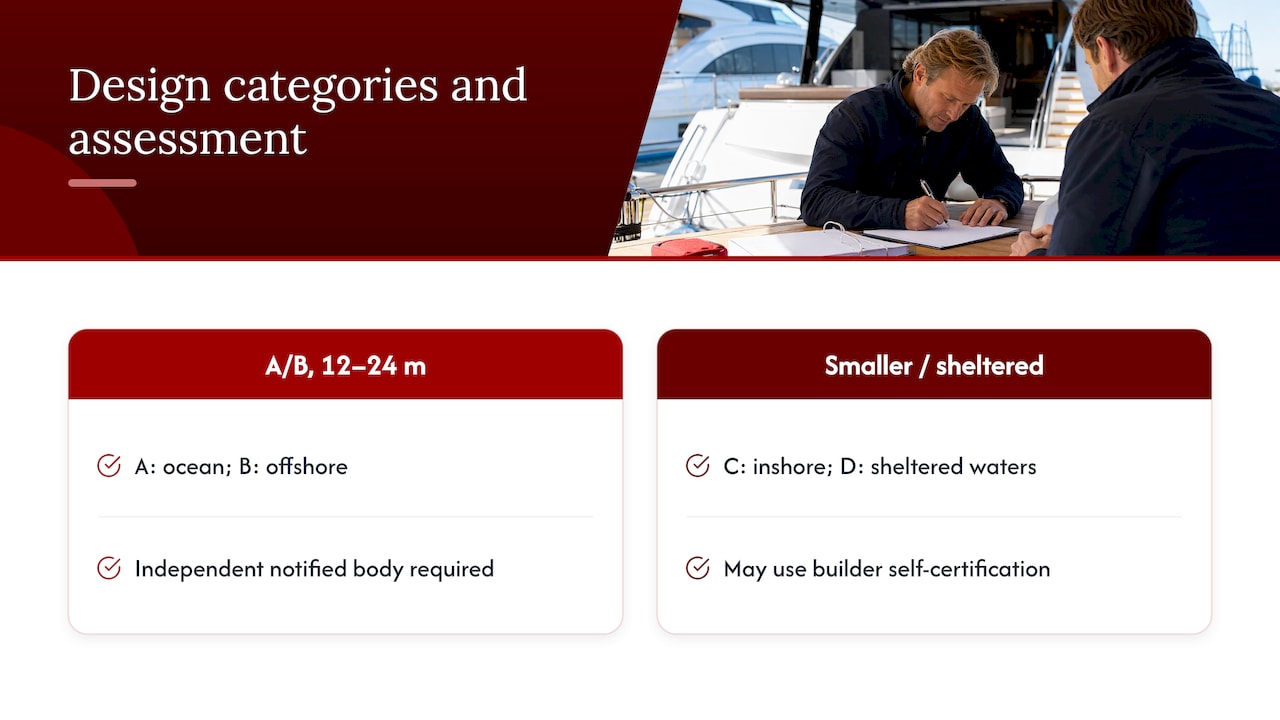
This is why a larger offshore yacht carries a notified-body number beside its CE mark, and a small day boat may not. If you operate charter vessels or work on commercial hulls, a structured marine risk assessment is a useful companion to the RCD paperwork, because the directive’s design category sets the sea conditions the hull was built for, while a risk assessment looks at how you actually operate it.
The rule that decides most cases
The principle running through the GB and EU guidance is simple. A product must comply with the legislation in force on the day it is first placed on the market or put into service in a territory, whichever comes first. Practical Boat Owner sets this out and adds that boats cruising in the EU are in transit and do not need RCD compliance.
Three consequences follow:
- A CE mark on the plate is not enough on its own. Yachting Monthly notes that a French-built yacht with a notified-body certificate still needs assessment if it was never sold or in service in the EEA.
- A boat first put into service in UK waters only can need an EU notified-body assessment to be sold in the EU without evidence of EEA sale or service.
- A pre-June 1998 boat can keep its pre-directive status if the owner can evidence its build date or EU presence. The same article warns that a UK-exempt pre-1998 boat can lose that exemption when sold in Europe. A builder’s certificate is the best single piece of evidence, and our guide to the yatlar için inşaatçı sertifikası explains what it contains.
Imported and non-CE-marked yachts
The question brokers ask most is what happens to a yacht bought outside the EU, a US-built boat for example, or one with no CE mark at all.
The Directive’s answer is the post-construction assessment. A private importer must apply it before putting the craft into service if the manufacturer has not carried out conformity assessment. It is also required after a major modification or conversion, and when a craft built for the builder’s own use is sold within five years of building (Directive, Article 19 and 23).
In practice, according to the industry compliance guide, the boat is assessed individually by a notified body. The person placing it on the market draws up a Declaration of Conformity and affixes the CE mark with the notified body’s number. The builder’s plate should read “Post Construction Certificate”.
Cost and practical limits
Yachting Monthly put a post-construction assessment at £3,000 to £6,000 before any modifications the assessor requires. That was a 2022 figure, so treat it as an order of magnitude and obtain current quotes.
For Great Britain, Practical Boat Owner reports that a non-CE boat destined for the UK needs assessment by a UK Approved Body, with the private importer, based in the UK, signing the Declaration of Conformity. The same article flags that approved bodies willing to certify used imports may be scarce, so start this early.
GOV.UK also sets out the importer’s duties on the GB market. The importer must make sure the manufacturer did the conformity assessment, the technical documentation exists, the marking and documents are in place, and instructions are in English. If there is reason to believe a product is non-conforming, it must not be placed on the market.
UK and EU marking today
The position has been stable enough to plan around, with one caveat.
- For recreational craft, the marking needed to place a product on the GB market is UKCA or CE, per the GOV.UK sector table published 31 March 2026. For Northern Ireland it is CE, or UKNI with CE.
- Regulations in force from 1 October 2024 extended recognition of CE marking in Great Britain indefinitely, while CE remains mandatory for the EEA, according to GOV.UK.
- The same guidance says a CE-marked product already on the market cannot later be UKCA-marked without a full UK Approved Body assessment.
“Indefinite” means there is no published end date. The Product Regulation and Metrology Act 2025 lets ministers change UK product rules, as one commentary notes, so check GOV.UK before a transaction rather than relying on a note in an old file.
RCD compliance is not yacht registration
This is where owners and brokers most often mix things up.
| RCD / CE compliance | Bayrak tescili | |
|---|---|---|
| What it concerns | The boat as a product: design, build, safety | The boat’s nationality and legal identity |
| Who deals with it | Builder, importer, notified body or approved body | Owner (or an agent) and the flag registry |
| Proof | CE mark, builder’s plate, Declaration of Conformity | Registry certificate issued by the flag registry |
| When | When first placed on a market or into service, or after major conversion | At registration, transfer between flags or deletion |
A CE-marked yacht can be registered under any flag the owner is eligible for, and a registered yacht can still have a gap in its RCD paperwork. Each registry sets its own documentary requirements for evidence of ownership and build, so confirm the list for your chosen flag early. A builder’s certificate, bill of sale and previous registry deletion certificate typically sit in both files.
The practical lesson is sequencing. If a yacht is bought abroad and will be registered and sold within the EU or GB, decide at purchase whether it needs a post-construction assessment, then register. Our guide on a Polish flag for a yacht bought abroad covers that route, and the comparison of Poland, San Marino and UK Part 1 helps you choose a flag.
A worked example
A broker has a 15 m motor yacht built in the USA in 2009, now lying in Croatia, being sold to a UK buyer.
- Check the file. No CE mark and no EU Declaration of Conformity: the boat was built for the US market.
- Identify the territory. The buyer wants to put it into service in Great Britain, so GB rules apply at that point. Cruising in EU waters on the way is transit.
- Plan the assessment. A UK Approved Body assessment is needed, with the UK-based importer signing the Declaration of Conformity. Budget for assessor-required modifications, and allow time if approved bodies are hard to find.
- Register. In parallel, the owner chooses a flag. UK Part 1 can be used by an owner who is eligible personally, through an existing UK or eligible foreign company such as a Delaware corporation, or through a new UK LTD.
The broker’s role, as Yachting Monthly frames it, is to alert and educate both sides, not to judge whether evidence of earlier EEA sale is sufficient.
Mistakes that cost money
- Assuming a CE mark settles it. The mark has to match the boat’s market history.
- Treating a refit as cosmetic. A major conversion can reopen compliance. Our note on yacht interior refit compliance lists what owners should check before work starts.
- Skipping the hull number check. A mismatched or badly formatted number on the transom undermines the whole file.
- Waiting for the buyer’s surveyor. Raise documentation gaps before the listing goes live.
How Vessel Flag fits in
We are a private yacht registration consultancy, not a registry or government body. We prepare and file registration applications for private owners, companies and brokers under Poland, San Marino, UK Part 1, Malta, Palau, the Marshall Islands, the Cayman Islands and the Cook Islands. The flag registry issues the certificate. The service is fully remote, with published one-off prices.
We see RCD paperwork and registration as two halves of one ownership file. Owners come to us asking about a flag, and the sensible first question is which documents the yacht already holds: builder’s certificate, bill of sale, previous registry papers, any CE documentation.
Our approach is to keep the registration side clean and predictable. We list our prices, we work remotely, and we handle the whole ownership set-up in one place: company formation, MMSI radio licence and flag transfers. That lets a broker or owner spend their time on the RCD question, which depends on the boat’s history, while we deal with the filing.
For owners who need to choose a flag, our experience across eight flags, our listed agent role with the San Marino and Palau registries and our UK local representative service are designed to remove avoidable delays, though processing times always depend on the registry.
Gemi Bayrağı
Registration prices and set-up
Our published one-off prices start at €320 for Poland, €290 for San Marino and €550 for UK Part 1. Malta starts at €849 and Palau at €700. Marshall Islands is a €250 service fee plus registry fees, and Cayman Islands is a €450 service fee plus registry fees. Cook Islands is quoted per yacht. Poland provisional papers take 2 to 5 days, and the San Marino provisional certificate takes 2 to 6 days, not guaranteed.
An MMSI number and ship radio licence cost €149 in Poland, €150 in the UK and €200 in San Marino, VAT included with no annual fees. The UK licence takes 1 day, and the Polish one takes 4 to 6 weeks after registration. If the yacht will be held through a company, we also form UK LTD, Delaware LLC and Marshall Islands companies, which is covered on our company formation page.
If your yacht’s papers are in order and you are ready to choose a flag, start with our UK Part 1 yacht registration page or the MMSI telsiz lisansı service.
SSS
Does a yacht need RCD compliance to be registered?
RCD compliance and registration are separate processes. The registry issues the registration certificate, and each registry sets its own document list, so confirm it for your flag. Keeping CE documents, the builder’s certificate and the bill of sale together makes both tracks easier.
Do I need RCD compliance if I just cruise in the EU?
Boats cruising in the EU are classed as in transit and do not need RCD compliance, according to Practical Boat Owner. The requirement bites when the boat is first placed on the market or put into service in a territory, including when it is sold there.
What is the five-year rule?
If a craft built for the builder’s own use is placed on the market within five years of being built, it needs a post-construction assessment under Article 19 of the Directive. The same applies after a major conversion.
Is a CE mark still valid in Great Britain?
Yes. GB currently accepts either UKCA or CE for recreational craft, per GOV.UK. CE remains mandatory for the EEA, and the rules can change, so check GOV.UK before a transaction.
Kaynaklar
- Recreational Craft Regulations 2017: Great Britain, GOV.UK
- Product regulations by sector and current approaches to product marking, GOV.UK
- Directive 2013/53/EU, EUR-Lex
- RCD compliance guide, European Boating Industry
- Second hand boats: CE mark headache for sailors?, Yachting Monthly
- What the indefinite delay of the UKCA mark means for boat buying and selling, Practical Boat Owner
- RCD/RCR Guide to Vessel Certification and Due Diligence
- RCD, Recreational Craft Directive, Mark Cameron Yachts
- UKCA vs CE marking in 2026
- Marine risk assessment
Ready to register? See our UK Part 1 yacht registration page, or book a consultation and tell us which flag and yacht you have in mind.
Tavsiye edilir
VesselFlag is a private consultancy that prepares and files yacht registration applications for owners. We are not a government body or flag registry; certificates are issued by the relevant registry. This article is general information, not legal advice.