
San Marino requires proof of financial-security insurance that satisfies the 1992 Civil Liability Convention and related IMO conventions before it will register your yacht. The San Marino Ship Register (SMSR) will not process a registration application without documentation confirming your insurer’s compliance. Your first move: confirm your insurer can actually issue SMSR-compliant certificates before you submit anything.
TL;DR:
- Insurance certificates must explicitly meet SMSR’s format and certify compliance with the 1992 Civil Liability Convention and related IMO conventions.
- Only insurers in the International Group of P&I Clubs are automatically recognized; others must apply for recognition and provide specific documentation.
- Proper documentation includes a compliance certificate, insurer recognition letter if needed, Resident Agent appointment, and current inspection or survey reports.
- Common delays occur from mismatched certificate wording, expired policies, translation issues, or delayed inspections, especially RO sign-offs for larger vessels.
- Vesselflag can facilitate insurer verification, document preparation, and inspection scheduling to streamline the registration process.
İçindekiler
- What Insurance Coverage Does San Marino Yacht Insurance Actually Require?
- Which Insurers and P&I Clubs Does SMSR Accept?
- What Documents Does SMSR Need for Registration and Renewal?
- Common Registration Delays and How to Avoid Them
- How Vesselflag Helps Owners Navigate Insurance and Registration
- When Does San Marino Registration Make Sense?
- Ready to Register Your San Marino-Flagged Yacht?
- Sources
- SSS
What Insurance Coverage Does San Marino Yacht Insurance Actually Require?
San Marino yacht insurance isn’t a single policy type. It’s a set of financial-security obligations tied to specific international conventions, and SMSR checks your documentation against each one.
The registry follows IMO Circular Letter No. 3464, which references four conventions:
- 1992 Civil Liability Convention (CLC) — covers pollution liability from oil spills
- 2001 Bunkers Convention — covers pollution from bunker fuel, separate from cargo oil
- 2007 Nairobi Wreck Removal Convention (WRC) — covers the cost of removing a wreck that poses a hazard
- 2010 HNS Convention — covers hazardous and noxious substances, relevant mainly to certain commercial vessels
Each convention maps to a distinct coverage type, and a standard hull and machinery policy doesn’t touch most of them. Hull cover protects the vessel itself against damage. What SMSR wants is proof of financial security against liability to third parties and the environment, which is a different animal entirely. Many owners assume their existing yacht policy already handles this. In practice, retail policies rarely produce certified documentation tied to convention compliance, which is exactly what SMSR asks to see.
If you charter, cruise commercially, or otherwise put the vessel to commercial use, expect additional certificates beyond what a private pleasure yacht needs.
Which Insurers and P&I Clubs Does SMSR Accept?
Every International Group of P&I Club is automatically recognized by SMSR. That’s the fastest path to compliance, since these clubs already issue the certificates the registry expects in the format it expects.
If your insurer isn’t part of the International Group, they aren’t automatically shut out. They can apply for recognition, but they need to submit documentation matching SMSR’s policy letter SMPL–2023–TEC–007, which spells out exactly what the flag state needs to see before granting acceptance.
Before you commit to a policy, ask your insurer three direct questions:
- Can you issue a CLC or equivalent financial-security certificate specifically for SMSR?
- Have you worked with San Marino registrations before?
- Will you liaise directly with the SMSR Flag State office if questions come up?
Pro Tip: A vague “yes, we cover yachts” from an insurer isn’t good enough. Ask them to name the certificate format and confirm they’ve issued one for an SMSR-flagged vessel before. If they hesitate, that’s your answer.
You can cross-check any provider against the SMSR’s own list of approved P&I clubs, and the registry also maintains contact points for insurers active on San Marino-flagged vessels.
What Documents Does SMSR Need for Registration and Renewal?
Proof of insurance sits inside a larger paperwork package, and SMSR checks each piece against its own forms and checklists. Here’s the sequence that matters:
- Certificate of financial security or CLC documentation. This goes into the registration package alongside your ownership proof, and SMSR verifies it against the vessel registration guidelines before anything moves forward.
- Insurer recognition letter, if your provider isn’t already on the approved P&I list.
- Resident Agent appointment (Form 02), required for any non-resident owner. Skipping this is one of the most common reasons applications stall.
- Inspection or survey documentation, tied to vessel size. Smaller private yachts under 24 meters sometimes qualify for a self-assessment, while larger vessels need sign-off from an authorized Recognized Organization (RO).
Insurance proof and inspection results get cross-referenced by SMSR staff, so a mismatch between what your certificate says and what your survey shows will bounce the application back to you.
Common Registration Delays and How to Avoid Them
Most delays trace back to the same handful of mistakes, and nearly all of them are avoidable with a quick review before you file.
The biggest one: submitting documentation from an insurer who has never issued an SMSR-format certificate before. They mean well, but the wording doesn’t match what the registry expects, and the application comes back for correction. Other frequent snags include missing translations on foreign-language corporate documents, certificates that expired between the time you bought the policy and the time you filed, and a vessel-use classification that doesn’t match the insurance you’re holding (private cover on a vessel you’re using commercially, for instance).
Run through this before you submit:
- Confirm certificate wording matches SMSR’s expected format
- Translate any non-English or non-Italian documents
- Appoint your Resident Agent if you’re a non-resident owner
- Make sure your inspection or survey is current, not just scheduled
Pro Tip: If your vessel needs RO sign-off, book that inspection early. A delayed survey is the single most common bottleneck owners run into, and it has nothing to do with insurance itself.
How Vesselflag Helps Owners Navigate Insurance and Registration
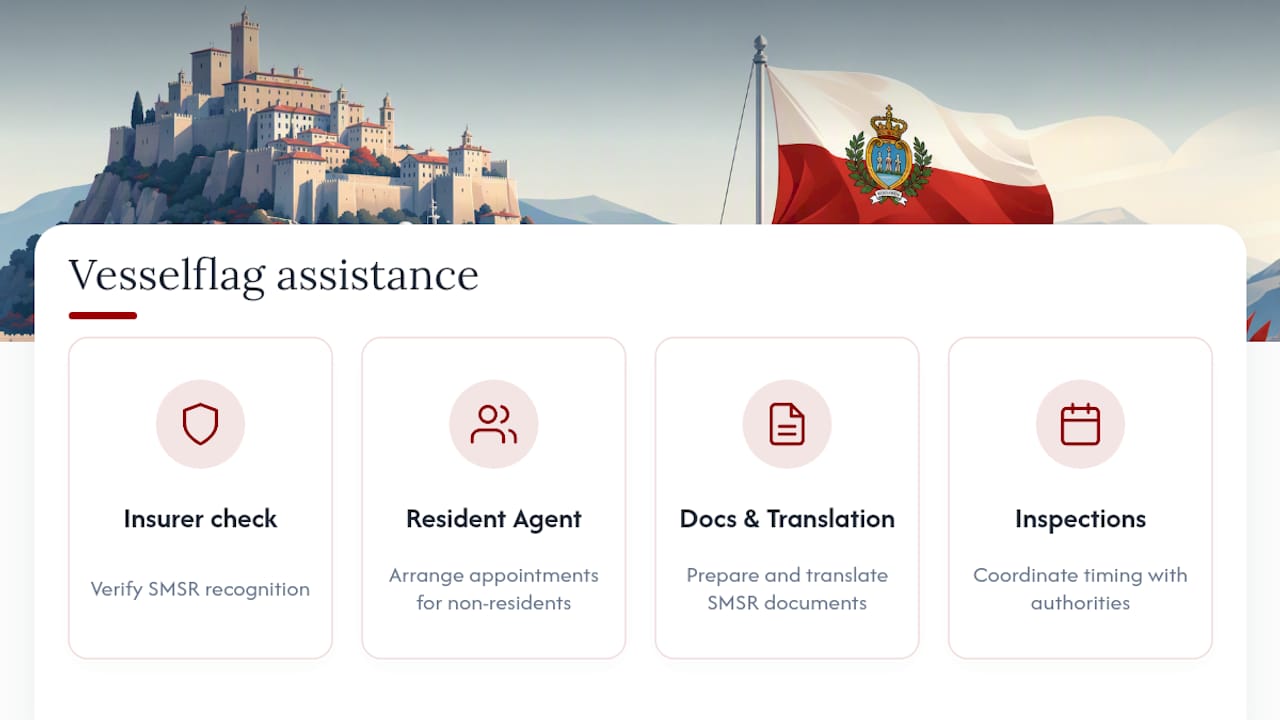
Coordinating an SMSR-compliant insurance policy alongside the rest of a registration file is a lot to track for anyone handling it once. Vesselflag works through this process regularly: checking whether a proposed insurer meets SMSR’s recognition standards, arranging Resident Agent appointments for non-resident owners, preparing and translating the documentation SMSR expects, and coordinating inspection timing with the right authority.
The administrative snags that trip up first-time filers—mismatched certificate wording, missing translations, inspection scheduling conflicts—are common issues routinely encountered and resolved. That familiarity tends to shave real time off the registration timeline, since fewer documents bounce back for correction.
When Does San Marino Registration Make Sense?
San Marino tends to fit owners who want a European flag with straightforward administrative requirements and a registry that’s responsive to insurer verification questions. It’s less suited to owners who need extensive naval architecture flexibility or who already have deep ties to another flag’s compliance system. Working with experienced helpers may cut down the back and forth that eats weeks off a timeline.
Ready to Register Your San Marino-Flagged Yacht?
Getting insurance recognition right the first time saves weeks, not days. Some services handle verification calls with insurers, arrange Resident Agent coverage for non-resident owners, prepare the documentation SMSR expects, and keep the inspection timeline moving alongside everything else.
If you’re weighing San Marino against other flags, or you already know it’s the right fit, start with a San Marino yacht registration request and get a clear picture of your timeline and documentation needs before you commit to an insurer. For a broader look at how registration steps fit together across jurisdictions, the bayrak tescili overview covers what to expect beyond San Marino too.
Sources
Check SMSR’s approved P&I clubs list, its vessel registration guidelines, and its insurance services page directly. For non-resident filings, review the private yacht registration procedure and the International Group of P&I Clubs for background on club recognition.
- Vessel registration guidelines | San Marino Ship Register
- Insurance Services | San Marino Ship Register
SSS
Does San Marino Require Specific Insurance Conventions?
Yes. SMSR requires financial-security documentation tied to the 1992 Civil Liability Convention, the 2001 Bunkers Convention, the 2007 Nairobi Wreck Removal Convention, and the 2010 HNS Convention where applicable.
Are All P&I Clubs Accepted by SMSR?
No. Only members of the International Group of P&I Clubs are automatically recognized; other insurers must apply for recognition under policy letter SMPL–2023–TEC–007.
Do Non-Resident Owners Need a Resident Agent?
Yes, non-resident owners must appoint a Resident Agent using Form 02, and applications missing this document will not be processed.
How Do I Verify My Insurer Is SMSR-Compliant?
Ask your insurer directly whether they can issue a CLC-equivalent certificate for San Marino and check their name against the SMSR’s approved list.
Can Vesselflag Help With San Marino Insurance Verification?
Vesselflag reviews proposed insurers against SMSR recognition standards and coordinates the surrounding paperwork, including Resident Agent appointments and document translation, as part of its registration service.