

TL;DR:
- Many yacht owners overlook the importance of their vessel’s flag, risking legal, operational, and financial consequences. Reflagging involves a complex legal process that affects compliance, taxes, and market access, requiring careful planning and due diligence. Engaging specialized experts ensures a smooth transition that safeguards asset value, operational flexibility, and long-term regulatory adherence.
Many yacht owners treat their vessel’s flag as a paperwork formality, something handled once and forgotten. That assumption is expensive. Your flag determines which country’s laws govern your vessel, how crew members are hired and compensated, what taxes you owe, which ports welcome you without friction, and whether your vessel can operate legally in certain charter markets. Get it wrong and you risk fines, port detention, or a complete halt to commercial operations. This guide walks you through what reflagging actually means, why owners do it, what pitfalls to avoid, and how to execute a clean, compliant change.
Índice
- What does it mean to change a vessel’s flag?
- Key reasons to change vessel flag: Compliance, tax, and practical drivers
- Legal and regulatory implications when switching vessel flags
- Risks and pitfalls: What to watch for when reflagging
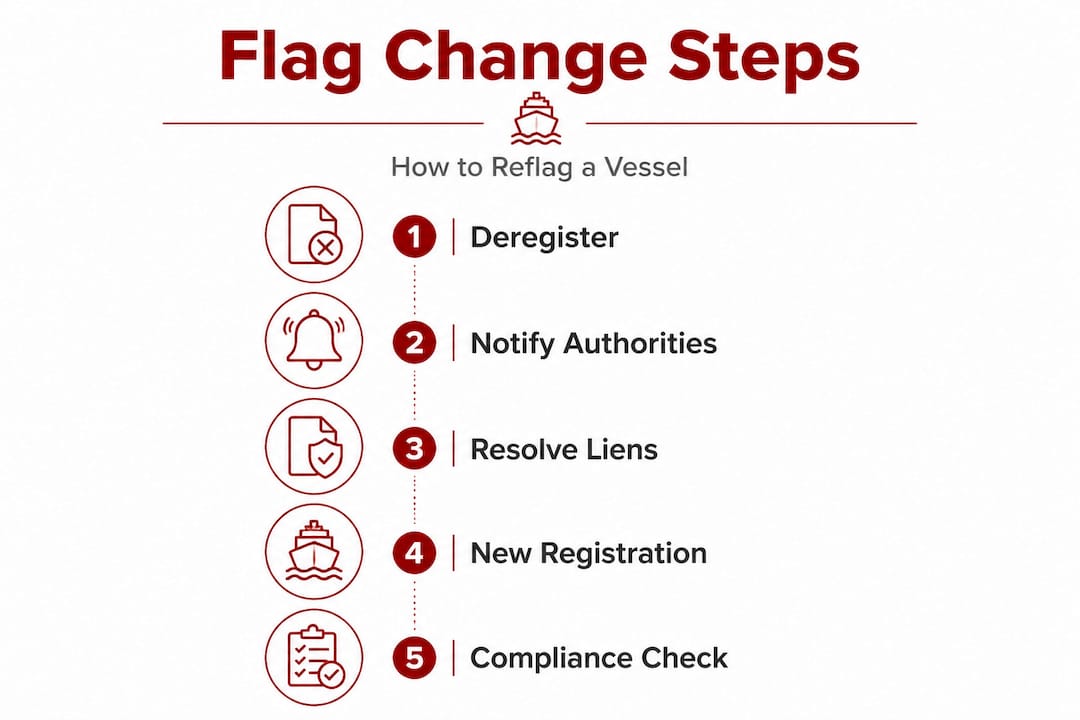
- Step-by-step: How to approach a successful flag change
- The hidden costs and realities: What most yacht owners overlook about flag changes
- Expert help for stress-free flag changes and compliance
- Frequently asked questions
Principais conclusões
| Ponto | Detalhes |
|---|---|
| Flag impacts compliance | Choosing or changing your vessel’s flag directly affects legal obligations and international operational rights. |
| Tax benefits drive reflagging | Many owners change flags to minimize taxes or unlock financial benefits, but must follow strict rules. |
| Due diligence is essential | Proper investigation and expert help can prevent costly mistakes during the reflagging process. |
| Reputation matters | A credible flag boosts your vessel’s value and access, while poor choices invite risk and scrutiny. |
What does it mean to change a vessel’s flag?
A vessel’s flag is not decoration. It is a legal declaration of the country whose law governs the ship. Every flagged vessel is subject to that nation’s maritime statutes, safety inspections, crew certification standards, and tax obligations. Think of it as choosing a nationality for your boat, with all the rights and obligations that come attached.
Reflagging, formally called a change of registry, means deregistering your vessel from its current flag state and registering it under a new one. The moment the new flag flies, a different legal system governs everything from crew contracts to environmental reporting. Understanding global vessel registration is essential before you start, because the differences between registries are far more significant than most owners expect.
Here is what a vessel’s flag actually affects:
- Navigation rights and access to territorial waters
- Crew nationality and certification requirements
- Safety inspection standards and inspection frequency
- Tax treatment, including VAT, tonnage tax, and corporate income tax
- Eligibility to trade commercially in certain markets
- Insurance premiums and the underwriter’s appetite to cover you
- Resale value and financing options
In the U.S. context, reflagging can be legally complex and may require Maritime Administration (MARAD) approval for certain U.S.-documented vessels being transferred to foreign ownership or registry.
The process is not just about swapping paperwork. It involves legal notifications, deregistration certificates, resolution of any maritime liens, and full compliance with the incoming registry’s requirements. Reviewing the full registration process guide before starting saves costly surprises. For vessels operating in multiple jurisdictions, navigating maritime law often requires qualified legal counsel who understands cross-border obligations.
Key reasons to change vessel flag: Compliance, tax, and practical drivers
Now that you know what reflagging actually involves, let’s examine the main reasons owners consider switching their vessel’s flag. The motivations are varied, but they nearly always come back to one of five core drivers.
Top 5 motivations for switching vessel flags:
- Tax optimization. Some registries offer tonnage tax regimes, VAT exemptions for commercial charters, or favorable income tax treatment. Tax and fiscal planning is a major stated driver for reflagging, with owners seeking jurisdictions that offer structured regimes for commercially chartered use.
- Legal compliance alignment. A vessel purchased in one country and operated globally may carry outdated or mismatched regulatory obligations. Reflagging to the right jurisdiction fixes that mismatch cleanly.
- Commercial trading eligibility. Certain charter markets and commercial routes require vessels to hold specific flag registrations. The EU commercial charter market, for example, has flag-linked licensing requirements.
- Operational flexibility. Some flags offer more streamlined crew certification rules or fewer mandatory inspections, making day-to-day operations simpler in international waters.
- Asset protection and ownership structure. Changing ownership to a corporate entity and reflagging simultaneously can shield the vessel from personal liability exposure.
Here is a comparison of popular flag options across key factors:
| Flag state | Tratamento fiscal | Registry transparency | Typical compliance burden | Charter eligibility |
|---|---|---|---|---|
| Ilhas Marshall | Low tonnage tax | High | Moderado | Global |
| Chipre | Favorable VAT/tonnage regime | High | Moderado | EU and global |
| Gibraltar | Low corporate tax options | High | Moderado | EU access |
| USA | Full domestic tax rules | Muito elevado | High | U.S. coastal and global |
| Malta | EU tonnage tax option | High | Moderado | EU and global |
Compreensão registration cost factors is just as important as understanding tax benefits. Upfront savings on registration fees can be wiped out by ongoing compliance costs or unexpected inspection requirements. Evaluating your full operational profile against efficient registration requirements will help you model realistic long-term costs rather than just headline numbers.
Pro Tip: Do not evaluate flags purely on tax rates. A flag with an excellent tonnage tax regime but a poor port state control record can result in your vessel being detained for inspections every time you enter a new port. The operational cost of delays can easily outstrip the tax saving.
When exploring your flag options for yachts, pay attention to regulatory information published by international maritime bodies. A flag’s standing on the Paris MOU or Tokyo MOU white list directly affects how often your vessel will be stopped and boarded.
Legal and regulatory implications when switching vessel flags
Once you’ve clarified why you want to reflag, it’s vital to consider the legal and compliance implications. Changing flags is not just an administrative task. It is a legal transfer of regulatory authority over your vessel, with real consequences if done carelessly.
Key steps in the legal and administrative reflagging process:
- Notify your current flag state of your intent to deregister
- Resolve any outstanding maritime liens, mortgages, or court orders against the vessel
- Obtain a certificate of deletion or deregistration from the current flag state
- Apply to the new flag state’s registry with full ownership documentation
- Pass safety and technical inspections required by the new flag state
- Obtain new vessel certificates, including safety management certificates and radio licenses
- Update MMSI, AIS, and call sign registrations to reflect the new flag
In 2026, international discussions emphasize improving due diligence and transparency in ship registration, driven by the IMO Legal Committee’s first international guidelines designed to deter maritime fraud and misuse of flags.
As of 2026, most reflagged vessels undergo enhanced scrutiny by port state control officers, particularly when moving from a high-scrutiny registry to a lesser-known one. This is partly driven by growing international pressure to prevent flags being used to obscure vessel ownership or evade sanctions. Reviewing the registration types explained for your target registry gives you a clearer picture of which category your vessel will fall into and what that means for inspections.
The legal consequences of skipping steps are severe. Vessels that proceed without proper deregistration can face dual-registration disputes, which can result in arrest in foreign ports. Failure to update certificates means your vessel operates outside its legal framework, which voids most commercial insurance policies. Consulting due diligence resources for yacht sales and transfers is especially valuable if ownership is changing hands at the same time as the flag.
Risks and pitfalls: What to watch for when reflagging
Understanding compliance is not enough. Owners must anticipate and protect against the most common risks of reflagging before they become expensive lessons.
Pro Tip: Avoid any registry that markets itself primarily on speed and low fees without mentioning its port state control record or IMO compliance standing. Fast registration that results in your vessel being flagged for repeat inspections costs far more in delays and stress than a rigorous but reputable registry ever would.
4 common mistakes yacht owners make when reflagging:
- Chasing false savings. Choosing a registry for its headline fee while ignoring annual maintenance costs, renewal fees, and mandatory survey costs can turn a “cheap” flag into the most expensive decision you make.
- Paperwork errors and omissions. Incomplete deregistration or missing certificates during the transition period can leave your vessel in legal limbo, uninsured and technically unfit for commercial use.
- Ignoring registry reputation. Reflagging for lower oversight can raise credibility and enforcement risks as international bodies push for stronger verification. Some flags are categorized as “grey” or “black” by major port state control regimes, triggering automatic enhanced inspections.
- Timing errors on ownership transfers. Combining a sale with a reflagging without careful coordination between both parties’ legal teams creates gaps in coverage and liability exposure.
The impact on resale value and financing is often overlooked. Lenders and brokers are familiar with which registries command respect and which do not. A vessel under a poorly regarded flag can lose buyer interest or face higher borrowing costs. Flags for yacht owners should be evaluated with an eye toward the full asset lifecycle, not just immediate operational convenience. Working toward compliant flag selection protects both current operations and future transactions.
Step-by-step: How to approach a successful flag change
With risks understood, here’s how to navigate a successful vessel reflagging, from regulatory review to operational handoff.
6 key steps to a successful reflagging:
- Regulatory and use-case assessment. Define your vessel’s intended use, primary operating waters, crew structure, and tax residency before selecting a target flag. Match those requirements to a flag state whose laws genuinely serve your profile.
- Legal and financial review. Engage a maritime attorney and a tax advisor simultaneously. Flag choice has tax implications that should be modeled before any paperwork is filed.
- Lien and encumbrance clearance. Confirm that no mortgages, liens, or legal orders are attached to the vessel. These must be resolved or transferred before deregistration can proceed.
- Application to the new registry. Submit full documentation to your chosen flag state, including ownership certificates, builder’s certificate or bill of sale, tonnage measurement certificate, and any existing safety certificates.
- Safety and technical inspection. Most registries require a survey conducted by an approved classification society before issuing new certificates. Plan for this in your timeline.
- Certificate issuance and operational update. Once certificates are issued, update your MMSI and AIS data, inform your insurer, notify port authorities in your primary operating region, and update your vessel’s documentation throughout.
Here is a comparison of the U.S. versus international flag change procedures:
| Factor | U.S. flag change process | International flag change (typical) |
|---|---|---|
| Approval required | MARAD approval may be required | Varies; usually registry authority only |
| Environmental review | May apply | Rarely required |
| Processing time | Several weeks to months | Days to a few weeks |
| Statutory restrictions | High for commercial U.S. vessels | Varies by registry |
| Dual-registry risk | Low (strict oversight) | Moderate (requires careful coordination) |
For U.S.-registered vessels, the process is more demanding. Reflagging a U.S. vessel to a foreign registry is not merely a paperwork step. It can be conditioned by statutory approval and additional administrative steps, including formal application forms and environmental-related processing delays. Commercial operators should follow a commercial vessel step-by-step framework to ensure nothing is missed. Understanding industry standards for yacht rentals is also relevant if the vessel will operate commercially post-reflagging.
Pro Tip: Always align your flag choice with your vessel’s intended use over the next 5 to 10 years, not just your current situation. A flag that works perfectly for private use may create significant friction if you later decide to charter commercially.
The hidden costs and realities: What most yacht owners overlook about flag changes
Most reflagging conversations start and end with tax. That is understandable. The potential savings on VAT and tonnage taxes can be substantial. But focusing exclusively on the headline numbers means you walk into a decision with an incomplete picture.
The lure of a tax-friendly or “easy” flag consistently comes with trade-offs that emerge later. Higher global scrutiny from port state control. Insurance underwriters who either decline to cover certain registries or price them at a premium. Restricted access to specific charter markets that require EU or well-regarded registries as a condition of licensing. These are not minor inconveniences. They are operational realities that can fundamentally change your vessel’s earning potential and day-to-day experience.
Most owners also underestimate the ongoing administrative burden after reflagging. Initial registration is one event. But annual renewals, mandatory surveys, crew certificate validation, and reporting obligations continue indefinitely. A flag that looked cost-effective in year one can become a time and money drain by year three.
Registry reputation ripples further than most owners realize. Lenders factor it into financing decisions. Charter brokers consider it when listing yachts for high-end clients. Some Mediterranean ports process vessels from well-regarded registries faster and with fewer inspections. These differences are hard to quantify upfront but very real in practice. Understanding hidden registration costs before committing to any registry is one of the most underrated steps in the whole process.
A long-term mindset, paired with genuine expert due diligence, delivers more lasting value than chasing the lowest initial fee. A credible flag choice is not just a compliance checkbox. It is an investment in the asset value, operational freedom, and peace of mind that serious yacht ownership demands.
Expert help for stress-free flag changes and compliance
Changing your vessel’s flag touches legal, financial, and operational dimensions simultaneously. Most owners have expertise in running a yacht, not in cross-border maritime law or international tax structuring.
Em VesselFlag.com, we specialize in exactly this. Our platform guides yacht owners through flag registration services covering flags across multiple jurisdictions, with transparent timelines, upfront costs, and compliance support built into the process. Whether you are moving from a U.S. registry to an international flag or switching between two international registries, we help you find the right flag for your vessel’s profile and operational goals. We also handle ancillary requirements including MMSI setup, AIS registration, vessel insurance coordination, and corporate registry support, so nothing falls through the cracks during your transition.
Frequently asked questions
Is it legal to switch a vessel’s flag to another country?
Yes, it is generally legal to change your vessel’s flag, but strict procedures apply and approvals may be required. For example, certain U.S.-documented vessels transferring to foreign ownership or registry may require MARAD approval before the process can proceed.
Do yacht flag changes affect taxes?
Absolutely. Tax and fiscal planning is one of the primary drivers of reflagging decisions, with different jurisdictions offering significantly different VAT, tonnage tax, and income tax treatment, especially for commercially chartered vessels.
What is the risk of choosing a “flag of convenience”?
Flags with weak supervision can trigger more frequent port state control inspections, raise insurance premiums, and attract legal scrutiny. International bodies are pushing for stronger verification and due diligence in flag registration precisely because of how misuse risks have grown.
What documents are required for changing a vessel’s flag?
Typically you need proof of ownership, a certificate of deregistration from the current flag state, a tonnage certificate, and safety compliance certificates. U.S.-registered vessels face additional steps including formal application forms and potential environmental-related processing delays before the transfer is approved.