

Resumo:
- Changing a yacht’s flag involves deregistration from the current registry and registration with a new one, typically taking 4 to 16 weeks and costing $3,000 to $8,000. The process includes notifying the old authority, obtaining a deletion certificate, passing technical surveys, and receiving the new registration, with delays often caused by incomplete documents or regulatory issues. Proper preparation, legal review, and expert guidance are essential to avoid costly delays and ensure a smooth transition.
A yacht flag change is defined as the formal process of deregistering your vessel from its current flag state and registering it under a new one. The yacht flag change timeline typically runs 4–16 weeks, depending on the complexity of your compliance requirements and the flag states involved. Costs generally fall between $3,000 and $8,000, covering administrative fees and legal assistance. The industry term for this process is “reflagging,” and understanding both the procedural steps and the legal triggers involved is what separates a smooth transition from a costly, months-long delay.
What is the yacht flag change timeline, step by step?

Reflagging a yacht is not a single transaction. It is a regulated sequence of actions that spans two separate maritime authorities, each with its own requirements and pace.
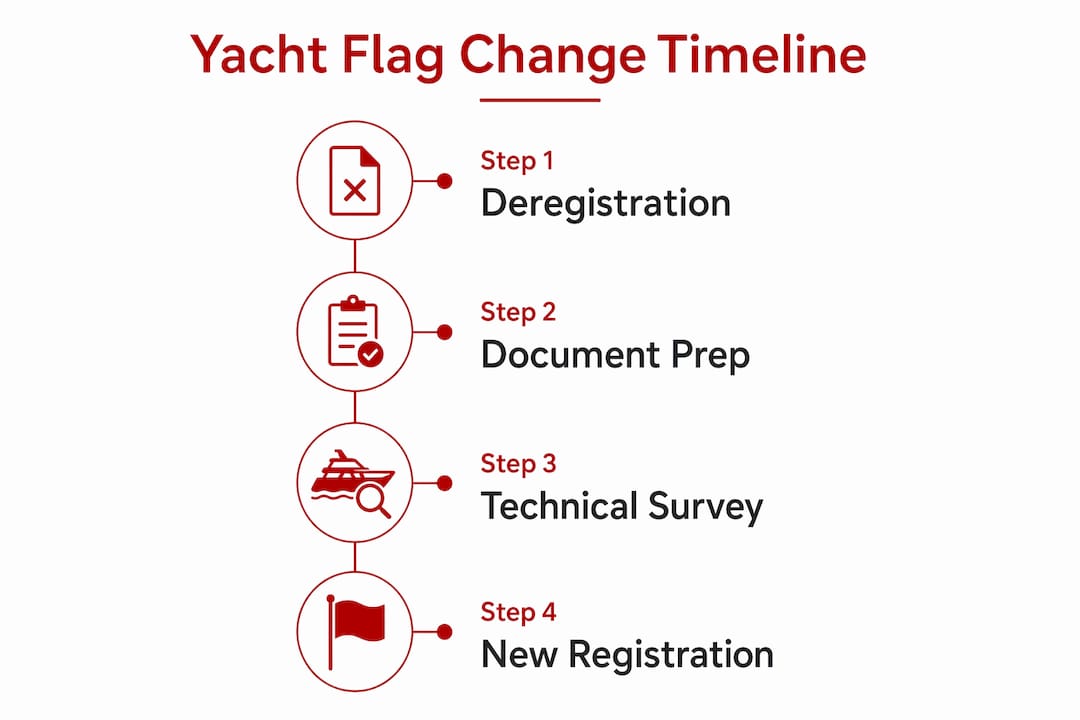
The process breaks down into five distinct phases:
- Notify your current flag authority. Submit a formal deregistration request and settle any outstanding fees or obligations. This step alone can take 1–3 weeks depending on the flag state’s administrative workload.
- Obtain your deletion certificate. O deletion certificate confirms release from the old registry. No new flag authority will accept your application without it. This is the single most common bottleneck in the entire process.
- Submit your application to the new flag authority. Provide all required vessel documents, including the Builder’s Certificate, Bill of Sale, and tonnage measurement details. Incomplete submissions restart the clock.
- Undergo technical survey and inspection. Technical surveys by appointed surveyors are mandatory. Inspectors verify hull condition, safety systems, and environmental compliance. If your vessel does not meet the new flag state’s standards, rectification work is required before certification proceeds.
- Receive your new Registration Certificate. Once all inspections pass and paperwork clears, the new flag authority issues your certificate. This final step typically takes 1–2 weeks after survey approval.
| Phase | Typical Duration |
|---|---|
| Deregistration and deletion certificate | 1–3 weeks |
| Document preparation and submission | 1–2 weeks |
| Technical survey and inspections | 1–4 weeks |
| New flag authority review and approval | 1–4 weeks |
| Certificate issuance | 1–2 weeks |
| Total range | 4–16 weeks |
Dica de profissional: Plan your reflagging around your vessel’s operational calendar. Initiating the process at least 12 weeks before a scheduled charter or delivery date gives you buffer for unexpected survey findings or administrative delays.
Vessel modifications add time. If your yacht requires safety equipment upgrades or structural changes to meet the new flag state’s standards, add 2–6 weeks to your estimate. Errors in registration can cause costly delays, and vessels may require modifications before certification is issued.
What documents and prerequisites do you need first?
The fastest way to extend your reflagging timeline is to arrive at the process unprepared. Most delays trace back to missing documents or unresolved obligations from the original flag state.
Before you submit a single form, work through this checklist:
- Clear all outstanding obligations with your current flag state. Unpaid fees, unresolved inspections, or pending violations will block the issuance of your deletion certificate.
- Gather core vessel documents. You need the original Builder’s Certificate, all Bills of Sale in the chain of ownership, tonnage measurement certificates, and current safety certificates.
- Review your insurance policy. Insurance and financing contracts may restrict flag changes, requiring careful review before you proceed. Reflagging without lender or insurer consent can trigger a default or void your coverage.
- Check crew employment contracts. O flag state dictates the daily operational framework, including crew employment law and safety equipment standards. Changing flags can alter the legal framework governing your crew’s contracts.
- Confirm the new flag state’s survey requirements. Each flag state publishes its own technical standards. Reviewing them before you apply tells you whether your vessel needs upgrades before the survey.
O lista de controlo do registo de iates published by Vesselflag covers each of these prerequisites in detail and is worth reviewing before you contact any flag authority.
Dica de profissional: Engage a maritime lawyer before you start, not after a problem surfaces. Legal review of your insurance, financing, and crew agreements typically costs far less than resolving a breach or coverage dispute mid-process.
One often-overlooked document is the corporate ownership structure. If your yacht is held through a company, the new flag state may require certified corporate documents, proof of beneficial ownership, and a power of attorney. Gathering these takes time, especially across multiple jurisdictions.
How do costs and legal factors affect your reflagging decision?
Reflagging is not just a paperwork exercise. It carries real financial and legal consequences that affect your vessel’s operations for years after the certificate is issued.
Cost breakdown for a standard reflagging:
- Administrative fees to the old flag state: $300–$800
- Administrative fees to the new flag state: $500–$2,000
- Legal and professional fees: $1,500–$4,000
- Technical survey costs: $500–$2,500
- Vessel modifications (if required): variable
The total standard reflagging cost runs $3,000–$8,000. That figure assumes no major modifications and no legal complications. Real-world costs frequently exceed this range when tax restructuring, mortgage amendments, or insurance renegotiation are involved.
The Paris MOU categorizes flag states by detention record into white, gray, and black lists. Choosing a white list flag state means fewer Port State Control inspections and lower risk of operational penalties. A black list flag state can result in frequent detentions, which cost far more than the registration savings.
| Flag State Category | Inspection Frequency | Operational Risk |
|---|---|---|
| White List | Low | Mínimo |
| Gray List | Moderado | Elevated |
| Black List | High | Significant |
Flag choice is a strategic decision with direct implications for tax optimization, crew law, and daily operations. Owners who choose a flag state purely on registration cost often face higher ongoing compliance costs that outweigh the initial savings. Reviewing the compliance advantages of different flag states before committing to a new registry is time well spent.
What causes delays and how do you avoid them?
Most reflagging delays are preventable. They fall into three categories: documentation gaps, technical failures, and contractual conflicts.
Common delay triggers and how to address them:
- Incomplete paperwork. Missing a single document, such as a notarized Bill of Sale or a certified translation, can pause your application for weeks. Build a complete document checklist before submission.
- Outstanding fees with the current flag state. Unpaid dues block the deletion certificate. Audit your account with the current registry at least 30 days before you plan to submit your deregistration request.
- Survey failures. Technical or safety standards failures require rectification works before certification is issued. Commission a pre-survey inspection by an independent surveyor to identify problems before the official survey.
- Insurance or mortgage conflicts. Reflagging without written consent from your lender or insurer is one of the most expensive mistakes an owner can make. Get written confirmation before you notify the flag authority.
- Regulatory changes in the new flag state. Many owners do not review flag state choice regularly, risking compliance gaps at ownership or operational changes. Flag state regulations evolve, and what was compliant two years ago may not be today.
Reflagging is the moment when every deferred maintenance item and every unreviewed contract becomes a real problem. The owners who complete the process on time are the ones who treated preparation as the work, not the paperwork.
Dica de profissional: Work with a registrar who has direct experience with both your current and target flag states. Processing times and document requirements vary significantly between jurisdictions, and an experienced registrar knows which steps can run in parallel to compress the timeline.
Timely preparation and professional assistance are the single greatest factors in reducing reflagging delays. Owners who engage professionals at the start of the process consistently complete reflagging faster and with fewer unexpected costs than those who attempt to manage it independently.
Pontos-chave
A successful yacht flag change requires completing deregistration, documentation, survey, and new registration in sequence, with total timelines running 4–16 weeks and costs between $3,000 and $8,000.
| Ponto | Detalhes |
|---|---|
| Timeline is 4–16 weeks | Complexity, flag states involved, and survey outcomes determine where you land in that range. |
| Deletion certificate is mandatory | No new flag authority will process your application without confirmed release from the old registry. |
| Costs exceed registration fees | Budget for legal review, survey, and potential vessel modifications beyond the base administrative fees. |
| White list flag states reduce risk | Paris MOU white list status means fewer Port State Control inspections and lower operational penalties. |
| Preparation prevents delays | Auditing documents, fees, insurance, and crew contracts before starting is what keeps the timeline on track. |
What we’ve learned from watching owners rush this process
Flag choice is one of the most consequential decisions a yacht owner makes, and it rarely gets the attention it deserves. At Vesselflag, we see the same pattern repeat: an owner decides to reflag because of a tax advantage or a broker’s recommendation, submits the application without reviewing their mortgage agreement, and then spends three months resolving a lender consent issue that a 30-minute legal review would have caught.
The owners who complete reflagging efficiently share one trait. They treat the preparation phase as the actual work. The paperwork is just the output. They review their insurance policy, talk to their lender, audit their flag state account, and commission a pre-survey inspection before they contact any authority. By the time they submit their application, approval is nearly a formality.
The other lesson we’ve learned is that flag state decisions should be revisited at every major ownership or operational change. Regulations evolve. Tax positions shift. A flag state that was optimal three years ago may now expose your vessel to more inspections or higher compliance costs. Build a flag state review into your ownership calendar, not just your refit schedule.
— VesselFlag
Ready to start your flag change with expert support?
Reflagging a yacht involves coordinating two flag authorities, a technical survey, legal reviews, and document preparation across multiple jurisdictions. Getting one step wrong extends your timeline by weeks and can trigger costs that far exceed the original budget.
Vesselflag provides end-to-end registration services covering deregistration, deletion certificate coordination, new flag applications, and survey management. The platform’s expertise spans flags including San Marino, Malta, UK Part 1, Palau, and more, with clear timelines and transparent costs for each. Whether you are reflagging for tax efficiency, operational compliance, or a change in ownership structure, the complete yacht registration guide walks you through every requirement. For owners comparing flag options before committing, the flag registration service page outlines current timelines and costs by jurisdiction.
Perguntas frequentes
How long does a yacht flag change take?
The standard reflagging timeline runs 4–16 weeks, depending on the flag states involved, document completeness, and whether the vessel passes its technical survey on the first attempt.
What is a deletion certificate and why does it matter?
A deletion certificate is the official document confirming your vessel has been released from its current registry. It is mandatory before any new flag authority will process your registration application.
Can my lender or insurer block a flag change?
Yes. Insurance and financing agreements frequently contain clauses that restrict reflagging without written consent. Proceeding without that consent can void your coverage or trigger a loan default.
What does a yacht flag change cost?
The typical cost range is $3,000–$8,000, covering administrative fees, legal assistance, and the technical survey. Vessel modifications required to meet new flag standards add to that figure.
How often should i review my flag state choice?
Flag state regulations and tax positions evolve, so reviewing your flag state periodically at ownership changes, major refits, or shifts in your operational area is the standard practice recommended by maritime compliance professionals.

[…] who want a fuller breakdown of where delays typically surface can review a detailed flag change timeline covering each stage in […]