
TL;DR:
- A single missing document or incomplete owner disclosure can cause significant delays and operational disruptions for vessel owners. Proper preparation, understanding the differences between federal and state registration, and choosing the right flag are essential for efficient vessel documentation. Most delays stem from owner-side oversights, making thorough, compliant application packets critical to securing timely registration and avoiding costly setbacks.
One paperwork gap can cost you an entire charter season. Vessels turned away at foreign ports, revenue on hold, and crew left waiting, all because a single form was missing or an owner disclosure was incomplete. Commercial vessel documentation is not a formality; it’s the legal foundation that lets you trade coastwise, fish in federal waters, operate charters, and cruise internationally without interruption. This guide walks you through every stage of the process, from understanding which rules apply to your vessel, to choosing the right flag, to passing 2026 compliance checks the first time.
Inhaltsübersicht
- Understanding commercial vessel documentation: The essentials
- Prepping for documentation: Requirements and paperwork
- Choosing the right flag: USCG vs. international registries
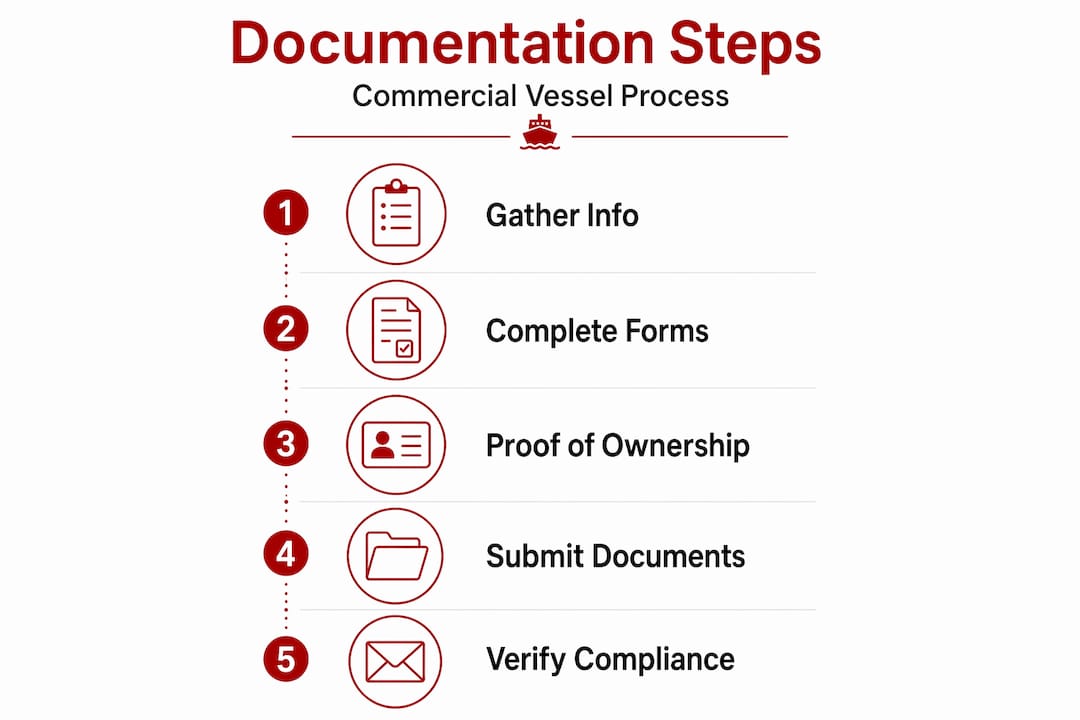
- Step-by-step commercial documentation process
- Compliance and verification: Preventing delays and legal issues
- The reality of commercial vessel documentation: Experience vs. theory
- Ready to streamline your commercial vessel documentation?
- Frequently asked questions
Wichtigste Erkenntnisse
| Punkt | Einzelheiten |
|---|---|
| Preparation is critical | Missing or incomplete documents are the most common reason for commercial documentation delays. |
| Flag choice impacts speed | Open registries like Marshall Islands and Panama often process applications much faster than USCG, provided you meet compliance rules. |
| New 2026 compliance rules | Disclosure of ultimate beneficial ownership is now strictly enforced to prevent fraud and delays. |
| Prior registry deletion is mandatory | Owners must delete any previous flag registry before reflagging a commercial vessel internationally. |
| Expert help saves time | Professional guidance can help avoid common pitfalls and expedite your vessel documentation process. |
Understanding commercial vessel documentation: The essentials
Let’s clarify what commercial vessel documentation specifically enables and why it matters for owners like you.
Documentation is more than a piece of paper. It’s the official federal or international record that establishes your vessel’s nationality, authorizes specific commercial activities, and protects your ownership rights. Without it, you cannot legally operate in coastwise trade, fly a specific national ensign, or secure certain types of marine financing.
Who needs commercial documentation?
Under U.S. rules, USCG documentation requires vessels of at least 5 net tons (roughly 25 feet or longer), U.S. citizenship ownership at 51 percent or more for recreational use, and is mandatory for commercial uses including coastwise trade or fishing. If your vessel earns revenue, this threshold is the starting line.
A critical distinction most owners miss early: federal documentation vs. state registration are fundamentally different systems. Federal documentation through the Coast Guard is preferred for international travel, commercial operations, and vessel financing. State registration is simpler and cheaper but cannot replace federal documentation for coastwise trade or commercial purposes. You may end up needing both in certain states, where a state sticker is still required alongside your federal certificate.
Key ownership requirements at a glance:
- U.S. corporations or LLCs qualify if at least 75 percent of managing members are U.S. citizens
- Trusts may qualify depending on trustee citizenship
- Foreign owners can document under international registries rather than USCG
- Corporations with mixed citizenship must review each flag’s ownership rules carefully
Understanding where your vessel and business structure fall within these categories directly shapes which documentation route makes the most sense. Review the commercial yacht legal criteria before you commit to any application.
| Feature | USCG documentation | State registration |
|---|---|---|
| Coastwise trade | Ja | Nein |
| International recognition | Strong | Limited |
| Financing preference | Ja | Rarely |
| Processing time | 4 to 6 weeks | Tage |
| Annual renewal | Ja | Ja |
| Ideal for | Commercial/offshore ops | Small recreational boats |
Prepping for documentation: Requirements and paperwork
With a firm grasp of the basics, let’s list the required documents and how to assemble them for the application.

The paperwork stage is where most owners stumble. Not because the forms are complicated, but because gathering every piece of supporting evidence takes more time and coordination than people expect. A missing builder’s certificate or an expired citizenship document can send your application back to square one.
Core forms and documents you’ll need:
- CG-1258: The primary application form for initial documentation
- CG-1261 (builder’s certificate): Required for new vessels as proof of construction
- Bill of sale: Essential for pre-owned vessels, must trace back to original builder
- Tonnage measurement (CG-5397): Required if tonnage is in question or not established
- Citizenship proof: Passport, birth certificate, or corporate formation documents
- UBO (Ultimate Beneficial Owner) disclosure: Increasingly mandatory under 2026 rules
Die full USCG documentation process requires you to complete the CG-1258, provide ownership proof, supply citizenship documents, verify tonnage if necessary, and submit everything through the NVDC’s eStorefront portal with a $133 fee. Standard processing runs 4 to 6 weeks.
Edge cases that catch owners off guard:
Older vessels, specifically those over 15 years, often require additional surveys before registration is approved. Commercial yachts are frequently capped at fewer than 12 passengers under flag-specific rules such as those of the Marshall Islands. If your vessel was previously registered under another flag or in another state, you must formally delete that prior registration before a new one can be issued. And under 2026 IMO guidelines, UBO disclosure is no longer optional since registries are cross-checking ownership records to prevent fraud.
Pro Tip: Gather your complete chain of title before you start the application. If you bought from a broker who bought from a foreign owner, you may need multiple bills of sale going back to the original builder. Missing one link stops the whole process.
For a detailed walkthrough of each document and step, the step-by-step vessel registration resource covers exactly what to assemble for each flag option.
| Document | Purpose | Common issues |
|---|---|---|
| CG-1258 | Primary USCG application | Incomplete fields, missing signatures |
| CG-1261 | Builder’s certificate | Lost for older vessels |
| Bill of sale | Ownership chain | Gaps in chain of title |
| UBO declaration | Ownership transparency | Vague corporate structures |
| Prior deletion cert | Clears old registry | Often forgotten |
Choosing the right flag: USCG vs. international registries
Once you’ve collected your documents, your next decision is which flag registry will best fit your needs.
Flag selection is a strategic decision, not just an administrative one. The flag your vessel flies determines your tax obligations, inspection requirements, crew certification standards, and how quickly you can get back on the water when problems arise. Different operations call for different flags.
How the major registries compare:
Popular flags for commercial yachts each come with distinct profiles. The Marshall Islands offers fast 1 to 2 week processing, annual fees in the $5,000 to $10,000 range, and relatively low restrictions, making it a favorite for charter operators who need speed. The Cayman Islands carries prestige as a Red Ensign territory, also offering 1 to 2 week provisional documentation. Malta brings EU regulatory benefits and access to European waters, though at higher cost and with a 2 to 4 week timeline.
Processing speed benchmarks:
When timing matters, the numbers tell the story. USCG initial processing runs 4 to 6 weeks for a new application, while Marshall Islands provisional documents come through in as little as 1 to 3 days, and Panama can issue provisional certificates in a single day. Many U.S. states also require you to carry a state sticker alongside your federal USCG documentation, which is a detail often overlooked until port entry.
The speed advantage of open registries is real, but it comes with a condition: your paperwork must be completely in order before you submit. Registries that process fast do so because they expect accurate submissions. A single discrepancy flips speed into delay. Review efficient registration flags to compare current options side by side.
What to consider for your specific use case:
- Charter operations: Prioritize flags with strong port recognition and passenger endorsements
- Fishing: Confirm the flag authorizes fishing in your target zones and meets flag state control
- Cruising internationally: Choose a flag that minimizes port state control inspections
- Financing a purchase: USCG preferred; many lenders require it for U.S.-based mortgages
Understanding boat registration timelines und yacht registration cost factors will help you weigh speed against cost against operational fit before committing.
Step-by-step commercial documentation process
Now, follow these concrete steps to successfully complete your commercial vessel documentation.
A clear sequence prevents the circular problem many owners face: submitting incomplete applications, receiving rejections, correcting errors, and resubmitting. Here’s the ordered process that works.
-
Determine eligibility. Confirm vessel tonnage, ownership structure, and intended use to identify the correct documentation category and flag authority.
-
Gather all required documents. Collect your CG-1258 or equivalent international form, full chain of title, citizenship or corporate ownership proofs, UBO declarations, and prior deletion certificate if applicable.
-
Select your registry. Based on operational needs, budget, and timeline, choose USCG, an open registry, or a flag-of-convenience registry that suits your use.
-
Submit your application. For USCG, submit through the NVDC eStorefront with the $133 fee. The complete documentation process outlines exactly how to package your submission to minimize rejections. For international registries, submission methods vary but most now accept digital packages.
-
Respond to requests promptly. Registrars may request additional information. Slow responses are the number one reason processing extends beyond stated timelines.
-
Await inspection if required. Some flags and all USCG processes require a physical inspection for vessels over a certain age or tonnage. Schedule this proactively rather than waiting for the registry to contact you.
-
Receive and verify your certificate. Once issued, verify every detail: vessel name, official number, owner name, tonnage, and endorsement type. Errors here must be corrected before you sail commercially.
-
Obtain provisional documents for international operations if needed. Processing benchmarks confirm that Marshall Islands provisional documents arrive in 1 to 3 days, allowing you to operate legally while the full certificate processes.
Pro Tip: Before submitting anything, photocopy every document in your packet and store digital backups. Registries can lose physical submissions, and having duplicates ready means you can resubmit the same day rather than starting over.
“The most common reason for documentation delays is not fraud or disqualification. It’s simple omissions: a missing signature, an incorrect tonnage figure, or an old registration that was never formally deleted.” This is true across USCG and international registries alike.
For international owners, see international boat registration steps and the vessel registration process explained for jurisdiction-specific guidance.
Compliance and verification: Preventing delays and legal issues
After submission, it’s essential to ensure your registration is accepted and compliant with all 2026 requirements.
The compliance landscape shifted significantly this year. The IMO’s 2026 guidelines have pushed registries to demand verifiable UBO data, and cross-border information sharing means that gaps in your disclosure will be caught more reliably than ever before.
What is an Ultimate Beneficial Owner and why does it matter?
A UBO is the real human being who ultimately owns or controls the vessel, even if ownership is layered through shell companies or trusts. Under the 2026 IMO guidelines, all registries are expected to collect, verify, and share UBO data to prevent vessels from being used as instruments for sanctions evasion or financial fraud. Older vessels over 15 years also face mandatory survey requirements before registration is approved.
Frequent compliance snags:
- Incomplete UBO chain: multiple holding companies without tracing to a natural person
- Prior flag not formally deleted before applying to a new registry
- Passenger endorsement mismatch: vessel certified for 20 passengers but flag limits commercial charter to under 12
- Out-of-date tonnage certificate when the vessel has been modified
- Owner citizenship documentation that doesn’t match the ownership structure on file
Pro Tip: If your vessel is owned through a multi-layer corporate structure, prepare a simplified ownership chart showing every intermediate entity and the final natural person at the top. Registrars appreciate clarity, and a clear chart prevents follow-up requests.
“Registries in 2026 are not just checking your documents. They are checking whether your documents match what other registries have on file. A vessel that hasn’t been properly deleted from a prior registry will be flagged immediately.”
Stay current with evolving 2026 registration compliance trends to ensure your vessel maintains valid status as regulations tighten.
What to do if your application is flagged:
First, read the deficiency notice carefully and respond to every point, not just the ones you understand. Partial responses generate follow-up requests and more delays. If your prior registry deletion is the issue, contact that registry immediately and obtain a certified deletion certificate. If the UBO disclosure is questioned, expand your corporate chart with supporting documentation. Most flags allow a 30 to 60 day response window before an application is officially withdrawn.
The reality of commercial vessel documentation: Experience vs. theory
Beyond checklists and forms, a realistic perspective highlights why so many owners get tripped up mid-process.
Here’s what nobody tells you upfront: speed is a conditional promise. Open registries like the Marshall Islands genuinely can issue provisional certificates in 1 to 3 days, and that speed is a real operational advantage. But that speed assumes your packet is clean, complete, and correctly formatted. The moment something is off, the clock restarts and the registry is under no obligation to rush a corrected submission.
We’ve seen owners spend months in a documentation loop that should have taken two weeks. Not because of complex ownership structures or unusual vessel histories, but because of small, preventable oversights. A bill of sale unsigned by a witness. A corporate resolution dated after the ownership transfer. A prior Cayman registration never formally closed.
The IMO’s 2026 framework also reshapes the tradeoff between open registries and USCG. Open registries like the Marshall Islands offer speed and lower costs, but they now carry stricter UBO verification requirements to meet IMO anti-fraud standards. USCG remains the right answer for U.S.-based operations that prioritize coastwise trade and domestic financing, even if its 4 to 6 week timeline feels slow by comparison.
The uncomfortable truth is that most documentation failures are owner-side failures. Incomplete UBO disclosures, forgotten prior registrations, and underestimated tonnage verification requirements cause the vast majority of delays. The registries themselves are performing predictably. The practical documentation guide we’ve built reflects real application patterns, not just theoretical requirements.
What separates owners who document cleanly from those who don’t is preparation rigor, not luck. Treat your documentation packet like a legal filing, because that’s exactly what it is.
Ready to streamline your commercial vessel documentation?
If you’re eager to avoid bottlenecks and get on the water fast, specialized help can make all the difference. Commercial vessel documentation doesn’t have to be a months-long ordeal. With the right guidance, the right flag selection, and a fully prepared application packet, you can move from application to certificate efficiently and legally.
Unter VesselFlag.com, we work directly with yacht owners, boat operators, and maritime businesses to navigate every stage of the registration process. Whether you need help understanding the yacht vs. boat registration distinctions, need a clear guide to registering your yacht under an international flag, or want to confirm your vessel’s registration validity across global jurisdictions, our team brings the expertise to move your application forward without costly missteps. Get your vessel documented correctly the first time.
Frequently asked questions
What documents are required for commercial vessel documentation?
You need the completed CG-1258 form, proof of ownership such as a bill of sale or builder’s certificate, tonnage verification, and proof of citizenship or ultimate beneficial ownership for all relevant parties.
How quickly can I get a commercial vessel documented under foreign flags?
Provisional documents are usually issued in 1 to 3 days for the Marshall Islands or as fast as 1 day for Panama, with full approval typically completing within 1 to 2 weeks for most major open registries.
Do I need to delete previous registration before applying?
Yes, deleting prior registry is a hard requirement before any new national flag can be assigned, and failure to do so is one of the most common reasons applications are rejected outright.
What happens if my documentation application is delayed?
Delays most often result from missing documents, incomplete UBO disclosure, or an unresolved prior registration; respond to deficiency notices comprehensively and promptly to avoid the application being withdrawn entirely.