
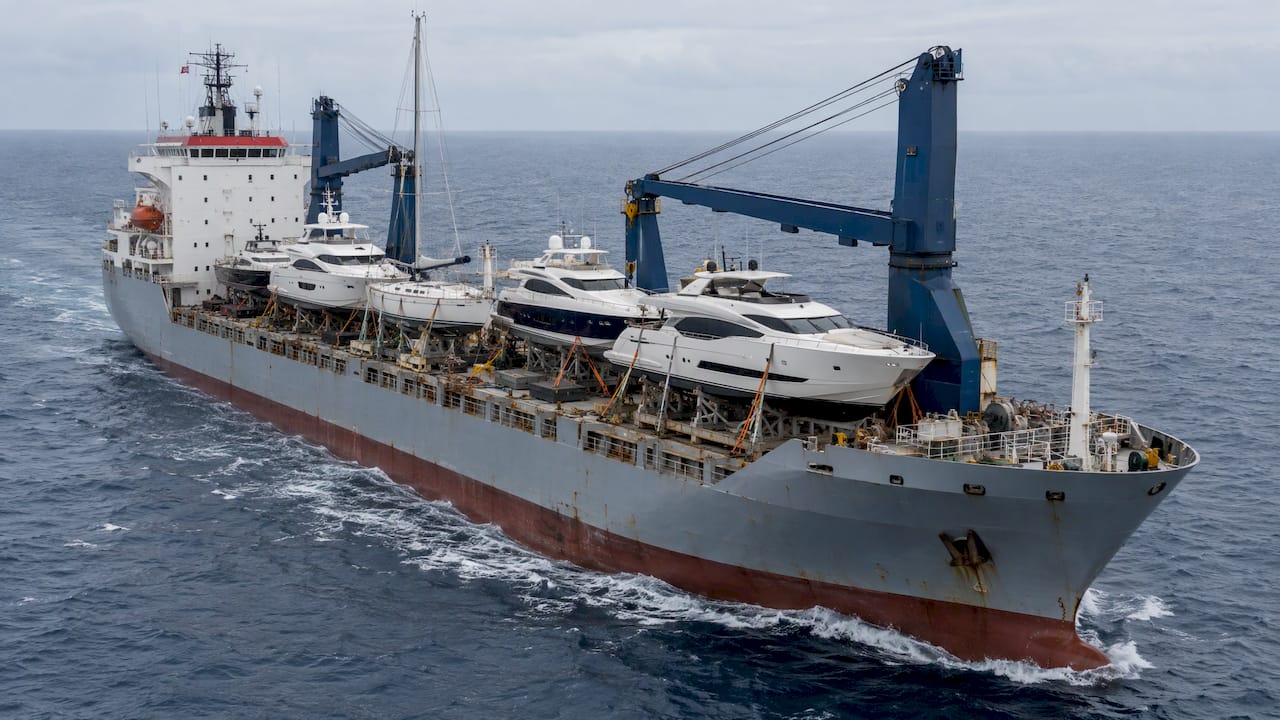
Deck cargo yacht shipping means your yacht is lifted out of the water, set in a cradle on the deck of a cargo ship, lashed down and carried to the destination port, where the process is reversed. It is the usual way to move a yacht across an ocean without putting miles and crew time on the boat. This guide explains the loading methods, the preparation, the paperwork and the cost drivers, and why your registration and ownership documents deserve attention before the ship arrives.
TL;DR
- Deck cargo is normally done lift-on/lift-off (a crane loads the yacht into a cradle) or float-on/float-off (the ship submerges its deck and the yacht floats in).
- Freight is driven mainly by length, beam, route, season and method. Insurance is a separate cost and should be arranged before loading.
- Preparation is practical: empty tanks, remove the backstay, disconnect batteries, switch off AIS and hand over accurate plans and weights.
- Carriers and customs ask for proof of registration and ownership, so the flag, the company behind the yacht and the radio licence should be in order first.
- Vessel Flag prepares registration applications, MMSI licences and ownership companies remotely, and can also arrange yacht transportation on request.
İçindekiler
- What deck cargo yacht shipping actually is
- The two loading methods
- How loading day works
- How the yacht is secured on deck
- Which yachts suit deck cargo
- How to prepare your yacht
- Documents and paperwork
- What affects the cost of deck cargo shipping
- Transit time and tracking
- Deck cargo versus the alternatives
- Perspective
- Getting the papers right before the ship arrives
- A short pre-shipping checklist
- SSS
- Kaynaklar
What deck cargo yacht shipping actually is
A yacht shipped as deck cargo travels on the open deck of a heavy-lift or general cargo vessel, not inside a container and not under its own power. Operators often charter a whole vessel and fill it with yachts heading the same way at the same time of year, for example out of the Caribbean ahead of hurricane season or into the Mediterranean for the summer. That grouping is why prices and dates depend so much on the season and the lane.
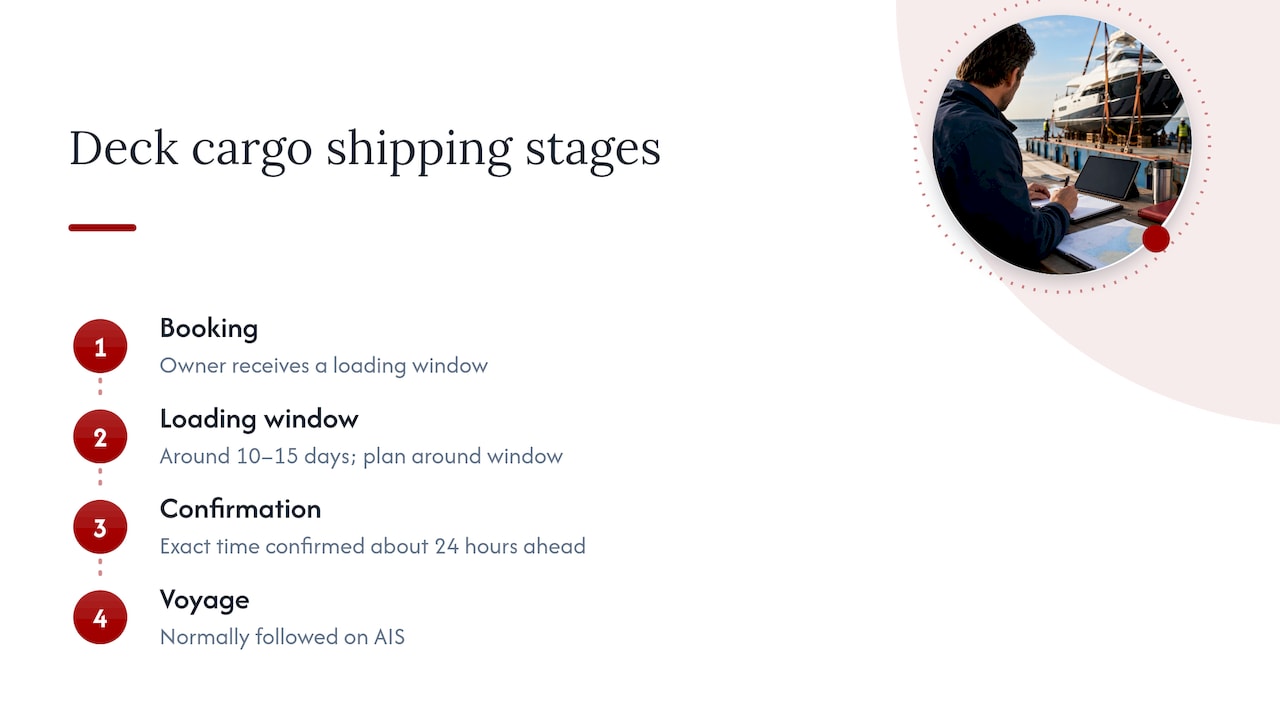
Once a booking is made, the owner is typically given a loading window of around 10 to 15 days. The exact loading time is usually confirmed about 24 hours ahead, and the voyage can normally be followed on AIS tracking, according to Yachting World. Plan your own travel around a window, not a fixed hour.
The two loading methods
Lift-on/lift-off (LoLo)
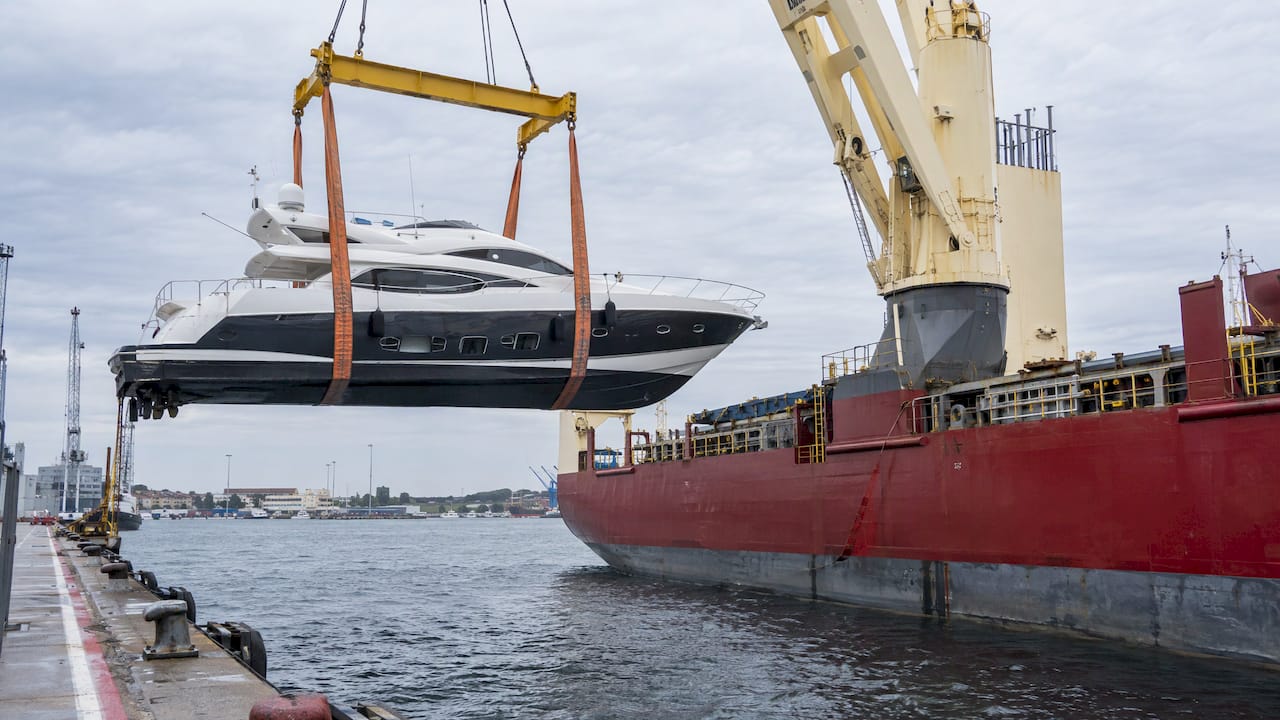
The ship’s cranes lift the yacht from the water on slings and set it into a cradle on deck, where it is lashed. At the destination the same steps run in reverse. This is the method most private owners meet, and it suits the majority of motor yachts and sailing yachts in the small to mid-size range. Cranes have lifting limits, so the yacht’s exact weight and its sling positions matter a great deal.
Float-on/float-off (Flo-Flo)
A semi-submersible ship lowers its deck below the waterline, the yacht is driven or towed into position over prepared supports, and the deck is raised so the yacht sits out of the water. This is typically used for larger yachts, where craning is impractical. Because the yacht is never slung, it avoids the lifting stage altogether, but it needs a ship and a port that can accommodate it.
How loading day works
For a lift-on/lift-off loading, the sequence described by Yachting World is straightforward:
- The owner (or delivery skipper) drives the yacht alongside the ship.
- A loadmaster comes aboard while divers help position the slings.
- The yacht is lifted from the water into its cradle on deck.
- It is lashed to the cradle and the ship’s deck.
- The owner locks up, hands over the keys and steps off.
Loadmasters generally prefer the owner to bring the yacht alongside personally. As one loadmaster told Yachting World, owners know where the tools are and how to remove the backstay, which makes loading much smoother.
How the yacht is secured on deck
Securing is where deck cargo is won or lost. The hull sits in a cradle or on cribbing shaped to the hull, which should support the yacht sideways. Lashing belts are then applied over the yacht to press it into the cribbing, and the cribbing is fixed to the deck with welded stoppers or lashing chains, as the Cargo Handbook describes. A cradle built for your hull form is not a detail to skip.
Marine insurers are direct about the stakes. A paper from the International Union of Marine Insurance describes lifting and lashing yachts as complex work that needs considerable diligence and expertise, and lists heavy-weather damage and poor lashing among the main risks. Shifting cargo can also threaten the ship itself.
Which yachts suit deck cargo
In broad terms, deck cargo covers everything from mid-size cruisers to large motor yachts and sailing yachts, with float-on/float-off used at the top end of the size range. Smaller boats that fit a container or a trailer have other options. The question to ask any carrier is not just length, but:
- Overall length and beam: these set the space the cradle needs on deck.
- Weight: the precise figure, including fuel, water and stores, since crane and cradle capacity depend on it.
- Keel and appendages: a deep or protruding keel, bulbous bow, stabilisers or thrusters change the cradle design.
- Air draft: the height from waterline to the highest point, which matters where mast or arch clearance is limited.
- Condition: a sound hull and a clean underwater surface, especially for destinations with biosecurity rules.
Confirm the limits for your yacht with the specific carrier, as every ship and every cradle set-up has its own.
How to prepare your yacht
Preparation instructions come from the carrier, but the common points are consistent. According to Yachting World’s preparation guide:
- Empty the fresh and grey water tanks before approaching the ship, leaving a little fuel for offloading on arrival.
- Remove the backstay and topping lift where required.
- Disconnect the batteries and turn off AIS.
Marine insurers add that only a minimum of water, fuel and lubricants should remain on board during transport and that electronics should be shut down and protected against short circuits. Lithium-ion batteries deserve special attention: the insurance industry has started to attach conditions to fire cover, including approved charging equipment, approved charging locations and a full risk assessment. Tell your insurer about your battery set-up before you ship, not after.
Whatever the carrier’s checklist says, also do these things yourself:
- Photograph and video the yacht from every angle before handover, with a dated record of existing marks.
- Secure or remove loose items, canvas, tenders, dinghy davits and anything on the cabin top.
- Prepare a list of any equipment that must stay on board and any that should come off.
- Keep a copy of the yacht’s papers with you, not in the boat.
Documents and paperwork
Carriers normally ask the owner for a general arrangement plan, a docking plan showing anything protruding below the keel line, the weight of the yacht, its centre of gravity and suitable lashing points. These help them plan a level lift and a proper cradle.
For customs, the usual export set includes a bill of lading, a commercial invoice or declaration of value, an export declaration and, for some destinations, a certificate of origin, together with the yacht’s registration and proof of ownership. Import rules vary by destination, so ask the receiving agent early. Mistakes in customs and immigration paperwork cause delays, fines or refused entry.
Some destinations, notably Australia, New Zealand and parts of the Pacific, apply biosecurity inspection, so a clean, antifouled hull is part of the preparation, not an afterthought.
Why registration matters before you ship
This is the part owners most often leave late. The yacht’s registration and proof of ownership are among the first documents a carrier, a customs agent and an insurer will ask for. If your yacht is unregistered, registered in a flag you plan to leave, or owned through a company that is not yet set up, shipping is the wrong moment to find out.
The sensible order is:
- Decide the flag and ownership structure for the yacht’s next phase, based on where it will be used and who will own it.
- Complete the registration, or the transfer between flags, so the documents match the owner named on the shipping paperwork.
- Make sure the ship radio licence and MMSI number match the registration and the flag.
- Only then confirm the shipping dates and insurance.
Provisional papers can take days rather than weeks with some flags, which is why this step is easy to schedule but hard to rush. For instance, Vessel Flag’s experience is that Poland provisional papers take 2 to 5 days, and the San Marino provisional certificate takes 2 to 6 days, though that is not guaranteed. The certificates themselves are issued by the flag registry, not by Vessel Flag.
What affects the cost of deck cargo shipping
There is no single price for deck cargo, and any figure quoted without a route, a length and a season should be treated with caution. The main drivers are:
- Size: freight is based mainly on length overall and beam, and air draft can matter on liner services.
- Route: a busy lane with regular sailings is cheaper per yacht than a one-off route.
- Season: departures cluster around the hurricane season and the start of the Mediterranean season, and space is tighter then.
- Method: lift-on/lift-off, float-on/float-off, roll-on/roll-off and container shipping are priced differently.
- Extras: cradle and lashing, port charges, customs clearance, preparation and any transfer to or from the port.
Insurance is separate. Standard yacht cover often stops at ocean transport, so a specialist marine transit policy is usually needed. Rates that look too low and carriers that do not own their own cradles or lifting gear are, as one transport specialist told Crown & Caliber, warning signs. Read the quote line by line, and check what the policy actually demands: many require cradle certification, lashing reports and a pre-shipment survey.
We do not publish a price for yacht transportation, as the cost depends entirely on the yacht and the route. Ask for a quote with your length, beam, weight, departure port and destination.
Transit time and tracking
Sea time is measured in weeks, not days, and varies a lot by route, with long routes such as Europe to the Far East taking several times longer than a transatlantic crossing. Add the loading window before departure, the discharge and any customs clearance at the other end. For planning, assume your yacht will be out of use for longer than the sea passage alone, and book crew, marina berths and delivery handover accordingly.
Deck cargo versus the alternatives
| Method | En iyisi | Main trade-off |
|---|---|---|
| Deck cargo (LoLo) | Mid-size to large yachts that do not fit a container | Exposed to weather on deck, so lashing and cradle quality matter |
| Float-on/float-off | Larger yachts where craning is impractical | Needs a suitable ship and port, so schedules are limited |
| Container or flat rack | Smaller yachts and boats | Needs more dismantling, size limited by container dimensions |
| Karayolu taşımacılığı | Europe, trailerable or near-trailerable boats | Width, height and route permits limit size |
| Sailing or motoring | Owners who want the passage | Crew, fuel, time and wear on the yacht |
Stowage below deck is generally preferable from a risk point of view because the yacht is better protected from weather and accelerations, as insurers such as HDI Global point out. Where that is not possible, deck cargo with a proper cradle and lashing plan is the established answer.
Perspective
Owners tend to treat shipping as a logistics decision and registration as an admin task. In practice the two are linked. The flag, the owning company and the radio licence decide which documents a carrier and a customs agent will accept, and which insurers will quote.
What we see most often is a yacht ready to load with papers that do not match: an owner named on the bill of sale but not on the registration, a company that has not yet been formed, or a ship radio licence still tied to the old flag. Each can be fixed, but not on the quayside.
Our approach is to settle the paperwork first. We prepare and file registration applications for Poland, San Marino, UK Part 1, Malta, Palau, the Marshall Islands, the Cayman Islands and the Cook Islands, arrange MMSI numbers and radio licences, form ownership companies and handle deletion certificates and transfers between flags, all remotely. Then the yacht moves with documents that agree with each other.
Gemi Bayrağı
Getting the papers right before the ship arrives
Vessel Flag is a private consultancy run by BRN Enterprises (Warsaw and London). We prepare and file yacht and boat registration applications for private owners, companies and brokers. We are not a registry or a government body, and certificates are issued by the flag registries. Our prices are published and one-off:
| Service | Fiyat |
|---|---|
| Poland flag registration | from EUR 320 |
| San Marino yat tescili | from EUR 290 |
| UK Part 1 yacht registration | from EUR 550 |
| Malta yat kaydı | from EUR 849 |
| Marshall Islands yacht registration | EUR 250 service fee plus registry fees |
| Cayman Adaları yat kaydı | EUR 450 service fee plus registry fees |
San Marino also has a 5-year all-in registration package at EUR 1,290. Palau is from EUR 700, and Cook Islands registration is quoted per yacht. Other flags, including Langkawi, Dutch Zeebrief, Gibraltar and Panama, are handled on request with prices confirmed per case.
For radio, an MMSI radio licence costs EUR 149 in Poland, EUR 150 in the UK and EUR 200 in San Marino, each VAT included with no annual fees. The UK MMSI licence takes 1 day, while the Polish licence takes 4 to 6 weeks after registration, so start it early. Our MMSI and ship radio licence service covers the options.
If the yacht will be owned through a company, company formation for yacht ownership covers a UK LTD at EUR 485 and a Delaware LLC from EUR 455, or EUR 605 with apostille. For UK Part 1, the owner can register personally if eligible, through an existing company (UK or an eligible foreign company, such as a Delaware corporation) or through a new UK LTD, so a UK company is not always required. Transport, insurance and interior design requests are handled through our yacht services, with quotes given per yacht.
A short pre-shipping checklist
- Registration and proof of ownership in the name that appears on all shipping documents.
- Radio licence and MMSI valid for the flag the yacht will carry.
- Accurate plans, weight and centre of gravity supplied to the carrier.
- Marine transit insurance confirmed in writing, with the carrier’s cradle and lashing requirements met.
- Tanks, batteries, AIS and loose gear dealt with as the carrier instructs.
- Customs and biosecurity requirements for the destination checked with the receiving agent.
- Photographic record of the yacht’s condition before handover.
SSS
Is deck cargo the same as container shipping?
No. In deck cargo the yacht itself is lifted onto a cradle on the ship’s open deck, while container shipping places a smaller boat inside or on a container unit. Containers give more weather protection but need more dismantling and limit size, so deck cargo suits larger yachts.
How long is the loading window?
For group departures, owners are typically given a window of around 10 to 15 days, with the actual loading time normally confirmed about 24 hours ahead. Ask your carrier for their specific terms and keep your own schedule flexible.
Do I need to be on board when the yacht is loaded?
In most cases yes, or a delivery skipper must be. The yacht is usually driven alongside the ship, and loadmasters generally prefer the owner to do it because they know the boat. After the lift you lock up and hand over the keys.
Do I need to change flag before shipping a yacht?
Not necessarily, but the registration, owner and radio licence must be valid and consistent for the carrier, insurer and customs. If you plan to change flag for the yacht’s new base, complete the transfer before shipping so the paperwork matches throughout.
Does Vessel Flag issue the registration certificate?
No. We prepare and file the application, and the flag registry issues the certificate. We are a private consultancy, not a registry or a government body.
Kaynaklar
- Should you ship a yacht to a destination rather than sail it, Yachting World
- Yacht shipping: how to prepare your boat for a trip on a cargo transporter ship, Yachting World
- Boats and Yachts, Cargo Handbook
- Risks associated with the carriage of yachts as deck cargo, IUMI
- Lithium-ion batteries on yachts, IUMI
- Transport of boats and yachts, HDI Global
- Shipping Superyachts Across Oceans, Crown & Caliber
Ready to get the yacht’s papers in order before it ships? See the Vessel Flag flag registration options or book a consultation and we will confirm the right flag, company structure and radio licence for your route.
VesselFlag is a private consultancy that prepares and files yacht registration applications for owners. We are not a government body or flag registry; certificates are issued by the relevant registry. This article is general information, not legal advice.