Most owners searching “US cruising license” actually need one of two things: federal vessel documentation through the USCG National Vessel Documentation Center, or state registration, and often both. If you plan to cruise internationally, use AIS or DSC radio equipment, or hail foreign coast stations, add an FCC Ship Station License, with an assigned MMSI. Before you leave the dock, confirm your insurance policy carries a navigation-territory endorsement for wherever you’re actually headed.
TL;DR:
- Federal vessel documentation is required for boats of at least 5 net tons, but many owners also need state registration for local use, which can involve separate fees and decals.
- Obtaining a USCG Certificate of Documentation involves multiple steps, including ownership proof, surveys, and recording mortgages, with delays if any attachments are incomplete.
- An FCC Ship Station License with an MMSI is mandatory for international cruising or using DSC/AIS equipment across borders, but not necessary for domestic-only vessels.
- Insurance policies usually only cover U.S. waters unless specifically endorsed for foreign territories like the Bahamas or Mexico, which must be requested beforehand.
- Renewals for vessel documentation, licenses, and FCC permits are needed annually or every few years, and lapses can cause port or legal issues when caught.
İçindekiler
- What Counts as a US Cruising License for Yachts?
- How Do You Register a Yacht Step by Step?
- Do You Need an FCC License for Your Yacht’s Radio Gear?
- What Insurance Endorsements Do You Need Before Cruising?
- How Long Does Registration Take and What Does It Cost?
- What Compliance Mistakes Cause the Most Problems?
- What License Do You Need to Captain a Yacht in US Waters?
- Who Is Eligible to Apply for a US Yacht License?
- What Training and Testing Do USCG Licenses Require?
- Recreational Boating License vs Professional Captain License: What’s the Difference?
- How Often Do You Need to Renew a US Cruising License?
- What Are the Legal Limits of Each License Type?
- Why Professional Registration Support Beats Going It Alone
- Let VesselFlag Handle Your Registration and Compliance Filing
- Where to Verify These Requirements Yourself
- Sources
- SSS
What Counts as a US Cruising License for Yachts?
There’s no single federal “cruising license” that covers everything. What you actually need is a combination of documents, and which combination depends on your vessel’s size, use, and cruising range.
The USCG Certificate of Documentation (COD) is federal proof of nationality for vessels of at least 5 net tons, typically boats around 25 feet or larger depending on hull design. It supports preferred ship mortgages, simplifies international port entry, and is often required for commercial or coastwise trade. State registration is a separate, state-level system that governs decals, local taxes, and on-water enforcement.
Here’s the part owners miss: documenting your vessel federally does not automatically exempt you from state registration. Many states still require a registration number or decal for a documented vessel, particularly if it’s moored or primarily used within that state’s waters. The two systems run in parallel, and understanding how Coast Guard documentation differs from state registration before you file either one saves you from duplicate paperwork or a mismatched title later.
How Do You Register a Yacht Step by Step?
Getting a yacht properly documented and registered follows a predictable sequence, but the order matters more than most first-time owners expect.
- Gather ownership proof first. You’ll need the Hull Identification Number (HIN), a signed bill of sale, and, for federal documentation, proof of U.S. citizenship for the owner or controlling entity.
- Order a survey if the vessel is used or financed. Lenders and insurers typically require one, and it can surface title issues before you file anything.
- Complete NVDC Form CG-1258. This is the core application for initial vessel documentation, submitted with supporting attachments like the builder’s certificate or bill of sale through the NVDC eStorefront.
- File state registration where required. Even a documented vessel may need a state number if it’s based in a state that requires one for local operation.
- Request coastwise or commercial endorsements if applicable. These aren’t automatic; you apply for them specifically if the vessel will carry passengers or cargo for hire.
- Record any preferred ship mortgage with the NVDC. Lenders generally require this before releasing loan funds tied to a documented vessel.
Doing this yourself is possible, and plenty of owners manage it for a straightforward, unencumbered vessel. Where it gets messy is foreign-built hulls, unclear chains of title, or existing liens, since a documentation specialist typically catches gaps in the attachment package before NVDC rejects the filing and resets your timeline.
Pro Tip: Pull an Abstract of Title from the NVDC before you buy a documented vessel. It’s the fastest way to confirm there’s no open preferred ship mortgage or hidden claim that transfers to you at closing.
Do You Need an FCC License for Your Yacht’s Radio Gear?
You need an FCC Ship Station License, which includes an FCC-issued MMSI, if you plan to cruise internationally, operate DSC or AIS equipment while crossing borders, or communicate with foreign coast stations. If your yacht stays in U.S. waters only, you can skip the FCC process and get an MMSI from an approved private registrar like BoatUS or Sea Tow instead.
The FCC’s ship radio station guidance spells out the filing mechanics: applications go through Form 605 in the FCC’s ULS system, and owners with multiple vessels sometimes look at a fleet license to save on individual filings.
- A fleet license only works if none of the vessels use DSC or AIS; either one requires an individual MMSI per boat.
- Private-registrar MMSIs are valid for U.S. domestic use but won’t satisfy foreign authorities checking for FCC documentation.
- Keeping your registered contact and vessel data current isn’t optional. Search-and-rescue teams rely on accurate MMSI records, and stale or duplicated numbers are an FCC violation with real enforcement exposure.
If you’re not sure which category your cruising plans fall into, reviewing when an FCC ship station license actually applies before you buy radio gear avoids buying the wrong MMSI twice.
What Insurance Endorsements Do You Need Before Cruising?
Standard yacht policies are written for a specific navigation territory, usually U.S. coastal waters, and they typically exclude trips to the Bahamas, Mexico, the wider Caribbean, or Canada unless you request an endorsement in writing. A verbal assurance from your broker isn’t the same as a policy rider, and insurers frequently deny claims tied to unendorsed foreign cruising.
No federal law mandates boat insurance, and most states don’t either, though Arkansas, Utah, and Hawaii have their own specific requirements. What actually forces the issue is your lender or marina: most financed vessels and many marinas require proof of coverage regardless of state law.
Before departure, confirm with your underwriter that your policy covers your actual route, not just your home port, and ask about wreck removal, salvage coverage, and pollution liability limits. If you charter the vessel even occasionally, disclose that use explicitly, since undisclosed charter activity is one of the fastest ways to void a claim. Carry your insurance binder, registration, and documentation certificate on board; foreign customs officials and U.S. marinas both ask for them routinely.
How Long Does Registration Take and What Does It Cost?
Timelines and fees vary by filing type and whether you pay for expedited service. NVDC documentation moves faster than many owners expect if the application package is complete on first submission, and slower by weeks if it isn’t.
| Filing type | Typical processing time | What affects the fee |
|---|---|---|
| USCG initial documentation (CG-1258) | Several weeks standard | Vessel size, expedited service requested, mortgage recording |
| State registration | Days to a few weeks | State-specific fee schedule, vessel length, renewal cycle |
| FCC Gemi İstasyonu Lisansı | Processed through ULS after Form 605 filing | Individual vs fleet license, DSC/AIS equipment count |
A complete document matrix for your NVDC filing typically includes the bill of sale, builder’s certificate or equivalent proof of build, the HIN, proof of U.S. citizenship, a current survey if financed, an insurance binder, and any mortgage paperwork your lender requires. Missing even one attachment is the single most common reason a CG-1258 filing gets kicked back for correction.
What Compliance Mistakes Cause the Most Problems?
The pitfalls that trip up owners aren’t exotic. They’re paperwork gaps that surface at the worst possible moment, usually a foreign customs desk or a sale closing.
- Using a private-registrar MMSI on a vessel that now cruises internationally, which leaves you without FCC documentation a foreign port may ask for.
- Skipping a title and lien search before purchase, then discovering an open preferred ship mortgage after the sale closes.
- Assuming your existing insurance covers a Bahamas or Mexico trip without confirming the endorsement in writing.
- Letting your MMSI contact information go stale after a change of ownership or address, which creates real risk during a search-and-rescue response.
- Displaying incorrect or outdated hull numbers, which can trigger enforcement stops even when your paperwork is otherwise in order.
Run through insurance territory coverage, documentation and registration certificates, current MMSI records, and proof of ownership every single time before you leave U.S. waters, not just on the first trip.
Pro Tip: Match your insurance navigation endorsement to your actual season. Add the Bahamas endorsement before a winter crossing, then remove it during summer layup, so you’re not paying a year-round premium for coverage you only use for eight weeks.
What License Do You Need to Captain a Yacht in US Waters?
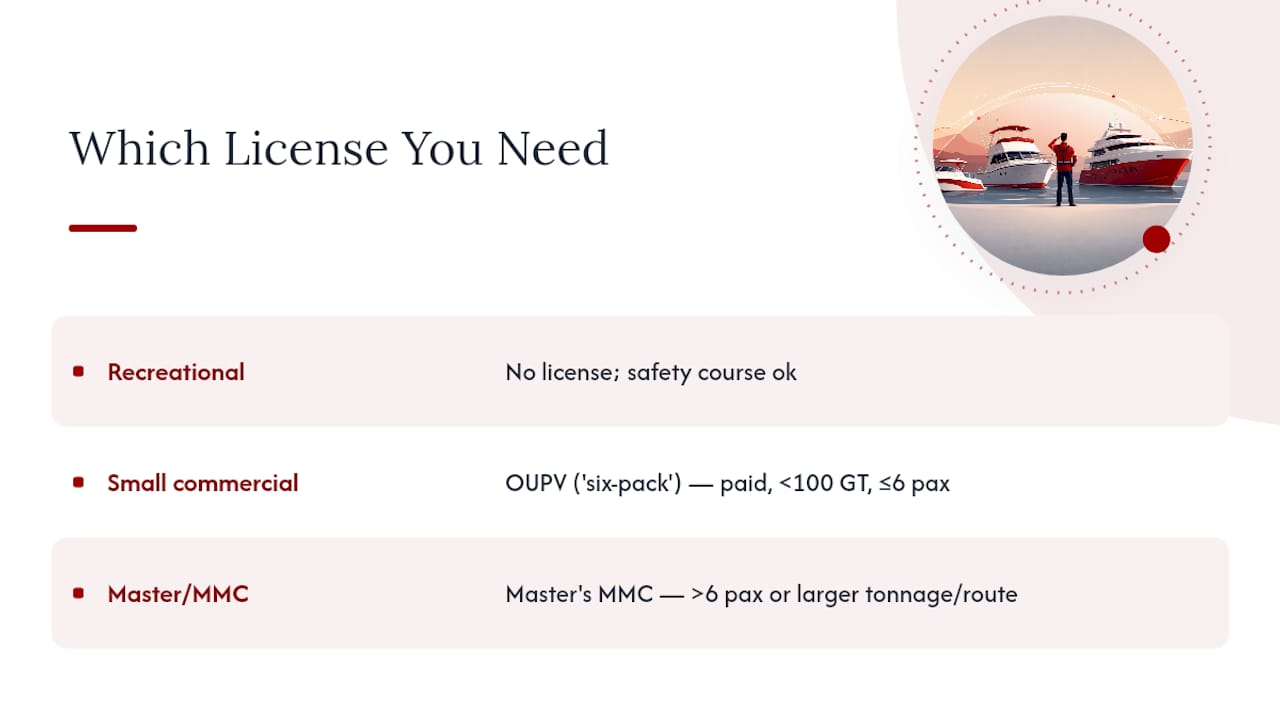
Operating your own recreational vessel generally doesn’t require a captain’s license at all; a state boating safety course certificate usually covers you. The moment money changes hands for passengers aboard, the rules change entirely.
If you carry paying passengers on a vessel under 100 gross tons and fewer than seven passengers, you need an Operator of Uninspected Passenger Vessels (OUPV) credential, often called a “six-pack” license. It’s the entry point for most charter captains and small-yacht operators who take on paid guests.
Larger commercial operations, or vessels carrying more than six passengers for hire, require a full Merchant Mariner Credential with a Master’s endorsement, scaled by gross tonnage and route. A Master’s license for near-coastal waters differs from one rated for inland routes or greater tonnage, and each tier carries its own experience and exam requirements.
Neither credential is required simply to own and cruise your own yacht recreationally. Where owners get this wrong is informal chartering: if a friend pays you cash for a weekend trip, you’re legally operating as an uninspected passenger vessel and need the OUPV at minimum. Brokers selling yachts intended for charter use should flag this distinction early, since a buyer planning to offset ownership costs with paid trips needs to budget for licensing, not just registration.
Who Is Eligible to Apply for a US Yacht License?
Eligibility depends entirely on which credential you’re after. For registration and documentation, the bar is ownership and citizenship, not seamanship.
Federal vessel documentation under the COD system generally requires the vessel be owned by a U.S. citizen, a U.S. entity, or, in specific coastwise trade cases, meet build and ownership requirements tied to the Jones Act. State registration eligibility is simpler: you generally just need proof of ownership and a completed application, though some states may impose additional checks for liens or taxes.
For a professional captain’s license like the OUPV, prerequisites get more specific. Applicants typically need to be at least 18 years old, pass a physical exam and drug test, document a set number of days underway on the water (commonly 360 days, with at least 90 within the last three years for many license tiers), and pass a background check. A clean record matters; certain criminal convictions or a history of substance abuse can disqualify an applicant or trigger additional review.
None of this applies if you’re simply registering and cruising your own yacht recreationally. The eligibility bar only rises once you’re either bringing the vessel into commercial or coastwise service, or putting a paying passenger aboard.
What Training and Testing Do USCG Licenses Require?
Getting an OUPV or higher captain’s license means proving both sea time and classroom knowledge, and the Coast Guard checks both independently.
Most applicants complete an approved USCG captain’s course covering navigation rules, chart plotting, meteorology, and vessel stability, typically delivered through a licensed maritime school rather than the Coast Guard directly. Course length varies, but many OUPV prep programs run a concentrated week or two of in-person instruction followed by a proctored exam.
The exam itself covers rules of the road, navigation general and near-coastal, deck general, and safety and environmental compliance. Each section requires a separate passing score, and a failed section can typically be retaken without redoing the entire exam. Alongside the written exam, applicants submit sea-time documentation, usually logged and signed off by vessel owners or employers, along with a Coast Guard-approved physical exam, drug test results, and CPR/First Aid certification.
Renewing at a higher tier, say moving from OUPV to a Master’s endorsement, means logging additional sea time and passing the corresponding higher-tier exam sections. None of this testing applies to vessel documentation or state registration, which is purely a paperwork process. It’s easy to conflate the two because both involve the Coast Guard, but a captain’s license and a vessel’s registration status are entirely separate systems that happen to share a regulator.
Recreational Boating License vs Professional Captain License: What’s the Difference?
A recreational boating license, really a boating safety course certificate required by most states for operators born after a certain year, proves you understand basic navigation rules and safe operation. It takes a few hours online, costs relatively little, and lets you legally operate your own boat.
A professional captain’s license like the OUPV is a federal credential from the Coast Guard, not a state certificate. It requires documented sea time, a multisection proctored exam, a physical, a drug test, and periodic renewal, and it authorizes you to carry paying passengers commercially. The two aren’t tiers of the same system; they answer entirely different questions. One asks “can you safely operate a boat,” and the other asks “are you qualified to be legally responsible for paying passengers’ safety.”
This distinction matters directly for owners who plan to offset costs by chartering. A boating safety certificate never substitutes for an OUPV once money is involved, and operating a charter without the proper credential exposes the operator to real regulatory and insurance risk. If your policy’s claims adjuster discovers you were running an uninsured, unlicensed charter operation at the time of an incident, that alone can void coverage regardless of what caused the loss.
How Often Do You Need to Renew a US Cruising License?
Vessel documentation under the COD system doesn’t expire on a fixed clock in the way a driver’s license does, but it does require an annual renewal filing with the NVDC to keep the certificate current, along with updates whenever ownership, mortgage status, or vessel details change. Missing a renewal doesn’t erase your registration, but it does put you at risk of a lapse that complicates a sale or a foreign port inspection.
State registration typically runs on a one to three year cycle depending on the state, with a renewal fee and, in most states, a fresh decal to display. Captain’s credentials like the OUPV run on a five-year renewal cycle, requiring continued sea time, a current physical exam, and, depending on how long it’s been, a refresher course or renewed exam sections if the license has lapsed significantly.
FCC Ship Station Licenses also carry a defined license term, and the FCC’s own ship radio station guidance covers the renewal filing process through the ULS system. Letting any of these lapse mid-cruising-season is the kind of gap that surfaces at the worst time, usually when a foreign customs officer asks for current paperwork you assumed was still valid.
What Are the Legal Limits of Each License Type?
Every credential in this space authorizes a specific activity and nothing beyond it, and confusing the boundaries is where owners run into real liability.
Vessel documentation establishes nationality and supports financing; it doesn’t authorize commercial passenger service on its own. State registration permits recreational operation within that state’s waters and doesn’t substitute for federal documentation if you need one. An OUPV license permits carrying up to six paying passengers on a vessel under 100 gross tons; exceed either limit and you’re operating outside your credential’s scope, which is a straightforward regulatory violation even if nothing goes wrong on the trip.
FCC licensing is narrower still: it authorizes specific radio equipment use and assigns your MMSI, but it says nothing about who can legally captain the vessel or how many passengers you can carry. Insurance endorsements are contractual, not regulatory, but violating a territory restriction or an undisclosed charter use can void coverage entirely at the exact moment you need it. Each license answers one question. Owners get into trouble when they assume one credential covers ground it was never designed to cover.
Why Professional Registration Support Beats Going It Alone
Owners who handle documentation themselves usually get there eventually, but a rejected CG-1258 attachment or a missed FCC filing detail can cost weeks during peak cruising season. Pairing registration, MMSI setup, and an insurance territory check in one pass catches the gaps that cause port delays or denied claims, rather than discovering them one at a time.
— VesselFlag
Let VesselFlag Handle Your Registration and Compliance Filing
If everything above sounds like a lot of separate agencies to track, that’s because it is. A specialized service consolidates USCG documentation assistance, MMSI and FCC guidance, and insurance coordination into one filing process to simplify tracking NVDC status updates and FCC ULS confirmations.
Clients typically provide their HIN, bill of sale, proof of citizenship, and current survey up front, then receive assistance with attachment preparation for the CG-1258 filing and notification of any state registration overlap to avoid rejected applications. Expedited processing options may be available depending on service providers when the cruising timeline is tight. If you want the full walkthrough first, see how to register a yacht from start to finish, or go straight to requesting a compliance checklist and quote tailored to your vessel and planned cruising route.
Where to Verify These Requirements Yourself
Start with the NVDC’s initial documentation instructions and CG-1258 form for the authoritative federal filing steps. For radio licensing, the FCC’s ship radio station guidance and the Navigation Center’s MMSI page cover both FCC licenses and private-registrar MMSIs. For insurance basics by state, review Legal Clarity’s insurance requirement breakdown before contacting your underwriter.
Sources
- Ship radio stations — FCC
- Initial vessel documentation (NVDC instructions, CG-1258) — USCG
- Bestboating
- Do you have to have insurance on a boat? — Legal Clarity
SSS
Do I Need a License to Cruise My Own Yacht?
No license is required to operate your own recreational yacht, only a state boating safety certificate in most states. A professional license like the OUPV is only required once you carry paying passengers.
What’s the Difference Between USCG Documentation and State Registration?
USCG documentation is federal proof of nationality that supports mortgages and simplifies foreign port entry, while state registration governs local operation, taxes, and decals. Many vessels need both simultaneously.
When Do I Need an FCC Ship Station License Instead of a Private MMSI?
You need an FCC license if you cruise internationally or use DSC/AIS equipment across borders; domestic-only vessels can use a private registrar MMSI instead.
How Long Does USCG Vessel Documentation Take?
Initial documentation through NVDC’s CG-1258 process typically takes several weeks, with expedited service available for owners on a tighter timeline.
Does My Boat Insurance Automatically Cover Trips to the Bahamas or Mexico?
No. Most policies exclude foreign cruising unless you request a specific navigation-territory endorsement in writing before departure.