

Özetle:
- Registering a vessel in Langkawi under the LIYR provides tax exemptions on import duties and sales tax, making it highly cost-effective for owners. The process involves verifying eligibility, gathering documentation, and completing registration, with fast processing for straightforward cases. Despite 2026 tax changes affecting luxury vehicles, maritime registrations remain advantageous for Southeast Asian operations, emphasizing operational efficiency and strategic positioning.
Registering a vessel in Langkawi is defined as enrolling your yacht or boat under the Langkawi International Yacht Registry (LIYR), a framework that grants owners exemption from import duties and sales tax on qualifying maritime assets. Langkawi’s duty-free status covers yachts and maritime equipment outright, making it one of Southeast Asia’s most cost-effective registration jurisdictions. The island’s strategic position in Kedah state places registered vessels within direct reach of regional shipping lanes and major Southeast Asian ports. For private yacht owners and commercial operators alike, the reasons to register in Langkawi go well beyond geography. This guide covers the core benefits, the 2026 regulatory updates, the registration process, and how Langkawi compares to other flag options.
Why register in Langkawi: the core benefits for vessel owners
The single most compelling reason to register in Langkawi is the tax exemption structure. Yachts registered under LIYR pay no import duties and no sales tax on the vessel itself or on maritime equipment purchased within the zone. For a vessel valued at several hundred thousand US dollars, that exemption translates directly into six-figure savings at the point of acquisition.

The benefits extend beyond the purchase price. Owners gain access to duty-free spare parts, marine electronics, and maintenance services sourced locally. Customs clearance for registered vessels is simplified compared to standard Malaysian ports, reducing turnaround time and administrative burden for operators running tight schedules.
Both private leisure owners and commercial operators benefit, though in different ways. Private yacht owners use the registry to reduce ownership costs and gain a recognized flag for international cruising. Commercial operators value the corporate vessel registration options that allow flexible ownership structures, which can reduce tax exposure across multiple jurisdictions.
- No import duties on qualifying vessels and marine equipment
- No sales tax on yachts registered under LIYR
- Simplified customs clearance procedures within Langkawi
- Access to duty-free marine parts and services
- Corporate ownership structures available for commercial operators
- Recognized flag status for regional and international cruising
Profesyonel İpucu: If you plan to purchase marine electronics or safety equipment alongside your vessel, time those purchases to coincide with your Langkawi registration. Buying within the duty-free zone under your registered vessel’s name can eliminate sales tax on those items entirely.
How have the 2026 regulatory changes affected vessel registrations?
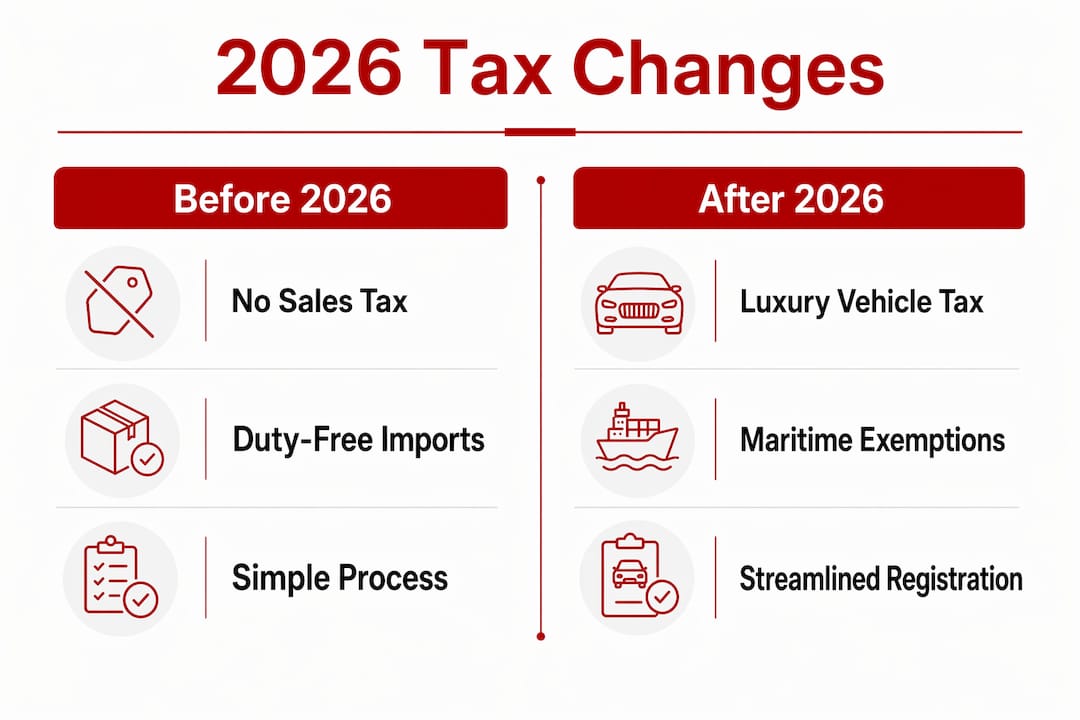
The 2026 policy update that drew the most attention was the sales tax imposed on luxury vehicles valued above RM300,000 transported to or imported into Langkawi. This change ended a long-standing perk that had attracted high-net-worth buyers to purchase premium cars on the island. The practical effect was immediate: buyers who had used Langkawi as a tax-efficient route for luxury car acquisitions lost that advantage as of January 15, 2026.
For vessel owners, the picture is different. Maritime registrations retain their core tax exemptions under the updated framework. The government’s decision to target luxury vehicles while preserving maritime incentives reflects a deliberate fiscal priority: Langkawi’s role as a regional maritime hub is considered strategically valuable in a way that luxury car sales are not.
“Malaysia’s move to limit tax perks reflects broader fiscal policy, yet maritime registrations remain favorable.” — South China Morning Post
The distinction matters for anyone evaluating Langkawi as a registration base. The 2026 changes signal that Malaysia is tightening duty-free zone rules selectively, not broadly. Vessel owners should monitor future policy updates, but the current regulatory environment remains favorable for maritime assets.
| Category | 2026 Tax Treatment | Impact on Owners |
|---|---|---|
| Luxury vehicles above RM300,000 | Sales tax now applies | Higher acquisition cost; reduced incentive to buy in Langkawi |
| Yachts and maritime vessels | Duty and sales tax exempt | No change; full exemption retained |
| Marine equipment and parts | Duty-free within zone | Cost savings on maintenance and upgrades |
| Commercial vessel registration | Favorable tax regime maintained | Corporate structures remain viable |
What are the requirements for the Langkawi registration process?
The Langkawi registration process follows a defined sequence. Understanding each step before you begin prevents delays and avoids the most common compliance errors. A typical vessel registration requires proof of ownership, vessel specifications, and payment of applicable registration fees.
- Confirm eligibility. The vessel must meet LIYR criteria, which generally covers pleasure craft and commercial vessels operating in Malaysian waters or internationally under a Malaysian flag. Foreign-owned vessels can qualify through corporate registration structures.
- Gather documentation. Required documents include the bill of sale or proof of ownership, vessel survey certificate, builder’s certificate or previous registration certificate, and valid identification for the owner or authorized corporate representative.
- Submit the application. Applications go to the relevant Malaysian maritime authority. Submissions can be made directly or through a registered agent. Using an agent with local expertise reduces the risk of incomplete filings.
- Pay registration fees. Fees vary by vessel type, size, and intended use. Commercial vessels face additional compliance requirements and higher fee schedules than private leisure craft.
- Receive your certificate. Processing timelines for Langkawi registrations are faster than many competing jurisdictions, with straightforward applications often completed within a few weeks.
- Maintain compliance. Annual renewals and periodic surveys keep the registration active. Commercial operators must also meet ongoing safety and operational reporting standards.
Private registrations are simpler in terms of documentation and compliance checkpoints. Commercial registrations require additional steps, including proof of the vessel’s commercial purpose, crew certification records, and adherence to Malaysian maritime safety regulations.
Profesyonel İpucu: Corporate vessel owners should structure their ownership entity before beginning the registration application. Registering through a properly formed company can unlock additional tax optimization options and simplifies future ownership transfers. Vesselflag’s corporate ownership guidance covers the most effective structures for Langkawi-registered vessels.
How does Langkawi compare to other maritime registration options?
Langkawi’s registration advantages are real, but they are not universal. The right flag depends on your vessel’s operational profile, ownership structure, and the waters you intend to cruise or operate in.
| Registration Jurisdiction | Tax Treatment | İşlem Hızı | Best Suited For |
|---|---|---|---|
| Langkawi (LIYR) | Duty-free; no sales tax on vessels | Fast; weeks for standard applications | Southeast Asia operations; cost-conscious owners |
| Malta | EU-recognized flag; VAT implications vary | Moderate | European cruising; charter operations |
| Birleşik Krallık Bölüm 1 | No specific duty exemptions; recognized globally | Moderate to slow | Global cruising; prestige flag preference |
| Palau | Low cost; minimal tax obligations | Fast | Budget-focused owners; Pacific operations |
| San Marino | Inland registry; recognized internationally | Fast | Owners seeking European flag without EU VAT |
Langkawi’s clearest advantage is the combination of zero import duties, fast processing, and geographic positioning for Southeast Asian operations. Owners who cruise primarily in Malaysian, Thai, or Indonesian waters gain the most from a Langkawi registration. The global registration guide from Vesselflag provides a detailed breakdown of how each jurisdiction compares across cost, compliance, and operational criteria.
Where Langkawi is less suitable: owners who need an EU-recognized flag for charter operations in European waters will find Malta or a similar EU registry more practical. Vessels operating primarily in the Atlantic or Mediterranean gain limited geographic benefit from a Langkawi flag, even if the tax treatment is attractive.
The commercial vessel registration benefits of Langkawi are particularly strong for operators running regional ferry services, dive boats, or charter yachts within the Andaman Sea corridor. Lower operating costs and simplified customs procedures compound over time into a meaningful competitive advantage.
Önemli noktalar
Langkawi vessel registration delivers its strongest value through duty-free acquisition, fast processing, and favorable positioning for Southeast Asian maritime operations.
| Nokta | Detaylar |
|---|---|
| Duty-free acquisition | Vessels registered under LIYR pay no import duties or sales tax, generating significant savings at purchase. |
| 2026 changes favor vessels | Luxury vehicle tax exemptions ended, but maritime vessel exemptions remain fully intact under current policy. |
| Defined registration steps | The process requires ownership proof, survey certificates, fee payment, and ongoing compliance for both private and commercial vessels. |
| Langkawi vs. other flags | Langkawi leads on cost and speed for Southeast Asian operations; EU flags suit European charter operators better. |
| Corporate structures available | Vessel owners can register through a company to optimize tax treatment and simplify future ownership transfers. |
Langkawi registration: what experience actually teaches you
After working with vessel owners across dozens of jurisdictions, the pattern I see most often is this: owners who research Langkawi registration focus on the tax exemptions, which is correct. What they underestimate is how much the geographic advantage compounds over time. A vessel based in the Andaman Sea corridor that clears customs in Langkawi repeatedly throughout a season saves not just money but hours of administrative time per port call. That operational efficiency is harder to quantify than a duty exemption, but it is equally real.
The 2026 vehicle tax change caused some confusion in the market. I have spoken with owners who assumed the new rules applied to their vessels as well. They do not. The Malaysian government drew a clear line between luxury consumer goods and maritime assets, and that distinction reflects a genuine policy commitment to Langkawi’s role as a maritime hub.
One area where I see owners make avoidable mistakes: waiting too long to formalize corporate ownership before registering. If you intend to hold the vessel through a company, set that structure up first. Retrofitting corporate ownership after registration creates paperwork, delays, and sometimes additional fees. The registration process itself is not complicated, but sequencing matters.
Langkawi is not the right answer for every vessel or every owner. But for operators working in Southeast Asia who want a recognized flag, low acquisition costs, and a registration process that does not consume months of your time, it remains one of the strongest options available in 2026.
— VesselFlag
Register your vessel in Langkawi with Vesselflag
Vesselflag specializes in vessel registrations across multiple international jurisdictions, including Langkawi, Malta, UK Part 1, Palau, and San Marino. The platform handles documentation preparation, compliance checks, and submission coordination so that owners avoid the delays that come from incomplete or incorrectly filed applications.
For Langkawi registrations specifically, Vesselflag manages the full process from eligibility confirmation through certificate issuance, including support for corporate ownership structures. The vessel registration global guide covers every jurisdiction Vesselflag supports, with current timelines and fee structures. Owners who need faster processing can also review fast-track compliance options for Langkawi and other flags. Start your registration today and put the duty-free advantages of Langkawi to work for your vessel.
SSS
What makes Langkawi registration different from other Malaysian registrations?
Langkawi registration under the LIYR grants duty-free and sales-tax-free status on qualifying vessels and marine equipment, which standard Malaysian port registrations do not provide. This exemption structure is specific to Langkawi’s designated free-trade zone status.
Did the 2026 tax changes affect vessel registrations in Langkawi?
The 2026 changes imposed sales tax on luxury vehicles above RM300,000 but left maritime vessel exemptions intact. Vessel owners registering in Langkawi continue to benefit from the same duty-free treatment that existed before January 2026.
How long does the Langkawi registration process take?
Processing times for straightforward private vessel applications typically run a few weeks. Commercial vessel registrations with additional compliance requirements may take longer, depending on documentation completeness and the complexity of the ownership structure.
Can a foreign-owned company register a vessel in Langkawi?
Foreign-owned companies can register vessels in Langkawi through corporate ownership structures that meet Malaysian maritime authority requirements. Setting up the correct corporate entity before applying is the most efficient approach.
Is Langkawi registration suitable for vessels that cruise outside Southeast Asia?
Langkawi registration works best for vessels operating primarily in Southeast Asian waters. Owners who cruise regularly in European or Atlantic waters may find that an EU-recognized flag such as Malta offers more practical operational benefits for those specific regions.