

TL;DR:
- Yacht market valuation determines a vessel’s current fair market worth using transaction data and vessel characteristics. Accurate valuations help parties avoid overpaying or underselling, especially in a multi-billion-dollar industry. Market conditions, builder tier, age, and condition significantly influence yacht prices and depreciation over time.
Yacht market valuation is the process of calculating a vessel’s current market worth using empirical data, builder tier, vessel characteristics, and prevailing market conditions. Buyers, sellers, lenders, and insurers all rely on accurate valuations to make sound decisions. Get it wrong, and you risk overpaying by hundreds of thousands of dollars or selling a premium asset well below its true worth. This guide breaks down the core valuation methods, the factors that move prices, and the practical steps owners and investors use to arrive at a defensible number.
What is yacht market valuation, and why does it matter?
Yacht market valuation is the formal determination of what a vessel would sell for between a willing buyer and a willing seller in current market conditions. The industry term most professionals use is “fair market value,” and it differs from insurance replacement value or book value. Fair market value reflects real transaction data, not theoretical replacement costs.
Accurate valuation matters for several reasons. Buyers need it to avoid overpaying. Sellers need it to price competitively without leaving money on the table. Lenders require a documented valuation before approving marine financing. Insurers use it to set coverage limits. Without a credible number, every party in a yacht transaction is working from guesswork.
The global superyacht market runs into the tens of billions of dollars annually. At that scale, even a 5% pricing error on a $10 million vessel represents $500,000. Investors treating yachts as portfolio assets face the same discipline required in commercial real estate: you need a methodology, not a gut feeling.
What factors influence yacht market valuation?
Several variables drive the value of yachts, and understanding each one prevents costly misjudgments.

Length overall (LOA) is the single strongest predictor of price. Longer vessels cost more to build, maintain, and crew, and that reality is priced into the market. A 40-meter motor yacht does not simply cost twice as much as a 20-meter vessel. The relationship is exponential, not linear.
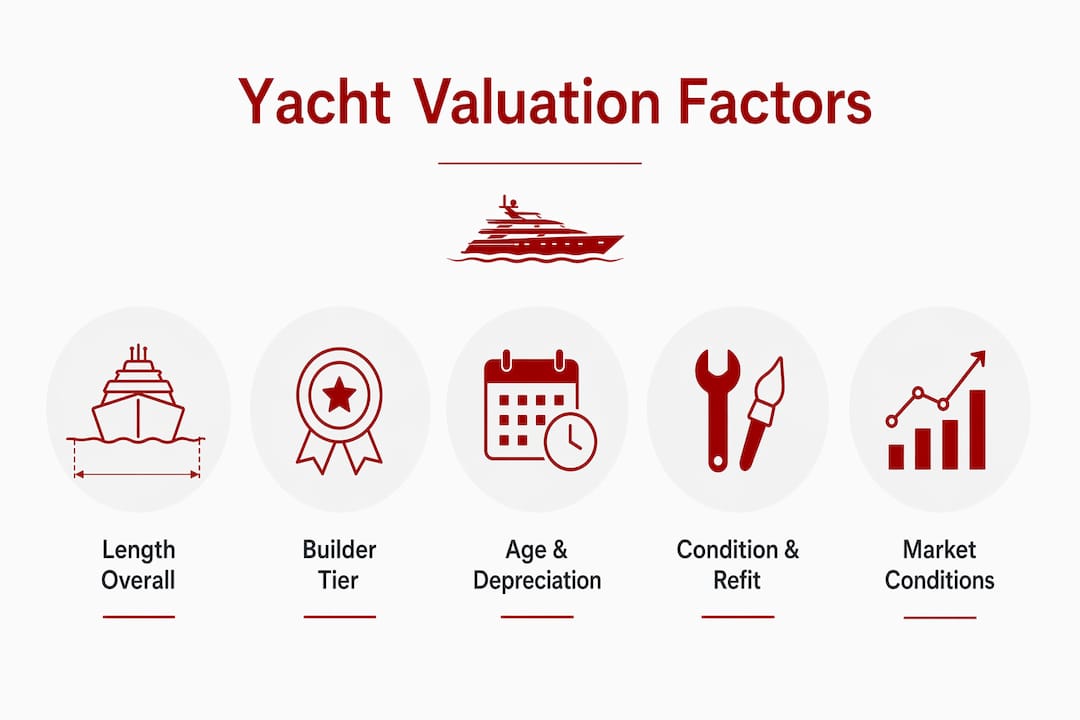
Builder tier adds a static price multiplier at the point of sale. Ultra-premium builders such as Feadship, Lürssen, and Oceanco command roughly a 93% premium over the market baseline price. Mid-tier premium builders add approximately 20%. Critically, builder status does not change the depreciation curve. A Feadship and a production motor yacht of the same age lose value at nearly identical annual rates. The premium is baked into the starting price, not the rate of decline.
Age and depreciation follow a predictable pattern. Annual depreciation runs approximately 7.4% from new, decelerating as the vessel ages. A five-year-old yacht has already absorbed the steepest part of the curve.
Condition and refit status can shift value significantly in either direction. A vessel with a recent Lloyd’s or DNV GL classification survey and documented refit work commands a premium because it reduces buyer risk. A yacht with deferred maintenance carries a discount that often exceeds the cost of the work itself.
Market conditions determine whether asking prices hold or collapse. The current 2025–2026 environment is a buyer’s market for most segments, which compresses transaction prices relative to asking prices.
| Factor | Direction of influence | Magnitude |
|---|---|---|
| LOA (length overall) | Positive, exponential | Muito elevado |
| Builder tier | Positive multiplier | High (up to +93%) |
| Age | Negative, decelerating | High |
| Condition and refit | Positive or negative | Moderate to high |
| Market conditions | Variable | Moderado |
| Customizations | Positive or negative | Low to moderate |
Pro Tip: Classification status from Lloyd’s Register or DNV GL is one of the fastest ways to justify a price premium. Buyers pay for reduced risk, and a current survey certificate is the clearest proof of it.
How does yacht depreciation affect market value over time?
Depreciation is the single most misunderstood element of yacht ownership. Most buyers focus on purchase price. The smarter question is: what will this vessel be worth in five years?
Production yachts under 50 feet lose 25–35% of value within the first three years. Over a full decade, production yachts typically shed 50–60% of their original value. Custom yachts hold up better, depreciating 30–40% over the same ten-year period. The difference reflects build quality, materials, and the smaller secondary market for custom vessels, which limits supply and supports prices.
The depreciation curve is steepest in years one through three, then flattens. This has a direct implication for buyers: purchasing a three-year-old vessel rather than a new one captures most of the early depreciation discount while still acquiring a relatively modern yacht.
Operating costs compound the depreciation problem. Annual running costs including maintenance, crew, insurance, and mooring typically run 8–20% of purchase price, with 10% being the most commonly cited benchmark. A $5 million yacht may cost $500,000 per year to operate. Those costs do not build equity. They accelerate the effective rate at which the asset loses financial value relative to what the owner has put in.
Failing to model annual running costs of 8–20% of purchase price is a primary cause of forced sales below market value. Owners who underestimate operating expenses face financial distress and sell under pressure, often accepting prices well below fair market value.
Pro Tip: If you are selling, the optimal window is typically before year three for production yachts, when the depreciation curve is still decelerating. Waiting until year five or six means selling into a flatter but still declining price environment with more competing inventory.
What is the difference between a yacht survey, appraisal, and market valuation?
These three terms are used interchangeably in casual conversation, but they describe distinct professional services with different outputs and purposes.
-
Marine survey is a physical inspection of the vessel’s condition and seaworthiness. A marine survey assesses condition for insurance and purchase decisions. The surveyor examines the hull, machinery, electrical systems, and safety equipment. The output is a condition report, not a price.
-
Accredited appraisal is a documented monetary valuation prepared by a credentialed appraiser. Professional appraisal reports are accepted by marine lenders and insurance carriers. Appraisers are separate professionals from surveyors, and their reports carry legal and financial weight in loan applications, insurance claims, and ownership transfers.
-
Market valuation is the broader analytical process of determining fair market value using comparable sales data, hedonic pricing models, and current market conditions. It may incorporate survey findings and appraisal reports, but it also draws on transaction databases and market indexes.
The distinction matters because surveys focus on seaworthiness while appraisals determine monetary value. Hiring a surveyor and expecting a market valuation is a common and expensive mistake. For any transaction involving financing or insurance, you need both a survey and an appraisal, and ideally a market valuation analysis to cross-check the appraised figure.
Pro Tip: Always verify that your appraiser holds recognized credentials such as those from the American Society of Appraisers or the Marine Appraisers Association. An uncredentialed opinion carries no weight with lenders or insurers.
How do asking price and transaction price differ in the yacht market?
Asking price is a psychological anchor, not a statement of value. Sellers set asking prices based on what they paid, what they need, or what they hope the market will bear. None of those factors determine what a buyer will actually pay.
In the current 2025–2026 buyer’s market, superyachts sell at 15–25% below asking price when the vessel is older or poorly maintained. A yacht listed at $4 million may transact at $3 million to $3.4 million. That is not a negotiating win. That is the market correcting an inflated anchor.
Well-maintained vessels from top-tier builders sell much closer to asking price. The discount narrows when condition is excellent, the vessel has a current survey, and the seller is not under time pressure. Days on market is a powerful signal. A vessel that has sat listed for 12 months is telling you something about its pricing relative to true market value.
Asking price is often a psychological anchor. Actual transaction prices are driven by days on market, vessel condition, and seller urgency, especially in buyer’s markets where inventory is high and buyers have options.
The yacht market lacks the price transparency of public equity markets. Brokers access comparable sale data through private networks and proprietary databases. This opacity benefits informed buyers and sellers who invest in proper market analysis. It punishes those who rely on listing prices alone.
Compreensão broker expertise in yacht transactions is one practical way to close the information gap. Experienced brokers track actual transaction prices, not just asking prices, and that data is what drives realistic pricing decisions.
| Scenario | Asking price | Typical discount | Likely transaction price |
|---|---|---|---|
| Older vessel, deferred maintenance | $3,000,000 | 20–25% | $2,250,000–$2,400,000 |
| Mid-age, average condition | $3,000,000 | 10–15% | $2,550,000–$2,700,000 |
| Recent refit, top builder | $3,000,000 | 3–8% | $2,760,000–$2,910,000 |
Practical steps to determine a yacht’s market value
Arriving at a defensible market value requires a structured process, not a single data point.
- Gather detailed vessel specifications. Collect LOA, year built, builder, engine hours, refit history, and classification status. These are the primary inputs for any valuation model.
- Review comparable sales. Identify vessels of similar size, age, and builder tier that have transacted in the past 12–18 months. Asking prices are not comparables. Transaction prices are.
- Apply a hedonic pricing model. Hedonic models calibrated against 303 motor yacht listings and 59 sailing yachts across major brokerages use vessel length, year built, and builder tier to produce a value estimate with a defined confidence range. Williams Yacht Intelligence publishes one of the most widely referenced indexes for superyacht valuation.
- Commission a professional appraisal. A credentialed appraiser provides a documented report that lenders and insurers accept. This is non-negotiable for any financed transaction.
- Consult a specialist broker. Brokers with access to private transaction databases can validate or challenge the modeled value with real market evidence. The role of boat brokers in the valuation process is often underestimated by first-time buyers.
- Account for current market trends. A valuation conducted in a seller’s market will produce a different number than one conducted in a buyer’s market. The model must reflect current conditions, not historical averages.
Pro Tip: Never rely on an informal broker estimate or an online listing price as your valuation. Both are starting points for negotiation, not statements of market value. Only a credentialed appraisal and a data-driven model produce a defensible number.
Principais conclusões
Accurate yacht market valuation requires combining hedonic pricing models, professional appraisals, and current transaction data, not asking prices or informal estimates.
| Ponto | Detalhes |
|---|---|
| Fair market value is the standard | Use transaction-based fair market value, not insurance replacement value or book value. |
| Builder tier adds a price multiplier | Ultra-premium builders add up to 93% over baseline price, but depreciation rates stay the same across tiers. |
| Depreciation is front-loaded | Production yachts lose 25–35% of value in the first three years; plan purchases and sales around this curve. |
| Surveys and appraisals are different | A marine survey assesses condition; an accredited appraisal determines monetary value for lenders and insurers. |
| Asking price is not market value | In the current buyer’s market, transaction prices run 15–25% below asking price for older or poorly maintained vessels. |
Yachts as assets: what the numbers don’t tell you
Yachts are lifestyle assets. That is not a criticism. It is the most important thing to understand before treating one as a financial investment.
At Vesselflag, we work with yacht owners and investors across dozens of jurisdictions. The pattern we see repeatedly is this: buyers model the purchase price carefully and ignore the operating cost reality. Annual running costs of 8–20% of purchase price are not a footnote. They are the dominant financial variable in yacht ownership. A $5 million yacht that costs $600,000 per year to operate is not a $5 million asset. It is a $5 million liability with a depreciating resale value attached.
The builder premium insight is one that most buyers miss entirely. Paying a Feadship or Lürssen premium does not slow your depreciation. It raises your starting price. The annual rate of value decline is nearly identical across builder tiers. What you get for the premium is build quality, prestige, and a stronger secondary market, not a better investment return.
Market timing matters more than most owners admit. Selling in a buyer’s market because of financial pressure is the most common cause of below-value transactions. Owners who model their total cost of ownership honestly, including depreciation and operating expenses, make better decisions about when to buy, when to sell, and how long to hold.
My honest view: the investors who do best in the yacht market are those who treat valuation as a discipline, not a formality. They commission proper appraisals, track comparable sales, and account for the full cost picture before committing capital.
— Vesselflag
How Vesselflag supports yacht owners through registration and compliance
A yacht’s registration status directly affects its marketability and perceived value. Lenders, insurers, and buyers all scrutinize registration documents before any transaction closes. A vessel with lapsed or incorrect registration faces delays, reduced buyer confidence, and in some cases, outright rejection from marine lenders.
Vesselflag provides yacht registration services across multiple international flags, including San Marino, Malta, Poland, UK Part 1, Palau, and Langkawi. Each jurisdiction carries different compliance requirements, timelines, and cost structures. Vesselflag handles the full process, from documentation to MMSI and AIS setup, so owners maintain valid, globally recognized registration status. A properly registered vessel is a more marketable vessel. Start with the complete registration guide to understand your options, or review global registration compliance to confirm your current status meets international standards.
FAQ
What is yacht market valuation?
Yacht market valuation is the process of determining a vessel’s fair market value using transaction data, hedonic pricing models, vessel specifications, and current market conditions. It differs from insurance value and book value, both of which use different calculation methods.
How much does a yacht depreciate per year?
Annual depreciation runs approximately 7.4% from new, decelerating as the vessel ages. Production yachts lose 50–60% of value over ten years, while custom yachts typically depreciate 30–40% over the same period.
What is the difference between a marine survey and an appraisal?
A marine survey assesses the vessel’s physical condition and seaworthiness. An accredited appraisal determines the vessel’s monetary market value and is the document accepted by lenders and insurers for financing and coverage purposes.
How far below asking price do yachts actually sell?
In the current buyer’s market, older or poorly maintained yachts typically sell 15–25% below asking price. Well-maintained vessels from top-tier builders sell much closer to the listed figure, often within 3–8%.
Does registration status affect a yacht’s value?
Yes. A vessel with current, valid registration under a recognized flag is more attractive to buyers and lenders. Lapsed or incorrect registration creates transaction delays and can reduce buyer confidence, which puts downward pressure on the achievable sale price.