

TL;DR:
- Choosing the right vessel flag impacts legal liability, port access, insurance, and operating costs.
- Different registry types include national, open (FOC), and dual, each suited for specific operational needs.
- Expert guidance ensures compliance, risk management, and optimal long-term benefits in vessel registration.
Choosing a registration flag for your vessel is not a simple paperwork exercise. Most owners focus on upfront fees or prestige, but the flag you fly determines the legal system governing your crew, the ports that welcome you without friction, and whether your insurer will pay out when things go wrong. A wrong choice can mean denied port access, regulatory fines, or coverage gaps that cost far more than any registration savings. This guide breaks down every major registration type, compares the world’s top flags, and gives you a practical framework to match your vessel to the right flag with confidence.
Índice
- What is maritime registration and why does it matter?
- Major types of maritime registrations explained
- Popular maritime flags: Pros, cons, and cost comparison
- Navigating complexities: Edge cases, legality, and compliance risks
- How to select the best flag for your vessel
- A closer look: What most guides miss about flag selection
- Get expert support for efficient, compliant registration
- Frequently asked questions
Principais conclusões
| Ponto | Detalhes |
|---|---|
| Flag choice influences compliance | Where you register your vessel affects your ability to operate, your costs, and your legal responsibilities. |
| Open registries suit global ops | Flags of convenience are popular for international operations due to cost and flexibility, but require careful compliance checks. |
| Documentation is essential | Prepare proper ownership, tonnage, and compliance documents to avoid processing delays and penalties. |
| Risks in edge cases | Flag-hopping, dual registration, or outdated compliance can lead to legal and insurance complications. |
| Strategic flag selection matters | A thoughtful approach to flag selection aligns with operational needs, cost optimization, and long-term compliance. |
What is maritime registration and why does it matter?
At its core, maritime registration is the formal process of linking your vessel to a specific country, known as the flag state. That link is not symbolic. It means the flag state’s laws govern everything from crew wages and safety standards to tax obligations and liability rules. Every vessel operating internationally must carry this registration, and the flag state is responsible for enforcing international maritime law on that vessel wherever it sails.
O boat registration process involves more than filling out a form. Proof of ownership, tonnage certification, and safety compliance are all required before a flag state will issue a certificate. Depending on the jurisdiction, you may also need a builder’s certificate, a commercial survey, or proof of corporate structure.
Why does this matter beyond legality? Consider these practical consequences of flag selection:
- Insurance eligibility: Many P&I clubs and underwriters will only cover vessels registered under recognized, compliant flag states.
- Port access: Some ports apply heightened inspection protocols to vessels flying certain flags, adding delays and costs.
- Tax exposure: Flag states vary dramatically in how they tax vessel income, charter revenue, and crew salaries.
- Operational zones: Certain flags restrict or enable trading in specific regions, particularly within the European Union.
- Liability framework: The flag state’s legal system determines how disputes, accidents, and crew claims are resolved.
Under the United Nations Convention on the Law of the Sea (UNCLOS), flag states are obligated to maintain a genuine link with their registered vessels and to enforce international safety and labor standards. In practice, enforcement varies widely, which is exactly why flag selection is a strategic decision.
Pro Tip: Before comparing fees, map out where your vessel will operate, what crew nationalities you plan to employ, and whether you intend to charter commercially. These three factors alone will eliminate half the flags on your shortlist.
Now that we’ve reset what flag registration really means, let’s break down the ways different types of registrations actually work.
Major types of maritime registrations explained
Not all registries work the same way. Understanding the structural differences between registry types helps you predict what you’re getting into before you commit.

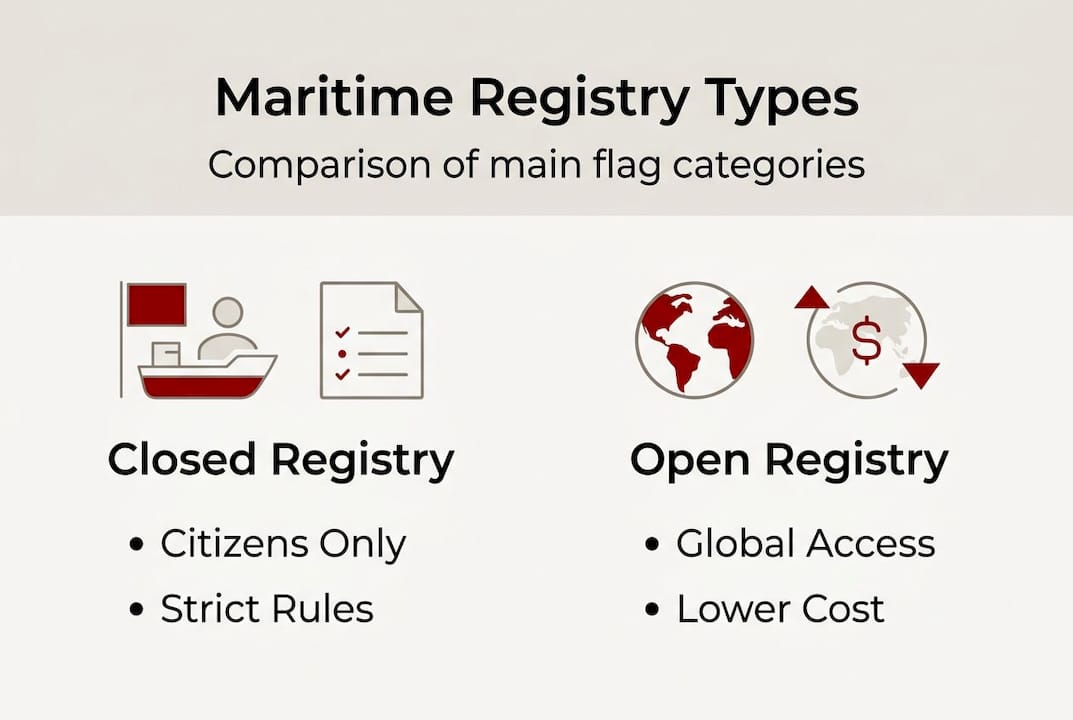
1. National or closed registries
These require a genuine connection to the flag state, typically citizenship, residency, or a locally incorporated company. Examples include the United States and the UK Part 1 registry. They tend to carry strong reputations, robust enforcement, and access to domestic trading routes. The tradeoff is stricter ownership requirements and often higher operating costs.
2. Open registries (flags of convenience or FOC)
Open registries allow any owner, regardless of nationality, to register a vessel. Panama, Liberia, and the Marshall Islands are the most prominent examples. Panama, Liberia, and Marshall Islands control roughly 50% of world fleet tonnage, which tells you how dominant this model has become in global trade. The ITF’s 2026 FOC list includes 48 countries, covering approximately 30% of the world fleet.
3. Dual or secondary registries
Some jurisdictions offer conditional or secondary registration, where a vessel is temporarily registered under one flag while maintaining ties to another. This is common for vessels under bareboat charter, where the charterer’s flag state takes temporary jurisdiction. It is a flexible tool but requires careful legal management to avoid conflicting obligations.
Here’s a quick comparison of the three types:
| Registry type | Ownership requirement | Cost level | Best for |
|---|---|---|---|
| National/closed | Citizen or local company | High | Domestic trade, prestige |
| Open/FOC | Any nationality | Low to medium | Global trade, flexibility |
| Dual/secondary | Conditional | Varies | Bareboat charter, transitions |
Pro Tip: If you’re exploring open registries, look at top yacht registration services that specialize in FOC jurisdictions. A good agent will flag compliance risks that a basic registry website will not mention. For owners considering Panama yacht registration, the process is streamlined but requires attention to annual renewal obligations.
With the basic definitions in place, let’s dive into a side-by-side breakdown of the registry types and what sets them apart.
Popular maritime flags: Pros, cons, and cost comparison
Knowing the types is one thing. Seeing how specific flags perform in the real world is where decisions get made. Here’s how the most popular flags for yacht and boat owners actually compare.
Ilhas Marshall offers low fees, flexible ownership structures, and strong international recognition. It’s a favorite for globally trading vessels where cost efficiency matters most.
Malta is the EU’s flagship registry. It gives owners access to EU port privileges, strong legal infrastructure, and a well-regarded compliance record. Ideal for Mediterranean operations.
Cayman Islands and BVI are preferred by high-net-worth owners who prioritize privacy, prestige, and minimal taxation. Port access in some regions can be more scrutinized.
São Marinho has emerged as a fast-processing, low-tax option with a growing reputation among European yacht owners. Registration timelines can be remarkably short compared to traditional registries.
Annual registration costs range from $3,000 to $18,000 depending on the flag and vessel size. That range reflects a huge difference in what you get, not just what you pay.
| Bandeira | Annual cost range | Key benefit | Main drawback |
|---|---|---|---|
| Ilhas Marshall | $3,000 to $6,000 | Low cost, global flexibility | Less EU port advantage |
| Malta | $5,000 to $12,000 | EU access, strong compliance | Higher admin requirements |
| Ilhas Caimão | $8,000 to $18,000 | Privacy, prestige | Cost, scrutiny in some ports |
| São Marinho | $3,500 to $7,000 | Fast processing, low tax | Newer reputation |
| Panamá | $3,000 to $8,000 | Established, widely recognized | Variable enforcement reputation |
For owners operating in the Mediterranean, the San Marino, Malta, and Poland registration guide is worth reviewing before committing to a flag. Understanding the yacht registration benefits specific to each jurisdiction can reveal advantages that fee comparisons alone won’t show.
Armed with an understanding of registry types, it’s time to see how the world’s most popular flags stack up in practice.
Navigating complexities: Edge cases, legality, and compliance risks
Most registrations follow a clear path. But some situations introduce legal and financial risks that catch owners off guard.
Flag hopping refers to repeatedly changing a vessel’s registration to avoid regulatory scrutiny or enforcement actions. It is illegal in many jurisdictions and triggers automatic red flags with port state control inspectors worldwide.
Shadow fleets are groups of vessels that use false or obscure flags to evade sanctions, environmental regulations, or safety inspections. Shadow fleets, dual registration conflicts, and unflagged vessels are among the most serious compliance risks in modern maritime law. Legitimate owners who unknowingly use the same registries as shadow fleet operators may face guilt-by-association scrutiny.
Older vessels face a specific challenge. Vessels over 15 to 20 years old typically require additional surveys or waivers before many flag states will accept registration. Skipping this step is a common and costly mistake.
Key compliance risks to monitor:
- Lapsed certificates triggering port detentions
- Insurance voidance due to non-compliant flag state
- Crew employment disputes under unenforceable flag state law
- Sanctions exposure from operating under scrutinized registries
Pro Tip: Always verify that your chosen flag state is not on the Paris MOU or Tokyo MOU grey or black lists before registering. These lists identify flag states with poor port state control performance, and vessels flying those flags face automatic increased inspection rates.
For commercial operators, reviewing commercial vessel registration steps before initiating registration can prevent costly oversights. Following yacht registration best practices ensures your documentation and compliance posture hold up under scrutiny.
While most registrations follow clear rules, some special cases and legal risks need close attention.
How to select the best flag for your vessel
With all the variables in play, a structured decision process saves time and prevents expensive mistakes. Here’s how to approach flag selection systematically.
Step 1: Define your operating area
A vessel that will spend most of its time in the Mediterranean has different needs than one trading globally. EU flags like Malta offer real advantages in European waters. For global routes, Marshall Islands or Panama offer cost-efficient, widely accepted options.
Step 2: Clarify your intended use
Private recreational use, commercial charter, and cargo operations each carry different compliance requirements. Charter vessels face additional safety certification demands. Commercial vessels must meet ISM Code (International Safety Management) and ISPS Code (International Ship and Port Facility Security) standards.
Step 3: Set a realistic budget
Factor in not just the annual fee but also initial registration costs, survey fees, agent charges, and ongoing compliance costs. The cheapest flag upfront is rarely the cheapest flag over five years.
Step 4: Match flag to compliance maturity
If your vessel and crew are already well-documented and compliant, a more prestigious flag is achievable and worth pursuing. If you’re starting with an older vessel or incomplete documentation, a flag with flexible entry requirements may be a better starting point.
Step 5: Engage a specialist agent
Matching your flag to your operational needs is far easier with expert guidance. Agents who specialize in specific flags know the documentation shortcuts, common rejection reasons, and timeline expectations that general advisors miss.
Stay current with 2026 yacht registration trends to understand how regulatory shifts may affect your chosen flag. Once registered, take steps to ensure registration validity through proactive renewal and document management.
A closer look: What most guides miss about flag selection
Most articles on maritime registration focus on fee tables and document checklists. That’s useful, but it misses the bigger picture that experienced owners understand.
Flag selection is increasingly a reputational and risk management decision. Insurers, port authorities, and charter clients all form opinions about your vessel based on the flag it flies. A flag that saved you $4,000 in annual fees can cost you a charter contract or a favorable insurance premium.
The UNCLOS genuine link requirement is the clearest example of this gap. Technically, many FOC registrations lack a genuine connection between the vessel and the flag state. The ITF and maritime unions have long criticized this, while the International Chamber of Shipping notes that top-performing FOCs score well in audits. The truth is somewhere in between: the flag matters less than the specific registry’s enforcement culture and your own compliance posture.
We’ve seen owners treat flag selection as a one-time box-ticking exercise, only to face renewal crises, insurance disputes, or port detentions years later. The benefits of yacht registration under a well-matched flag compound over time. Treat it as a long-term strategic asset, not an administrative task.
Get expert support for efficient, compliant registration
If you’re ready to move from knowledge to action, here’s where expert help can make the difference.
VesselFlag.com works with yacht owners, boat operators, and commercial vessel managers across dozens of flag jurisdictions. Whether you’re registering a new build under Malta, transitioning an older vessel to San Marino, or exploring open registry options for global trade, the platform provides tailored guidance backed by deep regulatory expertise.
O yacht vs boat registration guide is a good starting point if you’re still clarifying what category your vessel falls into. For owners who are already registered and want to confirm their standing, the resource on how to ensure yacht registration compliance covers exactly what to check and when.
Frequently asked questions
What is the difference between open and closed ship registries?
Open registries allow any nationality to register a vessel, while closed or national registries require a local connection such as citizenship or a domestically incorporated company.
Which flag is best for a yacht operating in the Mediterranean?
EU flags like Malta are preferred for compliance, reputation, and ease of access in the Mediterranean, as matching your flag to your operating region directly affects port access and charter eligibility.
What documents do I need to start maritime registration?
You typically need a bill of sale or builder’s certificate, a tonnage certificate, and proof of safety compliance to initiate registration under most flag states.
Are there risks with using a flag of convenience?
FOCs can lower costs and simplify registration, but the genuine link requirement is often absent, which can attract scrutiny from port authorities, insurers, and international labor organizations.
How much does yacht registration cost per year?
Annual fees range from $3,000 to $18,000 depending on the flag state and vessel size, with open registries generally sitting at the lower end of that range.