

Kurz gesagt:
- Reflagging a yacht involves complex legal, technical, and financial steps that affect sale timelines and marketability. Starting the process early ensures smooth transactions, compliance, and buyer confidence, especially when targeting premium markets. Proper planning and professional support can prevent delays, legal issues, and unexpected tax liabilities during the sale process.
Yacht reflagging on sale is the formal process of transferring a vessel’s registration from one flag state to another to align with market, regulatory, and commercial objectives before or during a sale. The industry term is “change of flag” or “reflagging,” and it covers far more than paperwork. It triggers compliance audits, technical equipment updates, tax reviews, and lender notifications. Owners who treat it as a simple administrative task routinely face delays, unexpected VAT liabilities, and buyer concerns that kill deals. Getting it right requires planning across legal, technical, and financial dimensions simultaneously.
What is the yacht reflag process and how does it impact the sale timeline?
Yacht reflagging is rarely a quick task. The typical timeline runs 4–10 weeks, depending on the jurisdiction’s workload and how complete your documentation is from day one. That window can stretch further if surveys are delayed or paperwork is incomplete.
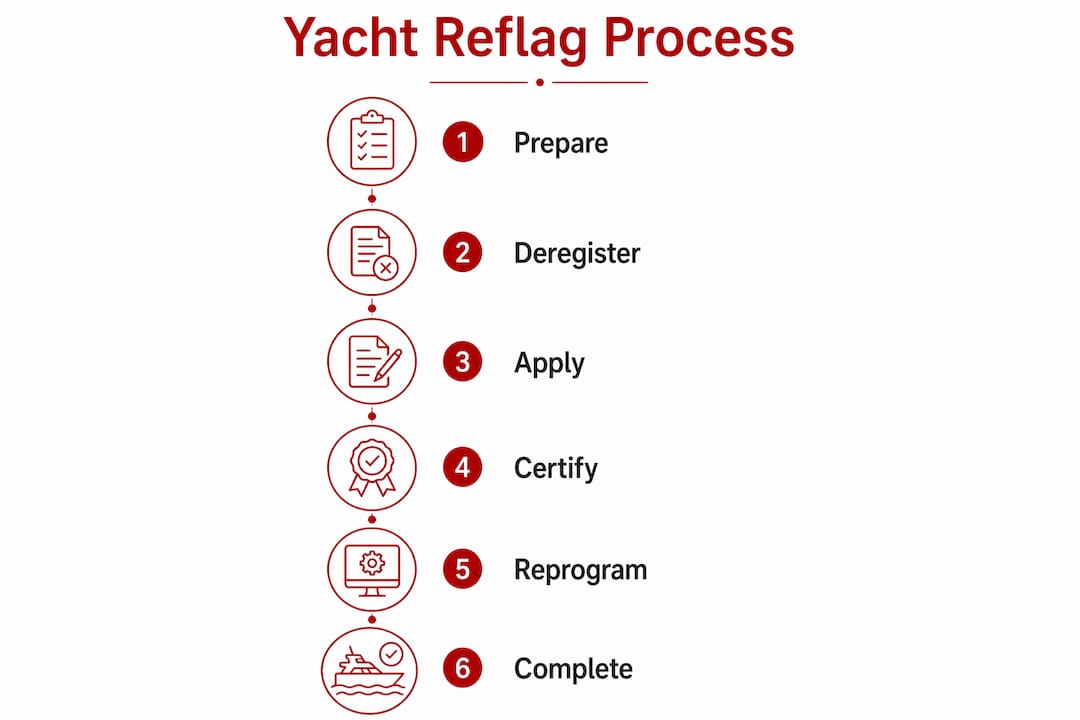
The process follows a clear sequence:
- Deregister from the current flag state. You must obtain a deletion certificate or closure of registry from your existing flag authority. This document proves the vessel is free of encumbrances and ready for transfer.
- Gather required documentation. This includes proof of ownership, the vessel’s measurement certificate, safety certificates, and any existing mortgage discharge or lender consent letters.
- Submit to the new flag state authority. Each jurisdiction has its own application forms, fee schedules, and processing timelines. Flags like Malta, UK Part 1, and San Marino each carry different requirements and turnaround speeds.
- Complete surveys and inspections. The new flag state will require statutory surveys to confirm the vessel meets its safety and technical standards before issuing a new certificate of registry.
- Update shipboard documentation and markings. Registration numbers, carving notes, and vessel name markings must reflect the new flag state before the yacht legally operates under it.
The sale timeline is directly affected by how early you start. A yacht listed for sale with a pending reflag creates uncertainty for buyers. Most serious buyers want clean, current documentation before signing a purchase agreement. Aligning the reflagging timeline with scheduled dry dock or maintenance periods is the single most effective way to avoid adding weeks to your sale process.
Pro Tip: Plan reflagging during a scheduled haul-out or annual service. You avoid extra dry dock fees, and the vessel is off the water anyway, so survey access is straightforward.

How does reflagging affect yacht marketability and buyer perceptions?
Flag state is not a neutral detail on a listing. Buyers scrutinize registration history and form strong preferences based on their home market, intended use, and financing needs. EU-registered yachts command a measurable premium in European markets because they signal regulatory compliance and reduce buyer risk.
The key factors that shape buyer perception include:
- Documentation continuity. A clean, unbroken registration history with no gaps or disputed ownership periods builds buyer confidence. Gaps raise questions about the vessel’s legal status during those periods.
- Flag reputation. Flags with strong maritime administrations, such as Malta, Gibraltar, or UK Part 1, carry credibility with buyers, brokers, and lenders. Lesser-known flags can slow financing approvals.
- Commercial vs. private registration. A yacht registered for commercial charter use carries different compliance obligations than a private vessel. Buyers planning private use may face additional steps to convert the registration category, which affects their willingness to pay a premium.
- VAT-paid status. In European markets, a yacht with documented VAT-paid status is significantly easier to sell. Reflagging to an EU flag without resolving VAT status first creates a liability that transfers to the buyer.
The practical implication is clear. Choosing the right flag before listing is not just a compliance decision. It is a pricing decision. Owners who select flags strategically for their target buyer demographic consistently report smoother negotiations and fewer price reductions driven by due diligence concerns.
What are the legal, tax, and lender considerations when reflagging a yacht for sale?
Reflagging triggers a compliance audit in most jurisdictions. Authorities review how the vessel has actually been used, not just how it was registered. Owners who declared private use but operated commercially face penalties and reclassification costs that surface at the worst possible moment: during a sale.
The legal and financial risks fall into three categories:
- VAT and import duty exposure. Moving a yacht from a non-EU flag to an EU flag can trigger a VAT importation event. If the vessel enters EU waters without documented VAT-paid status, the new owner or the seller may face a tax liability calculated on the current market value of the yacht. Commercial use exemptions exist but require detailed legal and tax planning before registration is completed.
- Mortgage and lender consent. A yacht’s mortgage jurisdiction is linked to its flag state. Changing the flag without lender consent can technically constitute a default on the financing agreement. Most mortgage agreements include explicit clauses requiring written approval before any flag change. Failing to obtain that approval before proceeding can nullify the financing and create legal complications that delay or block the sale entirely.
- Honest vessel use declaration. Switching a yacht’s usage category after registration is complex and regulated. Declaring the vessel as private when it has been used commercially is not a technicality. It is a compliance failure that auditors identify during the reflagging review.
Pro Tip: Contact your lender and a maritime tax advisor before submitting any deregistration paperwork. Both conversations take days. Fixing problems caused by skipping them takes months.
Integrating reflagging into a broader lifecycle compliance plan is the approach that avoids these risks. Owners who treat flag changes as isolated events consistently encounter problems that owners with proactive compliance calendars avoid entirely.
What technical and operational adjustments are required during reflagging?
Technical compliance is the part of reflagging that surprises most owners. The administrative steps are visible. The equipment updates are not, and they are mandatory.
The required technical steps follow this sequence:
- Reprogram AIS and MMSI identifiers. Your vessel’s AIS system broadcasts a unique Maritime Mobile Service Identity number tied to your flag state. When you change flags, the MMSI must be updated to reflect the new registration. Specialized technicians are required to reprogram and certify these devices. Using an outdated MMSI creates a safety and legal compliance failure.
- Update EPIRB and VDR equipment. Emergency Position Indicating Radio Beacons and Voyage Data Recorders are registered to specific flag authorities. Each device must be re-registered and recertified under the new flag state’s requirements.
- Complete statutory surveys. Full or partial surveys are required to confirm the vessel meets the new flag state’s safety standards. Classification societies such as Lloyd’s Register, Bureau Veritas, or DNV conduct these inspections and issue the certificates the new flag authority requires.
- Update physical markings. Carving notes, registration numbers, and official vessel name markings must be updated to reflect the new flag state. Inspectors check these during the survey process.
| Equipment | Required Action | Who Certifies |
|---|---|---|
| AIS / MMSI | Reprogram to new flag MMSI | Licensed radio technician |
| EPIRB | Re-register and recertify | Flag state authority |
| VDR | Update flag state records | Classification society |
| Safety equipment | Reinspect to new flag standards | Authorized service provider |
| Physical markings | Update carving notes and numbers | Surveyor confirms during inspection |
The least visible step is often the most complex. Reprogramming MMSI and radio equipment to new flag requirements demands a certified technician, and scheduling that technician during a busy refit season adds time to the overall process. Build that lead time into your sale schedule.
Key takeaways
Reflagging a yacht for sale is a multi-layered process that requires coordinating legal, technical, and financial steps well before the vessel is listed.
| Punkt | Einzelheiten |
|---|---|
| Timeline is fixed | The reflag process takes 4–10 weeks; start before listing to avoid sale delays. |
| Flag choice affects price | EU flags and reputable registries command buyer confidence and support premium pricing. |
| Tax risk is real | Moving to an EU flag without VAT planning can trigger an importation liability on the full market value. |
| Lender consent is mandatory | Changing flags without written lender approval can constitute a mortgage default. |
| Technical updates are required | AIS, EPIRB, and VDR equipment must be reprogrammed and recertified under the new flag state. |
What I’ve learned from watching owners get reflagging wrong
The most common mistake I see is owners treating reflagging as the last item on the sale checklist. They list the yacht, find a buyer, and then discover the flag change takes 8 weeks, the lender needs 3 weeks to respond, and the VAT situation requires a tax opinion before anyone will proceed. The deal stalls. Sometimes it collapses.
The second most common mistake is underestimating what reflagging actually involves. Owners assume it is a form and a fee. It is not. It is a compliance audit, a technical inspection, a lender conversation, a tax review, and a documentation overhaul. Each of those has its own timeline and its own professional involved.
The owners who get the best outcomes treat reflagging as part of the vessel’s lifecycle management, not as a transaction step. They keep their compliance calendars current, they know their VAT status at all times, and they have a relationship with their flag state authority before they need something urgently. When the time comes to sell, the reflag is a two-week administrative confirmation, not a two-month crisis.
My honest advice: start the reflagging conversation with your maritime lawyer, lender, and tax advisor at least three months before you plan to list. That timeline gives you room to resolve problems without pressure. It also gives buyers a clean, fully documented vessel to evaluate, which is the single strongest negotiating position you can hold.
— VesselFlag
Vesselflag’s registration services for owners preparing to sell
Reflagging a yacht for sale involves more moving parts than most owners anticipate. Vesselflag works with yacht owners and operators to select the right flag state, prepare documentation, coordinate technical requirements, and manage the process from deregistration through new certificate issuance.
Whether you need guidance on yacht registration options for your target market, support with MMSI and AIS updates, or help understanding the VAT implications of moving to an EU flag, Vesselflag’s team handles the full process. The platform covers flags including Malta, UK Part 1, Gibraltar, San Marino, and others, with clear timelines and transparent costs. For owners who want to list with confidence, flag registration support from Vesselflag removes the guesswork from a process that has real financial consequences when it goes wrong.
FAQ
What does reflagging a yacht mean?
Reflagging means formally changing a yacht’s registration from one flag state to another. The process involves deregistration, documentation, surveys, and technical equipment updates under the new flag authority.
How long does the yacht reflag process take?
The typical reflagging timeline runs 4–10 weeks, depending on the jurisdiction and how complete the documentation is at submission.
Does reflagging a yacht trigger tax liabilities?
Yes. Moving from a non-EU flag to an EU flag can trigger a VAT importation event, creating a tax liability based on the vessel’s current market value if VAT-paid status is not documented.
Do I need my lender’s permission to reflag?
Yes. Most mortgage agreements require written lender consent before any flag change. Changing flags without that approval can constitute a default on the financing agreement.
Does the flag state affect resale value?
Flags with strong maritime administrations, such as Malta or UK Part 1, increase buyer confidence and support premium pricing, particularly in European markets where EU registration is preferred.