
Most owners of yachts over 24 meters register through a holding company, several jurisdictions are commonly chosen: the Cayman Islands for tax neutrality and lender familiarity, Malta for VAT leasing on EU operations, the Isle of Man for Red Ensign standing and commercial code flexibility, the BVI and Marshall Islands for low-cost simplicity, and Delaware or Florida LLCs for US-resident owners seeking to reduce cross-border reporting friction. The right pick depends on where the boat cruises and whether it will ever carry paying guests. Talk to tax counsel and a maritime corporate service provider before you file anything.
Kurz gesagt:
- Choosing the right jurisdiction depends heavily on where the yacht operates most of the year, with Malta favored for EU cruising and Cayman for global routes and financing.
- Cayman Islands is ideal for large-yacht ownership due to its tax neutrality, flexible legal structure, and Category 1 Red Ensign registry, suitable for ships of any size.
- Malta offers VAT leasing benefits for EU residents, making it attractive for Mediterranean charters, while Isle of Man provides a balance of registry credibility and simplified compliance without EU VAT machinery.
- US LLC structures are best suited for private US owners with yachts primarily in US or Caribbean waters, as they avoid offshore reporting but lack EU VAT advantages.
- Proper registration, flag choice, and layered ownership structures must be continuously verified against updated laws and your specific usage to optimize tax, compliance, and insurance outcomes.
Inhaltsübersicht
- Which Jurisdiction Fits Your Use Case?
- Cayman, Malta, Isle of Man, BVI, Marshall Islands, and US LLCs Compared
- SPVs, Trusts, and Layered Ownership Structures
- VAT, Tax Residency, and CRS/FATCA Rules Owners Can’t Skip
- How Do You Choose the Right Jurisdiction?
- What Vesselflag Handles for Yacht Owning-Company Structures
- How International Maritime Law Shapes These Structures
- Migrating a Yacht Holding Company Between Jurisdictions
- How Jurisdiction Affects Yacht Insurance
- Where to Verify Jurisdiction-Specific Details
- Match the Structure to the Use Case, Not the Sales Pitch
- Let Vesselflag Handle the Registration Side of Your Structure
- Sources
- FAQ
Which Jurisdiction Fits Your Use Case?
The fastest way to narrow the field is to match the jurisdiction to where the yacht actually operates, not where the paperwork is cheapest.
- Kaimaninseln: best for global cruising and lender-financed yachts. No direct corporate taxation, and its exempted company structure is what banks and insurers expect to see on a loan file.
- Malta: best for EU and Mediterranean operation, especially charter. The VAT leasing framework can bring effective VAT exposure down substantially for a yacht that will spend real time in EU waters.
- Isle of Man: best for owners who want Red Ensign Group Category 1 registry recognition plus support for commercial codes like LY3, without a full EU tax footprint.
- BVI and Marshall Islands: best for owners prioritizing low setup cost and a straightforward, globally recognized registry over EU-specific tax planning.
- US LLC (Delaware or Florida): best for US-resident owners running a private yacht, where the offshore tax edge is usually smaller than it looks once US reporting rules are factored in.
A common pairing is a Cayman SPV owning a Cayman-flagged yacht, or a Malta company paired with a Malta flag for EU charter operations. Setup times vary depending on jurisdiction and documentation readiness, and first-year costs vary widely by registry and legal complexity, covered in detail below.
Cayman, Malta, Isle of Man, BVI, Marshall Islands, and US LLCs Compared
Each of these jurisdictions earned its place in yacht ownership for a different reason, and the differences matter more once you get past the marketing pitch.
Kaimaninseln
Cayman exempted companies are the workhorse of large-yacht ownership. The jurisdiction imposes no direct taxation on the company, and its corporate law is flexible enough to accommodate multiple share classes, nominee arrangements, and the kind of confidentiality that lenders and confidentiality-minded owners both want. The Cayman registry holds Category 1 Red Ensign status, meaning it can register vessels of any length or tonnage without the size caps that limit some other registries.
Setup typically involves initial fees for company formation and government costs, with first-year costs including registered agent and CSP fees varying by complexity. Annual maintenance includes renewal fees and CSP retainer costs. Cayman suits owners running large, globally cruising yachts, especially where bank financing is involved, since lenders are highly familiar with Cayman paper.
Malta
Malta built its reputation on the VAT leasing scheme, which lets a Maltese company lease the yacht to the owner to apply a lowered effective VAT rate based on the proportion of time the vessel spends in EU waters. That matters enormously for anyone planning serious Mediterranean cruising, because VAT-paid status is often the difference between free movement across EU waters and constant paperwork at every port.
Malta also offers tonnage tax treatment for yachts operated commercially. Setup costs are moderate, with ongoing compliance involving Malta’s corporate filing and audit requirements, generally more involved than Cayman’s. Malta fits owners who intend to charter in the EU or who want the yacht VAT-paid for unrestricted EU cruising.
Isle of Man
The Isle of Man pairs Category 1 Red Ensign registry status with a corporate tax regime that applies a zero rate to non-banking income, making it a frequent choice for privately owned superyachts that still want commercial code compliance in reserve, LY3 or REG codes included. That flexibility matters if an owner might later flirt with limited charter use without re-flagging the vessel entirely.
Costs for Isle of Man company formation and flag registration are comparable to Cayman, generally with advantages for owners connected to UK and European banking markets. It suits owners who want strong registry credibility and EU-adjacent logistics without Malta’s VAT machinery.
British Virgin Islands and Marshall Islands
Both jurisdictions offer BVI business companies or Marshall Islands corporations with generally lower formation and maintenance costs than Cayman or Malta, featuring simpler ongoing compliance. The Marshall Islands runs one of the largest ship and yacht registries in the world, with a genuinely global service network, while the BVI trades on decades of familiarity among lawyers and lenders. Neither carries Malta’s VAT leasing benefit or Cayman’s depth of financing precedent, but for owners who want a globally recognized flag without heavy structuring, they remain a practical, lower-cost route.
US LLC (Delaware or Florida)
For US-resident owners, an onshore Delaware or Florida LLC often produces a similar practical tax outcome to an offshore structure for a purely private-use yacht, while avoiding the reporting complexity that offshore ownership triggers for US taxpayers. State registration times are generally quick, costs modest, and no foreign entity disclosure is needed annually. The trade-off is that a US LLC generally can’t access EU VAT leasing or the same depth of international lender familiarity that Cayman or Malta paper carries, so it fits best when the yacht will stay largely in US and Caribbean waters under private use.
SPVs, Trusts, and Layered Ownership Structures
A special purpose vehicle, or SPV, is a company created to hold one asset and nothing else, insulating the yacht from any other liability the owner carries elsewhere. Most owners layer ownership rather than holding the yacht in their own name, for reasons that go beyond simple tax planning.
- Pick the SPV’s legal form. The usual choices are an exempted company (Cayman), a limited liability company (US or Marshall Islands), or a foundation company where a legal owner is needed without individual shareholders on record.
- Consider an orphan structure for financing. Lenders sometimes require shares held by an independent trustee rather than the beneficial owner directly, which keeps the SPV “orphaned” from the owner’s broader estate for security purposes.
- Add a trust or private trust company (PTC) for succession. A trust or PTC sitting above the SPV lets ownership pass to heirs without probate delay or a forced sale, particularly useful for owners spanning multiple citizenships.
- Keep a separate management company. Many owners run crew, operations, and flag-state correspondence through a distinct management company rather than the owning SPV itself, so operational headaches never touch the asset-holding entity.
- Document governance properly from day one. Banks and insurers expect clean share registers, board minutes, and a clear beneficial ownership trail. A structured SPV formation process avoids the scramble to fix paperwork gaps later.
VAT, Tax Residency, and CRS/FATCA Rules Owners Can’t Skip
VAT treatment is usually the single biggest financial variable in choosing a jurisdiction for EU-bound yachts. Malta’s VAT leasing route can meaningfully reduce effective VAT exposure for a yacht spending real time in EU waters, while temporary admission relief lets non-EU flagged yachts cruise EU waters VAT-free for a limited period, provided the yacht isn’t EU-owned or EU-resident-crewed. Commercially registered charter yachts can sometimes recover VAT on operating costs, but the rules hinge on genuine commercial use, not a private yacht dressed up as a charter asset.
A quick reality check on transparency: every jurisdiction on this list, without exception, now operates under Common Reporting Standard (CRS) and FATCA information-sharing regimes. Offshore no longer means opaque. Your CSP files the beneficial ownership disclosures that keep the structure compliant, and skipping that step is how structures quietly become liabilities.
For US-connected owners, the calculus gets more complicated:
- Offshore corporations owned by US persons can trigger Subpart F income and GILTI inclusion rules, potentially taxing the entity’s income even without a distribution.
- FBAR and FinCEN Form 114 reporting applies to US persons with signature authority over foreign financial accounts tied to the structure, including many yacht-owning entities’ bank accounts.
- A specialist partner in yacht charter tax regulation can help map these exposures, but the specifics always require sign-off from US tax counsel, not general reading.
None of this is optional homework. It’s the difference between a structure that survives an audit and one that becomes an expensive lesson.
How Do You Choose the Right Jurisdiction?
Start with four questions before you talk to anyone about incorporation: Where does the yacht cruise most of the year? Will it ever carry paying charter guests? Is the purchase financed, and if so, does the lender have a preferred jurisdiction? And how does this yacht fit into the broader estate plan?
- Match cruising region to VAT exposure first. EU-heavy use points toward Malta; global cruising with financing points toward Cayman or Isle of Man.
- Decide charter intent early. Occasional charter income changes the VAT and insurance picture enough to influence jurisdiction choice from day one.
- Loop in tax counsel before the CSP, not after. Reversing a jurisdiction decision after formation costs real time and money.
- Choose a CSP with demonstrable maritime compliance experience, not just general corporate services.
- Confirm flag registry recognition and insurance acceptance before signing any formation paperwork.
Profi-Tipp: Ask a prospective CSP for two references from yacht owners in your target cruising region, not just their general corporate client list. Maritime compliance experience and general offshore company formation experience are not the same skill.
What Vesselflag Handles for Yacht Owning-Company Structures
Specialized services support owners and advisors across the practical side of this process: multi-jurisdictional flag registration, MMSI and AIS setup, insurance consultancy, and corporate registration coordination once the ownership structure is decided.
- Registration guidance across flag options including Cayman, Malta, Isle of Man, BVI, and Marshall Islands, matched to how the yacht will actually be used.
- MMSI licensing and AIS setup handled alongside the registration process rather than as a separate scramble later.
- Insurance consultancy support so the policy lines up with the jurisdiction and flag chosen.
- {{PROOF_POINT_1}}
- {{PROOF_POINT_2}}
- {{PROOF_POINT_3}}
Support is provided to help implement the structure once counsel and the owner settle on a jurisdiction. It is not a substitute for tax or legal advice, and no reputable registration service should ever claim to be.
How International Maritime Law Shapes These Structures
Flag state choice isn’t just a tax decision. It determines which international conventions govern the vessel’s safety, crew certification, and inspection regime. Conventions like SOLAS and MARPOL apply based on flag and tonnage, not on where the owning company sits, so a Cayman-flagged yacht follows Cayman’s implementation of those conventions regardless of where the SPV’s directors live.
Die Red Ensign Group, which includes the UK, Cayman, Isle of Man, and BVI registries among others, maintains a tiered category system based on tonnage and vessel type a registry can handle. Category 1 status, held by Cayman and Isle of Man, means no upper limit on the size or complexity of yacht that registry can generally take. That tiering directly shapes which jurisdictions can register the largest superyachts without special dispensation.
Large private yachts also intersect with the Large Yacht Code (LY3), which sets safety management and crewing standards for yachts over 24 meters used privately or commercially. A holding company structure has to account for which flag’s version of these codes applies, because switching flags later can mean re-certifying the vessel entirely. This is precisely why owners consult government guidance like MGN notices before finalizing a jurisdiction, not after the flag application is already submitted.
Migrating a Yacht Holding Company Between Jurisdictions
Owners re-domicile holding companies more often than the industry likes to admit, usually triggered by a change in cruising region, a sale process, or a shift in the owner’s own tax residency. Moving a structure isn’t as simple as filing new paperwork in the destination jurisdiction and walking away from the old one.
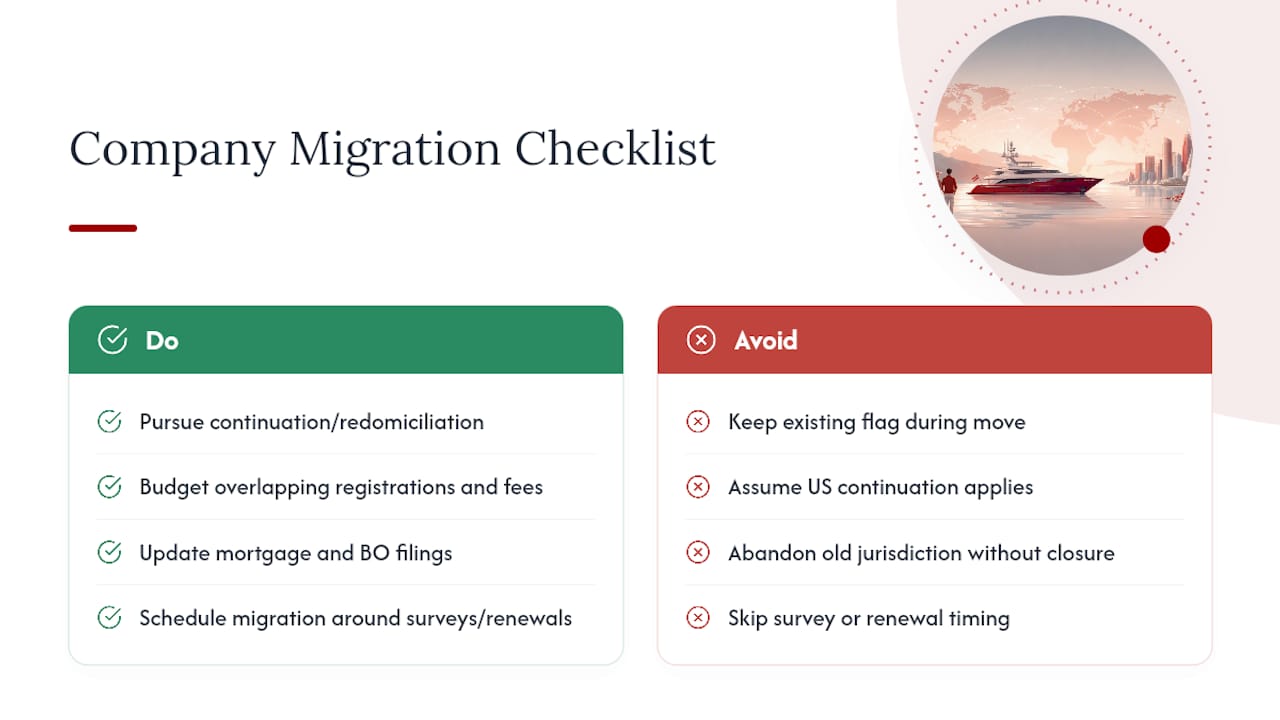
The cleanest path is usually company continuation, sometimes called redomiciliation, where the existing entity transfers its legal seat to a new jurisdiction while preserving its corporate history, contracts, and bank relationships. Not every jurisdiction pair supports this cleanly. Moving from a BVI company to Cayman is well-trodden ground; moving into or out of a US LLC structure typically means winding up the old entity and forming a new one, because US entities don’t participate in the same continuation frameworks.
Flag transfer runs on a separate track from company migration, and the two don’t have to happen simultaneously, but they usually should. A yacht can technically keep its existing flag while its owning company moves jurisdictions, but lenders and insurers tend to get uneasy about that gap, and it invites exactly the kind of compliance question a CSP is there to prevent. Budget for overlapping registration periods, updated mortgage documentation if the yacht is financed, and a fresh beneficial ownership filing under CRS and FATCA rules in the new jurisdiction. Plan the migration around survey and insurance renewal dates where possible, since re-certifying a vessel outside its normal survey cycle adds unnecessary cost.
How Jurisdiction Affects Yacht Insurance
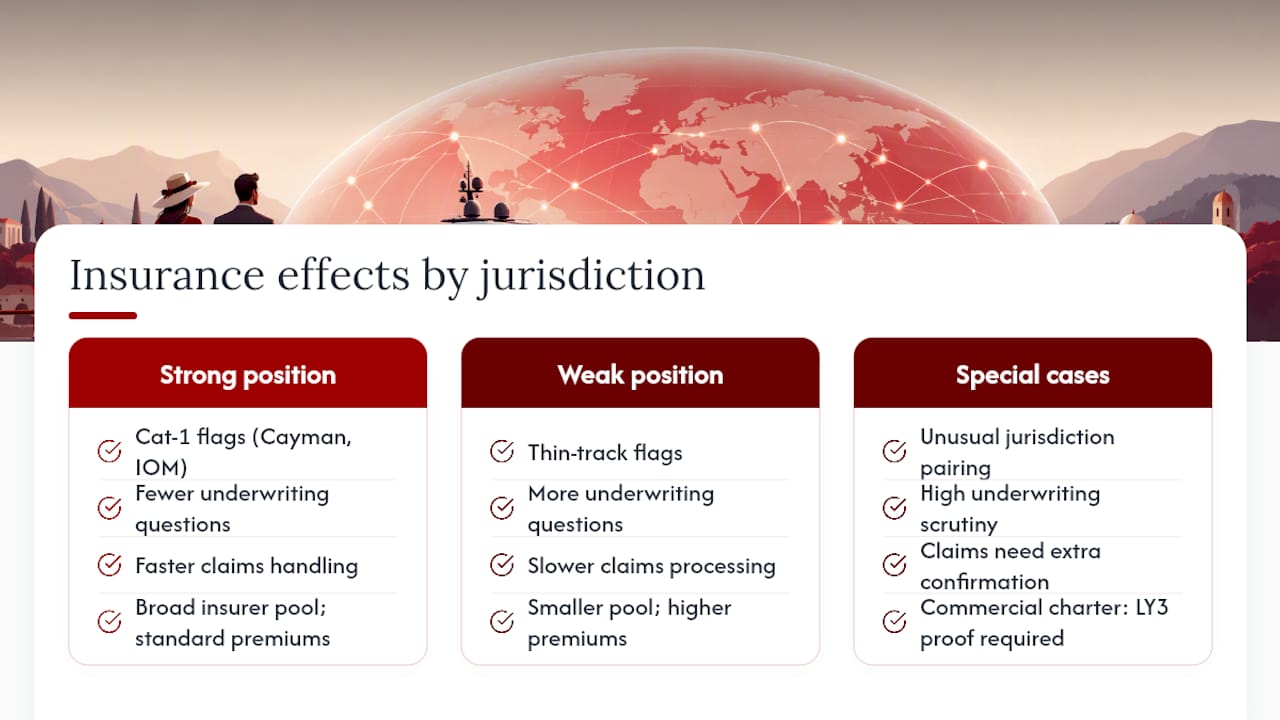
Insurers underwrite the flag and the ownership structure together, not just the vessel. A yacht flagged in a Category 1 Red Ensign jurisdiction like Cayman or the Isle of Man generally faces fewer underwriting questions than one flagged somewhere with a thinner compliance track record, because insurers already understand what safety management and survey regime that flag enforces.
Beneficial ownership clarity matters just as much as the flag itself. An opaque or poorly documented SPV can slow down a claims process considerably, since insurers need to confirm who actually holds the insurable interest before they pay out. A well-documented structure, with clean governance and a CSP that keeps records current, tends to move through underwriting and claims far faster than one assembled loosely and never revisited.
Jurisdiction also affects which insurance markets are practically available. Some underwriters specialize in covering yachts under specific flags or ownership structures, and a mismatch between an unusual jurisdiction pairing and mainstream underwriting appetite can mean a smaller pool of insurers willing to quote, or higher premiums to compensate for unfamiliarity. This is worth raising with a broker before finalizing a jurisdiction, not after the policy renewal notice arrives with an unwelcome surprise. Owners chartering commercially face an added layer of scrutiny, since commercial policies typically require proof that the vessel’s certification and flag status support commercial operation under codes like LY3.
Where to Verify Jurisdiction-Specific Details
Registry rules change, so verify details directly before forming a structure: GOV.UK’s MGN guidance covers ISM Code requirements for Red Ensign flags, and Conyers’ Cayman registry analysis details current exempted company rules. Check both against your CSP’s latest guidance before filing.
Match the Structure to the Use Case, Not the Sales Pitch
The advice that circulates around yacht holding companies tends to treat jurisdiction choice like a tax optimization puzzle, when it’s really an operations and estate planning decision wearing a tax costume. Cayman gets recommended reflexively because lenders know it, but a US-resident owner running a purely private yacht in Florida and the Bahamas is often better served by a Delaware LLC that skips the offshore reporting burden entirely, even if the “offshore” label sounds more sophisticated.
The bigger blind spot is charter intent. Owners routinely form a structure for private use, then decide two years later to charter occasionally, and discover their jurisdiction and VAT position weren’t built for it. Decide charter intent, even tentatively, before you form anything. Estate planning gets treated as an afterthought too, bolted on after the SPV exists rather than designed alongside it, which is backwards given how much a trust or PTC layer changes the practical answer to “which jurisdiction.”
Prioritize cruising region and charter intent first. Let tax efficiency follow from that, not lead it.
— VesselFlag
Let Vesselflag Handle the Registration Side of Your Structure
Once you and your advisors settle on a jurisdiction, the registration and flag pairing still has to get done correctly, and that’s where most delays actually happen. Services are offered across Cayman, Malta, Isle of Man, BVI, Marshall Islands, and other flag options, coordinating registration, MMSI and AIS setup, and insurance consultancy so the structure chosen on paper actually functions on the water.
Unlike piecing together a registry filing, a separate insurance broker, and a corporate registration agent on your own, Vesselflag coordinates those pieces under one process built specifically for yacht owners moving between jurisdictions. If you already know your target flag, start with our step-by-step yacht registration guide to see exactly what documentation your chosen jurisdiction requires, or explore Optionen zur Registrierung von Flaggen directly to compare timelines before you commit.
Sources
FAQ
What Is the 12-Person Rule on a Yacht?
It refers to the limit under which a vessel is generally treated as a private pleasure yacht rather than a passenger ship for regulatory purposes. Carrying more guests typically shifts a yacht into commercial passenger vessel rules, which is a separate question from how the owning company is structured, though it can influence flag and code choice.
Where Do Billionaires Keep Their Yachts?
Ownership structures cluster around Cayman, Malta, and the Isle of Man precisely because those jurisdictions offer the lender familiarity, VAT tools, and registry recognition large yachts need, regardless of where the vessel physically cruises. The yacht itself might spend its season in the Mediterranean or the Caribbean while the owning company sits in one of these jurisdictions.
What Is the 10% Rule for Yachts?
Definitions vary depending on the context, and this figure isn’t tied to a single universal maritime standard, so it’s worth confirming the specific rule your advisor or broker is referencing before treating it as a fixed threshold.
What Yacht Did Donald Trump Previously Own?
Donald Trump previously owned the Trump Princess, a superyacht he acquired decades ago from Saudi businessman Adnan Khashoggi before later selling it. It predates the current landscape of offshore holding company structures discussed in this guide.

[…] Owners & Advisors: Choose Yacht Holding Jurisdictions Where You Cruise […]