
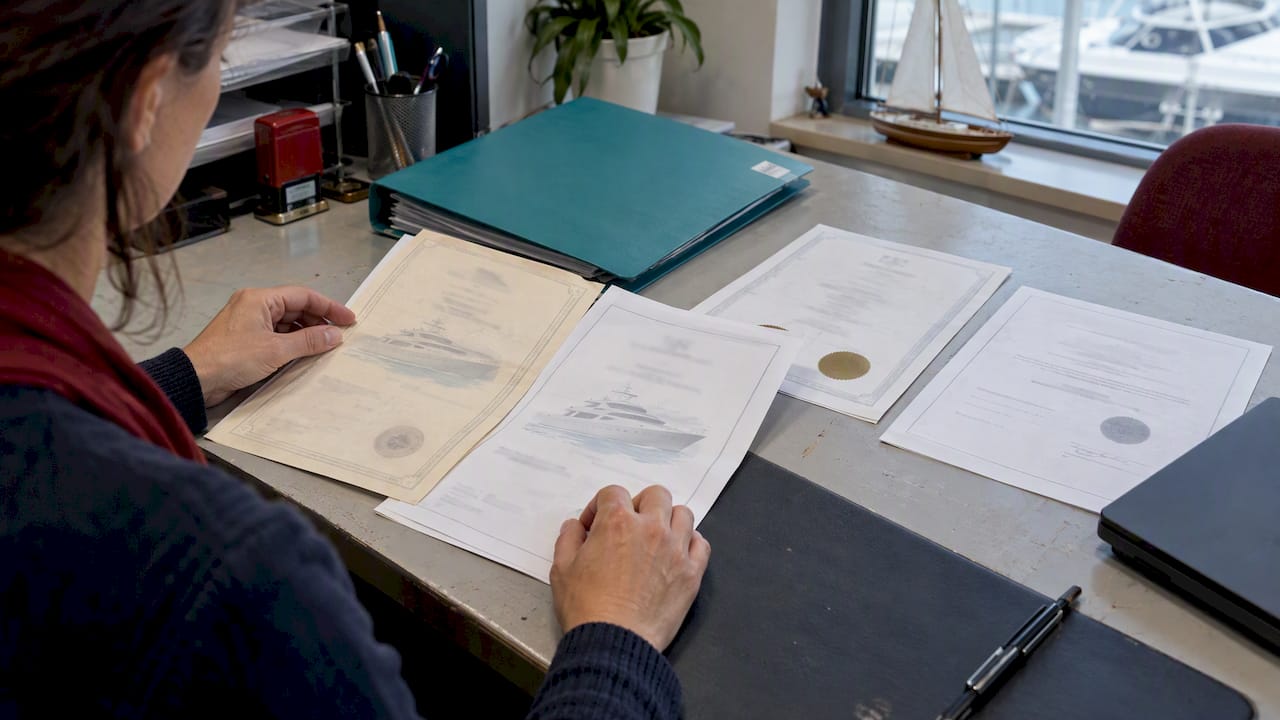
If your bill of sale, builder’s certificate or deletion certificate is not in English, most flag registries will want an English translation, and many want it done by a certified or sworn translator, sometimes notarized on top. The exact rule depends on the registry you choose, so the right order is: pick the flag, read its document checklist, then translate only what that checklist asks for, in the form it asks for.
This guide covers which documents usually need translating, who can certify a translation, how notarization and apostilles fit in, how to handle stamps and technical terms, and what drives cost and turnaround.
TL;DR
- Registries generally accept English, so anything else in your file (a foreign bill of sale, a previous registry’s deletion certificate, a company extract) usually needs an English translation.
- “Certified” is not one standard. Singapore asks for a certified translator, Hong Kong accepts a sworn translator or further notary or solicitor certification, and the UK Ship Register asks for a notarized translation.
- Translation does not replace notarization or legalization of the original signatures. Those are separate steps with separate rules.
- Cost and speed depend on page count, language pair, how clean the scans are and how many certification layers you add. Ask the registry before you order.
- Have the registry’s checklist in hand before translating anything. A translation in the wrong form is the most common reason a file bounces.
Inhaltsübersicht
- Which yacht documents usually need translating
- Who can translate: certified, sworn and notarized
- Translation is not notarization or legalization
- Originals, copies and what to send together
- Stamps, seals, handwriting and maritime terms
- How requirements differ by flag
- What affects cost and turnaround
- Our perspective: translate once, and to the registry’s standard
- Getting the file ready with VesselFlag
- FAQ
- Sources
Which yacht documents usually need translating
A registration file is a chain of proof: who owns the vessel, how they got it, what it is, and that it left its previous registry cleanly. Any link in that chain written in another language is a candidate for translation.
The Singapore Maritime and Port Authority’s registration checklist is a good example of what a registry lists: bills of sale, builder certificates, deletion certificates and tonnage certificates. Other registries use different forms but the same logic. In practice, the documents that most often need translation are:
- Bill of sale or sales contract. Especially when a vessel changes hands between countries, for instance a boat bought in Italy or Turkey and registered under another flag.
- Builder’s certificate. Needed for new builds, and often issued in the shipyard’s national language.
- Deletion certificate or proof of cancellation of previous registry. Issued by the old flag state in its own language.
- Tonnage or measurement certificate and survey reports. These carry technical vocabulary that needs a careful hand.
- Company documents. Certificate of incorporation, articles, directors’ register and extracts from a commercial register, when the owner is a company.
- Powers of attorney. If someone signs for the owner, the authority must be readable by the registry.
- Identity and address documents of individual owners, where the registry asks for them.
Not everything needs translating. A document already in English, or in a language the registry accepts, goes in as it is. Supporting items like insurance certificates are usually issued in English anyway.
Who can translate: certified, sworn and notarized
These three words get used loosely, and registries do not use them identically. Read the exact wording on the checklist.
Certified translation. A professional translator or agency signs a statement that the translation is complete and accurate. Singapore’s checklist says documents not in English must come with an English translation from a certified translator.
Sworn translation. The translator is officially sworn or authorized in a country, and their stamp carries legal weight there. Hong Kong’s Marine Department FAQ says foreign-language documents other than Chinese or English need a certified English translation, certified by a sworn translator or through further certification by a notary or solicitor, as applicable.
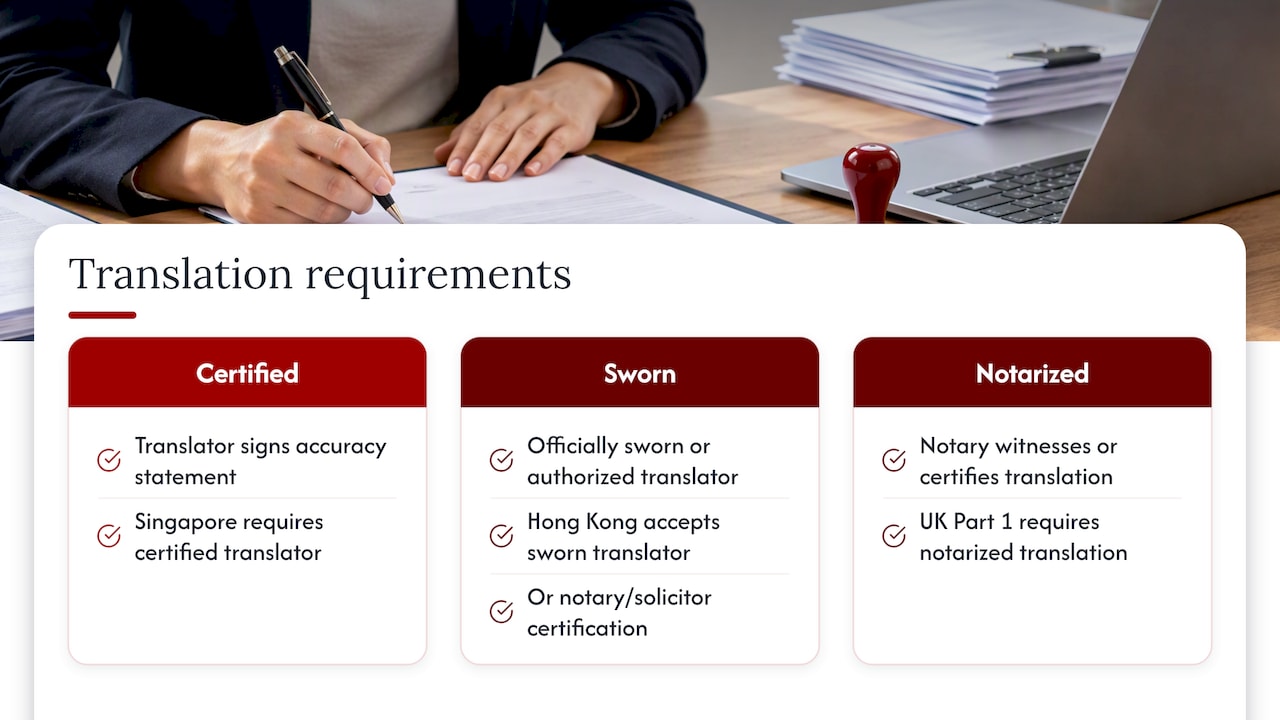
Notarized translation. A notary public witnesses the translator’s declaration, or certifies the translation. The UK Ship Register states that supporting documents for a Part 1 registration that are not in English must be accompanied by a notarized translation.
So a friend’s bilingual cousin will not do. Even where a registry only says “English translation”, a professional translator’s signed statement protects you from questions later. When the checklist names a stronger form, follow it exactly.
Translation is not notarization or legalization
Owners often assume one stamp solves everything. It does not. There are two separate questions:
- Is the text readable by the registry? That is translation.
- Can the registry trust the signatures and authority behind the original? That is notarization, apostille or legalization.
Singapore’s checklist requires builder certificates, bills of sale and powers of attorney executed overseas to be notarized, confirming the signatories’ identity, their ability to bind the entity and the authenticity of their signatures. That requirement applies to the original, whatever language it is in.
A sample ship purchase memorandum of agreement filed with the U.S. SEC shows how this looks in a real Malta-flag transaction. Its addendum requires documents to be in English or accompanied by an English translation and accepts electronic apostilles where the agreement calls for them. It also requires the buyers’ power of attorney to be notarized and legalized, the sellers’ to be notarized, and the bill of sale to be notarized only if the Malta Ship Registry requires it. Those are terms of one private contract, not a general rule, but they show how many layers can stack up on a single sale.
A practical order of operations:
- Get the original signed, and notarized if the registry requires it.
- Add an apostille or legalization if the registry or the countries involved require it.
- Translate the notarized, apostilled document, including the notary’s text and the apostille, unless the registry says otherwise.
- Certify or notarize the translation as the registry specifies.
Doing it in the wrong order can mean paying for the translation twice. If you are unsure whether the apostille page must be translated too, ask the registry before you order.
Originals, copies and what to send together
Registries differ on whether they want originals, certified copies or scans, and the answer can change between provisional and final registration.
Singapore, for example, allows copies of the builder certificate or bill of sale for provisional registration, and requires a power of attorney if the signatory is an attorney-in-fact. Malta registers a vessel provisionally for six months, extendible by up to six more, during which the documentation, including evidence of ownership and of cancellation of the former registry, must be finalized.
That staged approach is useful for translation planning. You can often start the registration with the documents you have, while the formal translations, notarizations and deletion paperwork are completed in parallel. Keep one tidy bundle per document: the original, its apostille or notarization, the translation, and the translator’s certification, all clearly linked.
Stamps, seals, handwriting and maritime terms
This is where cheap translations fail. A few habits make the difference:
- Translate what is on the page, including stamps and seals. A good translator describes each one in brackets, for example “[round seal of the Harbour Master’s Office, illegible in part]”, rather than skipping it.
- Flag handwriting and illegible parts instead of guessing. “[handwritten, illegible]” is acceptable. An invented word is not.
- Keep names and numbers exactly as written. Vessel names, hull identification numbers, engine serials and company registration numbers are never “translated”. Dates should be unambiguous, with the month written out if the source format could be read two ways.
- Use maritime terms consistently. “Deletion certificate”, “builder’s certificate”, “bill of sale”, “gross tonnage” and “length overall” have established English equivalents. A generic translator may render them literally and create a mismatch with the registry’s own forms.
- Match the layout where possible. A translation that follows the original’s order of fields is easier for a registry officer to compare line by line.
- Translate the whole document. Back pages, endorsements and small print count.
Terms for the same thing also differ by flag. A registry may call a certificate something specific to its own law, so give your translator the registry’s checklist and, if possible, its forms as a glossary.
How requirements differ by flag
The pattern is consistent but the details are not. Compare what we have seen from official pages:
| Registry | What the source says about non-English documents |
|---|---|
| Singapur | English translation from a certified translator; overseas builder certificates, bills of sale and powers of attorney notarized |
| Hongkong | Certified English translation for languages other than Chinese or English, by a sworn translator or with notary or solicitor certification as applicable |
| UK Part 1 | Notarized translation for supporting documents not in English |
| Malta | Provisional registration first, with ownership evidence and cancellation of the former registry finalized within the provisional period |
Before you submit anything, verify five points with your registry or your agent:
- Which documents are required for your vessel type and owner type.
- Which languages are accepted without translation.
- What level of translation certification is required.
- Whether originals, certified copies or scans are accepted at each stage.
- Whether notarization, apostille or legalization is needed for each document and who must apply it.
What affects cost and turnaround
Published per-page prices vary widely, and no single figure fits every file, so treat any quote as specific to your documents. The factors that move the price and the timeline are consistent:
- Language pair. Common pairs like Italian, German, Spanish or Turkish into English are easier to source than rare ones.
- Page count and density. Dense technical annexes cost more than a one-page certificate.
- Scan quality. Blurry, skewed or handwritten pages slow translators and raise the risk of queries.
- Certification layers. A signed translator statement is the base. Notarization, apostille or legalization each add cost and days, and may involve courier time between countries.
- Urgency. Rush work usually carries a premium.
- Revisions. If the registry rejects a form, you pay again for the fix.
To keep timelines predictable, send complete, high-resolution scans in one batch, state the destination registry up front, and ask for a quote that itemizes translation and certification separately.
Our perspective: translate once, and to the registry’s standard
We handle registrations across six major registries every day, and the same thing happens again and again: the translation was fine, but it was the wrong kind. A plain translation arrives where a notarized one was needed, or a notarized original arrives with an uncertified translation. Each mistake costs a week or more, which is painful when the whole point of a provisional registration is speed.
Our advice is to decide the flag first. Registries differ in how strict they are about documents, and that should be part of the choice alongside cost, eligibility and what you plan to do with the vessel. Once the flag is fixed, we work from that registry’s checklist, tell you which documents need translation and in what form, and keep the originals, notarizations and translations in one file so nothing is submitted out of order. Our provisional registrations typically take 1 to 7 days, but only when the file is complete and in the right form.
We also suggest asking for the deletion certificate early. It comes from the previous registry, often in another language, and it is the document most likely to hold up a file.
— VesselFlag
Getting the file ready with VesselFlag
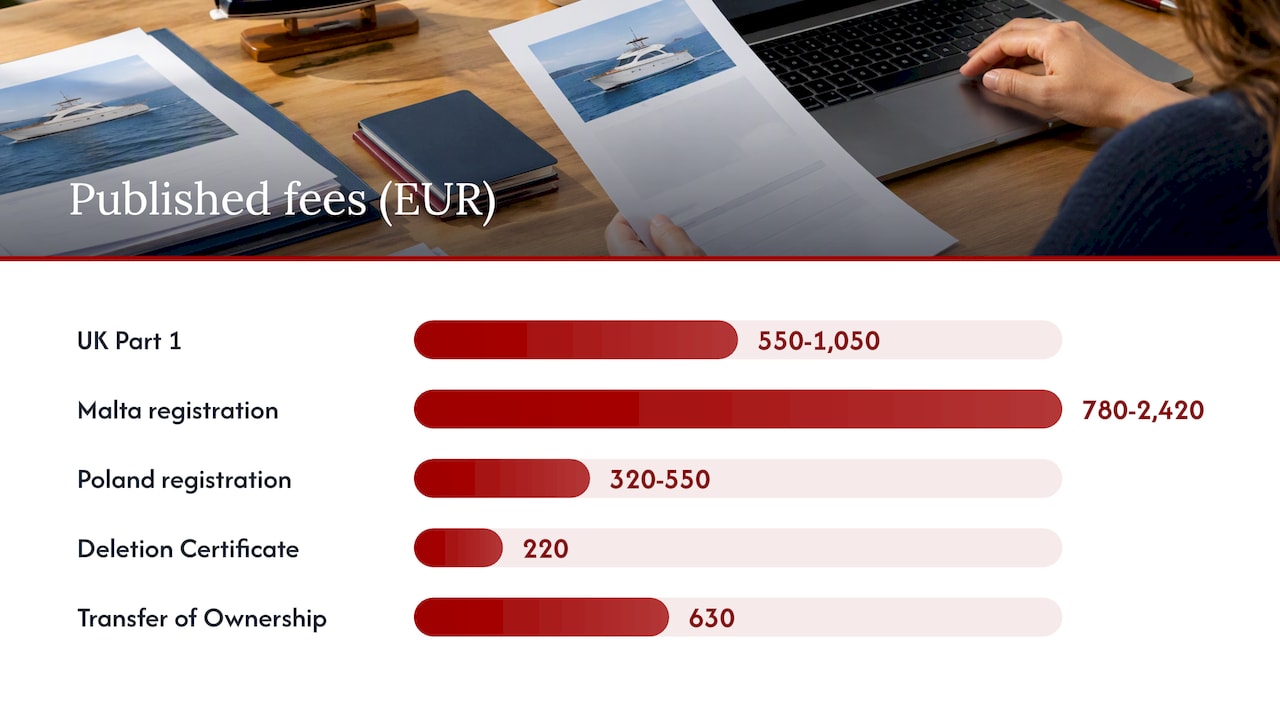
If you would rather not interpret six different checklists yourself, we manage the paperwork end to end, including document requirements, company setup for ownership and, where needed, deletion certificates and ownership transfers. Published one-off fees include UK Part 1 registration at 550-1050 EUR, Registrierung in Malta at 780-2420 EUR and Poland registration at 320-550 EUR. A Bescheinigung über die Löschung is 220 EUR and a Transfer of Ownership is 630 EUR. Translation and notarization of your own documents are not listed as separate prices, so ask us what your chosen flag needs before you order them. You can also see our full range on the services page.
FAQ
Do I need a certified translation for every yacht document?
Not necessarily. Only documents not in an accepted language need translating, and the required level of certification depends on the registry. Singapore asks for a certified translator, Hong Kong accepts a sworn translator or further notary or solicitor certification, and the UK Ship Register asks for a notarized translation. Check the checklist for your flag before ordering.
Can I translate the documents myself?
It is risky. Registries expect a translator’s certification, or a notary’s, and an owner’s own translation carries neither. Even if a registry only says “English translation”, a professional statement avoids questions and delays.
Does a translated document also need an apostille?
The apostille or legalization applies to the original document’s signatures, not to the translation itself. Some registries also want the notarization or apostille page translated. Confirm this with the registry, and do the notarization first, then translate.
How long does yacht document translation take?
It depends on page count, language pair and how many certification steps you add. A short certificate can take a day or two, while a multi-page file with notarization and legalization can take considerably longer. Request a timeline in writing before you commit.
Which document usually causes the most delay?
In our experience, the deletion certificate from the previous registry and any power of attorney signed abroad. Both involve foreign authorities and extra certification, so start them first.