
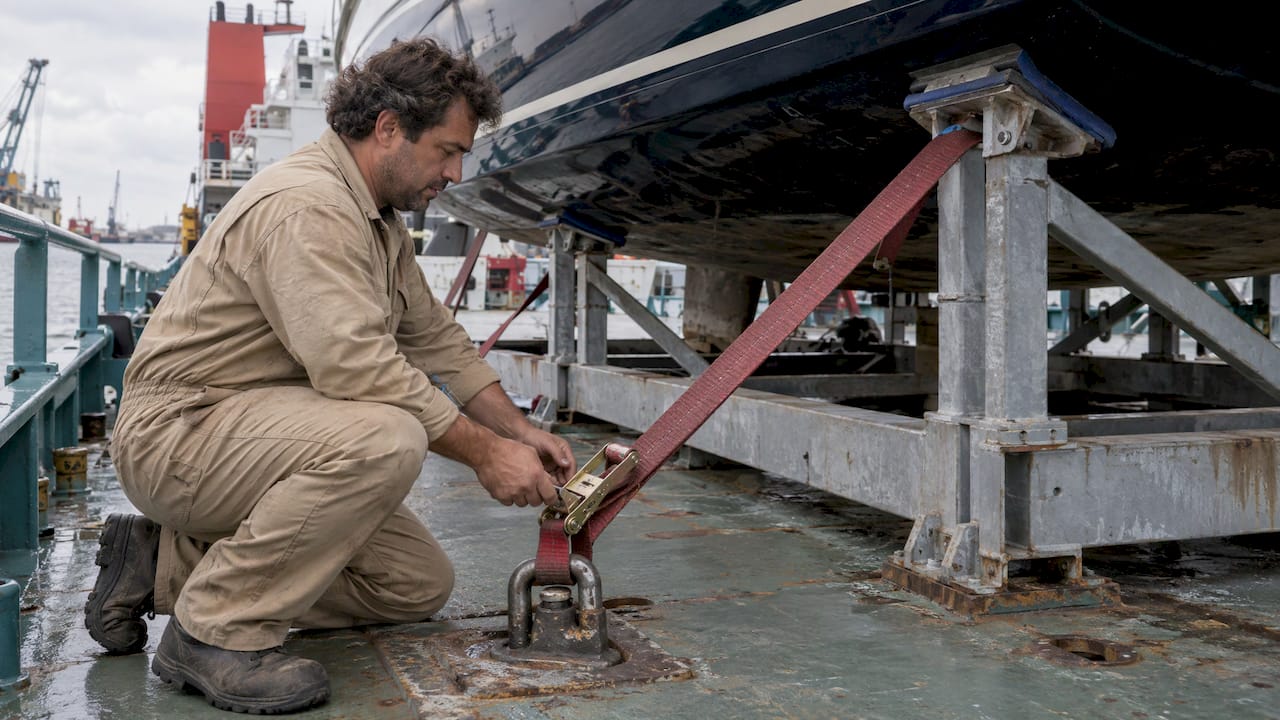
A load port survey is an independent inspection carried out at the port of loading, before a yacht goes onto a carrier. The surveyor records the yacht’s condition, checks the lifting and securing arrangements and attends while the yacht is loaded. If damage is claimed later, everyone then has the same baseline to work from. It is not a pre-purchase survey, and it is not a load-line survey. Owners, brokers and operators who ship yachts as cargo usually commission it.
This guide explains what the survey is and how it differs from similar surveys. It covers what the surveyor checks, how to prepare the yacht and what the report should contain. It also shows how the survey fits with the ownership paperwork, which is where Vessel Flag works.
TL;DR
- A load port survey documents a yacht’s condition and checks the lifting, cradle and lashing arrangements at the loading port. It is commissioned for yachts shipped as cargo.
- It is a different survey from a pre-purchase survey (condition and value for a buyer) and from a load-line survey (a ship’s seaworthiness and maximum loaded draft).
- The surveyor attends the securing operation from start to finish. The report is then compared with the arrival condition after discharge.
- Owners can help by carrying minimal fuel and water, securing loose equipment, isolating batteries and having the yacht’s papers ready.
- Registration and ownership documents should be in order before the yacht ships, because carriers, insurers and ports ask for them.
Inhaltsübersicht
- What a load port survey is
- How it differs from a pre-purchase or load-line survey
- When you need one, and who commissions it
- What the surveyor inspects
- What the report should record
- How to prepare the yacht and the paperwork
- Why registration and ownership papers matter before shipping
- Unsere Sichtweise
- Choosing a flag and getting the papers ready
- Registration and transport support from Vessel Flag
- FAQ
- Quellen
What a load port survey is
In yacht transport, a loading survey is carried out before the yacht is loaded. The surveyor checks that the securing methods are properly arranged and suitable for the journey. Those methods include lashings, cradles, blocks and hull supports. “Load port” simply names where it happens: the port, yard or marina quay where the yacht is lifted or floated onto the transport vessel, or driven onto a road carrier.
The survey can also be repeated at the discharge port. The two reports together show what the yacht looked like when it left and what it looked like when it arrived. Many owners treat the pair as one job: the first record is only really valuable when there is a second to compare it with.
The survey does not make the yacht seaworthy, and it does not replace the carrier’s own responsibilities. It is an independent record and a second pair of eyes on the way the yacht is handled.
How it differs from a pre-purchase or load-line survey
The search results for this topic mix up several different surveys, so it helps to separate them.
| Umfrage | Purpose | Who it serves | When |
|---|---|---|---|
| Load port (loading) survey | Records condition and checks lifting, stowage and securing for transport | Owner, broker, carrier, insurer | Before and during loading, often again at discharge |
| Pre-purchase survey | Condition and valuation of the yacht for a buyer | Buyer, lender, insurer | Before a sale completes |
| Load-line survey | Hull strength, watertight integrity and maximum loaded draft of a vessel | Flag, owner of a ship subject to load lines | At assignment and periodically |
A pre-purchase survey is a comprehensive condition and valuation survey, often with operational testing and a sea trial. It helps a buyer decide, and it may also satisfy insurance and bank-loan requirements. The report should identify the vessel, describe its construction and equipment, comment on its condition and recommend repairs. It should also include photographs and a fair-market value.
A load-line assignment is a different matter. It is meant to confirm an intact vessel’s seaworthiness, covering hull strength, watertight and weathertight integrity, reserve buoyancy and maximum loaded draft. Periodic inspections verify that these are maintained. The term “load line” refers to the freeboard marks on a ship’s hull, not to the loading of a yacht as cargo. People searching for a load port survey sometimes land on load-line pages by mistake. For a yacht travelling as cargo, the survey you want is the loading survey described here.
When you need one, and who commissions it
You should consider a load port survey whenever a yacht leaves the water or its own keel to travel on someone else’s vessel or trailer. Typical cases:
- A yacht is moving between cruising grounds, for example from the Mediterranean to the Caribbean, on a lift-on lift-off or float-on float-off carrier.
- A broker is delivering a yacht to a buyer overseas, and both sides want a record of its condition at handover.
- A charter operator is relocating a yacht for the season.
- An insurer or lender has made a survey a condition of cover for the transit.
The party paying for it is usually the owner, the broker acting for the owner or buyer, or the operator. Yacht transport surveyors describe their clients as owners, operators, brokers, shipping agents, insurers and lenders. The surveyor should be independent of the carrier. That independence is the point: a record the carrier produced for itself carries less weight in a dispute than one prepared by a neutral third party.
No single rule forces a survey on every voyage. Requirements depend on the carrier’s terms, the insurance policy, the contract of carriage and the transport method. Check them before you book the passage, not on the quay.
What the surveyor inspects
The work falls into three stages.
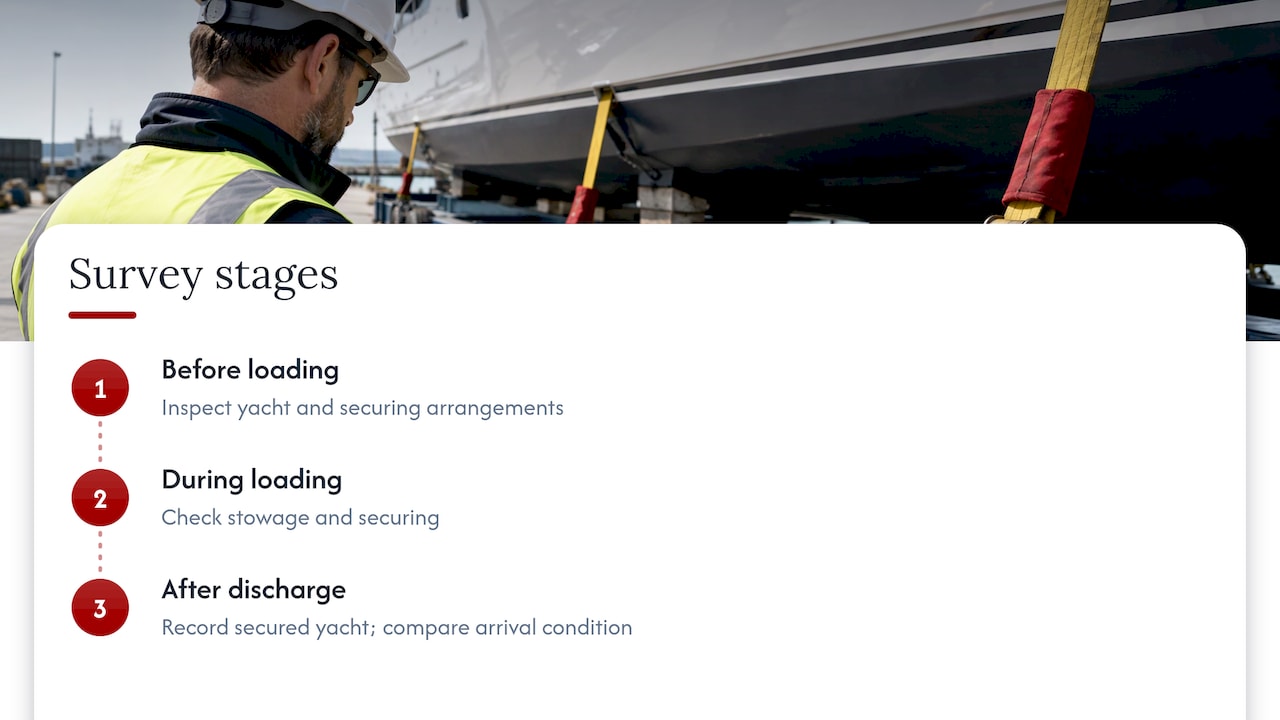
Before loading
The surveyor looks at the yacht and at the equipment that will carry it. For the cradle, the checks cover structural integrity, lifting points, tie-down arrangements, protection of the hull and fittings, and weight distribution. On the yacht itself, a typical pre-loading record covers:
- Hull and finish, including existing scratches, chips, blisters and repairs.
- Underwater appendages: keel, rudder, propellers, shafts, stabilisers and thrusters.
- Deck, topsides, rails, hatches, windows and fittings.
- Mast, rigging and any equipment to be removed or lowered.
- The positions where slings or cradle pads will touch the hull.
Photographs are essential. Every pre-existing mark that is photographed and dated is one that cannot later be blamed on the voyage.
During loading
The surveyor should be present from the start to the end of the securing operation. The lift or float-on, the placing of the yacht, the blocking and the lashing all need attention. The points a surveyor would typically verify are:
- The hull shape has been taken into account in choosing the cradles.
- Lifting straps sit in the designated areas.
- The lashing points are strong, tested and certified, and the load is evenly distributed.
- Dunnage and load-spreading material are suitable for the yacht and the deck beneath it.
- The yacht is stable against sliding and tipping, both across and along the carrier.
Where the carrier is a cargo ship, the securing may be assessed with calculation methods such as those in the IMO Cargo Stowage and Securing (CSS) Code. This checks that the arrangement can withstand the forces expected on the voyage. Whether this is needed depends on the carrier and the yacht, so ask the carrier what its securing manual requires.
Stowage below deck is generally preferable to deck stowage, as it reduces exposure to weather and to the accelerations acting on the yacht. Where deck stowage is the only option, the surveyor’s attention to the securing matters even more.
After loading and at discharge
Once the yacht is secured, the surveyor finalises the record. After discharge, the arrival condition is compared with the loading record, so that existing marks can be told apart from transport damage. If the surveyor finds a difference, the owner needs to hear immediately so that claims notice can be given on time.
What the report should record
A useful load port survey report is specific. It should include:
- The yacht’s identity: name, type, builder, length, weight, hull number and flag.
- The transport details: carrier, vessel or road unit, loading and discharge ports, and dates and times of operations.
- The lifting gear used and the position of slings or cradle pads.
- Visible defects and existing damage, each with a photograph.
- A description of the cradle, blocking, lashings and dunnage.
- Any recommendations made and whether they were acted on.
- The surveyor’s name, qualifications and signature.
The cargo side has its own paperwork. A pre-loading inspection documents the condition of the cargo, and any difference from the shipping documents should be described on the mate’s receipts and bills of lading. The same guidance says that early notice of deficiencies to the shipper is desirable, together with the owner’s intention to reject the cargo or have the receipts claused. For a yacht, that means a defect found at loading should be raised before the carrier signs clean documents, not afterwards.
The report is worth the most when it is neutral and detailed. It gives the owner, the carrier and the insurer a common baseline. Without one, a later damage dispute is left to competing accounts.
How to prepare the yacht and the paperwork
Good preparation makes the survey shorter and the report better.
Prepare the yacht.
- Keep only the minimum water, fuel and lubricants needed to reach the nearest marina after unloading, as insurers’ transport guidance advises.
- Secure all loose equipment, inside and out.
- Isolate the starter and service batteries safely.
- Clean the hull and topsides, so that marks are visible and photographs are clear.
- Lower or remove masts, antennas and other projecting items as the carrier requires.
- Remove or secure valuables and personal items. Check with your insurer what is covered in transit.
Prepare the people.
- Tell the carrier, the yard and the surveyor who will be on site, and agree who gives instructions for the lift.
- Make sure the captain or an authorised representative is present at loading and can sign off the condition record.
- Agree the surveyor’s attendance times with the carrier’s schedule, since loading windows can move at short notice.
Prepare the documents.
- Evidence of ownership and registration.
- The yacht’s weight, dimensions and lifting-point information from the builder.
- The insurance policy and any conditions on transit cover.
- The contract of carriage and the carrier’s securing requirements.
Brokers coordinating several parties find a simple checklist helps: one person owns the timetable, one owns the documents, and the surveyor is told both names.
Why registration and ownership papers matter before shipping
The survey is about the physical yacht, but the shipment also runs on documents. Carriers, insurers and port agents ask who owns the yacht and under which flag it is registered. A yacht with unclear ownership, an expired provisional certificate or a missing radio licence can hold up a shipment as surely as a poorly secured cradle.
A few practical points:
- Flag and ownership structure. If the yacht is moving because of a change of owner or a change of flag, settle the registration plan before the transport date. Our guide to international yacht flag registration explains the options.
- Provisional papers. Some registries issue provisional documents quickly. Poland provisional papers take 2 to 5 days, and a San Marino provisional certificate takes 2 to 6 days, though that is not guaranteed. Build that into the schedule rather than assuming it.
- Radio licence. An MMSI number and ship radio licence should match the yacht’s details. A UK MMSI licence takes 1 day, while a Polish MMSI licence takes 4 to 6 weeks after registration, so plan Polish applications early. See our MMSI radio licence page.
- Inspections on arrival. Once a yacht arrives and starts operating, port state control may look at it. Our guide to PSC inspections for yachts covers what inspectors check. Some flags also waive or limit certain survey requirements, as set out in our note on yacht survey exemptions.
Vessel Flag is a private consultancy. We prepare and file registration applications, and the certificates themselves are issued by the flag registries.
Unsere Sichtweise
Most owners treat the load port survey as a transport matter and the registration as a separate, later matter. In our experience the two meet on the quay. The surveyor writes the yacht’s name, flag and identity at the top of the report, and the carrier and insurer ask for the same details.
When we work with owners and brokers, we suggest settling the flag, the ownership structure and the radio licence before the shipping date is fixed. Our work is the paperwork: we prepare and file applications for Poland, San Marino, UK Part 1, Malta, Palau, the Marshall Islands, the Cayman Islands and the Cook Islands. We also arrange MMSI licences and company formation for yacht ownership, and we handle transfers between flags. Everything is done remotely, with published one-off prices, so an owner in one country can prepare a yacht lying in another.
We are not a registry, and we do not issue certificates. What we do is keep the file complete, so the yacht arrives with the documents already behind it.
Vessel Flag
Choosing a flag and getting the papers ready
If the transport is tied to a new registration, the flag choice affects cost and timing. Our published one-off prices for the main flags are:
| Flagge | Vessel Flag price |
|---|---|
| San Marino | from EUR 290 |
| Polen | from EUR 320 |
| UK Part 1 | from EUR 550 |
| Malta | from EUR 849 |
| Palau | from EUR 700 |
| Marshallinseln | EUR 250 service fee plus registry fees |
| Kaimaninseln | EUR 450 service fee plus registry fees |
The Cook Islands are quoted per yacht. Prices for other flags are confirmed case by case. A San Marino 5-year all-in registration package costs EUR 1,290.
For UK Part 1, owners can register personally if eligible, through an existing company (UK or eligible foreign, for example a Delaware corporation) or through a new UK LTD. A UK company is not always required. If a company is the better route, we can arrange company formation for yacht ownership. Poland has its own rules on who qualifies, set out in our Poland registry eligibility guide. A yacht bought abroad has extra steps, covered in our article on the Polnische Flagge für eine im Ausland gekaufte Yacht.
Registration and transport support from Vessel Flag
If you are shipping a yacht and want the registration, radio licence and ownership structure sorted before it leaves the quay, we can take the paperwork off your hands. We prepare and file the application with the flag registry, arrange the MMSI licence and, where needed, set up the owning company. We can also help with yacht transportation and boat insurance through our Dienstleistungen. Prices for those services are agreed per case.
The survey itself is carried out by an independent marine surveyor appointed by you or your broker. We make no claim to perform it. We make sure that what the surveyor writes at the top of the report matches the papers on board.
FAQ
Is a load port survey the same as a pre-purchase survey?
No. A pre-purchase survey assesses condition and value for a buyer. A load port survey records condition and checks securing arrangements for transport. A yacht can need both: the first before a sale, the second before it ships.
Is a load port survey mandatory?
There is no single rule for every yacht. The requirement usually comes from the carrier’s terms, the insurance policy, a lender or the contract of carriage. Ask each of them in writing before you book the passage.
Who pays for the survey?
Usually the owner, or the broker or operator acting on the owner’s behalf. On a sale, the contract may say who bears the cost. Agree it before the transport is booked so the surveyor can be appointed in time.
Should the surveyor be present at both ports?
It is common and sensible. Transport surveys can be done at the load port, the discharge port or both. Using both gives you a before-and-after comparison, which is the most useful evidence if damage is alleged.
What should I do if the surveyor finds a problem at loading?
Stop and raise it with the carrier and shipper before the documents are signed. Deficiencies should be notified early, and the receipts and bills of lading should describe any difference from the shipping documents. Tell your insurer as well.
Quellen
- USCG Load Line website
- Surveying a Boat, American Boat & Yacht Council
- Loading Survey, CMarine Surveyors
- Yacht Transport And Logistics Services, INS Yacht Survey
- Cargo Pre-loading Surveys, UK P&I Club
Ready to get the papers in order? See the relevant flag page, for example Yachtregistrierung in San Marino oder Yachtregistrierung im Vereinigten Königreich (Teil 1), then book a consultation.
Empfohlen
- PSC-Inspektionen für Yachten: Was die Inspektoren prüfen und wie man sich vorbereitet
- Ausnahmen von der Yachtbegutachtung: Welche Flaggenstaaten sind befreit und was gilt weiterhin?
- Funkbetriebszeugnis für Yachten: Was US-Eigner brauchen
VesselFlag is a private consultancy that prepares and files yacht registration applications for owners. We are not a government body or flag registry; certificates are issued by the relevant registry. This article is general information, not legal advice.