
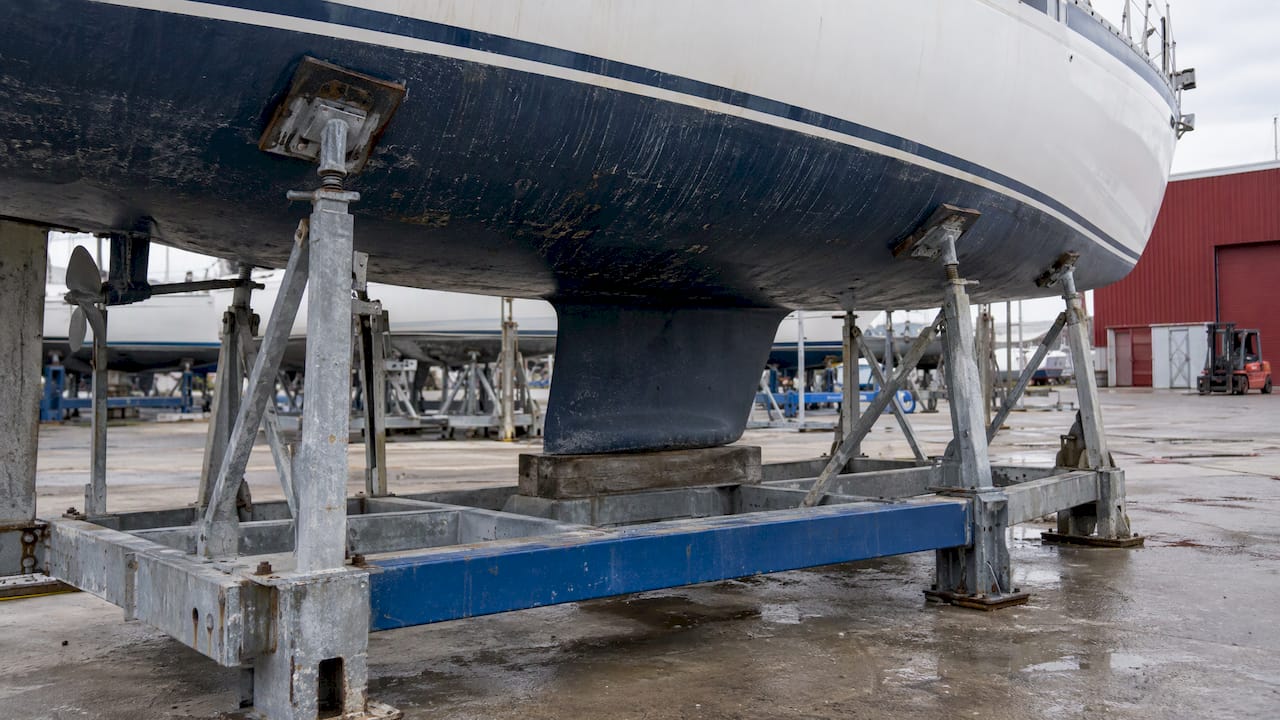
A yacht cradle has to match your hull, not just your length overall. You need the boat’s length, beam, draft and builder-stated weight, support pads that land on frames and bulkheads, most of the load carried by the keel, firm level ground, and a cradle that is checked before and after every use. Local yard rules then sit on top of all this, so confirm them before you book a lift.
This guide is for owners, brokers and operators who need to specify, hire or approve a cradle for storage, a survey, a refit or transport. It covers the details a cradle builder asks for, how supports should be placed, what to inspect, and what changes from yard to yard.
TL;DR
- Give the cradle builder the length, beam, draft, weight, hull type, hull drawings or a lifting plan, and photos of the underside.
- Pads belong where the hull is built to take load, clear of shafts, propellers, fins and transducers.
- The keel should carry most of the weight. One owner’s manual puts the minimum at 60% on the keel, with hull pads taking no more than 30 to 40%.
- Set the cradle on firm, level ground, check it before and after each lift, and take any damaged item out of service.
- Boatyards set their own procedures, so follow the yard’s checklist and the lift manufacturer’s requirements.
Inhaltsübersicht
- What a cradle builder needs to know about your yacht
- How supports should match the hull
- How many supports, and how far apart
- Material, blocking and what to avoid
- Ground, level and stability
- Lifting and transport checks
- What depends on the yard, not the rulebook
- Why cradle details matter for registration and inspections
- Our view on cradles and ownership paperwork
- Registering your yacht while it is ashore
- FAQ
- Quellen
What a cradle builder needs to know about your yacht
A cradle is made to fit a particular hull. One equipment supplier says you need at least the length, beam, draft and weight, the hull type (motor, sailing or catamaran), hull drawings or a lifting plan so the pads can be located on frames and bulkheads, and photos of the bottom and keel so the pads avoid shafts, propellers, fins and transducers.
Another cradle maker lists the measurements as hull length, beam at ground level, support-point width, support-point height and boat weight. It adds that the weight should come from the builder or the boat’s papers rather than an estimate (Cradle B).
Collect this before you call anyone:
| Detail | Why it matters |
|---|---|
| Length overall | Sets the cradle length and the number of supports |
| Maximum beam | The cradle must be at least as wide as the widest part of the hull |
| Draft and keel type | Decides where the keel block sits and how deep the cradle must be |
| Weight (builder’s figure) | Sets the structural rating; do not estimate |
| Hull type | Sailing, motor and catamaran hulls need different support layouts |
| Lines or lifting plan | Shows where frames and bulkheads are, so pads land on strong structure |
| Photos of the underside | Show shafts, struts, fins, transducers and anything the pads must avoid |
If you have a builder’s certificate or original documentation, keep it with the file. Our guide to the Bauzertifikat für Yachten explains what it is and why it is useful when a vessel’s details are questioned.
Weigh up the real weight
The weight on the builder’s plate or papers is usually the empty or design figure. What sits on the cradle is the boat as it is on the day. The Isle of Man government’s safe-storage leaflet advises removing excess weight before lifting a boat out of the water: fresh water, bilge water, gas bottles, and loose gear such as chains and anchors, plus sails and masts where possible. A lighter boat is easier on the cradle and on the lift.
The same leaflet says to follow the boat builder’s guidance before lifting or supporting the boat. If the builder published a lifting or storage plan, give it to the yard.
How supports should match the hull
The cradle’s job is to put the load where the hull can take it. The supplier guidance describes pads that meet the hull along frames and bulkheads, a keel block under the keel, and rails or side supports arranged to share the rest of the load. The aim is that no support pushes hard into one patch of the hull (Cigisped Middle East).
Sailing yachts
The keel block does most of the work on a ballasted sailing yacht. The side supports steady the boat and share the remainder. A manual for one production yacht sets a concrete rule of thumb: at least 60% of the weight on the keel, with the pads under the hull bearing no more than 30 to 40% of the total. It also says not to put weight on the keel further aft than the last keel bolt (CS36 owner’s manual). Treat those figures as one builder’s guidance for one design, and ask your own builder or surveyor for the equivalent on your boat.
Motor yachts and catamarans
Motor yachts have wider bottoms, engines and running gear, so the pad strategy changes. Catamarans need parallel support lines under both hulls. The supplier guidance makes the same point: the layout changes with hull type, which is why the hull type is on the list of details to supply.
Width, overhangs and stability
A cradle that is too narrow can tip. Canadian yacht club guidance on marine railway cradles warns that a cradle built too narrow can lead to tipping because of long overhangs. It also asks owners to check that the cradle gauge suits the boat and to consider the maximum beam amidships (QCYC). Accurate measurements are the starting point, and the stability of the whole assembly is the test.
Adjustability
A UK cradle maker explains that its cradles use adjustable screw jacks so the boat sits in the cradle without being trapped. For a second-hand cradle it suggests checking overall length, number of support pads, a width at least as wide as the widest part of the beam, and leg length (Tennamast). Adjustment lets you fine-tune contact after the boat is down, which matters when the hull shape is not a standard one.
How many supports, and how far apart
There is no single worldwide number, because it depends on the hull, the weight and the yard’s rules. The available guidance gives useful anchors:
- The Isle of Man leaflet prefers continuous keel support where possible, says supports should never be spaced more than 3 ft apart, and advises extra bow and stern supports where people will be working aboard, especially on short-keel sailing boats (Isle of Man government).
- A marine consultant’s blocking guidance puts jackstands about 8 to 10 ft apart along each side of the vessel (Out of Their Element).
Those two figures describe different parts of the arrangement (the leaflet is about keel and block spacing, the consultant about side jackstands), so do not read them as a conflict. What you can take from both is that supports are closely spaced under the keel and more widely spaced at the sides, and that a surveyor or the yard should confirm the count for your boat.
Typical manufacturer ranges exist, but they are product-specific. Ask the cradle supplier for the rated weight and length range of the exact model, and make sure your yacht’s weight sits comfortably inside it.
Material, blocking and what to avoid
The official safe-storage leaflet does not set a cradle material specification, so material requirements come from the cradle builder, the yard and your insurer. What it does say is practical: link and brace composite supports, and drive hardwood wedges hard home (Isle of Man government).
Where a yard uses blocks rather than a purpose-built cradle, the marine consultant’s guidance says blocking material must be strong, compression resistant, sound, rot-free and durable. Concrete blocks and oil drums are unsuitable. It also says to discard split, rotted or damaged blocks, to make sure every block touches the keel, and to block the vessel level so water drains (Out of Their Element).
A few practical checks follow from that:
- Look at the cradle’s welds, feet and moving parts, including screw threads, before the boat goes in.
- Look at any timber or wedges for splits or rot.
- Make sure pads are clean and sit flat against the hull.
- Check that nothing bears on a propeller shaft, strut, fin or transducer.
Ground, level and stability
A good cradle on bad ground is still a bad arrangement. The official leaflet says to use a properly designed cradle on firm, level ground with added stability provision, and to check the security of the site regularly (Isle of Man government). The yacht manual adds that the cradle should be placed or shimmed so the hull sits on a level plane and water flows to the overboard drains (CS36 owner’s manual).
After heavy rain or a hard frost, look at the ground under the feet. Soft or settling ground is the usual reason a boat that was level in October is leaning in March.
If people will be working under the boat for power-washing, a survey or repairs, the blocking guidance says to always support the keel (Out of Their Element). Make sure the yard’s cradle does not rely on the lifting equipment alone while anyone is underneath.
Lifting and transport checks
Slings and lifting gear
For a haul-out, the yacht manual places the forward sling near the forward main bulkhead and the aft sling near the main companionway. It says slings should never sit on a propeller shaft or strut, and that carpet pads or old towels laid flat against the hull protect the gelcoat (CS36 owner’s manual). Again, that is for one design: your builder’s lifting plan comes first.
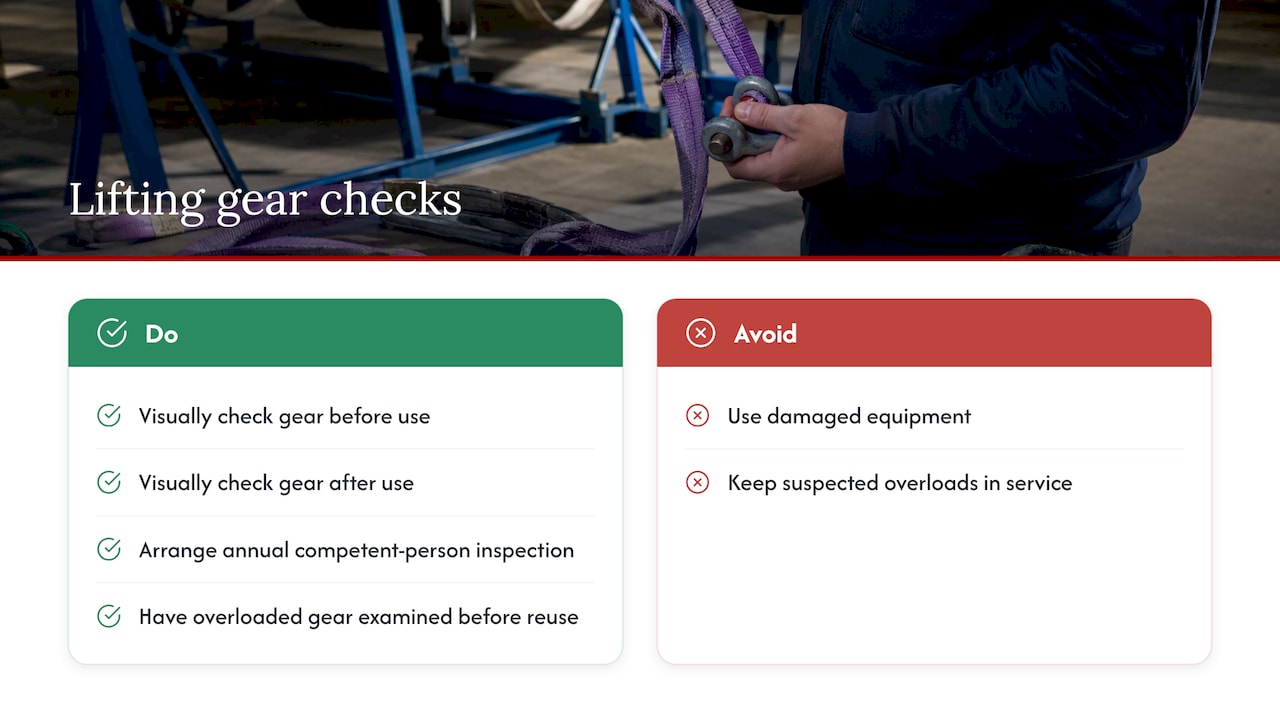
For larger yachts, UK government guidance on lifting gear on large commercial yachts says gear must be visually checked before use and again after use. It recommends an annual thorough inspection by a competent person for equipment exposed to deterioration. It also says damaged equipment must not be used and should be scrapped, quarantined or repaired (MGN 618). Anything suspected of having carried an excessive load comes out of service until a competent person has examined it.
That guidance is written for large commercial yachts, but the routine is a sound benchmark for any owner asking a yard how its cradle and lifting kit are inspected.
Shipping on a cradle
If the yacht is going by sea, the cradle becomes part of the cargo plan. A German marine insurer’s transport guidance says corrosion status and weather tightness of holds should be checked before loading. It says valuable parts such as the propeller, shaft, mast, rudder and navigation equipment need particular protection. Lashing points must be strong and tested or certified, and edge protectors should stop taut straps damaging the hull (HDI). One yacht shipping guide describes lift-on lift-off carriage using a bespoke steel cradle built for correct load distribution and stability, with loadmasters attending (Peters & May).
If you are arranging transport as part of a change of flag, our Serviceseite lists yacht transportation among the services we can arrange.
What depends on the yard, not the rulebook
There is no single worldwide cradle standard that every yard applies. A US industry standard preview says each facility should develop its own operating procedure or checklist, check the applicable federal, state or local requirements, and follow the lift manufacturer’s requirements and the owner’s manual (ABYC). It also says the boat should not be supported solely by lifting equipment when people are under or near it.
In practice, ask the yard before you book:
- Does it supply the cradle, or must you bring your own?
- What maximum weight, length and beam does its lift handle?
- Does it need a drawing, lifting plan or surveyor’s input?
- Who is responsible for the cradle’s inspection record?
- Does your insurer require a particular method for winter storage?
A yard that is used to your type of vessel will usually answer these in one call.
Why cradle details matter for registration and inspections
Yacht cradle questions tend to come up at the same moments as paperwork: a pre-purchase survey, a flag change, a refit, or an inspection. The same dimensions and weight you give a cradle builder appear in the documents behind a registration file. If a vessel changes flag, it may be hauled out for survey work, and the yard will want the facts above.
Inspectors also look at the overall condition of a vessel. Our guide to PSC inspections for yachts covers what inspectors check and how to prepare, and yacht interior refit compliance is worth reading if you are hauling out for a refit. If you are new to the subject, international yacht flag registration explains how flags work.
Our view on cradles and ownership paperwork
We are a private consultancy, not a registry or a shipyard, and we do not build cradles. What we see every week is how much smoother a haul-out, survey or transfer goes when the vessel’s facts are in order before anyone books a lift.
Length, beam, draft, weight and builder’s documents should agree across the cradle order, the survey and the registration file. When they do not, projects stall while someone chases a drawing or a certificate.
That is why we prepare and file registration applications for owners, companies and brokers remotely, under flags such as Poland, San Marino, UK Part 1, Malta, Palau, the Marshall Islands, the Cayman Islands and the Cook Islands, and help with company formation, MMSI radio licences and flag transfers. The certificates are issued by the flag registries, and our job is to get the application right.
If a flag change means a haul-out, plan the paperwork and the cradle together, and ask the yard early what it needs.
Vessel Flag
Registering your yacht while it is ashore
Many owners use time on the hard to sort out ownership and registration. Our published one-off prices start at €320 for Poland and €290 for San Marino, and at €550 for UK Part 1. Malta starts at €849 and Palau at €700. Marshall Islands registration has a €250 service fee plus registry fees, and Cayman Islands registration a €450 service fee plus registry fees. Cook Islands registration is quoted per yacht.
For UK Part 1, owners can register personally if eligible, through their existing company (UK or eligible foreign, for example a Delaware corporation) or through a new UK LTD. We can also arrange the radio side: an MMSI radio licence is €149 in Poland, €150 in the UK and €200 in San Marino, each VAT included with no annual fees. The UK licence takes one day, and the Polish licence takes 4 to 6 weeks after registration. Poland provisional papers take 2 to 5 days, and a San Marino provisional certificate takes 2 to 6 days, which is not guaranteed.
See our MMSI radio licence page for the radio options, or our Firmengründungsservice if you want the yacht owned through a company.
FAQ
What details do I need to order a yacht cradle?
Give the supplier your yacht’s length, beam, draft, builder-stated weight and hull type. Add hull drawings or a lifting plan and photos of the underside, so pads land on frames and bulkheads and stay clear of shafts, fins and transducers.
How much weight should the keel carry?
It depends on the design, so follow your builder’s guidance. One production yacht manual asks for at least 60% of the weight on the keel and no more than 30 to 40% on the hull pads. The keel block should do most of the work on a sailing yacht.
Can I leave a yacht in a cradle over winter?
Yes, if the cradle is properly designed, set on firm level ground with added stability provision, and checked regularly. Remove excess weight first, and look at the ground and the supports after bad weather. Ask your insurer and the yard for any storage conditions.
Who sets the cradle rules, the yard or a regulator?
In most cases the yard sets its own procedure, within local rules and the lift manufacturer’s requirements. Ask the yard for its checklist and weight limits before you book. Larger commercial yachts also have UK guidance on lifting gear inspection.
Do you build or supply cradles?
No. We prepare and file yacht registration applications and arrange related services such as MMSI licences, company formation and transport. For the cradle itself, speak to the yard or a cradle manufacturer with your yacht’s measurements ready.
Quellen
- Yacht Cradle Rental, Cigisped Middle East
- Safe Storage of Boats Ashore, Isle of Man government
- Which measurements do you need to choose a boat cradle? Cradle B
- Marine Railway Cradles, QCYC
- Cradle FAQs, Tennamast
- CS36 owner’s manual
- Out of Their Element, blocking guidance
- MGN 618, Large commercial yachts: lifting gear
- Transport of boats and yachts, HDI
- How to Ship a Yacht Internationally, Peters & May
- ABYC TY-28 preview
Ready to register while your yacht is ashore? See our Optionen zur Registrierung von Flaggen, pick the flag page that fits your vessel, such as Yachtregistrierung im Vereinigten Königreich (Teil 1) oder Yachtregistrierung in San Marino, and book a consultation with Vessel Flag.
Empfohlen
- Konformitätsbestimmungen bei der Yachtinnenausstattung: Was Eigner prüfen müssen
- Baubescheinigung für Yachten: Was sie ist und wie Sie sie erhalten
- Mindestbesatzung für Yachten: Wer benötigt ein Dokument?
VesselFlag is a private consultancy that prepares and files yacht registration applications for owners. We are not a government body or flag registry; certificates are issued by the relevant registry. This article is general information, not legal advice.