
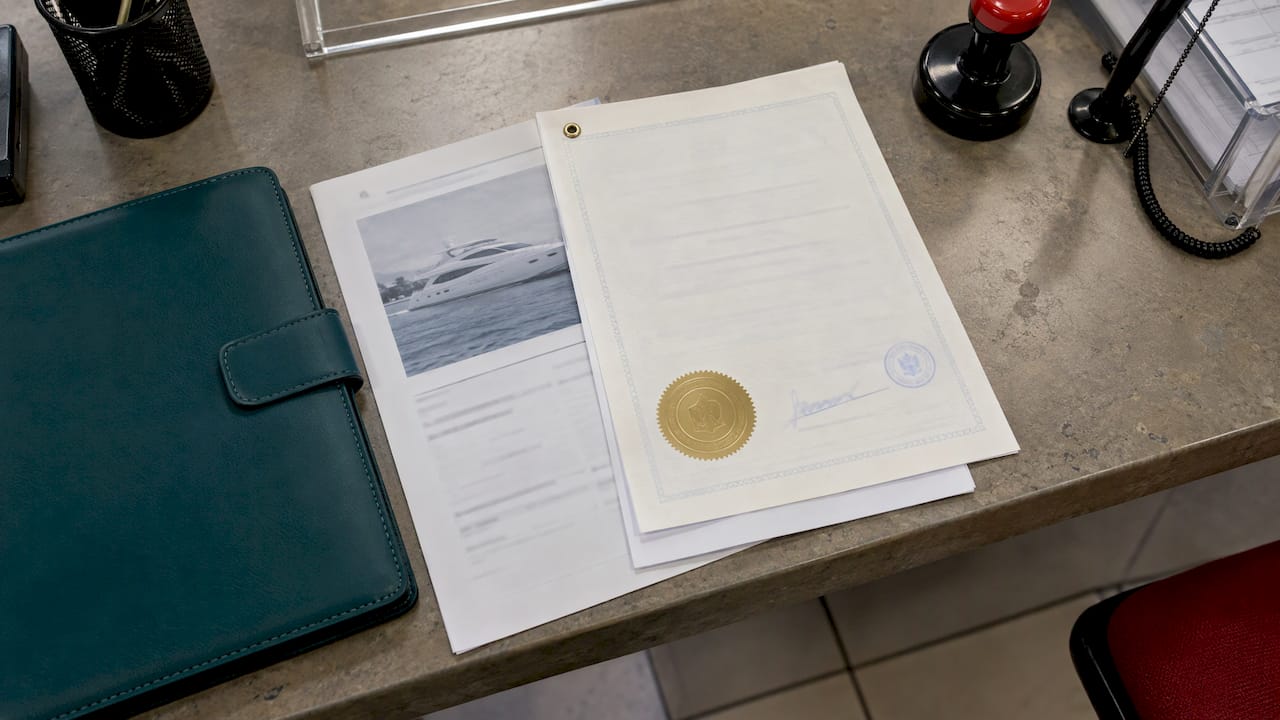
An apostille is a certificate that confirms a public document, such as a notarised bill of sale or a company certificate, is genuine in origin, so that a foreign registry will accept it. Yacht documents usually need one when they are signed or issued in one country and filed with a flag registry in another. Most of the time the order is the same: the document is notarised first, the apostille goes on afterwards, and the registry’s own rules decide whether that is enough.
This guide explains what an apostille does and does not do, which yacht documents it normally applies to, how the UK process works, what it costs, and how to avoid the mistakes that send paperwork back.
TL;DR
- An apostille certifies the origin of a public document, not the truth of what it says.
- For yacht registration, the usual candidates are the bill of sale, company documents and powers of attorney, normally notarised first and apostilled second.
- The UK FCDO Legalisation Office charges £45 for a standard paper apostille and £35 for an e-Apostille per document.
- An apostille does not settle translation or guarantee acceptance: the receiving registry decides, so check its list before you sign anything.
- If either country is outside the Hague Apostille Convention, you may need consular legalisation instead.
Inhaltsübersicht
- What an apostille is, and what it is not
- Which yacht documents usually need an apostille
- Notarise first, apostille second
- How to get an apostille in the UK
- When the Hague route does not apply
- Translation and acceptance: what an apostille will not do
- Mistakes that cause rejection
- A practical order of work
- How Vessel Flag helps
- Our view on apostilles
- FAQ
- Quellen
What an apostille is, and what it is not
The apostille comes from the Hague Apostille Convention of 1961. Under it, a public document issued in one member country can be used in another member country after a single certificate is attached by a designated authority. The Hague Conference’s handbook describes it as a certificate authenticating the origin of a public document. It confirms the signature, the capacity in which the person signed and the seal or stamp on the document.
That is all it confirms. It does not say the contents are accurate, that the sale price was fair, or that a registry will accept the document for its own purposes. This matters on a yacht file, where a registry may want a document in a particular form, in a particular language, signed by particular people, and apostilled on top.
The authority that issues the apostille is the “Competent Authority” each country designates. In the UK it is the Foreign, Commonwealth and Development Office (FCDO) Legalisation Office. In the United States it depends on the document: state-issued records need an apostille from the state secretary of state, while federal documents go through the US Department of State.
Two points follow from this:
- An apostille can only be issued by the country where the document was issued or signed. The UK service, for example, cannot legalise documents issued outside the UK; those must be dealt with in the country of issue.
- A private document, such as a bill of sale signed by two parties, is not a public document until a notary or solicitor has certified the signatures. That is why notarisation comes first.
Which yacht documents usually need an apostille
There is no single list, because each flag registry sets its own. What follows is the pattern we see across the registrations we prepare, and you should always check it against the registry’s current requirements for your flag.
| Dokumentieren | Typical treatment | Warum |
|---|---|---|
| Bill of sale | Notarised, often then apostilled | It is a private contract that proves transfer of ownership |
| Builder’s certificate | Sometimes notarised or apostilled, depending on registry | It proves the yacht’s origin and first owner |
| Company certificate of incorporation, good standing, register of directors | Apostilled if issued by a registry; certified copy first if not | Proves the owning company exists and who acts for it |
| Power of attorney | Notarised, then apostilled | Lets an agent sign and file for the owner |
| Passport or ID copies | Certified copy, sometimes apostilled | Identifies the owner |
| Proof of address | Depends on the registry | See our guide to Adressnachweis für die Yachtregistrierung |
| Deletion certificate from the previous flag | Usually issued by the old registry; may need apostille | Shows the yacht has left its former register |
A few real registry examples show how much the rules differ.
Palau. The Palau International Ship Registry’s FAQ says a bill of sale must be notarised and/or apostilled. It also says proof of ownership for a pleasure yacht can be notarised, apostilled or authenticated by the Deputy Registrar. In practice that gives the owner some flexibility, but it is still worth confirming the exact route before the signing session.
Isle of Man. The Isle of Man Ship Registry states that certain pleasure yacht registration documents must be notarised if executed outside the UK, Channel Islands, Isle of Man or British Dependencies. The bill of sale and the builder’s certificate are among the documents it flags.
Singapore. Rules can also loosen. Law firm Stephenson Harwood reports that from 2 June 2025, documents signed outside Singapore no longer need to be legalised or apostilled for the Singapore Registry of Ships, with notarisation still required for new registrations. It is a useful reminder that last year’s checklist may not be this year’s.
The lesson is not to rely on a general list, including this one. Ask for the registry’s current document schedule for your flag and vessel type.
Notarise first, apostille second
The usual order is a two-step chain:
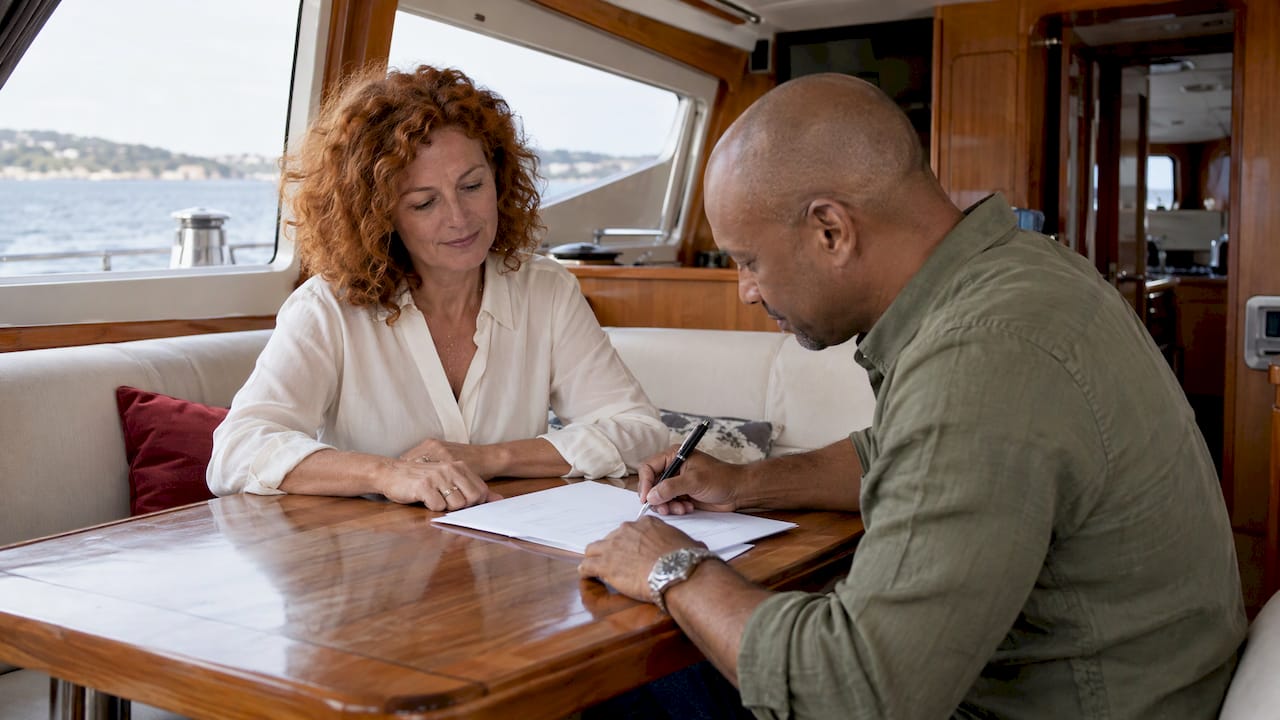
- Signing and notarisation. The owner, seller or director signs in front of a notary public or, in the UK, a solicitor acting as notary. The notary checks identity and capacity and adds a certificate, signature and seal.
- Apostille. The competent authority checks the notary’s signature and seal against its records and attaches the apostille.
The apostille therefore authenticates the notary, and the notary vouches for the signer. A missing link breaks the chain. A bill of sale signed at a marina café and sent straight to the Legalisation Office cannot be apostilled, because there is no public official whose signature the office can verify.
There is a practical reason registries ask for this. Foreign authorities have no independent way to check whether a document signed abroad is genuine, so they rely on a notary’s certificate and, where the Convention applies, on the apostille over it. A notary’s practice note from Ireland makes the same point about registering a vessel abroad.
Company documents
If a company owns the yacht, the registry will want proof the company exists and that the signatory has authority. Certificates issued by a public registry, such as Companies House, can often be apostilled directly. Internal documents, such as a director’s resolution, need notarisation first.
If you are forming a company for ownership, ask for the apostille to be arranged at formation: it is cheaper and quicker than returning to the paperwork months later. Our Delaware LLC formation is priced at EUR 455 to EUR 605, and the top of that range includes the apostille (EUR 605 with apostille). Details are on our company formation page.
How to get an apostille in the UK
If your documents were signed or issued in the UK, the process runs through the FCDO Legalisation Office. The steps are straightforward.
- Check what the registry wants. Confirm whether it asks for a paper or electronic apostille, and whether it wants originals or certified copies.
- Get the document notarised or certified. For privately signed documents, use a UK notary or solicitor. For official documents, such as a certificate of incorporation, check whether a certified copy is needed.
- Apply online. The FCDO says you apply online for both paper and e-Apostille. Choose paper if the receiving party asks for it or if your document type is not eligible electronically.
- Pay per document. Fees are listed below.
- Send or upload. For paper, you post or courier the original. For an e-Apostille, you upload a PDF carrying the notary’s or solicitor’s electronic signature.
- Forward the finished document to the registry or your agent, in the form they asked for.
Costs and speed in the UK
The government’s published fees per document are:
| Service | Fee per document |
|---|---|
| Standard paper apostille | £45, plus postage or courier |
| e-Apostille | £35 |
| Next-Day paper service (registered businesses only) | £40 |
| Restricted Urgent paper service (registered businesses only) | £100 |
Courier costs for paper documents are listed on the same page and depend on the destination. These are the FCDO’s fees only. A notary or solicitor charges separately for notarisation, and you should add that to your budget. Processing times change, so read the “how long it takes” table on the official page before you plan a closing date.
Electronic apostilles
An e-Apostille is issued as a digital file rather than a stamped sheet. It suits registries that accept PDFs and documents certified with a recognised electronic signature. It does not suit every document: the FCDO lists certain types that cannot receive one, and some registries still want a physical apostille attached to the original. Other countries run their own e-apostille systems with their own eligibility rules, and some authorities accept online notarisations only in certain circumstances. If a registry’s instructions say “original” or “wet ink”, assume paper until they say otherwise.
Because you cannot tell from outside whether a registry will take an electronic file, ask in writing before you pay for one.
When the Hague route does not apply
The apostille only works between countries that have joined the Convention. If the country where the document was issued, or the country where it will be used, is not a party, the document may need full consular legalisation instead. In that case the destination country’s embassy or consulate legalises it under its own rules, and an apostille may be needed beforehand.
US guidance reflects the same split: whether you need an apostille or an authentication certificate depends on whether the destination is on the Hague member list.
For yacht owners this tends to come up when:
- the owner lives in a country that is not a party to the Convention;
- the chosen flag is outside the Hague network;
- a document was issued in one country but must be used in a flag state that treats it differently.
We cover this in a separate guide to consular legalisation of yacht documents. If you are a US owner moving to a foreign flag, our page on Ausländische Yachtregistrierung für US-Eigentümer explains how the document chain works from the US side.
Translation and acceptance: what an apostille will not do
The Hague Convention deals with authentication, not language. It sets no rules on translating the underlying document or the apostille itself, so the receiving authority decides whether a translation is needed. A perfectly valid apostille can still be refused if a required translation is missing.
In practice:
- Check whether the registry works in a language other than English and, if so, whether it needs a sworn or certified translation.
- Ask whether the translation should be attached to the apostilled original or made from the original and then apostilled itself. Registries differ.
- Do not assume an apostille gives you acceptance. The registry can still ask for different wording, a newer date or another signatory.
Our guide to Yachtdokumentenübersetzung für die Registrierung sets out what is usually translated and when. If you are still waiting on the builder’s paperwork, see builder certificates for yachts.
Mistakes that cause rejection
The same errors come up repeatedly on yacht files:
- Apostilling before notarising. The chain must be complete and in order.
- Wrong country of issue. An apostille is issued where the document was signed or issued, not where you live or where the yacht is.
- Photocopies. Unless the registry accepts certified copies, send originals.
- Stale documents. Some registries want company certificates issued within a recent window. Check the age limit before you order.
- Name mismatches. The name on the bill of sale, passport and company records should match exactly, including middle names and spelling.
- Signing before the final text is agreed. Re-signing means a new notarisation and a new apostille, with new fees.
- Ignoring electronic limits. Not every registry accepts an e-Apostille or an online notarisation.
A practical order of work
For most registrations, this sequence saves money and time:
- Choose the flag and ask for its current document list.
- Decide who owns the yacht, personally or through a company, and form the company first if needed.
- Draft the bill of sale and confirm the exact wording the registry wants.
- Sign before a notary in one session, covering all documents that need it.
- Order the apostilles together, so postage and handling are shared.
- Check translation requirements and, if needed, have documents translated.
- Send the full pack to the registry or to your agent in one go.
How Vessel Flag helps
Vessel Flag is a private consultancy. We prepare and file yacht registration applications; the certificates themselves are issued by the flag registries. For each flag we handle the document checklist, tell you which items need notarisation or an apostille, and check the pack before it is filed. The service is fully remote with published one-off prices.
Here are some of the flags we work with, with the prices published on our site:
- Poland, from EUR 320 one-off
- San Marino, from EUR 290 one-off
- UK Part 1, from EUR 550 one-off
- Malta, from EUR 849 one-off
- Palau, from EUR 700 one-off
- Marshall Islands, EUR 250 service fee plus registry fees
- Cayman Islands, EUR 450 service fee plus registry fees
Cook Islands registration is quoted per yacht. We also handle other flags on request, with terms confirmed case by case.
For UK Part 1, owners can register personally if eligible, through an existing company (UK or an eligible foreign one, such as a Delaware corporation) or through a new UK LTD. A new UK company is not always required. You can see the details on our UK Part 1 yacht registration page.
If you are comparing options before you decide, our overview of international yacht flag registration is a good starting point. If the yacht is leaving another register, read about the yacht deletion certificate too.
Our view on apostilles
Most delays on a yacht registration are not caused by the registry. They come from documents signed in the wrong order, or signed before anyone has read the registry’s current checklist.
We prepare applications under eight main flags, and the document rules differ more than owners expect. One registry accepts a notarised bill of sale as it stands; another wants the apostille too; a third lets its own deputy registrar authenticate the paperwork. Our approach is to settle the document route before the signing appointment, so you pay for each notarisation and apostille once.
That is why we pair registration with company formation and the radio licence. A Delaware LLC formed with its apostille already attached, for example, is ready for a registry that asks for authenticated company papers, and the radio licence can follow without a second round of paperwork. Registries decide on acceptance; our job is to give them a complete, correctly ordered file.
Vessel Flag
FAQ
Which yacht documents can be apostilled?
Public documents can be apostilled: notarised signatures, official certificates and registry-issued company papers. For yachts this typically means a notarised bill of sale, power of attorney and company certificates. A private document must usually be notarised before it qualifies, and the registry sets which of them it wants apostilled.
Can an apostille be done in one day?
Sometimes. The FCDO offers a Next-Day paper service for registered businesses and a Restricted Urgent service, at £40 and £100 per document respectively. Both are paper-based and limited to registered businesses, and you still need notarisation first. Check the official page for current turnaround times.
Do I need a translation as well as an apostille?
That depends on the registry. The Hague Convention does not set translation rules, so the registry decides. If its working language differs from the document’s, ask whether a certified translation is needed and in what order it should be apostilled.
Does an apostille guarantee the registry will accept my documents?
No. It confirms where a document came from, not that its content or format suits a particular registry. The registry can still ask for different wording, newer dates or a translation. Checking its current requirements before signing is the safest way to avoid a second round.
What if the country is not part of the Hague Convention?
Then the document may need consular legalisation at the destination country’s embassy or consulate, sometimes after an apostille from the issuing country. Rules vary by country, so confirm the full chain with the registry first.
Ready to register? See the page for your flag, for example Yachtregistrierung im Vereinigten Königreich (Teil 1), or book a consultation and we will map out the document route for your yacht.
Quellen
- Apostille Handbook, Hague Conference on Private International Law
- Get your document legalised, GOV.UK
- Frequently Asked Questions, Palau International Ship Registry
- Pleasure Yacht Registration, Isle of Man Ship Registry
- Simplified documentation requirements, Singapore Registry of Ships, Stephenson Harwood
- Authenticate an official document for use outside the U.S., USAGov
- Document Authentication, The Owners Club
- Notary Services for Registering an Irish Vessel Abroad
- Does the Hague Convention set rules for translating documents?
Empfohlen
- Konsularische Legalisation von Yachtdokumenten: wann sie nötig ist
- Übersetzung von Yachtdokumenten für die Registrierung: Was übersetzt werden muss
- Baubescheinigung für Yachten: Was sie ist und wie Sie sie erhalten
- Löschungszertifikat für Yachten: Was es ist und wie Sie es erhalten
VesselFlag is a private consultancy that prepares and files yacht registration applications for owners. We are not a government body or flag registry; certificates are issued by the relevant registry. This article is general information, not legal advice.