

What is yacht syndication, and how does it work?
Yacht syndication is a formal multi-owner structure where four to eight individuals or entities share legal equity in a single vessel through a holding company and a binding syndicate agreement. The vessel typically sits inside a single-purpose company, often registered in jurisdictions like the Cayman Islands, Malta, or the Marshall Islands. That agreement governs everything: who owns what percentage, how usage is scheduled, how costs are split, and how owners eventually exit.
This is not a charter arrangement or a vacation club. Each syndicate member holds genuine equity in the vessel, including rights to the captain, crew, and a defined slice of the usage calendar, typically several weeks per share per year. The syndicate agreement also sets voting procedures and veto rights on major decisions, such as accepting a new co-owner.
Key features of a yacht syndicate at a glance:
- Ownership structure: Vessel held in a single-purpose holding company; each member owns a defined equity share
- Typical size: 4 to 8 co-owners, with costs and usage split pro-rata
- Usage rights: Scheduled calendar access, usually several weeks per share annually, not unlimited or unscheduled
- Governance: Formal syndicate agreement covering cost responsibilities, voting, and exit protocols
- Exit terms: Fixed sale windows (typically every 3–5 years) or right-of-first-refusal on share transfers
- Distinction from fractional pools: Syndicate members own the vessel directly; fractional pool participants hold contractual usage rights in a managed fleet
Inhaltsübersicht
- What are the real benefits of yacht syndication?
- What should a syndicate agreement actually cover?
- How does professional management keep a syndicate running?
- How does syndication differ from buying a yacht outright?
- How Vesselflag supports U.S. syndicate owners with registration and compliance
- Wichtigste Erkenntnisse
- FAQ
What are the real benefits of yacht syndication?
The core appeal is straightforward: access to a high-end yacht at a fraction of the full purchase and operating cost, with genuine equity rather than a rental receipt. On a €15 million yacht, for example, a six-owner syndicate splits the purchase at roughly €2.5 million per share and annual running costs at approximately €250,000 per share. Each owner gets around six weeks of use and can charter unused weeks through the syndicate.
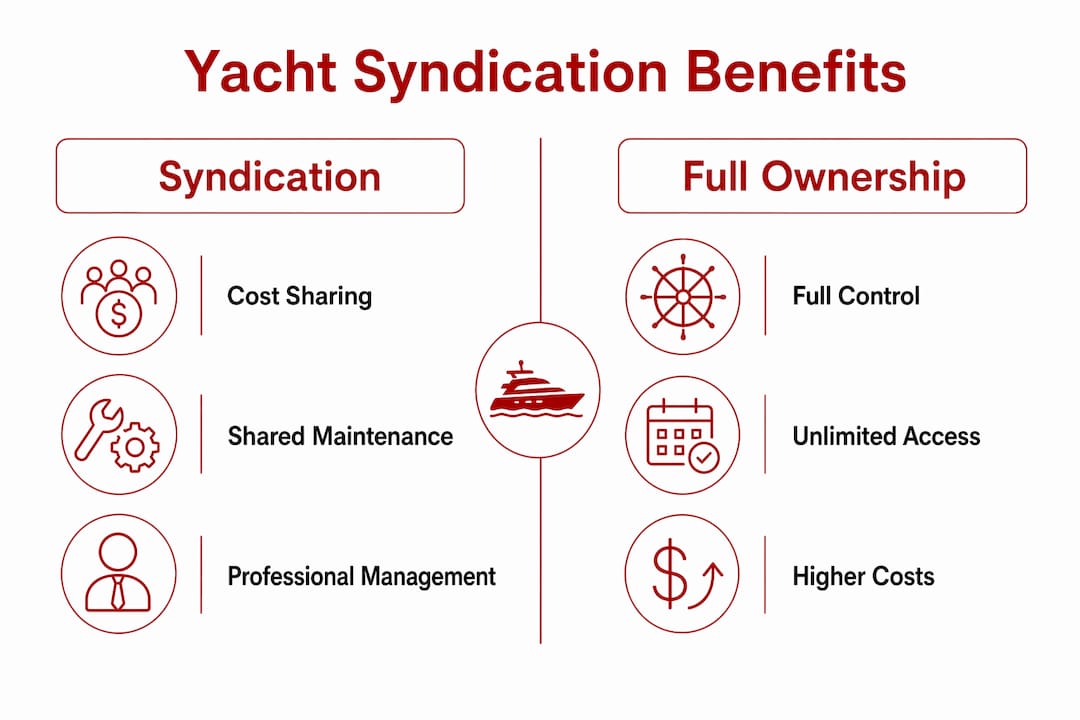
Beyond the numbers, the ownership experience itself changes. Professional management handles crew, maintenance, and compliance, so owners step aboard a ready vessel rather than managing a floating business.
Benefits worth knowing:
- Cost sharing: Purchase price and annual operating costs divided pro-rata, cutting individual financial exposure substantially
- Real equity: Unlike charter, syndicate members hold an ownership stake with resale value at exit
- Professional management: Crew hiring, maintenance scheduling, insurance, and legal compliance handled by experts, not by you
- Fair scheduling: Algorithm-driven booking systems distribute usage equitably across seasons, with owner swap options via apps
- Chartering upside: Unused weeks can often be chartered through the syndicate, generating income that offsets running costs
- Effortless ownership: Industry analysts describe this as the model’s defining value proposition: you own the asset without managing the operation
What should a syndicate agreement actually cover?
A poorly drafted syndicate agreement is the single biggest risk in co-ownership. The Royal Yachting Association (RYA) offers a standard shared-ownership agreement for members, and legal experts consistently recommend formal contracts even for family syndicates, because informal arrangements cause disputes over maintenance, usage, and costs at a predictable rate.
The agreement is not just paperwork. It is the operating system of the syndicate.
Essential contract components:
- Ownership shares: Exact equity percentages for each member, recorded in the holding company’s cap table
- Expense responsibilities: How purchase costs, running costs, and unexpected repairs are allocated and collected
- Usage rights: Scheduled booking procedures, advance notice requirements, and rules for high-demand periods
- Exit and transfer protocols: Fixed sale windows (commonly every 3–5 years) and right-of-first-refusal clauses protecting existing owners
- Veto rights: Conditions under which remaining owners can block a proposed new co-owner
- Voting thresholds: What decisions require unanimous consent versus a simple majority
- Legal structure clarity: Whether members own direct equity via a holding company or hold contractual usage rights, since this affects tax treatment, liability, and resale
Pro Tip: Get the legal structure confirmed in writing before signing anything. Direct equity ownership and contractual usage rights look similar on the surface but carry very different tax and liability consequences, especially for U.S. owners.
How does professional management keep a syndicate running?
Professional management is not a luxury add-on in a well-run syndicate. It is the mechanism that makes the model work for busy owners who are not maritime professionals. Management firms handle crew hiring and oversight, maintenance scheduling, insurance renewals, port logistics, cleaning between owner visits, and regulatory compliance, all coordinated so that each owner arrives to a vessel that is ready and in condition.

Scheduling is where management earns its keep most visibly. Rotational selection systems and dedicated apps distribute weekly usage across the year, with the order reversed annually so no single owner always gets first pick. Owners can swap weeks with each other through the same platform. A dedicated Finance Manager audits and reports all running costs to every owner, maintaining the transparency that prevents financial disputes.
Core management responsibilities:
- Crew recruitment, contracts, and day-to-day oversight
- Maintenance scheduling and service documentation
- Insurance management and regulatory compliance
- Housekeeping and provisioning between owner visits
- Usage calendar administration via scheduling software or apps
- Financial reporting: cost auditing and per-owner expense statements
- Owner communications and dispute mediation
A professionally managed syndicate also preserves vessel value more reliably than owner-managed arrangements, which matters at exit when the sale price determines each member’s return.
How does syndication differ from buying a yacht outright?
Full ownership gives you unlimited, unscheduled access and complete control over every decision about the vessel. Syndication gives you defined access, shared governance, and a fraction of the cost. Neither model is objectively better; they suit different buyers.
The financial gap is the most obvious difference. A sole owner absorbs 100% of purchase price, crew salaries, insurance, dockage, maintenance, and depreciation. A syndicate member absorbs their pro-rata share of all of those, which can reduce annual carrying costs dramatically. The trade-off is that you cannot simply decide to use the boat on a Thursday because the forecast looks good. Bookings go through the scheduling system, and high-demand periods like summer holidays are subject to competitive allocation.
Side-by-side comparison:
| Factor | Full ownership | Syndicate ownership |
|---|---|---|
| Financial commitment | 100% of purchase and operating costs | Pro-rata share only |
| Usage access | Unlimited, unscheduled | Scheduled, typically around six weeks per year |
| Decision-making | Autonomous | Requires syndicate consensus or vote |
| Exit complexity | Full vessel sale on open market | Share resale or fixed exit window |
| Management burden | Owner-directed | Handled by professional management firm |
| Equity retained | Full | Proportional to ownership share |
Syndication suits buyers who want genuine ownership rights and equity upside without the full carrying cost, and who are comfortable sharing the calendar. Full ownership suits those who need unrestricted access or want complete control over every operational decision.
How Vesselflag supports U.S. syndicate owners with registration and compliance
Yacht syndication in the U.S. market carries specific regulatory and tax considerations that syndicate members cannot afford to overlook. The ownership structure, whether the vessel is held in a domestic LLC, a foreign holding company, or a trust, affects how the IRS treats the asset, what state sales and use taxes may apply, and which federal documentation requirements apply under the U.S. Coast Guard or state agencies.
Syndicate-owned vessels operating internationally also face flag-state registration requirements that vary by jurisdiction. Choosing the right flag affects everything from MMSI licensing to insurance validity to port access. Vesselflag specializes in exactly this: Yacht-Registrierung under international flags including San Marino, Malta, Poland, UK Part 1, Palau, and Langkawi, with transparent timelines and compliance support built into the process.
How Vesselflag supports syndicate owners:
- Flag registration under multiple international jurisdictions, matched to the syndicate’s holding company structure
- MMSI and AIS licensing as part of the registration package
- Vessel insurance coordination and compliance consultancy
- Global registration validity checks to keep syndicate vessels compliant across cruising areas
- Corporate registration support for holding companies used in syndicate structures
- Expert guidance on documentation requirements for U.S. owners operating under foreign flags
Pro Tip: U.S. syndicate members using a foreign holding company should confirm their flag-state registration before the vessel enters U.S. waters. Vesselflag’s consultancy team can walk you through the requirements for your specific structure and flag choice at Schiffsflagge.de.
Wichtigste Erkenntnisse
Yacht syndication gives owners genuine equity in a high-value vessel at a fraction of the full cost, provided the syndicate agreement, professional management, and registration compliance are all handled correctly from the start.
| Punkt | Einzelheiten |
|---|---|
| Syndicate size and cost split | Typically 4–8 owners share purchase price and annual running costs on a pro-rata basis. |
| Usage is scheduled, not unlimited | Owners receive a scheduled number of weeks per year—typically around six—allocated through rotational scheduling systems. |
| Legal agreement is non-negotiable | A formal syndicate agreement covering equity, exit terms, and voting rights prevents disputes. |
| Exit windows are fixed | Sale windows every few years or right-of-first-refusal clauses govern share transfers. |
| Registration compliance matters | U.S. syndicate owners must align flag-state registration with their holding company structure. |
FAQ
What is the difference between yacht syndication and fractional ownership?
Syndication means co-owners hold direct equity in the vessel, usually through a holding company. Fractional ownership typically gives participants contractual usage rights in a managed pool without direct vessel equity, which affects tax treatment, liability, and resale options.
How many weeks can a syndicate member use the yacht each year?
Usage depends on the ownership share. Syndicates typically allocate around six weeks per owner per year, distributed through a rotational scheduling system that reverses order annually for fairness.
What happens when a syndicate member wants to sell their share?
Most syndicate agreements include a right-of-first-refusal for remaining owners and fixed exit windows, commonly every 3–5 years. Early transfers usually require shareholder approval, and agent fees apply on the sale.
Do U.S. syndicate owners need to register the vessel under a specific flag?
Yes. The flag-state registration must align with the vessel’s holding company structure and intended cruising area. U.S. owners using foreign holding companies face specific documentation requirements under both U.S. Coast Guard rules and the chosen flag state.
Is professional management required in a yacht syndicate?
Not legally required, but strongly recommended. Professional management handles crew, maintenance, scheduling, and compliance, protecting both the vessel’s condition and each owner’s equity value at exit.