

Kurz gesagt:
- Flag hopping involves deliberately re-registering vessels under different flags to conceal ownership and evade sanctions. As of 2026, authorities, including France and IMO, respond with stricter regulations and criminal penalties, emphasizing due diligence and behavioral monitoring. Legitimate re-flagging, supported by clear commercial rationale and transparency, differs from illicit flag hopping, which involves shell companies and rapid, repeated registry changes.
Flag hopping is the repeated re-registration of a vessel under different flag states to obscure ownership, evade sanctions, and reset compliance records. The practice is not a legal gray area. It is a deliberate tactic used by vessel operators to exploit weaknesses in the international registry system. The IMO’s LEG 113 session in April 2026 identified 529 vessels flying false or fraudulent flags, with 356 of those lacking recognized classification status. That scale confirms flag hopping is no longer a fringe problem. For maritime professionals and vessel owners, understanding how this practice works is the first step toward staying on the right side of international law.
What is flag hopping? definition and real-world examples
Flag hopping is defined as the deliberate and repeated switching of a vessel’s flag state registration, typically to avoid regulatory scrutiny, sanctions enforcement, or ownership transparency requirements. The industry term you will encounter in IMO documentation and compliance reports is “illicit re-flagging,” though “flag hopping” is the widely used shorthand among maritime risk analysts and port state control officers.
Here is how it typically works in practice:
- A vessel is registered under Flag State A and becomes subject to sanctions or a port state control detention.
- The operator transfers the vessel to a shell company and re-registers it under Flag State B, often an open registry with minimal due diligence.
- The vessel operates under Flag State B until scrutiny increases, then moves to Flag State C.
- Each registration change resets the paper trail, making it harder for enforcement agencies to track the vessel’s history.
The most documented modern example involves Russian shadow fleet vessels operating after the 2022 sanctions regime. These ships exploited open registries with minimal due diligence to conceal ownership and prior sanctions-related misconduct. Some vessels changed flags three or more times within a single calendar year. North Korean coal shipments followed a similar pattern years earlier, which is why analysts now describe flag hopping as a geopolitical strategy rather than simple commercial abuse of flags of convenience.
Pro Tip: When reviewing a vessel’s registration history, request the full chain of flag state certificates, not just the current one. A vessel that has held three or more flags in five years warrants deeper due diligence before any transaction.
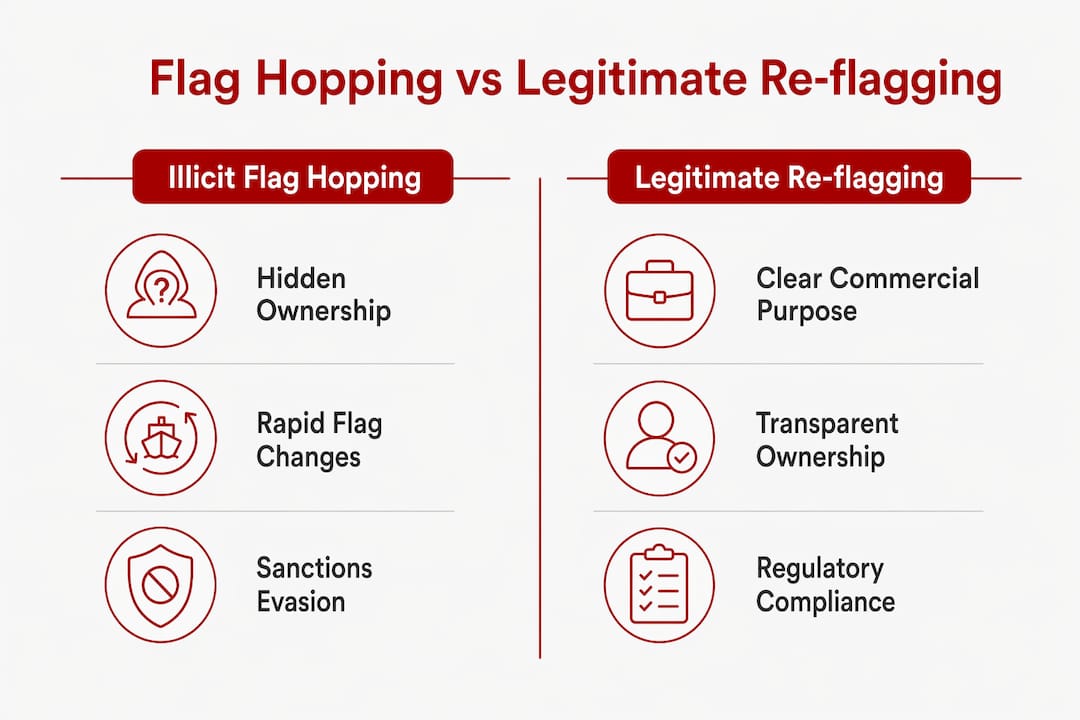
Legitimate re-flagging does exist and is common for commercial reasons. The key distinction is intent and transparency, which this article addresses in detail below.
Why do vessel owners engage in flag hopping?
The motives behind flag hopping are specific and financially significant. Vessel operators do not change flags repeatedly by accident. Each switch serves a calculated purpose.
- Sanctions evasion. After a vessel is blacklisted by the U.S. Office of Foreign Assets Control (OFAC), the EU, or the UK, re-registration under a new flag can temporarily remove it from watchlists that rely on flag state data rather than IMO numbers.
- Avoiding port state control inspections. Certain flag states carry higher inspection rates under the Paris MOU or Tokyo MOU. Moving to a flag with a lower inspection burden reduces the chance of detention for safety deficiencies.
- Resetting compliance audits. Repeated flag changes act as a compliance reset, preventing continuous regulatory oversight of vessel safety and ownership history. A vessel with a poor inspection record under one flag starts fresh under another.
- Concealing ownership. Shell companies registered in different jurisdictions are used alongside flag changes to sever the visible link between the beneficial owner and the vessel.
- Tax and labor law advantages. Some operators cycle through flags to access the most favorable crew wage rules or tax treatment at any given time, though this motive is less common than sanctions evasion in current enforcement cases.
- Obscuring cargo history. Vessels that have carried sanctioned cargo can use flag changes to make their operational history harder to reconstruct from public databases.
The financial incentive is real. A single sanctioned oil cargo can be worth tens of millions of dollars. The cost of re-registering a vessel under a new flag is often a few thousand dollars. That asymmetry explains why the practice persists despite growing enforcement pressure.
How does flag hopping affect maritime regulation and enforcement?
Flag hopping creates direct operational problems for the bodies responsible for maritime safety and sanctions compliance. The IMO, classification societies, and port state control authorities all face the same core challenge: their oversight systems are built around continuity, and flag hopping deliberately breaks that continuity.

The IMO’s LEG 113 session in April 2026 addressed this directly, issuing new guidelines focused on due diligence in the ship registration system. The session confirmed that 529 vessels had been identified flying false or fraudulent flags globally. That figure represents vessels actively in operation, not historical cases. The regulatory response is accelerating.
France moved first among major maritime nations with direct criminal penalties. As of April 2026, France enforces up to 2 years imprisonment and fines of €300,000 for ships flying false flags or engaging in illicit re-flagging. That is a significant escalation from administrative penalties. It signals that governments are treating flag hopping as a criminal act, not a paperwork violation.
| Enforcement Body | Challenge Posed by Flag Hopping | 2026 Response |
|---|---|---|
| IMO | Fragmented registration records across jurisdictions | LEG 113 due diligence guidelines |
| France (national authority) | Shadow fleet vessels evading EU sanctions | Criminal penalties up to 2 years and €300,000 fines |
| Klassifikationsgesellschaften | Verifying structural and safety history across flag changes | Increased cross-registry data sharing |
| Port state control (Paris MOU) | Identifying vessels with hidden detention histories | Enhanced IMO number tracking protocols |
Classification societies face a specific problem. When a vessel changes flag, it often changes its recognized organization as well. That means the new classification society may not have access to the vessel’s full inspection and deficiency history. The result is a vessel that appears compliant on paper but carries unresolved safety issues.
Pro Tip: Always verify a vessel’s classification history through the IMO’s Global Integrated Shipping Information System (GISIS) database, not just the current flag state certificate. GISIS tracks the IMO number across flag changes and provides a more complete compliance picture.
How do you detect and mitigate flag hopping?
Detection requires looking at a vessel’s behavioral arc over time, not just its current registration status. A single flag change proves nothing. A pattern of changes, combined with other indicators, is what triggers legitimate concern.
The core indicators professionals track include:
- AIS signal gaps. Vessels that disable their Automatic Identification System (AIS) transponder during flag transitions are a primary red flag. Tracking ownership changes, AIS data gaps, and registry switches over time is the standard detection methodology used by sanctions compliance teams.
- Rapid successive flag changes. Two or more flag changes within 12 months, particularly following a sanctions designation or port state control detention, indicate evasive intent.
- Shell company ownership chains. Vessels registered to recently formed companies in jurisdictions with minimal beneficial ownership disclosure are a consistent pattern in confirmed flag hopping cases.
- Ship name changes coinciding with flag changes. Renaming a vessel at the same time as re-flagging is a deliberate attempt to break the search trail in commercial databases.
- Mismatch between flag state and operational area. A vessel flagged in a landlocked jurisdiction like San Marino or Mongolia but operating in high-risk maritime corridors warrants scrutiny, particularly if the flag change is recent.
Continuous monitoring outperforms periodic screening by a significant margin. A vessel that appears clean during a quarterly review can complete a flag change and a sanctioned cargo run between checks. Tools like Kpler, Windward, and Lloyd’s List Intelligence provide real-time vessel tracking that captures these behavioral patterns as they develop.
Industry guidance is clear that no single flag change should be treated as definitive proof of wrongdoing. Flag hopping must be evaluated alongside other suspicious behaviors to build a credible risk assessment. That nuance matters for vessel owners who have legitimate reasons to re-flag, which the next section addresses directly.
Legitimate re-registration vs. illicit flag hopping: key differences
Legitimate administrative re-flagging differs from flag hopping by having a clear commercial justification and transparent ownership changes. Misidentifying a legitimate re-flagging as illicit flag hopping can damage business relationships and create unnecessary legal exposure for vessel owners.
The table below outlines the practical differences:
| Faktor | Legitimate Re-Flagging | Illicit Flag Hopping |
|---|---|---|
| Commercial rationale | Documented: sale, charter, cost reduction | Absent or fabricated |
| Timing relative to sanctions | Unrelated to enforcement events | Immediately follows sanctions designation |
| Ownership transparency | Beneficial owner disclosed | Shell companies obscure true owner |
| Flag state due diligence | Registry conducts full verification | Minimal or no due diligence by registry |
| Frequency | Rare, one or two changes over vessel’s life | Multiple changes within short periods |
| AIS behavior | Continuous signal maintained | Signal gaps during transition |
A vessel sold from a European owner to a Southeast Asian operator, then re-flagged under the Palau or Malta registry for operational cost reasons, is a routine commercial transaction. The ownership change is documented, the beneficial owner is disclosed, and the timing has no connection to any enforcement action. That is re-flagging. It is legal, common, and administratively straightforward.
The risk of misidentification is real for vessel owners who re-flag for legitimate reasons but do so poorly. Incomplete documentation, gaps in AIS coverage during the transition, or choosing a registry with a poor compliance reputation can make a clean transaction look suspicious. Working with a reputable registry and maintaining full documentation continuity is the practical defense against that risk. You can review vessel registration requirements in 2026 to understand what compliant re-flagging documentation looks like in the current regulatory environment.
Key takeaways
Flag hopping is a deliberate evasion tactic that exploits registry system gaps, and distinguishing it from legitimate re-flagging requires examining commercial rationale, timing, ownership transparency, and behavioral patterns together.
| Punkt | Einzelheiten |
|---|---|
| Core definition | Flag hopping is repeated re-registration across flag states to evade sanctions, oversight, and ownership transparency. |
| Scale of the problem | IMO LEG 113 identified 529 vessels flying false or fraudulent flags globally as of April 2026. |
| Criminal enforcement | France now imposes up to 2 years imprisonment and €300,000 fines for illicit re-flagging as of April 2026. |
| Detection method | Track AIS gaps, rapid flag changes, shell company ownership, and ship name changes together, not in isolation. |
| Legitimate re-flagging | A flag change with documented commercial rationale and transparent ownership is legal and common in maritime operations. |
Flag hopping in 2026: what we see on the ground
The pattern we observe most often is not the dramatic shadow fleet case that makes international headlines. It is the mid-sized commercial vessel owner who re-flags for entirely legitimate reasons but does so without proper documentation, creating a compliance profile that looks suspicious to port state control officers and sanctions screeners.
The 2026 regulatory environment has less tolerance for ambiguity than it did five years ago. The IMO LEG 113 guidelines, France’s criminal penalties, and the expansion of EU sanctions enforcement have collectively raised the cost of appearing non-compliant, even when you are not. That shift changes the calculus for every vessel owner considering a flag change.
The uncomfortable truth is that the registries most attractive for their low cost and fast processing are often the same ones that appear on risk analysts’ watchlists. Choosing a registry purely on price without considering its compliance reputation is a decision that can follow a vessel for years. We have seen owners spend far more resolving compliance questions than they saved on registration fees.
The practical advice is straightforward. Choose a registry with transparent due diligence processes. Maintain continuous AIS coverage through any transition. Document the commercial rationale for the flag change before you start the process, not after. And treat the role of flag state compliance as an ongoing obligation, not a one-time administrative task.
— Vesselflag
How Vesselflag supports compliant vessel registration
Vessel owners who want to re-flag without creating a compliance problem need a registration partner who understands both the process and the regulatory context. Vesselflag provides registration services across multiple international flags, including San Marino, Malta, UK Part 1, Palau, and Poland, with full documentation support and transparent due diligence at every step.
Every registration through Vesselflag includes guidance on maintaining AIS compliance, ownership documentation, and classification continuity. These are exactly the elements that distinguish a clean re-flagging from one that attracts enforcement scrutiny. Whether you are registering a yacht for the first time or transferring an existing vessel to a new flag, the flag registration process starts with getting the paperwork right. You can also review the full global vessel registration guide to understand what compliant registration looks like across jurisdictions in 2026.
FAQ
What does flag hopping mean in maritime law?
Flag hopping is the repeated re-registration of a vessel under different flag states to evade sanctions, hide ownership, or reset compliance records. It is treated as illicit re-flagging under IMO guidelines and is subject to criminal penalties in jurisdictions like France as of 2026.
How is flag hopping different from legitimate re-flagging?
Legitimate re-flagging has a documented commercial rationale, transparent ownership, and no connection to sanctions events. Flag hopping lacks commercial justification, involves shell companies, and typically follows enforcement actions against the vessel or its owner.
How do authorities detect flag hopping?
Authorities track AIS signal gaps, rapid successive flag changes, ship name changes, and shell company ownership patterns together. No single flag change is treated as proof of wrongdoing without supporting behavioral indicators.
Is flag hopping illegal?
Flag hopping itself is not a defined criminal offense in all jurisdictions, but the conduct it enables, including sanctions evasion and fraudulent registration, carries serious criminal penalties. France introduced up to 2 years imprisonment and €300,000 fines for illicit re-flagging in April 2026.
Can a vessel owner re-flag legally without triggering scrutiny?
Yes. A flag change with documented commercial rationale, continuous AIS coverage, transparent beneficial ownership disclosure, and a reputable registry will not trigger enforcement scrutiny. The key is documentation and choosing a registry with strong due diligence standards.
Empfohlen
- Maritime flag choice considerations: guide for yacht owners
- Boat registration guide 2026: efficient international flags
- The Role of Flag State in Compliance: 2026 Guide
- Vessel registration process explained: global guide 2026
Flag hopping: frequently asked questions
What is flag hopping?
Flag hopping is the repeated re-registration of a vessel under different flag states, usually to hide the real owner, evade sanctions or reset a poor inspection record. It is different from a one-off, documented change of flag for legitimate commercial reasons.
Is changing a vessel’s flag legal?
Yes. Re-flagging is legal when ownership is transparent and the ship is properly deleted from the old registry before joining the new one. Under UNCLOS Article 92 a ship sails under one flag only and may not change flag during a voyage or port call, except in a real transfer of ownership or change of registry.
How can you detect flag hopping?
Check the vessel’s IMO number, which stays with the hull for life, and review its flag, name and ownership history in registry and port state control databases. Several flag changes in a short time, shell-company owners and gaps in AIS tracking are typical red flags.
What are the consequences of flag hopping?
Vessels linked to flag hopping face more port state control inspections and detentions, insurance and financing problems, and – in sanctions cases – seizure or criminal penalties. Registries increasingly refuse vessels with a history of frequent flag changes.
How do yacht owners change flag the legitimate way?
Obtain a deletion certificate from the current registry, provide transparent ownership documents and register with the new flag state. Vessel Flag handles the whole process for Poland, San Marino, UK Part 1, Malta and other registries.
Changing your yacht’s flag the right way? Vessel Flag handles deletion from your old registry and registration under the new flag – Poland from €320, San Marino or UK Teil 1. Compare the options →