
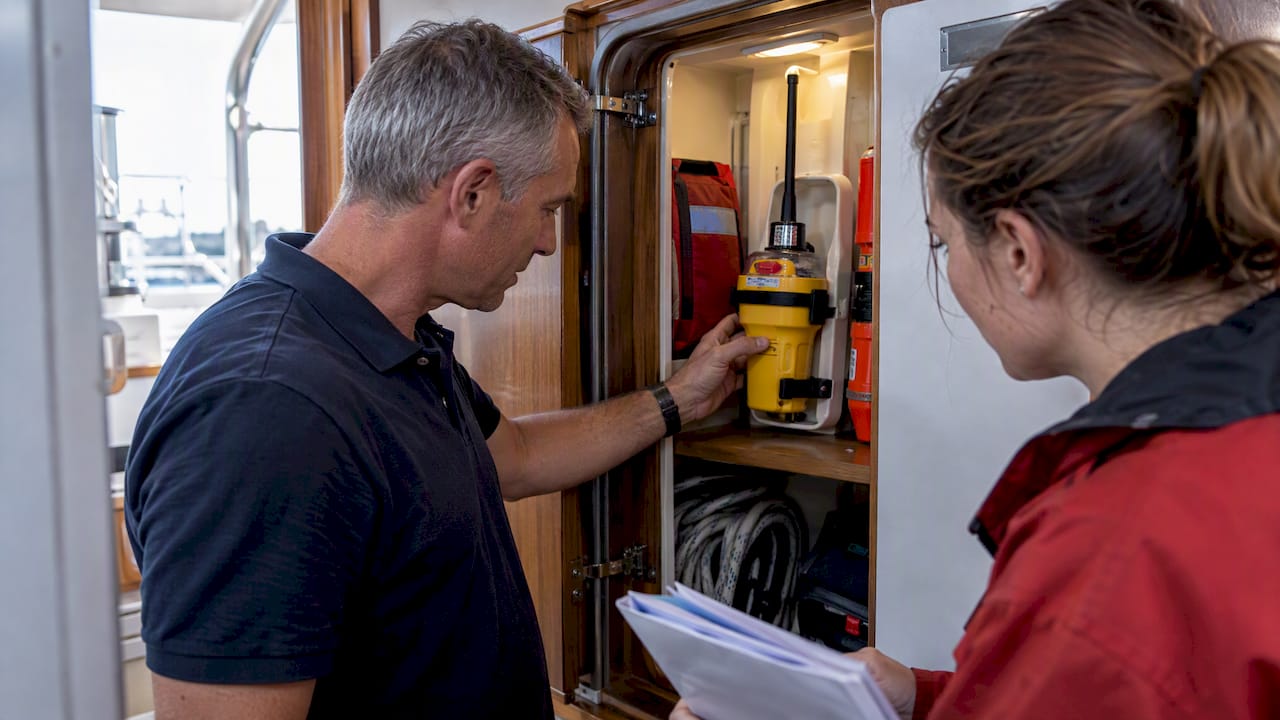
In this article, “EPIRB registration yachts” refers to registering your vessel under an international flag and the compliance work that goes with it: MMSI and AIS setup, corporate ownership structuring, and radio licensing, not registering an emergency beacon with a national search-and-rescue authority. If you are at this stage, your first move is to gather your ownership and technical documents and either start a provisional flag application or contact a specialist registrar directly.
TL;DR:
- Provisional registration can be obtained within days to weeks by submitting core ownership and technical documents, with full registration taking several weeks to months depending on surveys.
- Key documents include proof of ownership, technical certificates, and, if changing flags, a deletion certificate; missing paperwork is the main cause of delays.
- Updating the MMSI and radio registration after a flag or ownership change is essential to avoid confusion during distress calls and must be done before finalizing the new registration.
- Costs vary widely based on flag, vessel size, and services, with some packages including MMSI applications and transfers at fixed fees.
- Choosing the right flag requires weighing operational needs, such as charter rules, survey frequency, and ownership structures, since requirements differ significantly between jurisdictions.
İçindekiler
- What to Expect From the Registration Timeline and Costs
- Step-by-Step Checklist for Provisional and Full Registration
- Staying Compliant After Registration: Surveys, Certificates, and Radio Identity
- Choosing a Flag: Eligibility, Genuine Link, and Operational Fit
- Updating EPIRB and Radio Registration After an Ownership Change
- How Registration Requirements Differ Between Flags
- Checking Whether Your Current Registration Is Still Valid
- Why MMSI and DSC Radio Must Match Your EPIRB Registration
- Why a Specialist Registrar Makes the Process Easier
- Start Your Registration With a Specialist Who Handles the Paperwork
- SSS
- Sources
What to Expect From the Registration Timeline and Costs
Provisional registration typically takes days to a couple of weeks once your paperwork is in order, while full registration can run several weeks to a few months depending on surveys, flag-specific rules, and how quickly technical documents come together. Malta Taşımacılığı grants a 6-month provisional registration period for yachts joining the Malta flag, extendable once while surveys and final paperwork are completed. That window exists precisely because registries know owners need to operate before every certificate is in hand.
The process generally moves through the same stages regardless of flag:
- Application submission with ownership and technical documents
- Provisional registry entry, often issued within days
- Surveys and inspections scheduled with a recognized surveyor or Recognised Organisation
- Completion of outstanding documents (tonnage, deletion certificates, corporate papers)
- Final registry entry and issuance of the permanent certificate
Fees fall into a few predictable buckets: the registration fee itself, annual registry or tonnage charges, survey costs, and radio licensing fees for MMSI issuance. Costs vary widely by flag and vessel size, so it pays to get a quote against your specific tonnage and intended use before committing to a jurisdiction.
Step-by-Step Checklist for Provisional and Full Registration
Most rejections and delays trace back to missing or mismatched paperwork rather than anything complicated about the registry rules themselves. Working through the checklist below in order avoids the back-and-forth that eats weeks off your timeline.
- Collect ownership proof: bill of sale, builder’s certificate, and, if you are moving flags, a deletion or cancellation certificate from the previous registry.
- Assemble technical documents: tonnage certificate where required, builder’s plate details, CE marking, engine particulars, and official vessel measurements.
- Confirm your legal structure: decide whether the yacht will sit under personal or corporate ownership, and check whether your chosen flag requires a resident agent for non-resident owners or a specific share structure, as UK Part 1 registration does for qualified owners and shareholding.
- Sort out radio and safety items: apply for a ship radio station licence, prepare the documentation needed to request an MMSI number, and confirm GMDSS compliance where your vessel’s category requires it.
- Submit for provisional registration: most flags accept a provisional application with core ownership and identity documents, allowing surveys, tonnage certificates, and some corporate paperwork to follow after provisional entry.
Pro Tip: Start your MMSI application the same week you submit for provisional registration, not after, since radio licensing often takes nearly as long as the registry’s own paperwork and running in parallel saves real time.
UK guidance on Part 1 registration lays out exactly which owners qualify and how the authorisation framework for radio surveys works, including who is permitted to carry out those surveys on UK-flagged yachts, as detailed in the UK’s Part 1 and radio survey guidance. Reading the flag-specific rules before you file saves a second submission round.
Staying Compliant After Registration: Surveys, Certificates, and Radio Identity
Registration is the start, not the finish. Commercial and larger yachts face initial surveys followed by periodic cycles, often annual or on a five-year rotation depending on the flag and vessel category, and these are carried out by Recognised Organisations or other authorized surveyors acting on the flag administration’s behalf. IMO guidance on surveys and certification confirms that flag states retain responsibility for this oversight even when a Recognised Organisation performs the actual inspection.
Radio identity needs the same ongoing attention. When a yacht changes flag, the MMSI number tied to its previous registration generally needs to be deactivated or transferred, and UK guidance is explicit that owners must notify the relevant licensing authority when equipment moves to a foreign flag.
A few habits keep port-state inspections from turning into delays, such as maintaining your vessel’s condition with marine ceramic coating for boats that helps ensure ongoing maintenance and inspection readiness:
- Keep survey certificates, the current MMSI license, and ownership documents in one file, digital and physical.
- Renew radio licenses before they lapse rather than after an inspector flags the gap.
- Log every ownership or flag change the same week it happens, not at the next renewal cycle.
A flag administration’s core job, per IMO’s survey and verification framework, is to exercise jurisdiction and control through surveys and certification, which is why the paperwork trail matters as much after registration as before it.
Choosing a Flag: Eligibility, Genuine Link, and Operational Fit
Picking a flag on price alone is how owners end up with a registry that does not fit how they actually use the yacht. Every flag state sets its own conditions for registration, and the “genuine link” concept under UNCLOS Article 91 is the reason registries verify who really owns a vessel rather than rubber-stamping an application. UNCTAD’s background on the genuine link principle explains why this verification exists: it underpins the flag state’s authority to exercise jurisdiction and control over the vessel wherever it sails.
Open and closed registries differ mainly in who can own the vessel and how much local presence that ownership requires. Some flags demand a resident agent for non-resident owners; UK Part 1 has its own qualified-owner and share-structure rules that do not apply to every registry.
Before settling on a jurisdiction, weigh these factors against how you actually plan to use the yacht:
- Where you intend to trade or charter, and whether that area restricts certain flags
- Your crewing plan and whether the flag’s manning rules fit it
- Whether you need commercial yacht status for chartering, which changes survey obligations
- How much survey frequency and administrative follow-up you are willing to handle
- Whether provisional registration is available if you need to move quickly
Updating EPIRB and Radio Registration After an Ownership Change
Selling or buying a yacht does not just change the name on the registry certificate; it also changes who the radio identity and emergency equipment are registered to, and that update is easy to miss in the rush of closing a sale. The new owner typically needs to notify the licensing authority tied to the vessel’s MMSI, update the registered details for any satellite distress equipment onboard, and confirm the deletion certificate from the prior flag has been issued before the new registration can finalize.
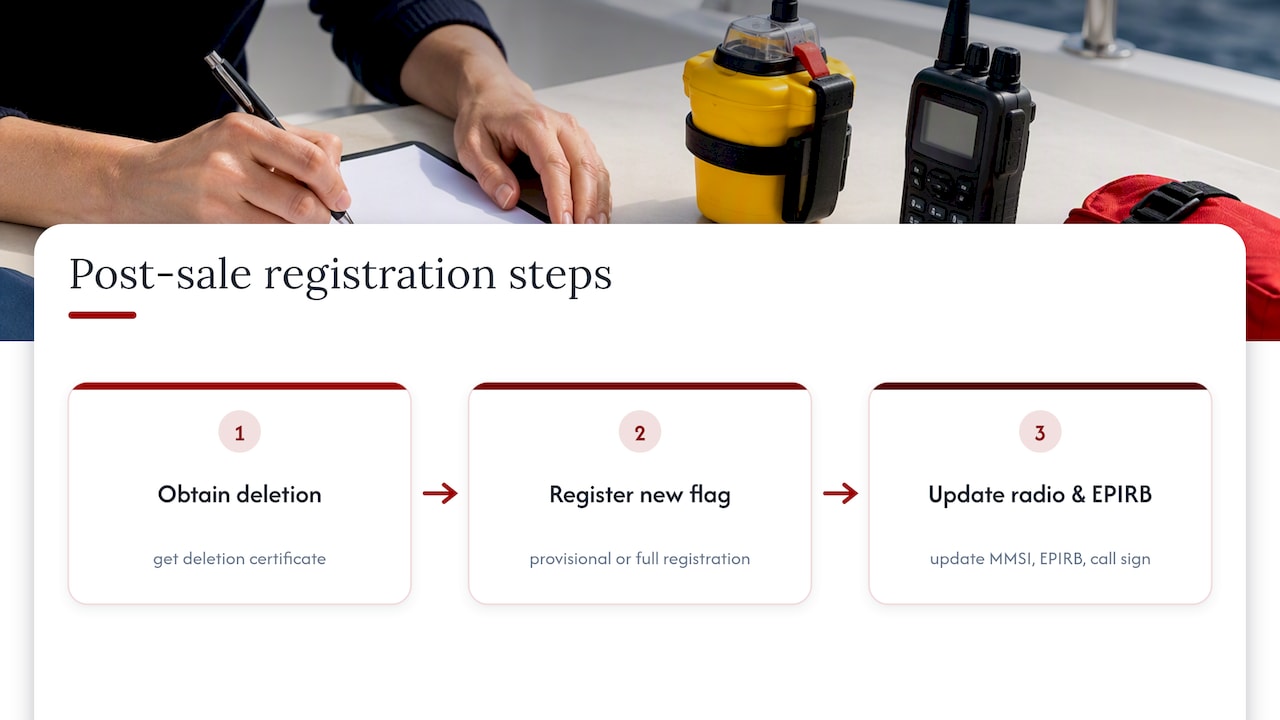
Skipping this step leaves distress equipment registered to someone who no longer owns the vessel, which creates confusion for rescue coordination if it is ever triggered. The practical sequence is to secure the deletion certificate from the old flag, complete the new flag’s provisional or full registration, then update the MMSI and any linked equipment registration to match the new owner’s details and the new call sign.
Brokers handling a sale should treat this as a checklist item alongside the bill of sale and transfer of ownership paperwork, not as something the buyer sorts out later. A transfer of ownership service bundled with the flag change keeps the radio and safety equipment records moving in step with the registry entry instead of trailing behind it.
How Registration Requirements Differ Between Flags
No single international framework standardizes registration procedures across flags. IMO and UN bodies focus on oversight and due diligence rather than issuing one uniform checklist, which is why requirements vary meaningfully from one registry to the next.
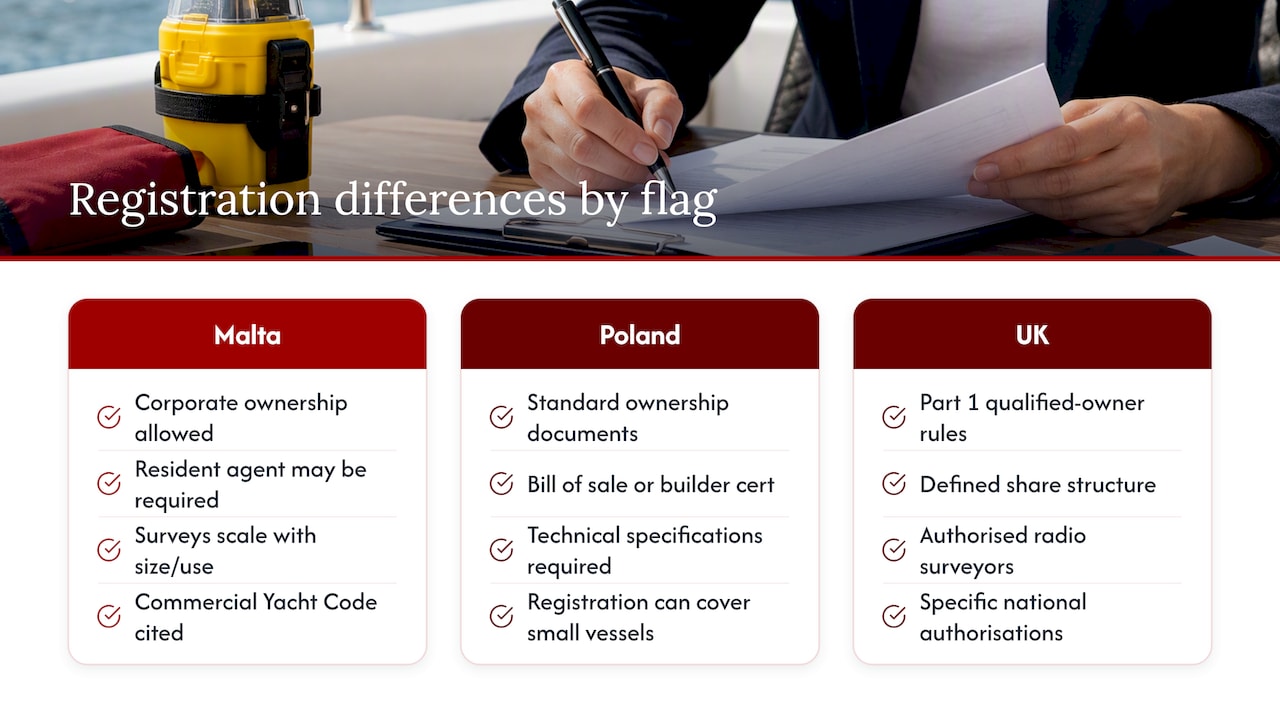
Some registries, including Malta, allow corporate ownership and may require a resident agent when the owner is not based locally, alongside survey and certification requirements that scale with vessel size and commercial use, as outlined in Transport Malta’s Commercial Yacht Code synopsis. Other flags, like Poland, lean on more standard proof-of-ownership documents such as a bill of sale or builder’s certificate alongside technical specifications, and may require registration even for smaller vessels operating outside the owner’s home waters, per Poland’s government guidance on yacht registration.
UK Part 1 registration adds its own layer: specific qualified-owner rules, a defined share structure, and an authorisation framework for who can perform radio surveys on UK-flagged vessels. None of this is better or worse across flags; it just means the paperwork you prepare for Malta will not transfer cleanly to Poland or the UK without adjustment. Confirming the exact document list for your target flag before you start, rather than assuming one registry’s requirements match another’s, is the single biggest time-saver in a cross-flag move.
Checking Whether Your Current Registration Is Still Valid
The fastest way to confirm your registration status is to check the certificate’s expiry date and cross-reference it against your flag’s survey schedule, since a lapsed survey can invalidate a certificate even if the registration document itself looks current. Most registries issue a certificate with a clear validity period tied to survey cycles, so a yacht due for its periodic survey but overdue is technically out of compliance even though the paper certificate has not expired yet.
Port-state control inspections are where gaps usually surface, which is why keeping survey certificates, the MMSI license, and ownership documents together in one file matters more than memorizing renewal dates. If you are unsure whether your registration or linked radio license is current, contacting the registry directly or working through a registration guide that walks through validity checks flag by flag is a faster route than guessing from the certificate date alone.
Why MMSI and DSC Radio Must Match Your EPIRB Registration
Your distress radio identity needs to point to the vessel that is actually flying the flag on your current certificate. When a yacht changes ownership or flag, the MMSI number linked to its DSC radio has to be updated to match, because a mismatch between the registered vessel and the radio identity broadcasting its distress calls creates confusion for rescue coordination exactly when accuracy matters most.
This is not a one-time setup task. Every flag change, ownership transfer, or radio equipment swap is a trigger to revisit the MMSI registration and confirm it still matches the vessel’s current flag, name, and owner. UK guidance is specific on this point: owners must notify the licensing authority and may need to deactivate or transfer satellite equipment registration as part of a flag change. Treating the MMSI update as part of the registration file, rather than a separate errand, keeps the radio identity and the registry certificate telling the same story.
Why a Specialist Registrar Makes the Process Easier
Specialist registrars working across major registries see the document mismatches and survey scheduling conflicts that slow owners down before they become a rejected application. Alongside flag registration, some registrars handle MMSI and AIS setup, insurance consultancy, and corporate ownership structuring, so the radio licensing and the registry paperwork move together instead of in separate queues.
A specialist registrar earns its fee most clearly when ownership is split across a company structure, when you need commercial yacht status for chartering, or when you need provisional entry fast. What you should expect from that kind of support is straightforward: someone managing your document file end to end, coordinating survey bookings with the registry, and giving you one point of contact instead of three.
Start Your Registration With a Specialist Who Handles the Paperwork
We offer fixed-fee flag registration across jurisdictions built for different ownership structures and budgets, from San Marino Yat Kaydı at 290 to 2,990 EUR to Malta Yat Kaydı at a range of prices from low to high EUR with MMSI application handled as part of the Malta package for a separate fee.
Depending on which flag fits your ownership and trading plans, here is where to start:
- UK Part 1 Yacht Registration with pricing that varies depending on vessel specifications, and separate MMSI (OFCOM) registration available for an additional fee.
- Polonya Bayrağı Tescili at prices generally ranging in the mid hundreds EUR, with a Polish MMSI license available for a separate fee.
- Palau Tekne Kaydı at a range of prices from moderate to higher EUR
- Langkawi Yacht Registration with pricing generally ranging from moderate to above moderate EUR, and additional services like transfer of ownership and deletion certificates available for separate fees.
Provisional registration can move in as little as one to seven days once your documents are ready. Send us your ownership papers and tell us which flag fits your plans, and we will take the paperwork from there.
SSS
What does EPIRB registration actually mean for a yacht owner?
In the context of yacht compliance, this refers to registering your vessel under a flag state and keeping the linked radio identity, including MMSI and DSC, current with that registration. It covers ownership documentation, surveys, and radio licensing rather than a standalone emergency beacon signup.
How long does provisional yacht registration usually take?
Provisional registration can be issued within days once ownership and basic technical documents are submitted, and Transport Malta grants a 6-month provisional period, extendable once, while full paperwork is completed. Other flags follow a similar pattern, though exact timing depends on document readiness and survey scheduling.
What documents do I need to start registering a yacht?
You will generally need proof of ownership such as a bill of sale or builder’s certificate, technical specifications including tonnage and engine details, and a deletion certificate if you are switching flags. Corporate ownership structures and non-resident owners may need additional paperwork depending on the flag’s specific rules.
Do I need to update my MMSI number if I change flags?
Yes, changing flags typically requires updating or transferring your MMSI registration so your radio identity matches your current flag and ownership. UK guidance confirms owners must notify the licensing authority and may need to deactivate satellite equipment tied to the previous registration.
Yat bayrağı tescil ücreti ne kadardır?
Costs vary by flag and vessel size; for example, San Marino Yacht Registration runs 290 to 2,990 EUR while UK Part 1 Yacht Registration runs 550 to 1050 EUR. MMSI licensing fees are typically separate and listed alongside each flag’s registration package.
Sources
- Transport Malta — Registration procedure (Superyacht registration)
- IMO — Surveys, verification and certification
- UNCTAD — United Nations Convention on Conditions for Registration of Ships (background on genuine link)
- UK guidance on radio survey service authorisation and MMSI/radio survey procedures (MGN/Notice)