

Notify your flag authority or the National Vessel Documentation Center immediately, then start the replacement application the same day. File CG-1258 for U.S.-documented vessels, or your flag state’s equivalent form, and ask about provisional documentation if you plan to operate before the duplicate arrives. Have your Hull Identification Number, Official Number, and a notarized loss declaration ready before you call.
TL;DR:
- Filing the CG-1258 form immediately and requesting provisional documentation can help you operate the vessel while waiting for the official replacement.
- Complete all required ownership proof and notarized loss declarations before submitting to avoid processing delays and application rejection.
- Federal fees for duplicate certificates are around $9, but additional costs for notarization, courier, and agent services can significantly increase the total expense and processing time.
- Using a registration agent to pre-check signatures and documents can reduce the typical two-week process to a faster turnaround, especially for urgent cases.
- Finding the original certificate after issuing a duplicate requires surrendering it to avoid fraud risks and ensuring compliance with registry rules.
İçindekiler
- How Do You Apply for a Replacement Certificate of Registry?
- What Documents Do You Need for a Duplicate Registry Certificate?
- How Much Does a Replacement Certificate Cost and How Long Does It Take?
- Can You Get a Provisional Certificate While the Vessel Is Abroad?
- What Happens If You Find the Original Certificate Later?
- VesselFlag’s Take on Urgency and Common Delays
- Get Your Replacement Certificate Handled Without the Back and Forth
- Sources
- SSS
How Do You Apply for a Replacement Certificate of Registry?
Losing a certificate of registry feels worse than it is, as long as you move in order. The process is mechanical once you know the sequence, and skipping a step is what turns a two-week fix into a two-month one.
Here’s the order that actually works:
-
Secure the vessel and notify the right people within 24 hours. Tell your insurer, any co-owners, and your crew. If theft is a possibility, file a police report right away. Some state-level duplicate forms, like Florida’s vessel duplicate registration application, explicitly require a police report when the loss involves theft rather than misplacement.
-
Confirm which form applies to your registration. U.S.-documented vessels use CG-1258, the Coast Guard’s application for initial, exchange, or replacement of a Certificate of Documentation. Flag states outside the U.S. system, such as San Marino or Malta, each run their own replacement form through their national registry.
-
Complete the form and gather signatures. CG-1258 needs the owner’s signature and, if a managing owner or corporate officer signs on behalf of an entity, documentation proving that authority.
-
Submit to the correct office. For U.S. vessels, that means the National Vessel Documentation Center, either by mail or through the NVDC’s online portal. State-registered boats typically go through a county tax collector or DMV-equivalent office instead.
-
Request provisional documentation if you need to operate now. 46 CFR §67.169 requires an application for replacement when a Certificate of Documentation is lost, mutilated, or wrongfully withheld, and the NVDC can issue interim proof of documentation while the formal replacement processes.
-
Use an authorized agent for anything time-sensitive. A registration agent can hand-deliver documents, arrange authentication, and flag missing signatures before the registrar rejects the file. That single check often saves a full processing cycle.
Filing the form is not the same as being reissued. The application itself doesn’t entitle the vessel to documentation until the NVDC or flag registrar actually acts on it, so build in buffer time before any deadline that depends on having the certificate in hand.
What Documents Do You Need for a Duplicate Registry Certificate?
Registrars reject incomplete files more often than they reject legitimate loss claims. The paperwork below is what actually clears a duplicate application on the first pass.
- Vessel identifiers: Hull Identification Number, Official Number, IMO number if the vessel carries one, vessel name, and hailing port.
- Ownership evidence: bill of sale, corporate registration documents if the vessel is owned through an entity, and a power of attorney if an agent is filing on your behalf.
- A notarized affidavit or declaration of loss: most registries won’t process a replacement without one, and a police report or consular declaration may be required alongside it if theft is suspected.
- A decision on mutilated versus lost originals: some registries want a damaged original physically surrendered with the application rather than declared lost, so check before you assume “lost” is the right category.
Missing ownership paperwork, particularly an unsigned bill of sale or an absent corporate resolution, is one of the most common reasons applications stall. Assembling a complete documentation checklist before you file saves weeks compared to responding to registrar follow-up requests one at a time.
Pro Tip: Scan and store your HIN, Official Number, and ownership documents in a cloud folder now, before anything is lost. Half the delay in a replacement application comes from owners hunting for numbers they could have photographed in thirty seconds.
How Much Does a Replacement Certificate Cost and How Long Does It Take?
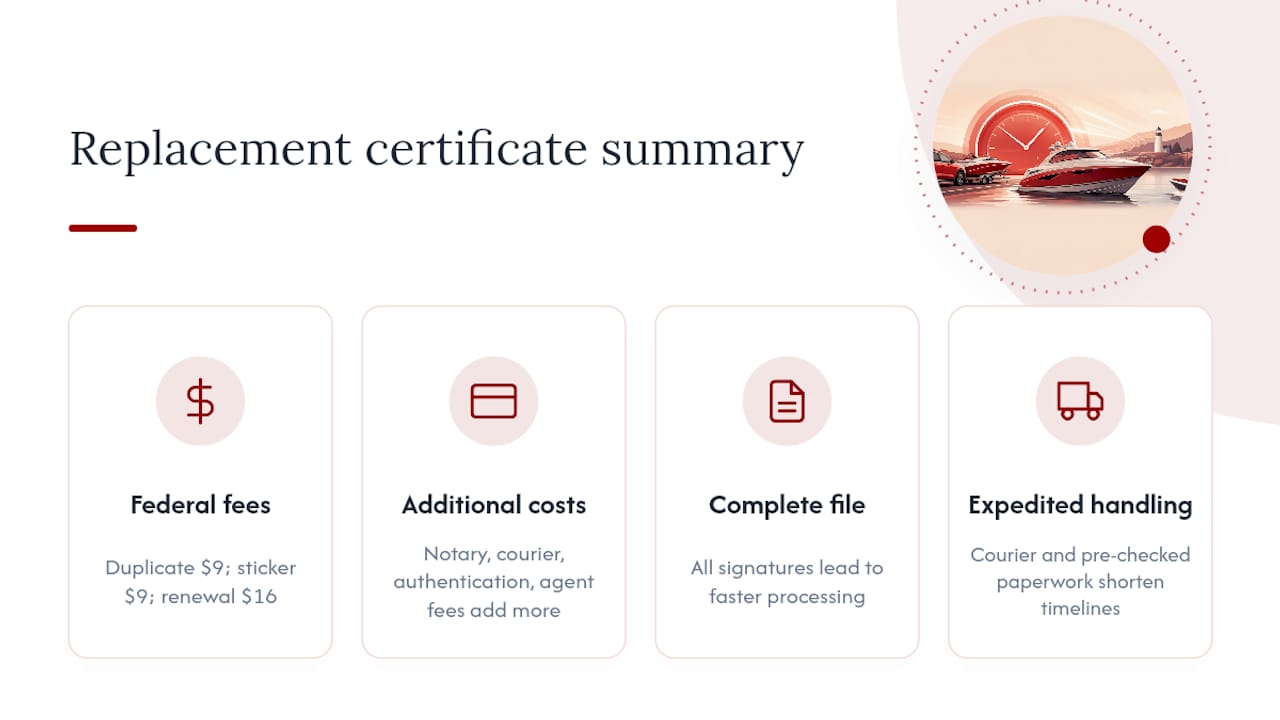
U.S. federal fees for related documents are modest on their own. The eCFR fee schedule under 33 CFR Part 173 lists a duplicate certificate of number at $9, with replacement validation stickers also running $9 and a renewal with two stickers priced at $16.
Those numbers only cover the federal filing fee, not the total cost of getting a replacement in hand. Notarization, courier delivery, authentication for use abroad, and any agent fee for form preparation typically add far more than the base fee itself. Processing timelines vary widely by registry and by how complete the application is on first submission. A clean file with every signature in place moves noticeably faster than one that comes back for corrections, and expedited handling through courier submission and pre-checked paperwork is usually the biggest timeline lever an owner controls.
Can You Get a Provisional Certificate While the Vessel Is Abroad?
A vessel stranded in a foreign port without its certificate has a narrower but workable path. Here’s how it typically plays out:
- Make a notarized or consular declaration of loss. Most registries accept a declaration sworn before a notary or at a consulate as the trigger for provisional authorization.
- Ask the registrar to authorize a provisional certificate. Many flag states empower an “appropriate person,” often a consular officer or registered agent, to issue a temporary document so the vessel can keep operating.
- Confirm the provisional document satisfies port control and your insurer. Some ports and underwriters treat provisional papers as fully equivalent to the original; others ask for additional confirmation from the flag registry.
Pro Tip: Call your insurer before you call the port authority. A provisional certificate that satisfies customs but not your policy leaves you technically compliant and financially exposed at the same time.
Expect to surrender the provisional certificate once the full replacement arrives. That surrender step is what keeps the registry’s records clean and closes the loop on the loss.
What Happens If You Find the Original Certificate Later?
Finding the original after a duplicate has been issued creates a real problem, not a minor inconvenience. Two valid-looking certificates for one vessel is exactly the situation registries and fraud investigators are trained to flag.
- Surrender the recovered original to the issuing registrar as soon as you find it, so the duplicate can be formally reconciled.
- Request written confirmation that the original has been received and canceled, and keep that confirmation with your permanent vessel file.
- Notify your insurer and any mortgagee holding an interest in the vessel that the documentation status has changed.
Holding both documents, even briefly and with no bad intent, puts you on the wrong side of rules built to prevent exactly that.
VesselFlag’s Take on Urgency and Common Delays
Treat a lost Certificate of Registry the way you’d treat a lost passport: as something to fix within days, not months. The vessels that sit undocumented longest almost never have a complicated legal problem. They have an unsigned affidavit, a missing HIN on the application, or an ownership document that never made it into the file.
Authentication and courier steps eat more calendar time than the actual registrar review, especially for owners managing this from a boat that isn’t near a notary or consulate. That’s the specific gap a registration agent is built to close: pre-checking the paperwork before it reaches the registrar, not after it bounces back.
— VesselFlag
Get Your Replacement Certificate Handled Without the Back and Forth
A lost certificate turns into a slow-motion problem the moment paperwork goes back and forth between you and a registrar you’ve never dealt with before. A registration agent can manage the process directly: completing the CG-1258 or flag-specific replacement form, arranging notarized declarations, coordinating authentication and courier delivery, and requesting provisional documentation when a vessel is stuck abroad without papers.
The same team that manages new bayrak tescili across jurisdictions like San Marino, Malta, and the UK applies the same process discipline to replacements, checking ownership evidence and signatures before submission instead of after a rejection. If your vessel also needs MMSI setup or insurance coordination during the gap, those run alongside the replacement request rather than as separate errands. Contact a registration service with your vessel’s HIN or Official Number and current flag state, and expect a specific list of what your registry requires within a day. Start with the flag registration services page to see documentation requirements for your jurisdiction.
Sources
- eCFR — Title 33, Part 173 (subpart D) — Certificates of number fees
- 46 CFR Ch. I — National Vessel Documentation Center — Replacement and exchange rules (subpart references)
- Application for initial, exchange, or replacement of Certificate of Documentation (CG-1258)
- Florida application for vessel duplicate registration, replacement decal, and change of classification (form example)
SSS
What Is the Fastest Way to Replace a Lost Certificate of Registry?
File the correct replacement form, CG-1258 for U.S.-documented vessels, immediately and request provisional documentation if you need to operate before the duplicate arrives. Using a registration agent to pre-check signatures and ownership evidence is the most reliable way to avoid the rejection cycle that causes most delays.
Do I Need a Police Report to Replace a Lost Certificate?
A police report is generally required only when theft is suspected, not for a simple loss. State forms, like Florida’s duplicate registration application, specify this distinction clearly, and most flag-state registries follow a similar rule.
How Much Does a Duplicate Certificate of Registry Cost?
Federal fees tied to certificates of number are small, with a duplicate certificate listed at $9 under 33 CFR Part 173. Total cost runs higher once notarization, courier, and any agent fee for handling the paperwork are added, and VesselFlag’s own service pricing is available on request through its flag registration pages.
What Happens if I Use the Duplicate After Finding the Original?
Holding both the recovered original and an issued duplicate at the same time creates a dual-documentation problem that registries treat as a compliance and fraud risk. Surrender the recovered original to the registrar right away and get written confirmation that it has been canceled.
Can a Vessel Operate Legally Without Its Certificate While Abroad?
A vessel abroad without its certificate can often continue operating under a provisional certificate issued after a notarized or consular declaration of loss. Confirm with your insurer and the relevant port authority that the provisional document is accepted before you rely on it for entry or clearance.