
TL;DR:
- Thorough yacht sea trial documentation provides essential legal evidence for acceptance, rejection, or renegotiation. Proper records include logs, photographs, fluid analysis reports, and surveyor assessments taken at specific times with clear measurements. High-quality documentation supports better deals and smoother registration processes after the trial.
Yacht sea trial documentation is the formal, systematic recording of a yacht’s performance, systems, and condition during its sea trial, serving as the primary evidence for compliance, purchase negotiation, and legal acceptance. The sea trial itself is the industry’s standard method for evaluating a vessel under real operating conditions. Without thorough documentation, buyers lose contractual leverage, sellers face disputes, and surveyors lack the evidence needed to support their findings. Under frameworks like the MYBA sales contract, surveyor reports directly trigger acceptance, rejection, or renegotiation rights. Getting this process right is not optional. It is the foundation of every sound yacht transaction.
What documents are required for yacht sea trial documentation?
Yacht sea trial documentation covers several distinct record types, each serving a specific legal or technical purpose. Together, they form a complete picture of the vessel’s condition and performance on the day of the trial.
The core documents fall into these categories:
- Sea trial log: Records engine hours, RPM readings at each throttle position, vessel speed (GPS and log), fuel consumption rates, water and oil temperatures, and any alarms triggered.
- Surveyor’s checklist and report: The formal written assessment from a qualified marine surveyor, covering structural observations, mechanical findings, and system performance notes.
- Photographs and video: Timestamped visual evidence of defects, smoke patterns, instrument readings, and any unusual conditions observed during the trial.
- Oil and fluid analysis reports: Laboratory results from engine oil, transmission fluid, and coolant samples taken before or during the trial.
- OEM specification references: Manufacturer data sheets confirming whether recorded RPM, speed, and temperature readings fall within acceptable ranges.
- Compliance certificates: Copies of safety equipment certifications, radio licenses, and any flag-state documentation already on board.
- Pre-trial dockside inspection notes: Written records from the cold-start check conducted before leaving the dock.
The IIMS notes that precise, technical, and neutral language combined with photos and measurements strengthens legal and arbitration outcomes. That means every entry in your log needs a timestamp, a unit of measurement, and a clear description. Vague notes like “engine seemed loud” carry no weight in a contract dispute.
| Document type | Primary purpose |
|---|---|
| Sea trial log | Performance baseline and defect record |
| Surveyor report | Legal evidence for acceptance or rejection |
| Photo and video evidence | Visual proof of condition and readings |
| Fluid analysis report | Hidden mechanical wear detection |
| OEM spec references | Confirms whether performance is within factory limits |
How to prepare for a thorough sea trial
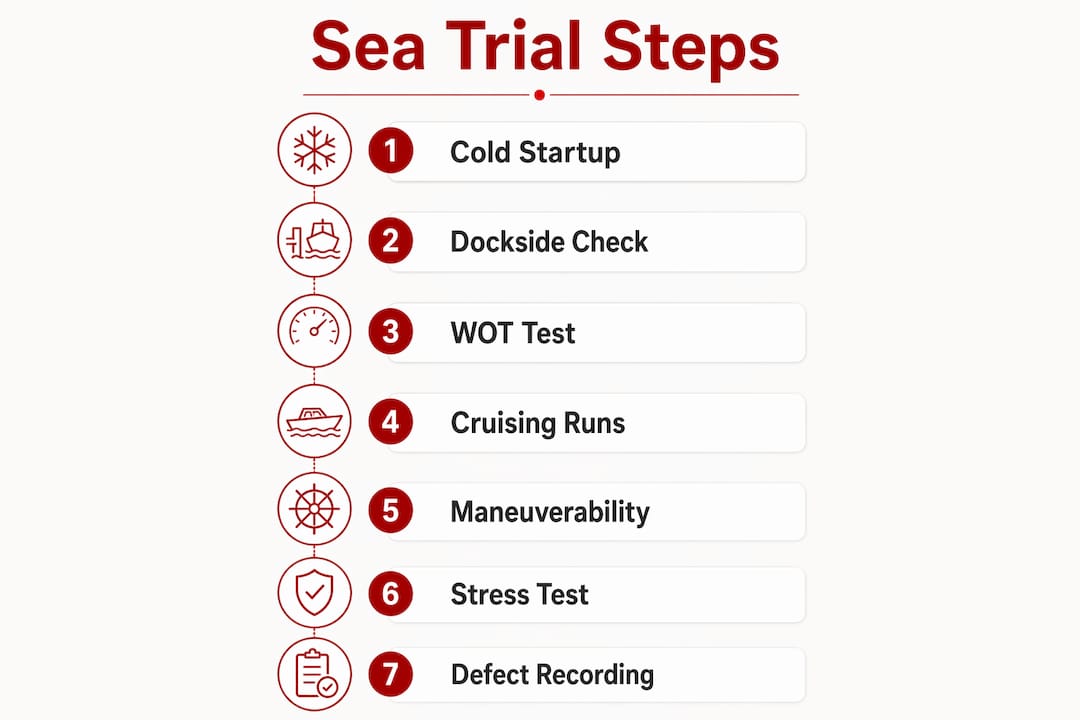
Preparation determines the quality of your documentation before the trial even begins. Arriving without the right people, tools, or prior records guarantees gaps in your report.
The key preparation steps are:
- Engage a qualified marine surveyor. Choose one familiar with the MYBA framework and IIMS standards. Their report carries legal weight; a general inspection does not.
- Book an engine specialist for complex yachts. Diesel mechanics or turbine engineers can interpret readings that a generalist surveyor may miss.
- Gather all prior vessel records. Maintenance logs, previous survey reports, engine service records, and the vessel’s registration documents give you a baseline for comparison.
- Allocate sufficient time. Standard sea trials run 1.5–3 hours for most vessels. Large or complex yachts may require up to four or more hours. Schedule accordingly and do not rush.
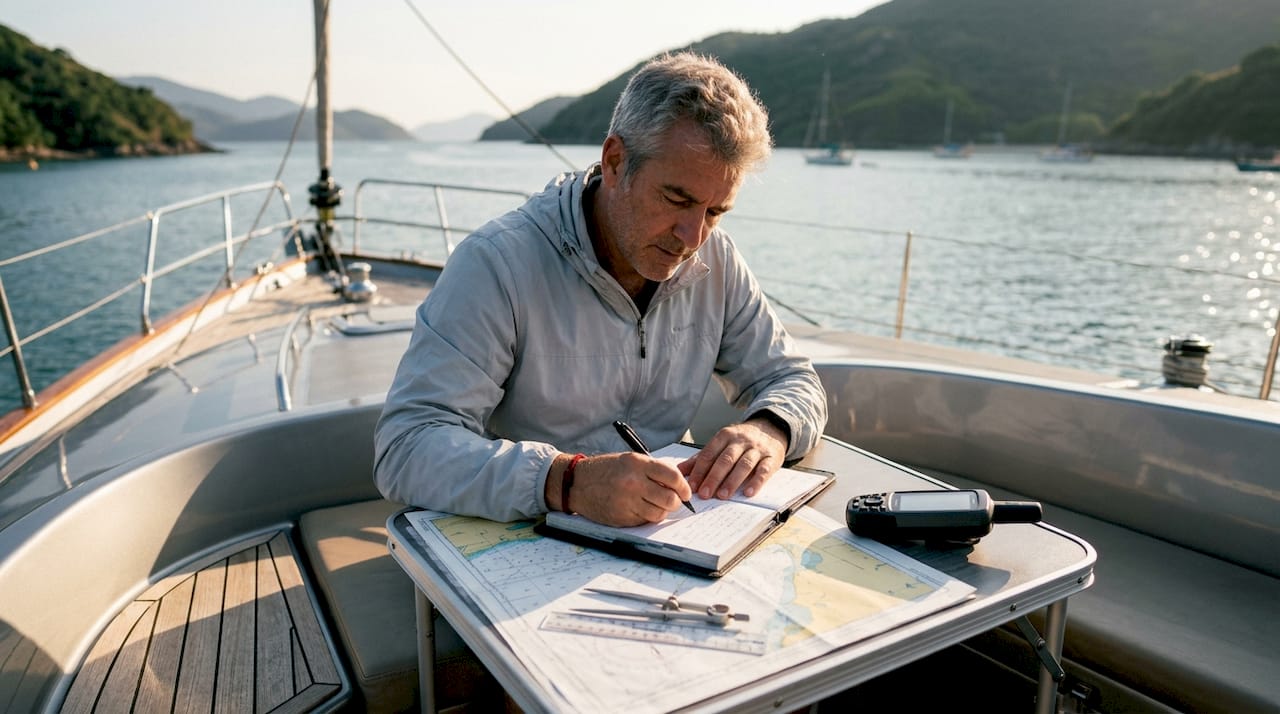
- Prepare your measurement tools. Bring a handheld GPS unit, an infrared thermometer, a vibration meter if available, a camera with timestamp enabled, and a printed sea trial checklist.
- Conduct a dockside cold-start check first. Record engine startup behavior, exhaust smoke color, oil pressure readings, and any warning lights before the vessel moves.
Pro Tip: Ask the seller to confirm the engines have not been run for at least 12 hours before the trial. Cold-start observations reveal exhaust smoke patterns and pressure anomalies that a pre-warmed engine will hide.
The buyer, seller or broker, and captain each play a defined role. The buyer observes and asks questions. The captain operates the vessel. The surveyor documents independently. Mixing these roles creates confusion and weakens the neutrality of the final report.
How to execute the sea trial step by step
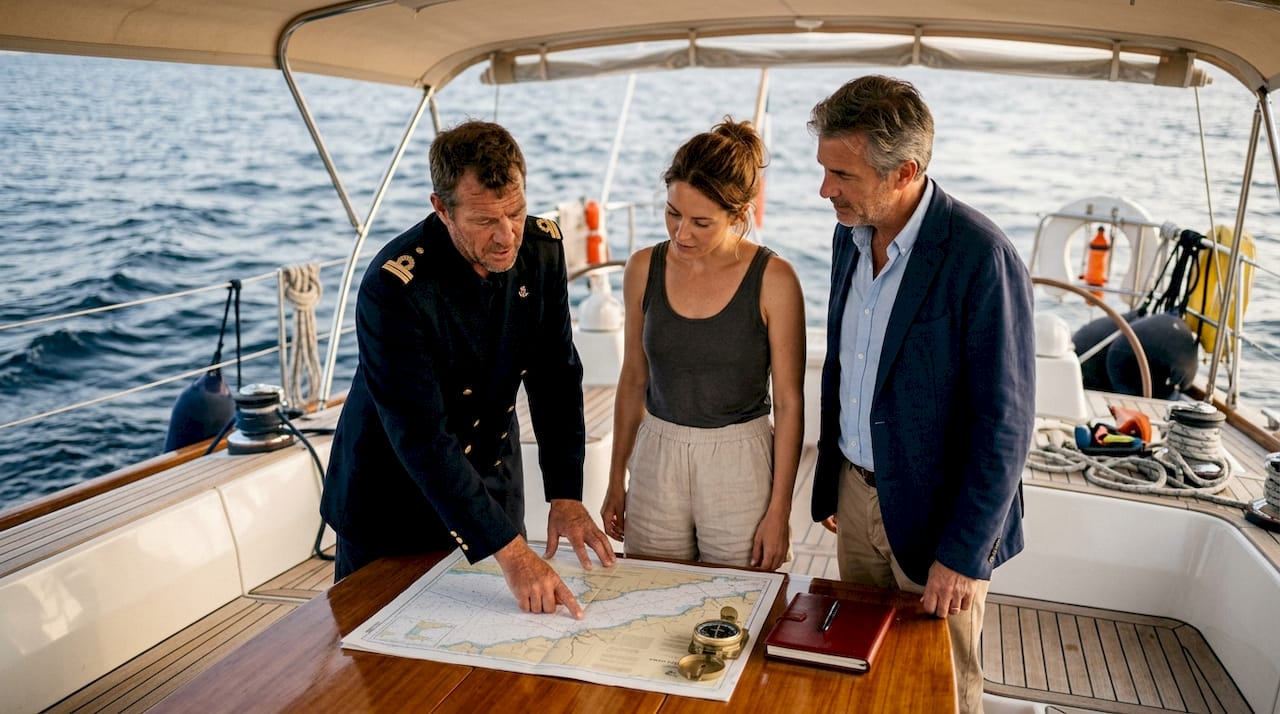
Executing the sea trial in a structured sequence produces documentation that holds up under scrutiny. Skipping steps or recording data out of order creates gaps that are difficult to explain later.
1. Cold engine startup
Start with the engines cold. Record the exact startup time, oil pressure at ignition, exhaust smoke color (white, blue, or black each indicates a different issue), and any warning alarms. Cold start checks identify hard-to-find faults that disappear once the engine reaches operating temperature.
2. Dockside systems check
Before leaving the berth, test all electrical systems, navigation electronics, bilge pumps, and safety equipment. Record which systems are operational and note any failures. This creates a pre-departure baseline separate from underway performance.
3. Wide-Open Throttle (WOT) test
Once clear of the marina, conduct a WOT test. WOT tests run 10–15 minutes at maximum RPM to verify peak engine performance without overheating or triggering alarms. Record maximum RPM achieved, GPS speed, water temperature, oil temperature, and exhaust temperature at the end of the run. Compare these figures against OEM specifications immediately.
4. Cruising speed runs
Drop to cruising RPM ranges, typically 60–80% of maximum, and hold each setting for at least five minutes. Record fuel consumption, temperatures, and speed at each load point. This data tells you what the vessel actually costs to operate, not what the brochure claims.
5. Maneuverability evaluation
Test hard-over turns to port and starboard, noting steering response time and any resistance or play in the helm. Record stopping distance from cruising speed. Document how the vessel tracks in a straight line without helm correction.
6. System stress test
Run all major electrical loads simultaneously: air conditioning, navigation electronics, entertainment systems, and galley equipment. Record whether voltage drops, circuit breakers trip, or generator behavior changes. Surveyors cannot inspect sealed structures, so load-based testing is the only way to expose faults in wiring and power distribution.
7. Real-time defect recording
Log every unusual noise, vibration, smell, or alarm the moment it occurs. Include the time, the vessel’s speed and heading, and the RPM at the moment of the event. Delayed notes introduce inaccuracy and reduce credibility.
Pro Tip: Assign one person solely to documentation during the trial. The surveyor observes and assesses. A second person, ideally the buyer or their representative, takes timestamped photos and maintains the running log. Splitting these tasks prevents either record from being incomplete.
The sea trial documentation must detail load-specific engine and system parameters including RPM, temperature, vibration, fuel consumption, alarms, and handling metrics to be effective as a legal and technical record.
Common pitfalls in sea trial documentation
Even experienced buyers make documentation errors that reduce the report’s value. Knowing the most common mistakes helps you avoid them.
- Vague or missing entries. Notes without timestamps, units, or specific conditions are nearly impossible to use in a contract dispute. Every entry needs a time, a measurement, and a context.
- Pre-warmed engines. Sellers sometimes run engines before the buyer arrives. Pre-warming masks cold-start faults including exhaust smoke and pressure anomalies. Confirm engine temperature at arrival.
- Too many people on board. Non-essential guests create distractions. A focused, professional environment is required to monitor systems accurately and maintain documentation quality.
- No visual evidence. Written notes without photographs are weak. Every defect, every instrument reading, and every unusual condition should have a timestamped photo or video clip.
- Missing contractual deadlines. Under the MYBA framework, survey and sea trial findings must be reported within defined windows. Missing these deadlines can forfeit the buyer’s right to reject or renegotiate.
- Ignoring safety alarm responses. If an alarm sounds and the captain resets it without explanation, document the alarm, the time, and the response. Unexplained alarm resets are a red flag.
“Surveyor reports serve as primary legal evidence affecting contractual acceptance, rejection, or renegotiation under MYBA sales contracts. Documentation that is objective, timely, and well-evidenced is the standard the industry expects.”
— IIMS, MYBA Sales Contract Analysis
One more point worth emphasizing: about 95% of survey findings are routine maintenance items, not defects that materially affect value. Document everything, but focus your negotiation energy on findings that affect safety, structural integrity, or major mechanical systems.
Önemli Noktalar
Thorough yacht sea trial documentation requires structured execution, neutral language, timestamped evidence, and alignment with MYBA contractual standards to protect buyers and sellers alike.
| Nokta | Detaylar |
|---|---|
| Documentation is legal evidence | Surveyor reports directly trigger acceptance, rejection, or renegotiation rights under MYBA contracts. |
| Cold-start checks are non-negotiable | Engines must be cold at trial start to reveal exhaust faults and pressure issues pre-warming hides. |
| WOT tests need full recording | Log RPM, GPS speed, and temperatures during the 10–15 minute WOT run and compare against OEM specs. |
| Neutral language protects all parties | Objective, timestamped notes with photos carry far more weight in disputes than subjective descriptions. |
| Focus negotiation on material defects | Roughly 95% of findings are maintenance items; prioritize safety and structural issues in any renegotiation. |
Why documentation quality decides the deal
At Vesselflag, we have worked with yacht owners across dozens of flag jurisdictions, and the pattern is consistent: the buyers who arrive with thorough, neutral, timestamped documentation walk away with better deals or cleaner transactions. The buyers who treat the sea trial as a formality often discover expensive problems after the contract closes.
The conventional wisdom is that hiring a good surveyor is enough. It is not. The surveyor’s report is only as strong as the supporting evidence gathered during the trial. A surveyor who notes “possible gearbox slip” without a logged RPM drop, a video clip, and a temperature reading has given you an observation, not evidence. That distinction matters enormously when you are trying to renegotiate $50,000 off a purchase price.
Well-documented sea trial findings frequently enable price reductions that exceed the total cost of the survey. That is the clearest argument for investing in proper documentation. The trial pays for itself.
One thing buyers consistently underestimate is the value of their own presence and active participation. You do not need to be a marine engineer. You need to be present, observant, and asking questions in real time. The surveyor documents the vessel. You document the process, the responses, and the context. Together, those two records are far stronger than either one alone.
After a successful trial, the next step is getting your yat kaydi in order. Sea trial documentation feeds directly into the compliance and registration process, and having clean records from day one makes that transition straightforward.
— Vesselflag
Vesselflag helps you move from sea trial to registered vessel
A successful sea trial is the start of ownership, not the finish line. Once your documentation confirms the vessel meets your standards, registration and compliance become the immediate priority.
Vesselflag specializes in yacht registration across multiple international flags including Malta, UK Part 1, San Marino, Palau, and others, with fast processing and full compliance support. Your sea trial report and survey documents feed directly into the registration process, and having them organized from the outset saves significant time. Vesselflag’s team guides owners through every required document, flag selection, and compliance step. Visit Vesselflag’s yacht registration guide to see exactly what comes next after your sea trial is complete.
SSS
What is a yacht sea trial?
A yacht sea trial is a structured underway test of a vessel’s engines, systems, and handling characteristics conducted before purchase or delivery. It produces the documentation used to evaluate performance and support contractual decisions.
How long does a yacht sea trial take?
Standard sea trials last 1.5–3 hours for most vessels. Large or complex yachts may require up to four or more hours to test all systems adequately.
What should a sea trial report include?
A complete sea trial report includes engine RPM and temperature logs, GPS speed data, WOT test results, maneuverability observations, system stress test outcomes, timestamped photographs, and the surveyor’s formal written assessment.
Can sea trial findings be used to renegotiate the purchase price?
Yes. Under the MYBA sales contract framework, surveyor reports serve as primary legal evidence supporting acceptance, rejection, or price renegotiation. Well-documented defects give buyers direct contractual leverage.
Who should be present during a yacht sea trial?
The buyer, the seller or their broker, the captain, and a qualified marine surveyor should be present. Non-essential guests should be excluded to maintain focus and protect the quality of observation and documentation.