

TL;DR:
- Proper vessel registration ensures legal compliance, avoids port detention, and secures insurance coverage.
- Choosing the right flag depends on cruising region, budget, insurer acceptance, and long-term plans.
- Working with an experienced agent streamlines the process, reduces delays, and maintains ongoing compliance.
Crossing international waters without compliant vessel registration isn’t just inconvenient. It can mean port detention, denied insurance claims, and costly legal exposure. For boat owners and operators who move between jurisdictions, the stakes of getting registration right are genuinely high. The good news is that the process doesn’t have to be a maze. With the right flag choice, organized documentation, and a clear sequence of actions, you can register your vessel efficiently, stay inspection-ready, and operate with full legal confidence anywhere in the world. This guide walks you through every stage.
Índice
- What to prepare before you start
- Step-by-step boat registration process
- Common pitfalls and how to avoid them
- Verifying and maintaining your registration
- Our perspective: Why one-size-fits-all advice leads to the biggest mistakes
- How Vessel Flag can make registration effortless
- Frequently asked questions
Principais conclusões
| Ponto | Detalhes |
|---|---|
| Choose the right flag | Match your operational area and budget to the most suitable flag to avoid future headaches. |
| Follow all steps | Each stage of boat registration is critical—missing even one can cause costly delays. |
| Stay compliant long-term | Keep annual renewals and inspections on schedule to maintain uninterrupted global access. |
| Use expert help | Professional agents can drastically reduce time and ensure your paperwork is error-free. |
What to prepare before you start
Before you submit a single form, you need a clear picture of what each flag state requires and what it will cost you. Skipping this step is the single most common reason registration stalls. Different flags have different document demands, fee structures, and processing timelines, and knowing these upfront saves weeks of back-and-forth.
Here’s a core checklist of documents almost every major registry will require:
- Proof of ownership: Bill of sale, builder’s certificate, or previous registration certificate
- Tonnage certificate: Measurement of gross and net tonnage, often issued by a recognized classification society
- Safety certificates: SOLAS compliance documents or equivalent for the vessel’s size and use
- Owner identification: Passport copies, corporate documents if the vessel is company-owned
- Agent appointment letter: Required by most flag states when using a third-party registration agent
- Deletion certificate: Proof that the vessel has been removed from any previous registry
Now compare the three most popular international flag options side by side:
| Bandeira | Estimated registration fee | Typical processing time | Key regulatory benefit |
|---|---|---|---|
| Ilhas Marshall | $1,500 to $3,500 | 5 to 10 business days | Paris MOU white-list, global recognition |
| Ilhas Caimão | $2,000 to $5,000+ | 3 to 6 weeks | Red Ensign prestige, strong insurer acceptance |
| Malta | $1,200 to $3,000 | 2 to 4 weeks | EU flag, Mediterranean cruising advantage |
As the flag comparison insight from Yacht Cost Calculator notes, popular flags for international yachts carry distinct regulatory benefits and fee structures that directly affect your operating costs and inspection frequency. Understanding these differences before you commit is essential.
Your budget and cruising plans should drive the flag decision. If you spend most of your time in Mediterranean waters, Malta’s EU status is a practical advantage. If you need global recognition with fast turnaround, Marshall Islands registration is a strong contender. For prestige and insurer acceptance in Atlantic and Caribbean routes, Cayman Islands requirements are worth the extra process rigor. You can also review registration cost factors to model your total spend before committing.
Pro Tip: Don’t pick a flag because it’s popular. Pick it because it matches where you cruise, what your insurer accepts, and what your budget can sustain long-term.
Step-by-step boat registration process
With your documents in order, follow this walkthrough to move from intention to legal registration. Each step builds on the last, and skipping ahead almost always creates delays.
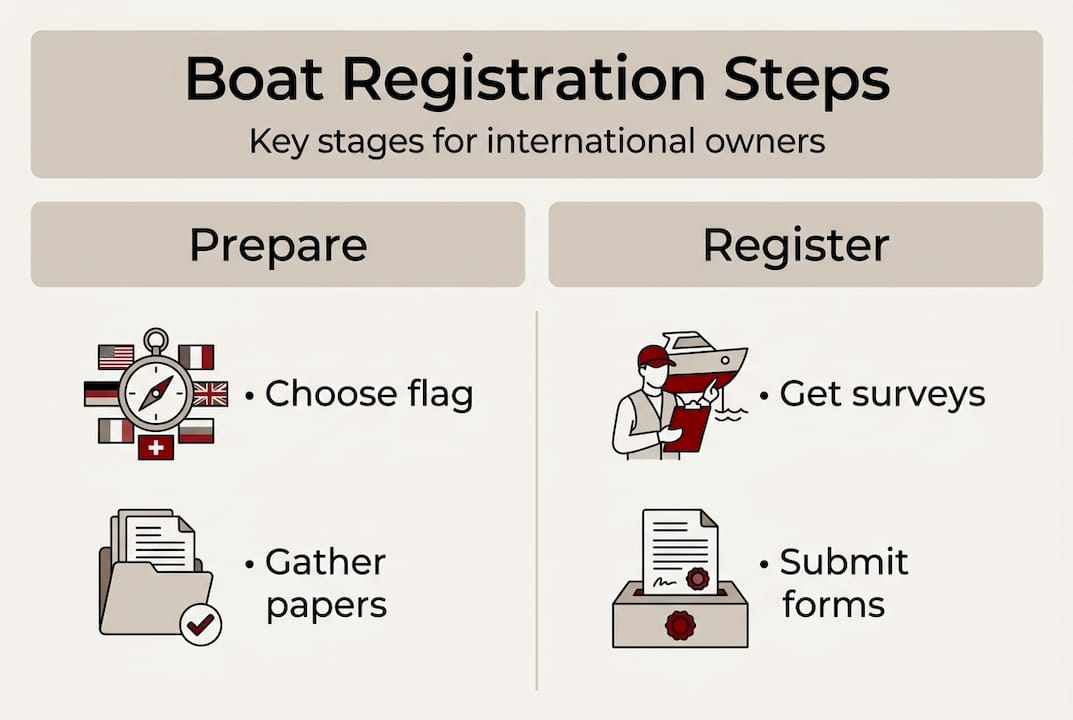
- Choose your flag state. Evaluate options based on cruising region, cost, and insurer requirements. Commit before gathering documents, since each flag has specific format requirements.
- Prepare and authenticate your documents. Notarize ownership proof, obtain your tonnage certificate from a recognized classification society, and compile all identification. Some flags require apostille authentication.
- Appoint a registered agent. Most flag states require a local agent or authorized representative to submit on your behalf. This is where using a professional service pays off immediately.
- Submit your application. Your agent submits the full document package to the relevant registry authority. Incomplete submissions are the leading cause of rejection.
- Undergo survey or inspection (if required). Cayman Islands, for example, requires a class society survey as part of the formal Cayman process, including Red Ensign compliance verification and specific CISR forms.
- Receive your provisional or permanent certificate. Most registries issue a provisional certificate first, valid for 6 to 12 months, while the permanent certificate is processed.
- Set up MMSI and AIS. Once registered, configure your vessel’s radio identification to match the new flag state’s requirements.
Here’s how timelines typically break down by flag:
| Bandeira | Provisional certificate | Permanent certificate | Survey required? |
|---|---|---|---|
| Ilhas Marshall | 1 to 3 days | 2 to 4 weeks | Not always |
| Ilhas Caimão | 1 to 2 weeks | 4 to 6 weeks | Yes, class society |
| Malta | 1 to 2 weeks | 3 to 5 weeks | Depends on vessel size |
Using a registration agent can cut lead times by up to three times compared to self-filing. Review efficient registration steps e registration best practices to understand exactly what each stage demands and where agents add the most value.
Pro Tip: Request a provisional certificate immediately upon submission. It lets you operate legally while the permanent certificate is processed, which matters if you have a charter or passage scheduled.
Common pitfalls and how to avoid them
Once you know the steps, it’s just as vital to avoid derailers that stall efficient registration or raise legal risks. Most problems are predictable and preventable.
The most frequent mistakes boat owners make include:
- Missed renewal deadlines: Registration certificates expire. Missing the annual renewal window can invalidate your status entirely, leaving you technically unregistered while underway.
- Incomplete document packages: Submitting without a deletion certificate from a prior registry, or with an expired tonnage certificate, triggers automatic rejection and restarts the clock.
- Flag mismatch with cruising area: Registering under a flag that isn’t recognized by port state control authorities in your primary cruising region leads to more frequent inspections and potential detention.
- Ignoring insurer requirements: Some insurers won’t cover vessels under certain flags. This is a hard constraint that should be checked before you choose a registry.
- Letting class society surveys lapse: For flags like Cayman Islands, a lapsed survey doesn’t just affect your registration. It can void your insurance and restrict charter operations.
“Efficient registration prioritizes white-list flags for minimal inspections and insurer acceptance.”
As the compliance guidance from Yacht Cost Calculator confirms, vessels registered under efficient flags face fewer port state control inspections and are more readily accepted by insurers. Choosing the wrong flag or missing procedural steps can lead to detention and coverage denial.
If you’ve already made one of these mistakes, the fix usually starts with contacting your registry directly and requesting a grace period or expedited review. Working with an agent at this stage is especially valuable. Explore challenge prevention strategies and compare best registration services to find the right support for your situation.
Verifying and maintaining your registration
Completing your registration is just the start. Staying compliant requires consistent follow-through, and the consequences of letting things lapse are serious.
Here’s how to keep your registration valid and inspection-ready year-round:
- Track your renewal date. Mark it in your calendar 90 days before expiry. Most registries send reminders, but don’t rely on them.
- Renew your tonnage and safety certificates. These supporting documents often have their own expiry cycles, separate from the main registration certificate.
- Schedule class society surveys on time. As the annual survey requirements for the Cayman Islands make clear, annual renewal and document checks are mandatory for all major registries, and a class society survey is required to maintain Cayman status.
- Update ownership or flag details promptly. Any change in ownership, vessel name, or home port must be reported to the registry within a specified window, typically 30 days.
- Maintain a complete on-board document file. Port state control officers will ask for your registration certificate, tonnage certificate, safety certificates, and crew documentation at any inspection.
Your on-board compliance file should always include:
- Original or certified copy of the registration certificate
- Current tonnage certificate
- Valid safety and radio certificates
- Insurance policy documents
- Crew list and officer certificates
For a full breakdown of what each stage demands, the global registration process guide and the registration checklist are practical references to keep bookmarked.
Pro Tip: Keep both a physical binder and a cloud-synced digital folder with all your registration documents. If you’re boarded for inspection in a remote port, having instant digital access can resolve questions in minutes rather than hours.

Our perspective: Why one-size-fits-all advice leads to the biggest mistakes
Here’s something most registration guides won’t tell you: following popular advice can cost you more than ignoring it. We’ve seen owners choose Marshall Islands because every forum recommends it, only to discover their primary insurer doesn’t accept it for their vessel class. We’ve seen others register under Malta because they cruise the Mediterranean occasionally, then spend three times more on compliance costs than a more targeted flag would have required.
The uncomfortable truth is that the “best” flag is entirely situational. Your cruising region, your crew’s nationalities, your charter ambitions, your insurer’s approved list, and your long-term ownership plans all feed into the right answer. Generic checklists can’t account for that. Only a strategic conversation about your specific operation can.
Choosing the right flag isn’t a one-time decision either. As your operation evolves, so should your flag strategy. Owners who treat registration as a living decision rather than a box to check consistently save money and avoid inspections. If you’re also considering ownership structure, corporate registration insights can open up additional flexibility that individual registration simply doesn’t offer.
How Vessel Flag can make registration effortless
If you’re ready to set course with peace of mind, here’s how Vessel Flag makes the process even easier.
Em VesselFlag.com, we handle the complexity so you can focus on your voyage. From flag selection tailored to your cruising region and insurer requirements to full document preparation and submission, our team guides you through every stage. Whether you’re comparing boat vs yacht registration options, working through your first yacht registration guide, or ready to explore all available flag registration services, we provide the expertise and support to get it done right the first time. No guesswork, no delays, just compliant registration built around your specific needs.
Frequently asked questions
Which flag is best for international boat registration?
The ideal flag depends on your budget, cruising region, and compliance needs. Marshall Islands, Cayman Islands, and Malta are leading choices because of their regulatory advantages and broad insurer acceptance.
How long does boat registration normally take?
Standard international boat registration typically takes 2 to 6 weeks, though working with a professional agent can cut registration time significantly, sometimes by up to three times.
What documents are needed for boat registration?
You’ll typically need proof of ownership, a tonnage certificate, safety certificates, and owner identification. Flags like Cayman Islands also require specific survey forms and class society compliance documentation.
What happens if I miss a renewal or inspection?
Missing a renewal or mandatory survey can invalidate your registration and restrict your insurance coverage. As confirmed by Cayman registry requirements, annual renewal and survey compliance are non-negotiable for maintaining valid status.