

Your commercial yacht survey schedule lives on the vessel’s Certificate of Survey, Certificate of Compliance, or Certificate of Inspection, issued by your flag administration or the classification society acting on its behalf. That document lists your certificate’s expiry date, the surveys required to keep it valid, and which authority signs off on each one.
Four things to do this week if you have not already:
- Pull your certificate and check the expiry date against today’s date.
- Calculate your annual, intermediate, and renewal windows from that anniversary.
- Confirm whether your flag has delegated statutory surveys to a Recognized Organization or whether the flag itself must attend.
- Call your surveyor and insurer now, not the month your window opens.
Certificates of survey are issued with the survey schedule built in, and owners are on the hook for meeting it. Miss the annual inspection window and the certificate can lapse, which grounds the vessel commercially until it is put right.
Principais conclusões
Meeting a commercial yacht survey schedule comes down to reading your certificate correctly, knowing who holds delegated authority, and booking surveys well ahead of statutory windows.
| Ponto | Detalhes |
|---|---|
| Find the schedule on your certificate | The Certificate of Survey or Compliance lists expiry dates and required survey types directly. |
| Respect the annual window | Most five-year certificates require annual inspection within three months either side of the anniversary date. |
| Confirm delegation | Check whether your flag or a Recognized Organization performs statutory surveys, and record both contacts. |
| Align class and flag attendances | Mapping both rulebooks together before drydock reduces repeat surveyor visits and lost charter days. |
| Get help tracking deadlines | Vesselflag centralizes certificate expiry, delegation status, and registration documentation for owners managing this calendar. |
Índice
- What Determines Your Commercial Yacht Survey Schedule?
- What Survey Types and Frequencies Apply to Your Yacht?
- How Do Vessel Size and Trade Status Change the Schedule?
- How Do You Read Survey Dates on Your Certificate?
- Who Performs Statutory Surveys on Commercial Yachts?
- How Should You Align Class and Flag Surveys?
- What Lead Times Should You Plan For?
- What Owners Miss Most When Scheduling Surveys
- Let Vesselflag Keep Your Survey Calendar on Track
- Sources
- FAQ
What Determines Your Commercial Yacht Survey Schedule?
Three parties typically shape the schedule: the flag administration that issues your certificate, the classification society or Recognized Organization that may carry out the technical inspections, and, separately, your insurer. Port-state control and, for U.S.-flagged inspected vessels, the Coast Guard under 46 CFR add another layer depending on where the yacht trades.
Most flags do not send their own surveyors to every yacht. They delegate the statutory survey work to an approved Recognized Organization or class society, while the flag retains ultimate oversight of compliance. Commercial Yacht Code provisions spell this out explicitly: delegation to Recognized Organisations and Appointed Surveyors is permitted, but the administration keeps oversight and the owner keeps the responsibility. Delegation is not a formality. It decides:
- Who physically attends the vessel for each survey.
- Which technical rulebook (flag or class) governs the pass/fail standard.
- How the audit and survey windows get calculated against your certificate.
Pro Tip: Check the delegation statement printed on your Certificate of Survey and save the Recognized Organization’s direct contact details in your compliance folder. When a survey is overdue by even a few weeks, you want a phone number, not a general inquiry form.
Understanding this split matters more than most owners realize until their flag administration compliance requirements collide with class deadlines that were never synchronized in the first place.
What Survey Types and Frequencies Apply to Your Yacht?
A commercial yacht’s schedule usually runs through five recurring survey types, each with a different rhythm.
- Annual inspection — a yearly check confirming the vessel still meets the conditions of its certificate. For a five-year Large Commercial Yacht Certificate, these inspections must fall within a three-month window either side of the certificate anniversary. Miss that window and the certificate can be invalidated.
- Intermediate survey — a more detailed mid-cycle check, often around the halfway point of a five-year certificate, covering structural and machinery items the annual inspection does not.
- Special or renewal survey — the full inspection due at the end of the certificate’s validity period, typically five years, that resets the clock for another cycle.
- Bottom or drydock survey — an underwater hull inspection required, for many classes and flags, at least twice within every five-year period.
- Pre-charter and damage surveys — condition checks demanded by charter brokers, insurers, or triggered by an incident, run independently of the statutory calendar.
Registries differ on exact rhythm. Isle of Man guidance, for instance, requires surveys twice in every five-year period with no more than 36 months between visits, plus a mandatory pre-registration survey before the vessel ever flies the flag. Insurers frequently layer their own condition survey requirement on top, often every one to five years depending on vessel age and claims history, regardless of what the statutory calendar says.
A practical anchor: if your certificate expires June 24, your annual inspection window opens March 24 and closes September 24 every year, and your renewal survey is due before June 24 five years out.
How Do Vessel Size and Trade Status Change the Schedule?
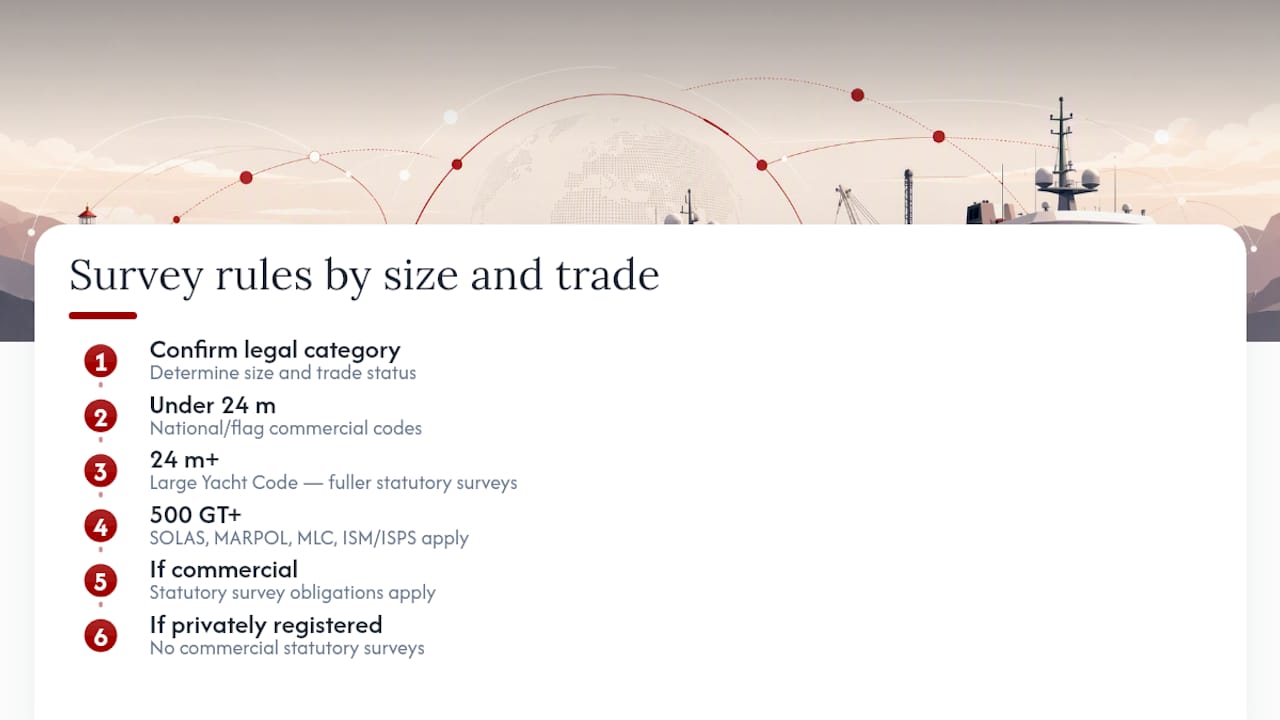
Length and tonnage thresholds change which rulebook governs your yacht, and with it, which surveys apply. Vessels under 24 meters generally sit under lighter national or flag-specific commercial codes. Cross 24 meters and you typically move into Large Yacht Code territory, which pulls in a fuller set of statutory certificates and survey cycles, closer to those governing small commercial ships. Reach 500 gross tons and international conventions like SOLAS and MARPOL start applying in full, alongside MLC crew welfare requirements and ISM/ISPS management codes.
Trade status matters just as much as size. A yacht certified for commercial charter carries statutory survey obligations a privately registered vessel of the same size never faces. A 25-meter commercial yacht will typically carry a Large Commercial Yacht Certificate with a five-year statutory cycle and annual inspections. A 20-meter commercial yacht under a national code might face a shorter certificate term or a different inspection interval entirely. Confirming which category your vessel falls under legally is the first step, not an afterthought.
How Do You Read Survey Dates on Your Certificate?
Three dates on your Certificate of Survey matter, and confusing them is the single most common scheduling error owners make.
- Issue date — when the certificate was first granted or last renewed.
- Anniversary date — usually the same calendar date each year, used to anchor the annual inspection window.
- Expiry date — the hard deadline by which a renewal survey must be complete.
Work backward from expiry. A certificate expiring June 24, 2029 sets annual inspection windows of March 24 to September 24 in each intervening year, with the special/renewal survey due before the 2029 expiry itself.
Before you build your calendar, confirm four things:
- Whether statutory surveys are delegated to a Recognized Organization or require the flag itself.
- Every certificate on board that carries its own annual, intermediate, or five-year cycle.
- Any insurer-mandated condition survey dates layered on top.
- What triggers a full renewal survey versus a routine annual inspection, since these are not interchangeable and a missed annual can force an early renewal.
Who Performs Statutory Surveys on Commercial Yachts?
Most statutory work is carried out by classification societies and Recognized Organizations acting under authority delegated by the flag, not by flag civil servants themselves. Registries typically publish a table mapping each certificate type to the authority responsible for issuing and periodically surveying it, and it is worth checking that table against your own paperwork rather than assuming.

A flag surveyor visit means an official from the flag administration itself attends. A class or RO surveyor visit means a classification society employee, approved by your flag to act on its behalf, conducts the inspection and reports back. Functionally similar to the owner, procedurally different when something goes wrong, since appeals and remediation routes differ between the two.
Keep the Recognized Organization’s contact details and your flag’s compliance office details in the same folder as your certificates, and re-verify the delegation entries every time you renew registration or change flag.
How Should You Align Class and Flag Surveys?
O accepted industry method for a yacht over 24 meters is to map flag statutory requirements and classification technical rules together, then schedule one attendance that satisfies both wherever the rules allow it. Separate visits for overlapping items waste surveyor time and charter days.
A workable planning sequence looks like this:
- List every survey item required by your certificate and by your class notation.
- Flag the items that overlap, since these can often be signed off in a single attendance.
- Schedule drydock or bottom work to capture every underwater inspection due in that window, not just the one that triggered the yard visit.
- Notify your insurer and Recognized Organization early, not after the yard slot is booked.
Pro Tip: Before a major refit or drydock, cross-check your class specification against your flag’s specific wording line by line. A common and costly mistake is meeting the class standard in full while missing a flag-specific procedural requirement, which forces rework after the yard has already closed up the vessel. Coordinating this with your boat survey planning checklist ahead of time saves a second yard visit.
What Lead Times Should You Plan For?
Annual inspections generally need a few weeks’ notice to book a surveyor, assuming no drydock is involved. Special/renewal surveys and drydock work need months of lead time, since yard slots and surveyor calendars both fill up well ahead of the deadline. Pre-charter condition surveys can often be arranged in days to a couple of weeks, depending on scope and how far the yacht is from its intended charter base.
What stretches a timeline: drydock unavailability, surveyor scheduling conflicts, outstanding rectifications from a prior inspection, a complex refit scope, and paperwork that has to move across two or more jurisdictions.
- Start booking five-year renewal and drydock windows at least six to twelve months out.
- Keep your rectification list current so you are not paying for a second surveyor visit.
- Coordinate insurer condition surveys with your RO’s calendar instead of running them separately.
What Owners Miss Most When Scheduling Surveys
The mistakes I see repeated most often are not technical, they are administrative. Owners lose track of which body delegated their statutory surveys, let an annual window slip by a few weeks, or plan a refit against class specifications without checking the flag’s own procedural wording. Insurer condition surveys get treated as an afterthought until a claim gets contested.
The fix is unglamorous: keep a rolling five-year compliance calendar and put one person, owner or manager, in charge of every survey booking and follow-up. Split responsibility is how deadlines get missed.
Let Vesselflag Keep Your Survey Calendar on Track
Vesselflag centralizes what most owners track across scattered emails and a certificate folder: expiry dates, delegation status, and the Recognized Organization or insurer contact you need at each stage of the cycle. Instead of chasing your flag registry and class society separately every time a window opens, you get one point of coordination that flags upcoming deadlines before they turn into a lapsed certificate.
That matters most right when a certificate is close to renewal, a flag switch is on the table, or you are bringing a newly commercial yacht into the fleet and need the paperwork built correctly from day one. If your registration documentation needs a review before your next survey window opens, start with Vesselflag’s guide on how to register a yacht and get your certificate status confirmed before it becomes a scheduling emergency.
Sources
For delegation questions, check your flag registry’s own survey pages. For technical cycle questions, consult your classification society directly, and review IMO’s conventions for statutory baselines that apply above tonnage thresholds.
- Yacht – Survey & Audit Certification | MACI
- Superyacht Survey & Inspection: What Large Yacht Owners Must Know
- Commercial Yachts Survey
- Survey of Commercial Yachts
- COMMERCIAL YACHT (CYC) — Commercial Yacht Code (CYC) 2020 (Transport Malta)
FAQ
Where can you find the required survey schedule for a commercial yacht?
It is printed on the vessel’s Certificate of Survey, Certificate of Compliance, or Certificate of Inspection, issued by the flag administration or its delegated Recognized Organization.
What is the 10 rule for yachts?
There is no universally recognized “10 rule” in commercial yacht survey regulations; if you encountered this term in a specific flag’s guidance, check that registry’s own published rules directly rather than relying on a general definition.
How much does a marine survey typically cost?
Costs vary widely by vessel size, survey type, and location, and no single figure applies across flags or classes; get quotes directly from your Recognized Organization or an approved surveyor for your specific vessel and survey type.
What is the 12 person rule on a yacht?
This typically refers to passenger limits distinguishing certain small commercial vessel categories from larger passenger-carrying classifications, but exact thresholds depend on your flag and vessel category, so confirm the applicable limit with your flag administration directly.

[…] transfer survey to confirm current condition, and issues fresh certificates once satisfied. Keeping survey documentation organized ahead of a transfer speeds the whole process considerably, and surveyors handling registration […]