
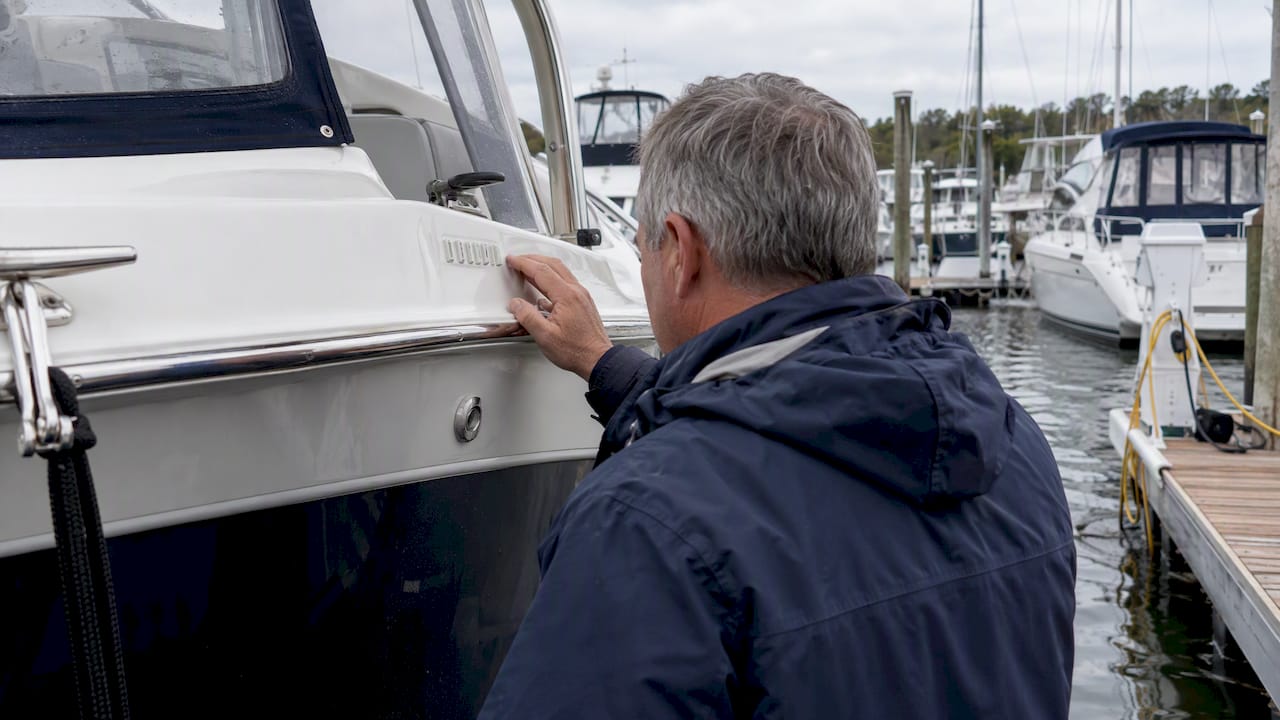
HIN compliance means your vessel carries a permanent 12-character Hull Identification Number, affixed in two identical, specified locations, that matches your registration paperwork exactly. A missing, mismatched, or improperly displayed HIN can stall registration, block flagging, and complicate insurance claims. This requirement comes from federal regulation and underpins how authorities, insurers, and buyers verify a boat’s identity.
TL;DR:
- A compliant U.S. HIN has 12 uninterrupted characters at least a quarter inch tall, with no spaces, slashes, or hyphens, and must match paperwork exactly.
- On transom boats, place the primary HIN on the starboard side within two inches of the top; put its duplicate inside or beneath a fitting.
- If the HIN is damaged, photograph or trace it first, then ask the manufacturer to verify the number; the state can assign a replacement when needed.
- Before filing, compare the hull marking against the bill of sale, title, and prior registration, and keep clear photos of both HINs with your records.
- An MMSI identifies radio equipment and cannot replace the hull number; apply for it separately, often after registration when the flag administration requires proof.
Índice
- What a HIN is and why it matters
- HIN format and display rules (practical checklist)
- Where to locate the HIN on different boat types
- What to do if the HIN is missing, damaged, or incorrect (state-assigned HIN process)
- Documentation and registration checklist owners should confirm before applying
- Common compliance pitfalls and validation tips
- Relationship between HIN and other vessel identifiers such as MMSI and AIS
- HIN compliance as routine ownership care
- How we help resolve HIN issues and complete registration
- FAQ
- Sources
What a HIN is and why it matters
Think of a Hull Identification Number the way you’d think of a car’s VIN or a person’s Social Security number: a single string that ties one specific hull to one specific record, permanently. No two boats share the same HIN, and once assigned, it never changes unless an error requires correction.
A standard US HIN typically encodes a manufacturer identification code, a serial number, and date-of-manufacture information packed into those 12 characters. Where European rules apply, the format follows EN ISO 10087:2022, which structures the craft identification number a little differently but serves the same purpose.
Registries, insurers, and buyers all lean on an exact match between the physical HIN and the paperwork:
- Registries use it to confirm the vessel hasn’t been reported stolen or previously titled elsewhere.
- Insurers use it to underwrite policies and process claims without disputes over vessel identity.
- Buyers and brokers use it to verify ownership history before a sale closes.
HIN format and display rules (practical checklist)
Federal rules under 33 CFR § 181.23–181.29 spell out exactly what a compliant HIN looks like and where it has to live on the boat. These aren’t suggestions: a HIN that fails any one of these points can trip up a registration review.
Statistic Callout: A compliant HIN must be 12 consecutive characters with no slashes, hyphens, or spaces, and characters must be at least a quarter inch tall, according to Washington State’s boat registration guidance. That height requirement exists so inspectors and registry staff can read the number without special equipment.
Run through this checklist before you submit any registration paperwork:
- Confirm the primary HIN reads as 12 uninterrupted characters, matching your title or prior registration exactly.
- Measure the character height. Anything under a quarter inch fails the standard set out in 33 CFR §181.29.
- Verify two identical HINs exist on the vessel, not just one.
- Check that both markings are permanent, either carved, molded, burned, or on a riveted plate, never on a part that unbolts or slides off.
- Make sure the duplicate HIN sits in an interior location or beneath a fitting, as the regulation specifies.
Boats built for the European market follow EN ISO 10087:2022 and related EU implementing decisions, which set harmonized marking and permanence rules for manufacturers and importers. Recent standards updates, including amendment notices tracked in standards databases, continue to refine coding structure and correction procedures for craft sold in Europe.
Where to locate the HIN on different boat types
Finding the HIN depends entirely on your hull design, and knowing both locations before you need them saves a frustrating search later.
- On boats with a transom, the primary HIN sits on the starboard outboard side, within two inches of the top of the transom.
- On hulls without a transom, such as certain pontoons or specialty hulls, the primary HIN goes on the starboard side near the stern, at the most practical equivalent location.
- Catamarans typically carry the primary HIN on the starboard hull in the same transom-area position as a monohull.
- The duplicate HIN belongs somewhere unexposed, inside a hatch, storage locker, or beneath a fitting, never on a part that can be removed or replaced.
Photograph both HINs against a ruler or coin for scale, and keep that image with your registration file. It becomes useful evidence if a registry ever questions legibility or placement.
What to do if the HIN is missing, damaged, or incorrect (state-assigned HIN process)
A missing or garbled HIN doesn’t have to end your registration attempt, but it does require a specific sequence of steps. Registries and the US Coast Guard rely on several verification methods, and knowing which one applies to your situation speeds things up considerably.
- Start with a pencil tracing or close-up photo of the existing marking, even if it’s partially damaged, since registries can sometimes still read enough characters to confirm authenticity.
- Contact the manufacturer directly if the boat is relatively new. USCG HIN verification guidance treats a HIN with the same seriousness as a vehicle VIN, and manufacturers can often reissue or confirm a correct number for boats they still have records on.
- If the manufacturer is out of business or the boat is older, your state will issue a state-assigned HIN following current format rules, a process detailed in USCG Policy #2020-1.
- Submit a notarized owner affidavit describing how you acquired the boat when no other documentation exists.
- Ask your state registry whether a National Insurance Crime Bureau check or similar database search is part of their verification process before they’ll issue a new number.
Pro Tip: Gather every piece of paperwork, photos, bills of sale, prior registration, before you contact your state authority; a complete file on the first visit often cuts weeks off the correction process.
Documentation and registration checklist owners should confirm before applying
Before you submit any registration or flag application, pull together the documents that prove your HIN and your ownership tell the same story.
- Bill of sale showing the HIN, buyer, seller, and sale date.
- Current or prior title, if your state or country of origin issues one.
- Previous registration certificate, especially for a boat changing jurisdictions.
- Clear photos of both the primary and duplicate HIN markings.
- Manufacturer’s certificate of origin or similar paperwork, if available.
- Proof of ownership chain for any used vessel with multiple prior owners.
For international flag applications, a HIN-to-paperwork mismatch is one of the most common reasons an application stalls or gets returned for correction. Registries cross-check the physical marking against every document in the file, so even a single transposed digit between your bill of sale and your transom marking can trigger delays.
Keep digital copies of everything, HIN photos included, and share them with your broker or registry contact before submission rather than after a request comes back. Our guide to registry search methods walks through how to confirm your HIN matches existing registry entries ahead of time.
Common compliance pitfalls and validation tips
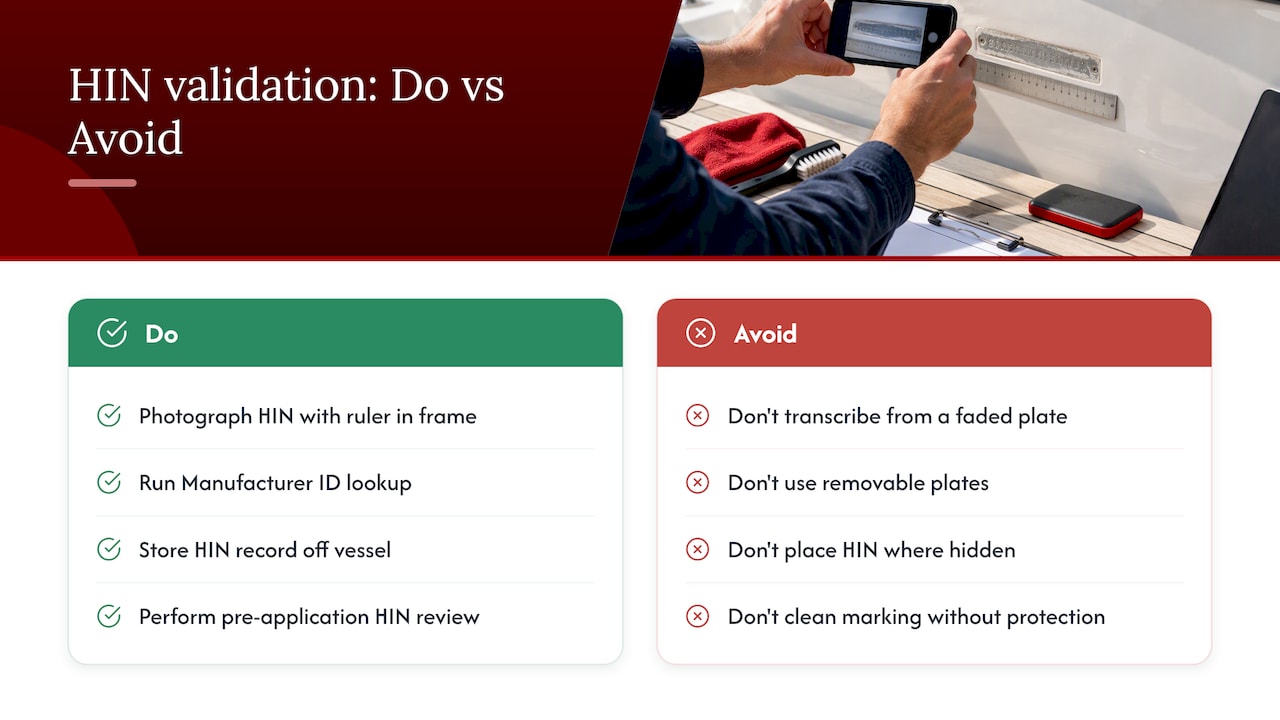
The same handful of mistakes show up again and again in registration reviews. Transcription errors top the list: someone copies a HIN from a faded plate and swaps a zero for an “O” or an “8” for a “B,” and the application bounces. Removable plates cause the second most common problem, since a HIN fastened to a part that unbolts doesn’t meet the permanence requirement at all. Wrong duplicate placement, often tucked somewhere so obscure that inspectors can’t locate it, rounds out the usual list.
A few habits prevent most of this. Photograph the HIN with a ruler in frame so size and legibility are both documented. Run the number through a Manufacturer Identification Code lookup if you’re unsure the prefix is valid. Keep a written and photographic HIN record somewhere off the vessel, so a theft, fire, or hull repair doesn’t erase your only copy.
Pro Tip: A pre-application review of your HIN against your paperwork, done before you file, routinely shortens the back-and-forth that follows a flag or state registry’s initial rejection.
If you’re preparing the hull for inspection or sale, make sure cleaning doesn’t obscure or damage the marking; guidance on hull cleaning steps and timing is worth a look before you schedule any deep clean near the transom.
Relationship between HIN and other vessel identifiers such as MMSI and AIS
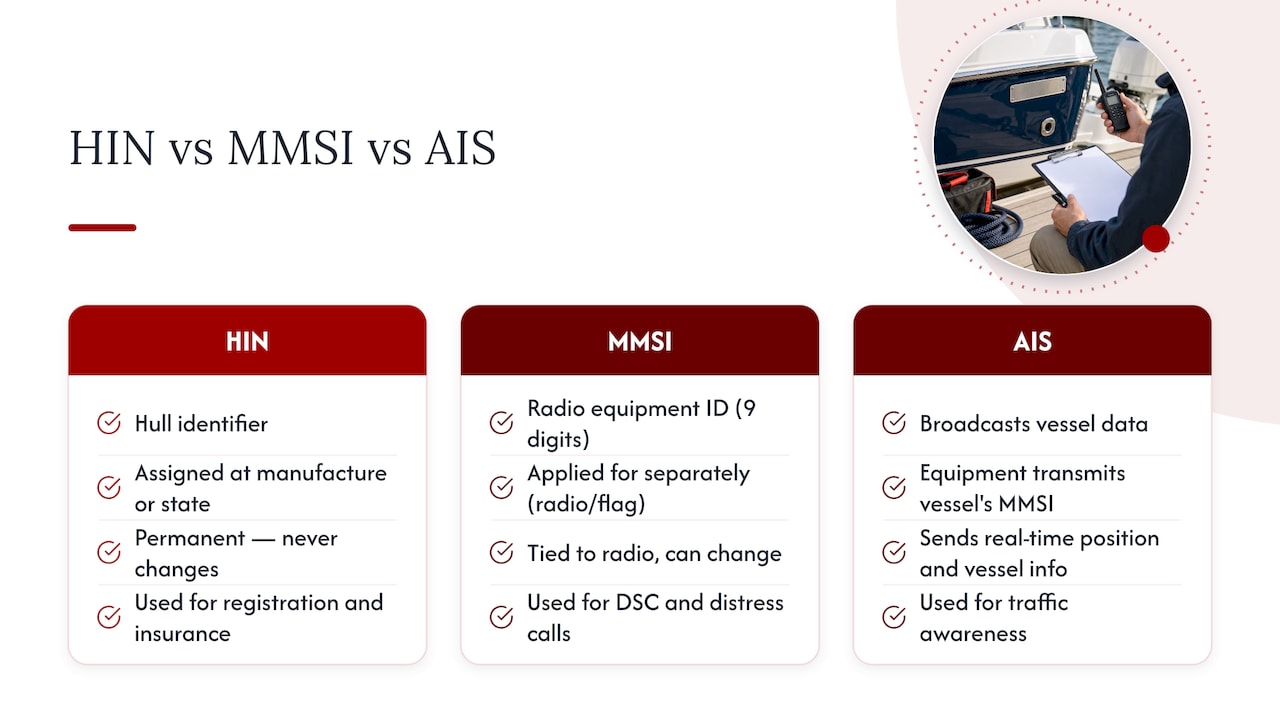
A HIN, an MMSI number, and an AIS transponder all identify your vessel, but they do different jobs and come from different places. The HIN is a permanent, physical identifier tied to the hull itself, assigned once at manufacture or by a state authority, and it never changes even if you sell the boat or change its name.
A Maritime Mobile Service Identity number, by contrast, is a nine-digit code tied to your vessel’s radio equipment, used for digital selective calling and distress communication. You apply for an MMSI separately from your HIN, often when you install a VHF radio or AIS transponder, and the two numbers exist in entirely different databases.
Automatic Identification System equipment broadcasts your MMSI, along with position and vessel data, to other ships and shore stations in real time. None of this replaces the HIN: registries don’t accept an MMSI as a substitute for hull identification, and insurers still require the HIN on file regardless of what radio equipment you carry. If you’re setting up MMSI service for the first time, it typically happens alongside flag registration rather than as a stand-alone step, since many flag administrations require proof of registration before they’ll process an MMSI application.
HIN compliance as routine ownership care
A HIN check takes a few minutes and costs nothing, yet it prevents some of the most common holdups we see in flag and registration applications. Catching a mismatch before you submit paperwork, rather than after a registry flags it, keeps timelines intact and avoids repeat filings.
We include HIN verification as part of document review for registrations to help avoid delays later.
— VesselFlag
How we help resolve HIN issues and complete registration

We review your HIN against your bill of sale, title, and prior registration before you ever submit an application, catching mismatches that would otherwise bounce back from a registry. From there, we handle flag registration directly, including São Marinho, Malta, and Reino Unido Parte 1 filings, plus MMSI licensing once your documentation is clean. Working directly with registries means fewer rounds of correction and a faster path to a compliant, flagged vessel.
FAQ
What does HIN mean on a boat?
HIN stands for Hull Identification Number, a permanent 12-character code that uniquely identifies a recreational vessel, similar to a car’s VIN. In the United States, it has been required on boats manufactured or imported for sale since November 1, 1972, according to Washington State’s boating authority.
How can I obtain a HIN certificate for my boat?
There isn’t a separate “HIN certificate,” but you can confirm your HIN is valid through your state registry, which may check it against manufacturer records or Coast Guard verification guidance. If you need a new or corrected HIN, your state registry issues one following the process outlined in USCG Policy #2020-1.
What if my boat doesn’t have a HIN?
If your vessel lacks a valid HIN, your state will typically issue a state-assigned HIN, a process more common with older boats or when the original manufacturer is out of business. You’ll need an owner affidavit, prior ownership paperwork, and often a physical inspection before the state issues a new number.
Where do I locate the HIN number?
On most boats with a transom, the primary HIN sits on the starboard outboard side within two inches of the top of the transom. A duplicate HIN is required somewhere interior, such as inside a hatch or beneath a fitting, and both locations are specified under 33 CFR §181.29.
Sources
- 33 CFR § 181.23–181.29 – Hull identification requirements (e-CFR)
- USCG HIN verification guidance
- Boat registration and hull identification numbers | Washington State Department of Licensing