
An open registry — also called a flag of convenience — lets foreign-owned vessels register under a nation’s flag with no requirement for the owner to hold citizenship or residency in that country. The immediate payoff is real: lower costs, flexible crewing, and simplified ownership structures. The trade-off is equally real: the flag state’s enforcement record shapes how port inspectors, insurers, and lenders see your vessel.
Índice
- How open registries work and what you need to submit
- Open registry vs. closed registry: the differences that actually matter
- Why vessel owners choose open registries
- Criticisms and regulatory concerns you should weigh
- Major open registries you will encounter
- What U.S. vessel owners specifically need to consider
- Principais conclusões
- The case for choosing your flag more carefully than your fee schedule
- Vesselflag handles the complexity so you can focus on operations
- Useful sources
- FAQ
How open registries work and what you need to submit
The registration flow is more predictable than most owners expect, though the timeline varies sharply by jurisdiction and how prepared your documentation is.
Typical steps:
- Select a jurisdiction based on your trading area, cost targets, and crew nationality requirements.
- Set up an ownership structure — often a legal entity such as an LLC or offshore company — since many flags require a registered corporate owner rather than an individual.
- Prepare your document package: proof of ownership, bill of sale, builder’s certificate or deletion certificate from the prior registry, tonnage measurement declaration, and proof of insurance.
- Submit the application through the registry directly or through an authorized registration agent, who handles local compliance requirements and communicates with the flag administration.
- Pass technical and safety checks — some registries conduct these remotely via a classification society survey report.
- Receive your certificate of registry and flag authorization.
Fast-track registries can issue provisional certificates within days. Standard processing typically runs two to six weeks. What slows things down most often is incomplete ownership documentation or a vessel that has not been formally deleted from its previous registry.
Pro Tip: Use a registration agent who operates in your target jurisdiction. Local agents know exactly which document formats the registry accepts, which prevents the back-and-forth that adds weeks to a standard application.

Open registry vs. closed registry: the differences that actually matter
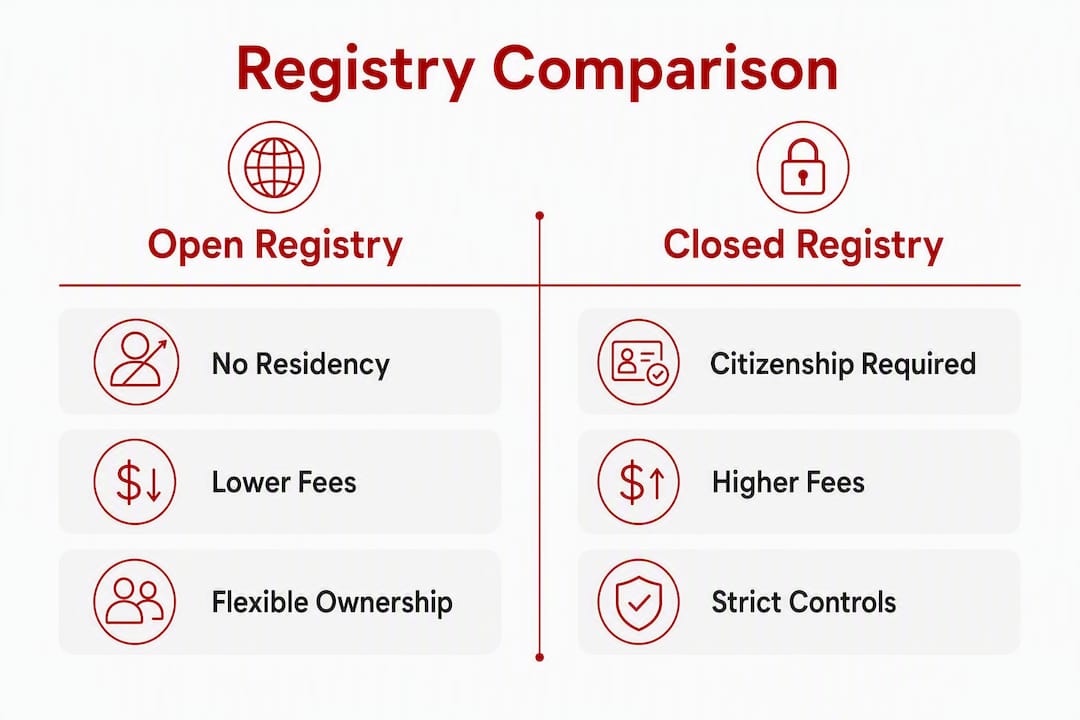
The functional gap between an open and a closed (national) registry comes down to who can register, what it costs, and how tightly the flag state monitors compliance.
| Factor | Registo aberto | Closed (National) Registry |
|---|---|---|
| Ownership requirement | No citizenship or residency tie required | Owner must be a national or resident |
| Crewing rules | Flexible; international crew permitted | Often requires national crew quotas |
| Registration fees | Generally lower; competitive tonnage taxes | Higher; structured around national policy |
| Administrative complexity | Streamlined; often agent-managed | More bureaucratic; domestic filings |
| Flag-state oversight | Varies widely by registry quality | Typically stronger domestic enforcement |
| Inspection risk | Depends on flag’s Port State Control record | Generally lower scrutiny at home ports |
One area where the open/closed distinction hits U.S. owners hardest: the Jones Act. Vessels registered under a foreign flag — open or otherwise — cannot carry cargo or passengers between U.S. ports. If your intended trading area is domestic coastal routes, a foreign open registry is not an option. International voyages are a different story entirely.
Why vessel owners choose open registries
The decision is almost always economic first, operational second. Open registries commonly offer lower administrative costs, favorable tonnage tax regimes, and flexible manning rules that reduce operating expenses — and those savings compound across a vessel’s operating life.
The main reasons owners register under open flags:
- Lower registration fees and tonnage taxes. Many open registries charge fees based on gross tonnage at rates well below what national registries impose.
- No social-charge exposure for foreign crew. Owners avoid mandatory contributions to national pension or welfare schemes when crewing internationally under a permissive flag.
- Flexible crew nationality rules. You can hire the most qualified crew at market rates without being locked into national manning quotas.
- Simplified corporate ownership. Holding the vessel in an offshore company or trust is straightforward under most open registries, which matters for liability protection and eventual sale.
- Easier transferability. Re-flagging or selling a vessel registered in an open registry is generally faster than unwinding a national registration.
- Speed of registration. Competitive registries market fast processing as a core service, and many deliver on it.
Pro Tip: Cost savings from a low-fee registry can evaporate quickly if that flag carries a poor Port State Control record. A vessel detained for inspection delays loses far more in off-hire time than it saved in annual registration fees. Check the flag’s Paris MOU or Tokyo MOU detention rate before committing.
Criticisms and regulatory concerns you should weigh
The open registry model draws persistent criticism, and not all of it is unfair. The core concern is a structural one: when a flag state has no economic or political stake in the vessel’s operations, its incentive to enforce international standards can weaken.
The IMO’s position is clear — because open registries are now widespread, the policy priority is ensuring flag states actually exercise the jurisdiction and control required under UNCLOS and IMO instruments, not debating whether open registries should exist. That framing matters: it places the compliance burden squarely on the flag state, not just the owner.
Port State Control is where weak enforcement becomes a practical problem for owners. Inspectors from the U.S. Coast Guard and regional PSC bodies target vessels flying flags with historically high deficiency rates. A vessel under a scrutinized flag faces more frequent inspections, longer detention risk, and harder conversations with hull and machinery underwriters.
Statistic: Approximately 29 states maintain open registers that include fishing vessels — a figure that illustrates just how mainstream the model has become globally, even as enforcement quality varies dramatically across those jurisdictions.
The FAO analysis notes that political will and the cost of non-compliance are the real variables that determine how strictly a registry enforces international standards. Smaller or newer registries sometimes carry a flag-of-convenience stigma precisely because they have not yet demonstrated that political will at scale. High-quality registries balance economic incentives with demonstrable compliance programs — that balance is what separates a reputable open flag from a liability.
Major open registries you will encounter
These five flags account for a substantial share of the world’s commercially registered tonnage. Each has a distinct profile that affects your inspection outcomes, insurance terms, and financing options.
- Panama. The world’s largest ship registry by tonnage. Broad acceptance by insurers and lenders, competitive fees, and a long track record. A practical default for many commercial operators.
- Liberia. One of the oldest and most established open registries, with a strong compliance reputation and active classification society relationships. Frequently chosen by tanker and bulk carrier operators.
- Marshall Islands. Known for rigorous flag-state oversight relative to its open-registry peers. Carries a strong PSC record and is well-regarded by major marine insurers and ship financiers.
- Bahamas. Popular with the superyacht and cruise sectors. The Bahamas Maritime Authority maintains active oversight and has built a reputation for responsiveness to owners.
- Malta. An EU member state registry, which gives Malta-flagged vessels access to EU port rights and a regulatory framework aligned with European maritime standards. Attractive for owners operating in European waters.
For a deeper look at how these flags compare on specific criteria, flag registry profiles break down each jurisdiction’s requirements and reputation in detail.
What U.S. vessel owners specifically need to consider
Registering under an open flag from a U.S. base involves a few layers that purely international owners do not face.
Checklist for U.S. owners:
- Confirm your trading area first. Open registry is only viable for international voyages. The Jones Act bars foreign-flagged vessels from U.S. coastwise trade.
- Check your mortgage lender’s consent. Most ship finance agreements require lender approval before re-flagging. Skipping this step can trigger a default clause.
- Verify insurance terms. Some hull and P&I underwriters restrict coverage or add premiums for certain flags. Confirm your flag choice with your broker before filing.
- Evaluate crew qualifications. Your flag state sets the manning standards your crew must meet. Mismatches between your crew’s certificates and the flag’s requirements create PSC exposure.
- Choose your ownership structure carefully. Structuring ownership through a legal entity — an LLC, corporation, or offshore company — affects liability, tax treatment, and your ability to mortgage or sell the vessel. Get this right before registration, not after.
- Understand U.S. Coast Guard inspection exposure. Foreign-flagged vessels calling at U.S. ports are subject to USCG Port State Control inspections. Your flag’s PSC record directly affects how often and how thoroughly your vessel gets examined.
Pro Tip: Set up your ownership entity before you apply for registration, not during. Changing the ownership structure mid-application restarts the process at most registries and can delay your certificate by weeks. Work with a specialist who understands both the flag’s requirements and U.S. tax implications for the entity type you choose.
For a full documentation checklist, vessel registration requirements covers what each major flag typically demands.

Principais conclusões
An open registry gives vessel owners access to foreign flags without residency ties, but the flag state’s enforcement record determines whether those savings translate into real operational advantage.
| Ponto | Detalhes |
|---|---|
| Core definition | An open registry lets foreign-owned vessels register under a flag with no citizenship or residency requirement. |
| Primary benefit | Lower fees, flexible crewing, and simplified corporate ownership reduce operating costs across a vessel’s life. |
| Primary risk | Flags with weak enforcement records attract more Port State Control scrutiny and harder insurance terms. |
| Top registries | Panama, Liberia, Marshall Islands, Bahamas, and Malta are the most widely used and lender-accepted open flags. |
| Vesselflag’s role | Vesselflag manages end-to-end registration across multiple open-flag jurisdictions, including ownership setup and compliance support. |
The case for choosing your flag more carefully than your fee schedule
The conventional wisdom in shipping circles treats flag selection as a cost optimization exercise. Pick the cheapest registry, minimize your tonnage tax, move on. That logic works until it doesn’t — and when it breaks, it breaks expensively.
What most owners underestimate is how much the flag state’s compliance reputation bleeds into every other operational cost. A vessel flying a flag with a high PSC detention rate pays for that choice in off-hire time, elevated insurance premiums, and lender skepticism when it comes time to refinance. The registration fee savings from a low-cost flag can disappear in a single detained inspection.
The smarter frame is to treat flag selection as a risk management decision, not a procurement decision. The best open registries — Marshall Islands and Liberia are the clearest examples — compete on compliance quality, not just price. They invest in flag-state infrastructure, maintain active relationships with classification societies, and publish their PSC records transparently. That transparency is exactly what makes insurers and lenders comfortable.
For U.S. owners specifically, the Jones Act constraint means the flag decision is already pre-filtered: you are choosing among international flags for international voyages. That narrows the field and raises the stakes on getting the compliance profile right. A flag that saves you $8,000 a year in registration fees but adds $25,000 in annual insurance loading is not a bargain.
Vesselflag handles the complexity so you can focus on operations
Choosing the right open registry involves more moving parts than most owners anticipate: ownership entity setup, document preparation, flag-state requirements, insurance coordination, and MMSI licensing all need to align before your certificate issues.
Vesselflag manages that entire process across multiple international flag jurisdictions. Whether you need a fast-track provisional certificate, corporate ownership setup for a new acquisition, or MMSI and AIS registration alongside your flag filing, the platform handles it end-to-end. Owners working with Vesselflag also get guidance on which flags carry the strongest PSC records for their trading routes — so the flag you choose actually works in your favor at the next port inspection.
Start your registration with Vesselflag, or review flag registration options across jurisdictions to find the right fit for your vessel and trading area.
Useful sources
- IMO — Registration of ships and fraudulent registration matters: Primary IMO policy page on flag-state obligations and open registry context. Best for understanding UNCLOS jurisdiction requirements.
- FAO — Rationale for the operation of open registers: Detailed economic and policy analysis of why open registries exist and how enforcement quality varies. Essential background for owners evaluating flags.
FAQ
What is the meaning of open registry in shipping?
An open registry allows vessels owned by foreign nationals or companies to register under a country’s flag without any citizenship or residency requirement. The IMO recognizes these registries as widespread and focuses policy on ensuring flag states exercise proper jurisdiction under UNCLOS.
What is an open ship registry, and how does it differ from a national registry?
An open ship registry accepts vessels regardless of owner nationality, while a closed or national registry restricts registration to citizens or residents of that country. The practical difference shows up in crewing flexibility, fee structures, and the level of flag-state oversight owners can expect.
Which open registries are most widely used?
Panama, Liberia, and the Marshall Islands are the three largest open registries by registered tonnage globally, with the Bahamas and Malta also widely used — particularly for yachts and vessels operating in European waters.
Can a U.S. owner register a vessel under an open registry?
Yes, U.S. owners can register vessels under open registries for international voyages, but those vessels cannot carry cargo or passengers between U.S. ports under the Jones Act. Owners should also confirm mortgage lender consent and insurance terms before re-flagging.
Does the flag state affect insurance and financing?
Directly. Lenders and hull underwriters assess the flag state’s Port State Control record when pricing risk. Flags with high detention rates can increase insurance premiums and complicate ship financing, sometimes offsetting the registration fee savings that made the flag attractive in the first place.