

Resumo:
- Flag registries grant vessels legal nationality and enable international trade, but choosing the right one impacts compliance and costs. Open registries like Panama, Liberia, and the Marshall Islands dominate globally due to low fees and broad acceptance, despite higher detention risks. International registries such as Malta and Singapore offer regional benefits and stronger regulation, while closed registries serve domestic vessels with stricter nationality requirements.
Flag registries are official national or international ship registers that grant vessels their legal nationality, enabling international trade, regulatory compliance, and port access worldwide. Choosing the right registry is one of the most consequential decisions a vessel owner makes. Over 76% of global shipping capacity is concentrated in the top ten flag states, which means the examples of flag registries you consider most seriously are likely Panama, Liberia, Marshall Islands, Malta, Singapore, and a handful of others. The International Maritime Organization (IMO) and the International Labour Organization (ILO) set the conventions that every flag state must enforce, making registry selection a compliance decision as much as a financial one.
1. What are the main types of flag registries?
Flag registries fall into three structural categories: open registries, international registries, and closed (national) registries. Each type carries different rules on ownership eligibility, crewing requirements, and regulatory oversight.
- Open registries allow foreign nationals and foreign-owned companies to register vessels, typically with low fees and minimal tax obligations. These are commonly called flags of convenience.
- International registries offer a hybrid model. They accept some foreign ownership but apply stronger regulatory frameworks and often provide tax incentives tied to specific regional agreements.
- Closed registries restrict registration to citizens or entities incorporated in the flag state. They enforce full domestic maritime law, including crewing requirements.
Understanding which category a registry falls into tells you immediately what ownership structure you need, what crewing rules apply, and what compliance burden you will carry. The type of registry also shapes how port state control officers treat your vessel during inspections.
Dica de profissional: Before comparing fees, identify which registry type fits your ownership structure. Registering under a closed registry when you hold foreign ownership is not possible, regardless of how attractive the fees look.
2. Open flag registry examples and why they dominate global shipping
Open registries are the most widely used flag registration systems in the world. Panama, Liberia, and the Marshall Islands together account for roughly half the world fleet by deadweight tonnage, with 17,752 ships registered as of 2024. That concentration reflects the core appeal: low registration costs, no restrictions on vessel ownership nationality, and broad acceptance at ports globally.
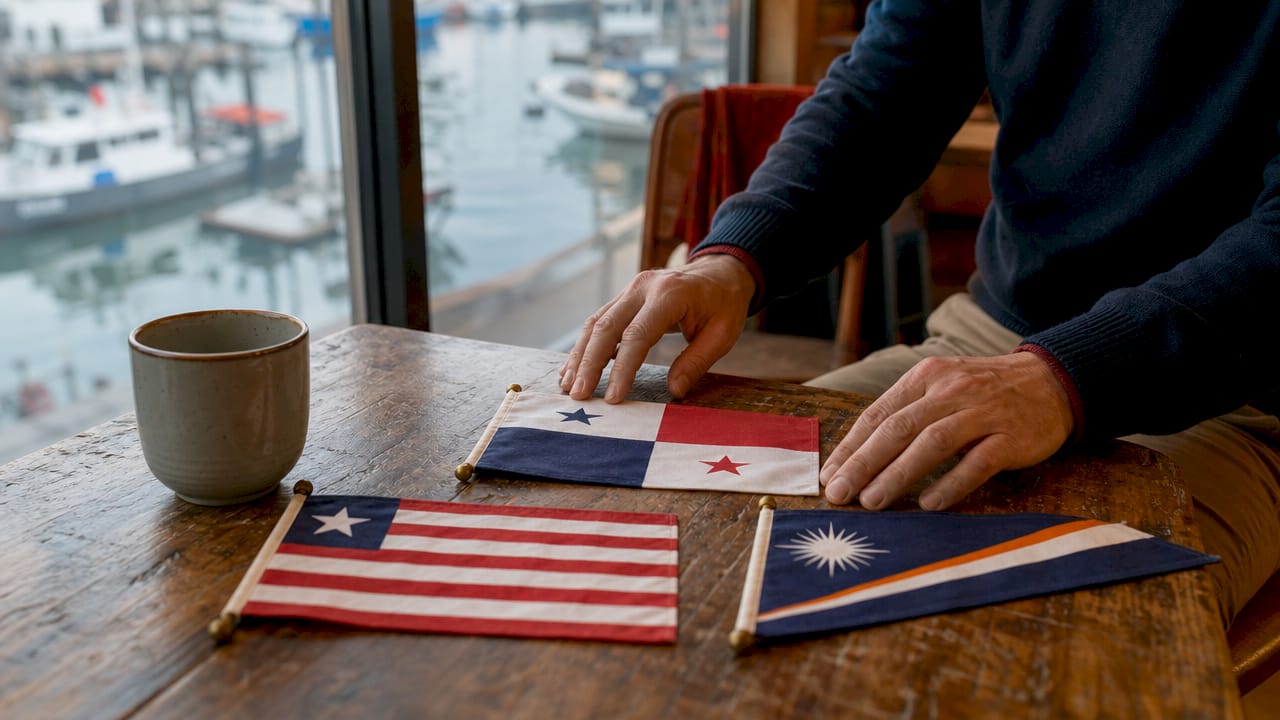
Panama is the largest single registry by fleet size. It offers a well-established legal framework, competitive annual fees, and a long track record of international acceptance. Liberia runs its registry through a U.S.-based administration, which gives it unusually strong legal infrastructure for an open registry. The Marshall Islands registry is known for fast processing and a strong Port State Control (PSC) record relative to other open registries.
The risks of open registries are real and worth naming directly. Vessels flying flags of convenience face higher rates of PSC detention in some regions. Insurance underwriters apply stricter scrutiny to certain open registry flags. Flag hopping between open registries is increasingly scrutinized by port authorities, and choosing the cheapest flag without regard for enforcement capability leads to operational and financial setbacks. Read more about the flag of convenience tradeoffs before committing to this route.
3. International flag registry examples: regulation meets competitive advantage
International registries sit between open and closed systems. They accept foreign ownership under defined conditions but apply stronger regulatory oversight and often deliver regional benefits that pure open registries cannot match.
| Registo | Key Benefit | EU Access | PSC Reputation |
|---|---|---|---|
| Malta | EU flag, tonnage tax regime | Sim | Strong |
| Chipre | EU flag, low corporate tax | Sim | Good |
| Bahamas | Established yacht registry | Não | Good |
| Singapura | Asia-Pacific trade hub | Não | Excellent |
| Ilhas Caimão | Luxury yacht preferred | Não | Good |
Malta and Cyprus carry EU flag status, which matters significantly for vessels trading within European waters. EU-flagged vessels access specific cabotage rights and benefit from EU legal protections in commercial disputes. Malta operates a tonnage tax system that reduces the overall tax burden for commercial operators. Singapore’s registry is the preferred choice for owners operating across Asia-Pacific trade routes, backed by one of the strongest PSC records globally.
The Bahamas and Cayman Islands registries are the dominant choices for luxury yacht registration. Both offer stable legal frameworks, English-language administration, and good standing with charter acceptance authorities. For owners seeking yacht registration best practices, these registries consistently rank at the top for the superyacht segment.
4. National (closed) registry examples and what they mean for owners
Closed registries restrict vessel registration to nationals or domestically incorporated entities. They represent the traditional model of maritime regulation, where the flag state exercises full legal control over the vessel and its crew.
The most significant closed registries include:
- United States (NVDC): The U.S. Coast Guard National Vessel Documentation Center registers U.S.-owned vessels. Registration is required for coastwise trade and provides strong legal title documentation. Foreign ownership is not permitted.
- United Kingdom (Part I Registry): The UK Ship Register Part I is a closed registry for British-owned vessels. It carries strong international recognition and is favored for commercial vessels and larger yachts owned by UK entities.
- Norway: Norway operates both a domestic closed registry (NOR) and an international open registry (NIS). The NOR registry is restricted to Norwegian nationals and provides access to Norwegian coastal trade.
- Japan: Japan’s registry is strictly closed, requiring Japanese ownership and crewing. It supports one of the world’s largest commercial fleets operating under domestic law.
Closed registries provide stable legal frameworks and clear title documentation, which matters in financing and insurance contexts. The limitation is straightforward: if you do not meet the nationality or incorporation requirements, these registries are not available to you. Owners who qualify often find that the legal certainty and domestic trade rights justify the stricter requirements.
5. Comparing flag registries: key criteria for vessel owners
Choosing between popular flag registries requires more than comparing annual fees. The criteria below give you a practical framework for evaluating any registry before committing.
Registration and annual fees
Fees vary widely across registry types. Open registries typically charge the lowest annual fees. International registries charge moderate fees but often offset costs through tonnage tax regimes. Closed registries may charge higher fees but provide stronger legal protections.
Port State Control record
Flag state performance is evaluated through PSC white, grey, and black lists published annually by the International Chamber of Shipping. A registry on the white list means your vessel faces fewer detentions and faster port clearance. A grey or black list flag increases inspection frequency and can delay commercial operations significantly.
Charter acceptance and insurance implications
Charter brokers and insurance underwriters maintain their own lists of preferred flags. Some registries are not accepted by major charter markets regardless of their legal standing. Confirm charter acceptance before registering a vessel you plan to operate commercially.
Dual registration and bareboat charter options
Dual registration and bareboat charter arrangements allow temporary flag switching to navigate regional trade rules without full re-registration. This option is underused by vessel owners who assume full re-registration is the only path to changing operational jurisdiction. Check vessel registration requirements in 2026 to understand which registries support these arrangements.
Dica de profissional: Always check the IMO’s GISIS database and the current ICS Flag State Performance Table before selecting a registry. A registry that looked strong two years ago may have moved to the grey list since then.
| Criteria | Registo aberto | International Registry | Registo fechado |
|---|---|---|---|
| Ownership eligibility | Qualquer nacionalidade | Defined foreign ownership | Nationals only |
| Annual fees | Low | Moderado | Moderate to high |
| PSC reputation | Varies widely | Generally good | Generally strong |
| Charter acceptance | Varies | High | High |
| Dual registration | Sometimes | Often | Rarely |
Pontos-chave
The most effective flag registry choice balances PSC reputation, ownership eligibility, and operational requirements rather than prioritizing the lowest registration fee alone.
| Ponto | Detalhes |
|---|---|
| Registry type determines eligibility | Open, international, and closed registries each have distinct ownership and crewing rules. |
| Top open registries dominate by volume | Panama, Liberia, and Marshall Islands together cover roughly half the world fleet by deadweight tonnage. |
| PSC record affects operations directly | A grey or black list flag increases port detentions and can delay commercial schedules. |
| International registries offer EU benefits | Malta and Cyprus provide EU flag access, which matters for vessels trading in European waters. |
| Dual registration adds flexibility | Bareboat charter and dual registration options let owners navigate regional trade rules without full re-registration. |
Vesselflag’s perspective on choosing the right flag registry
The single biggest mistake vessel owners make is treating flag selection as a cost-reduction exercise. Fees matter, but they are the last thing you should optimize for. A registry that saves you $2,000 per year in annual fees but lands your vessel on a PSC grey list will cost you far more in detention delays, increased insurance premiums, and lost charter bookings.
The growth of smaller, permissive registries since 2022 has made this problem worse. Emerging shadow fleet registries like those operated out of Gabon and Comoros have grown through permissive registration policies but lack the infrastructure to enforce IMO and ILO conventions. Owners who register with these flags to save money often find themselves unable to enter certain ports or facing sanctions enforcement actions they did not anticipate.
The registries that consistently perform well share three characteristics: they enforce IMO conventions actively, they maintain transparent PSC records, and they have established legal infrastructure for dispute resolution. Malta, Singapore, Marshall Islands, and the UK Part I registry all meet this standard. The Bahamas and Cayman Islands meet it for the yacht segment specifically.
My recommendation is to treat the role of flag state compliance as a living obligation, not a one-time registration decision. Registries change their enforcement posture, their PSC standing, and their fee structures. Review your registry’s current standing annually. If your flag has moved to the grey list, start the re-flagging process before it affects your operations.
— Vessel Flag
Vesselflag can guide your flag registry decision
Selecting the right flag registry is complex, but you do not have to work through it alone. Vesselflag provides expert guidance on flag selection, registration processing, and ongoing compliance for yacht owners, boat operators, and commercial vessel operators worldwide.
Vesselflag supports registration under a wide range of flags including Malta, UK Part I, Palau, San Marino, Poland, and Langkawi, with clear timelines and transparent fee structures for each. Whether you are registering a superyacht, a commercial vessel, or a recreational boat, the platform covers the full process from document preparation to MMSI and AIS setup. Start with the complete yacht registration guide or review the Registo de iates vs. registo de barcos breakdown to identify the right path for your vessel type and ownership structure.
Perguntas frequentes
What are flag registries in maritime law?
Flag registries are official national or international records that grant vessels their legal nationality and the right to fly a specific country’s flag. They establish the legal framework governing safety, labor, and environmental compliance for the vessel.
What are the most popular flag registries by fleet size?
Panama, Liberia, and the Marshall Islands are the largest flag registries by deadweight tonnage, collectively covering roughly half the world fleet. Malta, Singapore, and the Bahamas are the leading choices in the international registry category.
What is the difference between open and closed flag registries?
Open registries accept vessel registration from any nationality, while closed registries restrict registration to nationals or domestically incorporated entities. International registries fall between the two, accepting some foreign ownership under defined conditions.
How does Port State Control affect my choice of flag registry?
A registry’s PSC standing directly affects how often your vessel is inspected and detained at foreign ports. Registries on the ICS white list face fewer detentions, while grey or black list flags trigger increased inspection frequency and can delay commercial operations.
Can I switch flag registries after registration?
Yes, re-flagging is possible and common. Some registries also support dual registration and bareboat charter arrangements, which allow temporary flag switching without full re-registration, giving owners flexibility to meet regional trade requirements.