
Many yacht owners assume that programming a DSC (Digital Selective Calling) radio is all it takes to be ready on the water. It isn’t. Without a valid MMSI license, your vessel can be invisible to search and rescue teams, non-compliant under international maritime law, and potentially barred from foreign ports. Whether you operate a recreational yacht or a commercial vessel, understanding MMSI licensing is not optional. This guide walks you through what the license is, how to get it, who needs it, and the critical mistakes that put vessels at risk every year.
Índice
- What is an MMSI license?
- How MMSI licenses are issued and recognized globally
- Who needs an MMSI license: yachts vs commercial vessels
- Critical rules: updates, transfers, and avoiding common MMSI mistakes
- MMSI license: safety, compliance, and real-world impact
- Get expert help with MMSI and vessel registration
- Frequently asked questions
Principais conclusões
| Ponto | Detalhes |
|---|---|
| MMSI is mandatory | A valid MMSI license is required for all vessels using DSC, AIS, or GMDSS equipment. |
| Global recognition matters | Only nationally assigned MMSIs are valid internationally and included for search and rescue. |
| Keep info updated | You must update or transfer your MMSI when selling your vessel or changing its flag. |
| Separate EPIRB registration | EPIRB must be registered independently of your vessel’s MMSI license. |
| Compliance boosts safety | Proper MMSI licensing speeds up rescue response and ensures legal operation globally. |
What is an MMSI license?
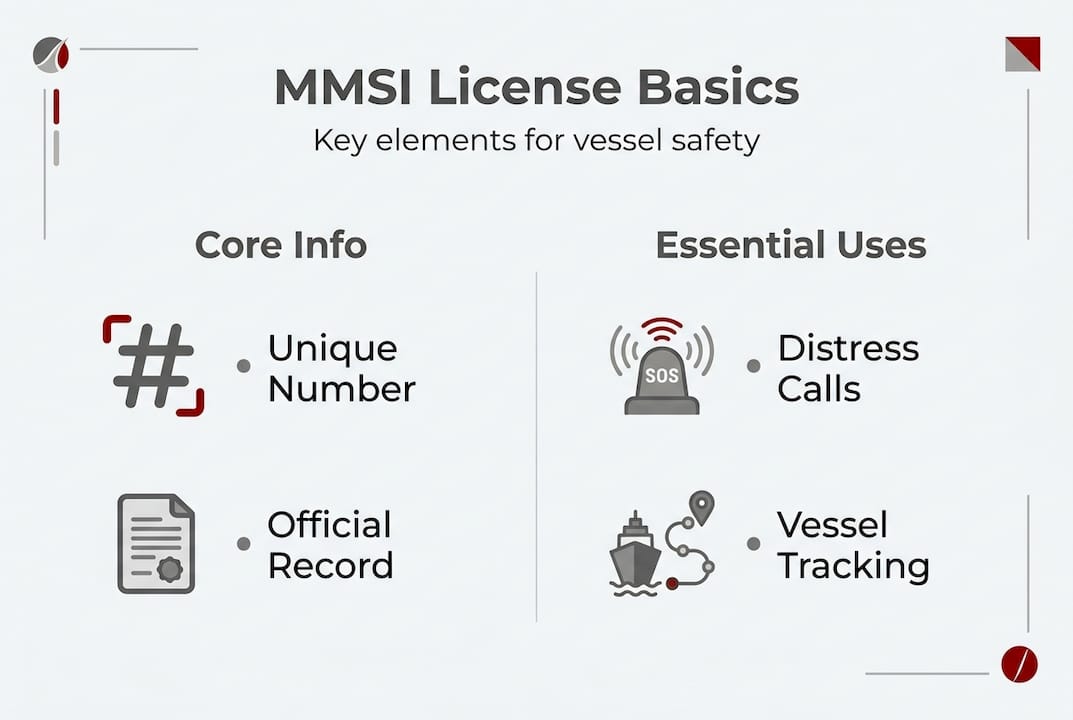
MMSI stands for Maritime Mobile Service Identity. It is a unique nine-digit identifier assigned to vessels and maritime stations, enabling identification across the Global Maritime Distress and Safety System (GMDSS). Think of it as your vessel’s permanent phone number on the water. Every distress call, position report, and vessel check runs through this number.
The MMSI license is the official authorization that ties this number to your vessel, your contact details, and your flag state. Without it, your DSC radio transmits a number that no authority can trace back to you. That gap can cost lives in an emergency.
Here is a quick look at which devices require an MMSI and which do not:
| Device | Requires MMSI? |
|---|---|
| DSC-equipped VHF radio | Sim |
| AIS transponder | Sim |
| EPIRB (Emergency Position Indicating Radio Beacon) | Yes (separate registration) |
| Standard handheld VHF (no DSC) | Não |
| Radar | Não |
| Depth sounder | Não |
The MMSI number connects your vessel to three critical safety systems:
- DSC (Digital Selective Calling): Sends automated distress alerts with your vessel ID and GPS position to coast guard and nearby vessels.
- AIS (Automatic Identification System): Broadcasts your vessel’s position, speed, and identity to other ships and traffic monitoring systems.
- EPIRB: Activates a satellite distress beacon that search and rescue (SAR) teams use to locate you. EPIRB registration is separate but also requires an MMSI.
“An MMSI license is not a formality. It is the backbone of how maritime authorities identify, track, and respond to vessels in distress. Operating without one is a compliance failure and a safety risk.”
You can learn more about the full scope of this identifier in our MMSI number guide. Your number is also searchable in the ITU List V database, the global registry used by SAR authorities worldwide.
How MMSI licenses are issued and recognized globally
Once you understand what the MMSI license is, it is vital to learn how to actually obtain one and ensure it works everywhere you sail. The process varies by country, but the core pathway follows a consistent structure.
MMSI registration is assigned by national administrations, such as the FCC in the United States via a Ship Station License, and then notified to the International Telecommunication Union (ITU) for inclusion in List V. That ITU listing is what gives your MMSI global recognition. Without it, your number may work domestically but fail to pull up vessel records during an international SAR operation.
Here is the typical registration pathway:
- Confirm your vessel’s registration status. Your vessel must be officially registered under a flag state before you can apply for an internationally recognized MMSI.
- Identify your issuing authority. In the US, this is the FCC. In the UK, it is Ofcom. Other countries have their own maritime administrations.
- Submit your application. Provide vessel details, owner contact information, and flag state documentation.
- Receive your MMSI and program your radio. Once issued, you program the number into your DSC radio, AIS transponder, and EPIRB.
- Verify ITU List V inclusion. Confirm your MMSI appears in the ITU database before any international voyage.
Here is how domestic and international MMSI licensing compare:
| Feature | Domestic MMSI | International MMSI |
|---|---|---|
| Cost | Free (e.g., via BoatUS in US) | Paid (e.g., ~$200 via FCC) |
| Valid for foreign travel | Não | Sim |
| ITU List V inclusion | Não | Sim |
| Required for commercial use | Não | Sim |
| Issued by | Non-profit/marina programs | National authority (FCC, Ofcom) |
Pro Tip: Before any offshore passage, search your MMSI in the ITU List V database. If it does not appear, SAR teams in foreign waters cannot access your vessel records during an emergency.
For a full walkthrough of getting an MMSI radio license, including flag-specific requirements, and to understand the broader vessel registration process, we have detailed resources that cover both.
Who needs an MMSI license: yachts vs commercial vessels
Understanding the process is one thing, but it is equally important to know exactly who needs an MMSI license and under what circumstances. The short answer: almost every vessel with a DSC radio or AIS transponder needs one.
Here is who is required to hold a valid MMSI license:
- Recreational yacht owners sailing in domestic waters with DSC-equipped radios (domestic MMSI minimum)
- Recreational yacht owners traveling internationally (internationally recognized MMSI required)
- Commercial vessel operators of any size operating in domestic or international waters
- Vessels participating in GMDSS as required under SOLAS (Safety of Life at Sea) regulations
- Any vessel fitted with an AIS transponder, regardless of size or purpose
The legal risks for non-compliance are real. Vessels operating without a valid MMSI license can face port state control inspections, fines, and detention. More critically, an unlicensed vessel transmitting a random or unregistered MMSI number can trigger false SAR responses, wasting coast guard resources and potentially delaying help for genuine emergencies.
For US-based yacht owners, domestic vs international MMSI costs break down clearly: a free domestic MMSI (valid for US waters only) versus an FCC Ship Station License at approximately $200 for a 10-year term, which covers international travel. That $200 is a small price for legal compliance on any foreign voyage.
One of the most common mistakes we see is yacht owners who obtained a free domestic MMSI through a marina program or BoatUS, then sailed to the Bahamas, Mexico, or the Mediterranean assuming they were covered. They were not. A domestic-only MMSI is not recognized by foreign coast guards or ITU SAR systems.
Pro Tip: Match your MMSI type to your actual cruising area. If there is any chance you will cross into foreign waters, get the internationally recognized license before you leave the dock. Review our boat registration compliance resources and yacht registration steps to make sure your full documentation package is in order.
Critical rules: updates, transfers, and avoiding common MMSI mistakes
Even with a valid MMSI, your responsibility does not end. There are important ongoing obligations and pitfalls to avoid to stay compliant and safe.
Here are the key situations that require you to update, cancel, or transfer your MMSI:
- Vessel sale: Cancel or transfer the MMSI to the new owner. Never leave your MMSI programmed in a vessel you no longer own.
- Flag change: A new flag state means a new MID (Maritime Identification Digits, the first three digits of your MMSI that identify your country). Your old MMSI becomes invalid and a new one must be assigned.
- Vessel name change: Update your records with the issuing authority and ITU to keep your MMSI linked to accurate vessel data.
- Owner contact change: SAR teams rely on the contact details tied to your MMSI. Outdated phone numbers can delay emergency response.
- Vessel decommissioning: Cancel your MMSI to prevent it from being reused or causing confusion in maritime databases.
These are the most common MMSI mistakes that vessel owners make:
- Self-assigning an MMSI number. This is illegal. Only authorized national authorities can issue a valid MMSI.
- Programming the same MMSI into multiple devices. One MMSI per vessel. Using the same number on a handheld radio and a fixed VHF creates conflicting distress signals.
- Not updating records after a vessel sale. The previous owner’s details remain linked to the MMSI, causing confusion during emergencies.
- Assuming EPIRB registration is covered by your MMSI license. It is not. EPIRB registration is a separate process, typically handled through NOAA in the US or the relevant national SAR authority.
- Ignoring MID changes after a flag transfer. The MID embedded in your MMSI identifies your flag state. A flag change without a new MMSI creates a mismatch that can invalidate your vessel’s identity in global systems.
Pro Tip: Set a calendar reminder to review your MMSI records every time you renew your vessel registration. Check that your contact details, vessel name, and flag state are all current in both your national authority’s database and the ITU List V.
For a full breakdown of vessel registration requirements across different flag states, including what triggers a mandatory MMSI update, our resources cover the specifics by jurisdiction.
MMSI license: safety, compliance, and real-world impact
With practical knowledge in place, it is worth seeing the direct impact of MMSI licensing on both compliance and emergency response. This is where the paperwork becomes life-or-death.
When a vessel sends a DSC distress alert, SAR authorities do not just receive a GPS position. They immediately pull up the vessel’s name, type, owner contact details, and emergency contacts, all linked through the MMSI. That information lets coast guard teams dispatch the right resources and contact someone ashore within minutes. Without a valid, registered MMSI, that lookup returns nothing.

Experts consistently emphasize that a properly licensed MMSI enables faster SAR response by giving rescue teams instant access to vessel details. Misuse, such as spoofing or grey fleet operations using unregistered MMSIs, actively undermines these systems and puts legitimate vessels at risk.
Here are the direct benefits of holding a valid, internationally recognized MMSI license:
- Faster SAR response: Rescue teams access your vessel profile instantly from a distress call.
- Port state control compliance: Inspectors verify your MMSI during routine checks. An invalid or unregistered number triggers further scrutiny.
- Full GMDSS participation: Your vessel is a recognized node in the global maritime safety network.
- AIS visibility: Other vessels and vessel traffic services can identify you correctly, reducing collision risk.
- Insurance validity: Many marine insurers require a valid MMSI as part of policy compliance.
“A vessel with a properly registered MMSI is not just compliant. It is connected to a global safety network that can locate, identify, and assist it anywhere in the world.”
The flip side is equally important. Grey fleet vessels and those using spoofed or self-assigned MMSIs create noise in maritime tracking systems, making it harder to identify genuine distress signals. Proper licensing is not just about your vessel. It protects the integrity of the entire system. Learn more about what compliant yacht ownership looks like in practice.
Get expert help with MMSI and vessel registration
Now that you know the requirements and potential pitfalls, here is how you can make the next step simple and stress-free. Navigating national authority requirements, ITU registration, and flag-specific rules takes time and expertise that most vessel owners simply do not have on hand.
Em VesselFlag.com, we specialize in exactly this. Our MMSI radio license services handle the full process for both recreational yacht owners and commercial vessel operators, ensuring your MMSI is correctly issued, internationally recognized, and properly recorded in all relevant databases. We also provide MMSI number registration guidance to help you understand every step before you commit. If you are starting from scratch, our team can guide you through registering your yacht under the right flag and securing all the documentation you need for compliant, confident sailing anywhere in the world.
Frequently asked questions
Can I self-assign an MMSI number for my yacht?
No. Self-assignment is illegal and only authorized national administrations can issue a valid MMSI. Using a self-assigned number puts your vessel outside recognized safety systems and exposes you to legal liability.
Do I need to update my MMSI license if I change my yacht’s flag?
Yes. A flag change invalidates your existing MMSI because the Maritime Identification Digits embedded in the number change with the flag state. You must apply for a new MMSI under the new flag.
Is an MMSI license the same as registering my EPIRB?
No. EPIRB registration is a separate process handled through NOAA in the US or the relevant national SAR authority. Your EPIRB does use your MMSI number, but it must be independently registered to function correctly in a distress scenario.
Can I keep using a domestic US MMSI if I sail abroad?
No. International travel requires an FCC-issued MMSI through a Ship Station License. A domestic-only MMSI is not recognized by foreign coast guards or included in the ITU List V, making it useless for international SAR operations.