
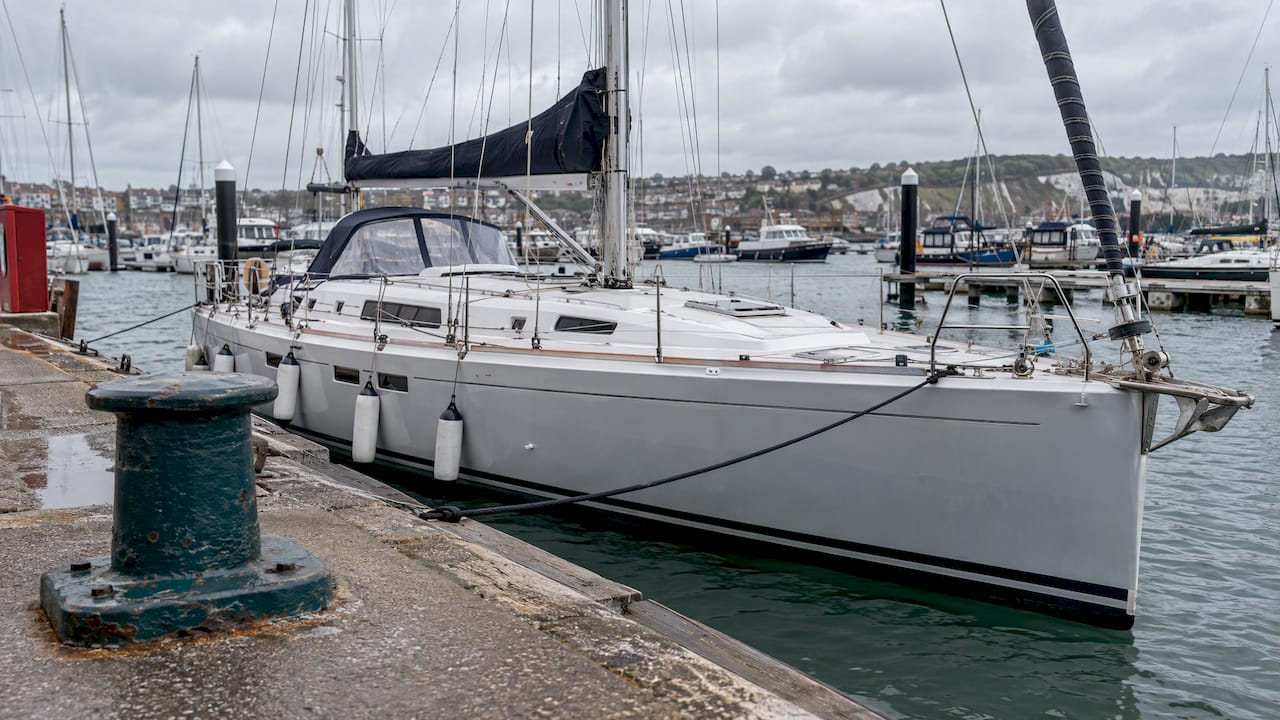
Bringing a yacht into the UK is treated as an import unless a relief applies. Import VAT, and in some cases customs duty, is due on the boat’s value. The customs side is dealt with through HMRC and Border Force. The registration side is separate: a yacht that will be kept and used in the UK usually needs a flag, and for many owners that flag is UK Part 1. Vessel Flag is a private consultancy that prepares and files yacht registration applications, so the second half of this guide is where we can take the paperwork off your hands. We are not a registry: certificates are issued by the flag registry.
TL;DR
- A yacht arriving from outside the UK is liable to import VAT and, depending on length and classification, customs duty, unless Temporary Admission, Returned Goods Relief or Transfer of Residence applies.
- The UK tariff lists 20% VAT for yachts and pleasure vessels under heading 8903, so the value you declare drives the bill.
- Temporary Admission lets a non-UK resident keep a qualifying yacht in the UK for up to 24 months in Great Britain (18 in Northern Ireland) without import VAT or duty.
- Once the boat is cleared, registration is a separate job: UK Part 1 needs a bill of sale, a declaration of eligibility, a deletion certificate from the previous register and an Ofcom radio licence.
- Vessel Flag handles UK Part 1 applications from €550, one-off, fully remotely.
Inhaltsübersicht
- Import or temporary visit: which are you?
- What you pay: import VAT and customs duty
- Reliefs that can reduce or remove the bill
- The arrival process, step by step
- After the import: registering the yacht
- Where Vessel Flag fits
- Our view: settle the flag and the owner before the boat moves
- FAQ
- Quellen
Import or temporary visit: which are you?
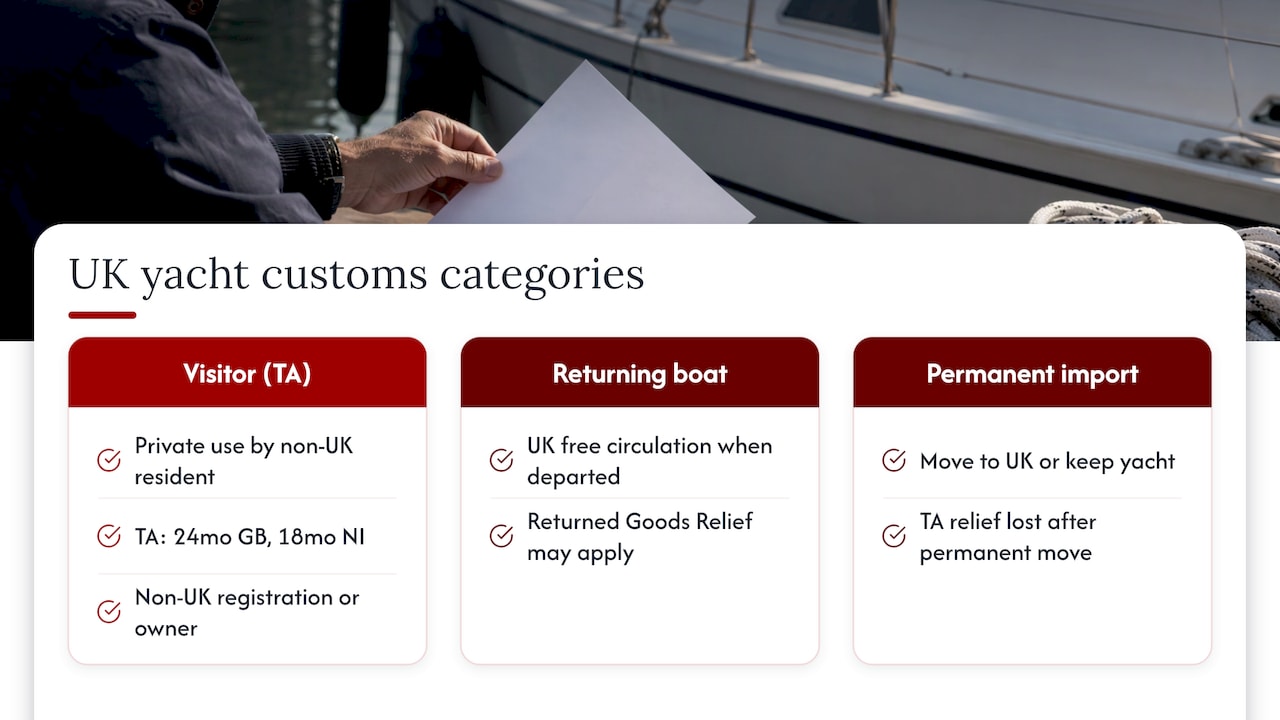
The first question is not how much you will pay but which category your boat falls into. The same hull can be a visitor, a returning British boat or a permanent import, and each has a different customs treatment.
A visitor. If you live outside the UK and use the yacht privately, Temporary Admission (TA) may apply. The GOV.UK guidance on sailing a pleasure craft into the UK temporarily sets the period at up to 24 months in Great Britain or 18 months in Northern Ireland. The boat must be registered outside the UK in the name of a person established outside the UK (or, if unregistered, owned by someone normally resident outside the UK). It must be used by a non-UK resident and be clearly identifiable by registration number or certificate, name or hull identification number.
A returning British boat. If the yacht was in free circulation in the UK when it left, Returned Goods Relief may apply, with conditions covered below.
A permanent import. If you are moving to the UK, or buying a yacht abroad to keep here, the boat is imported. If you decide to live permanently in the UK while the yacht is under TA, the vessel loses TA relief, although it may qualify for another relief such as Transfer of Residence.
For brokers and charter operators the distinction matters commercially. TA is for private use by a non-UK resident, so a vessel placed on the UK market or operated here for a UK client should be treated as an import and the position confirmed with HMRC before arrival.
What you pay: import VAT and customs duty
The RYA’s advice for visiting the UK states the default: unless a relief applies, you pay import VAT and duty on the boat’s current value.
VAT
Die UK Integrated Online Tariff for heading 8903 lists 17 commodity codes for yachts and pleasure vessels, all showing 20% VAT. That includes sailboats over 7.5m up to 24m (8903 22), sailboats over 24m (8903 23) and motorboats in length bands (8903 31, 32 and 33).
The VAT base is more than the price on the invoice. GOV.UK explains that import VAT is normally charged at the same rate as a domestic supply, on the customs value plus incidental expenses, any customs duty or levies, and any excise duty or other import charges, excluding the VAT itself. Incidental expenses include customs clearance charges, quay rent, entry fees, handling and loading or storage costs, as the GOV.UK valuation guidance sets out.
An illustrative calculation, not a quote:
| Item | Amount |
|---|---|
| Customs value of the yacht | £400,000 |
| Incidental expenses added (transport, handling, entry fees) | £10,000 |
| Customs duty | £0 |
| VAT base | £410,000 |
| Import VAT at 20% | £82,000 |
The figures are invented to show the method. Your own bill depends on the declared customs value, your commodity code and the duty position.
Customs duty
The tariff shows 0.00% third-country duty for the heading 8903 codes listed, but the GOV.UK arriving pleasure craft guidance says owners of vessels under 12 metres long may have to pay Customs Duty when the vessel is imported from outside the UK. Check the commodity code and duty line for your exact boat on the tariff on the day you declare, because the tariff is updated.
Declare the value even when nothing is due
GOV.UK’s customs value guidance says the normal method, the transaction value, is used for over 90% of duty-liable imports, and the value must be declared even where no duty or VAT is payable, because it feeds UK trade statistics. Keep the sale contract, the invoice and records of any fitting or transport costs, since they support the figure you declare.
Reliefs that can reduce or remove the bill
Temporary Admission
TA authorisation usually lets goods stay in the UK for up to 24 months before re-export without import duty or VAT, according to GOV.UK on importing goods temporarily. Private sea transport is limited to 18 months in Northern Ireland and 24 months in Great Britain. While the vessel is here it remains under customs supervision, and duties and taxes become due if the conditions are not met. No formal declaration is needed to re-export: the re-export declaration is considered made and accepted when the vessel leaves the UK.
The RYA notes that GOV.UK’s operational guidance covers the UK including Northern Ireland but excluding the Isle of Man, while the legal reference document frames eligibility in terms of Great Britain and the Isle of Man. If your plans involve either place, treat the operational guidance with caution and confirm the position first.
Returned Goods Relief
If you are bringing back a vessel that left the UK, GOV.UK says Returned Goods Relief can be claimed if it was in free circulation in the UK when exported and has had no more than running repairs abroad, with no value-increasing upgrades. For import VAT relief you need evidence that the same person who re-imported the vessel previously exported it. If the yacht was sold to a new owner abroad, that new owner is liable for import VAT on return.
Transfer of Residence
If you are moving your home to the UK, Transfer of Residence relief can remove import duties and charges. The main conditions are:
- you were resident outside the UK for at least 12 consecutive months;
- you import the goods within 12 months of moving;
- you intend to use them for the same purpose;
- for a vessel, you have used it for at least 6 months before moving.
The relief covers a living person’s personal property, not companies or trusts, and the goods cannot be lent, hired or transferred within 12 months. You need HMRC approval before claiming: complete a ToR1 form to obtain a unique reference number, quote it on the import declaration and use procedure code 40 00 C01.
This is why ownership structure matters. A yacht held by a company cannot use Transfer of Residence, so decide how the boat will be owned before it moves, not after.
The arrival process, step by step
- Get your EORI number. You need a GB-prefixed EORI to import into Great Britain, and may need an XI-prefixed one when moving goods to or from Northern Ireland, as GOV.UK’s import guide explains.
- Find the commodity code and work out the value. Use heading 8903 of the tariff and the length and propulsion of your vessel. Add the incidental expenses described above.
- Submit the pleasure craft report. The RYA says it must be submitted online at least 2 hours but no more than 24 hours before departing for the UK.
- Fly the yellow Q flag. Keep it flying until customs reporting is complete. Where you arrive directly from outside the EU, the Border Force National Yachtline is the route for reporting.
- Complete form C384 (Vessels). GOV.UK says owners of vessels designed or adapted for recreation or pleasure may have to pay VAT by completing it on arrival and emailing it to the Pleasure Craft Unit of Expertise.
- Declare what else is on board. That includes prohibited or restricted goods, surplus stores, tobacco and alcohol above allowances, and other goods acquired outside the UK worth more than £270 in total, including equipment bought and fitted abroad. Failing to declare can lead to fines and seizure.
- Pay, or claim the relief, and keep the paperwork. If the Customs Declaration Service calculation looks wrong, GOV.UK says you must work out the amount yourself using the Declaration Completion Instructions for Imports.
GOV.UK’s collection of customs rules for pleasure craft replaced the old Notice 8 and lists separate guidance for arriving, departing, temporary private use and sailing within UK waters. Always read the version dated closest to your arrival, since the arriving guidance was updated in July 2026.
Proof of VAT status afterwards
Keep the import declaration, the evidence of VAT paid or the relief claimed, the invoice and the bill of sale together in one file. A VAT-registered importer can claim back import VAT using a C79 certificate, as GOV.UK’s import guide notes. A future buyer, a marina, an insurer or a registry may ask to see that the boat’s VAT position is settled, and a file built at the time is far easier than reconstructing it years later.
After the import: registering the yacht
Clearing customs does not give the yacht a flag. Registration is a separate application to a registry, and the order matters: the vessel normally needs to be deleted from its previous register, which is why a deletion certificate appears on the document list below.
UK Part 1: what the registry asks for
The UK Ship Register’s Part 1 large-yacht page states a registration fee of £153 for a five-year period, paid through a GOV.UK secure payment link. It lists the documents needed:
- Bill of Sale (MSF 4705);
- Declaration of Eligibility (MSF 4727);
- a UK Certificate of Survey for Tonnage and Measurement issued within the last 12 months;
- ITC69 for vessels over 24 metres;
- a deletion certificate from the current register;
- the ship’s radio licence with call sign, applied for with Ofcom.
Smaller craft can use the Small Ships Register (Part 3), which the registry lists at £35 for five years and which requires a bill of sale or other document confirming ownership.
Who can register under Part 1
Owners can register personally if they are eligible, through their existing company (UK or eligible foreign, for example a Delaware corporation), or through a new UK LTD. A UK company is not always required. If a new company is the better route, our Firmengründungsservice covers UK LTD formation at €485, and Delaware LLC formation from €455 (€605 with apostille). Foreign company documents often need legalising for registry use, which is covered in our guides to apostille for yacht documents und consular legalisation.
The deletion certificate
If the yacht is registered elsewhere, the previous flag has to release it. Our guide to the yacht deletion certificate explains what it is and how to obtain it, and it is worth requesting early because the UK application cannot be completed without it.
Radio licence and MMSI
The UK registry asks for the ship’s radio licence with call sign. A UK MMSI licence through Ofcom costs €150 with us, VAT included, with no annual fees, and takes 1 day.
A bridge while you wait
Some owners need a flag in place quickly while customs and ownership questions are settled. Poland offers a route with provisional papers in 2 to 5 days, described in our guide to Polen vorübergehende Registrierung. San Marino provisional certificates take 2 to 6 days and are not guaranteed. Both are for owners who want a recognised flag before the final choice is made.
Where Vessel Flag fits
Customs clearance and VAT sit with HMRC, and the figures above are the ones to plan around. What we do is the registration and ownership set-up that follows. Yachtregistrierung im Vereinigten Königreich (Teil 1) starts at €550, one-off, and we prepare and file the application remotely, including the Ofcom MMSI registration at €150. Where the structure needs it, we form the UK LTD or arrange the Delaware route and handle the deletion certificate and transfer between flags.
The registry fee of £153 is paid separately to the UK Ship Register. Certificates are issued by the registry, never by us.
If Part 1 is not the right flag for the way you use the boat, we also file for Poland (from €320), San Marino (from €290), Malta (from €849), Palau (from €700), the Marshall Islands (€250 service fee plus registry fees) and the Cayman Islands (€450 service fee plus registry fees). Cook Islands registrations are quoted per yacht. Other flags, including Gibraltar and Panama, are handled on request with prices confirmed per case.
Our view: settle the flag and the owner before the boat moves
Most import problems we hear about begin before the boat leaves its berth. The owner is a company when the relief needs a person, or the previous registry has not yet released the vessel, or nobody has decided which flag the yacht will fly in the UK.
Our advice is to decide three things first: who will own the yacht, which flag it will carry, and whether it will be used privately or in business. Those answers decide whether Temporary Admission, Transfer of Residence or a full import is the right route, and they decide which documents the registry will ask for.
The second point is the paperwork chain. A bill of sale, a declaration of eligibility, a survey, a deletion certificate and a radio licence all have to line up in names and dates. When we prepare a UK Part 1 file, we build it in that order so that nothing waits on a document that should have been ordered weeks earlier.
The third is keeping one file. The import declaration, the VAT evidence and the registration papers belong together. Brokers who hand over a clean file sell boats faster and with fewer questions from the next buyer’s advisers.
Vessel Flag
FAQ
Do I have to pay VAT when I bring a yacht into the UK?
Usually yes, unless a relief applies. The UK tariff lists 20% VAT for yachts and pleasure vessels, charged on the customs value plus incidental expenses and any duty. Temporary Admission, Returned Goods Relief or Transfer of Residence can remove the charge if you meet their conditions.
How long can a foreign-registered yacht stay in the UK?
Under Temporary Admission, a qualifying yacht used privately by a non-UK resident can stay for up to 24 months in Great Britain or 18 months in Northern Ireland. The vessel must be identifiable and registered or owned outside the UK as the guidance describes.
How much does it cost to register a yacht in the UK?
The UK Ship Register lists a £153 fee for five years of Part 1 registration and £35 for five years on the Small Ships Register (Part 3). Our UK Part 1 preparation and filing service starts at €550, one-off, and the Ofcom MMSI registration is €150.
Do I need a UK company to register under Part 1?
No. Eligible owners can register personally, through an existing UK or eligible foreign company such as a Delaware corporation, or through a new UK LTD. The right route depends on who owns the yacht and how it is used.
Can I register the yacht before it arrives in the UK?
Registration and customs clearance are separate processes. Registration needs documents such as the bill of sale, the declaration of eligibility, the survey and the deletion certificate, so most of the file can be prepared while the boat is still abroad.
To start, see our UK Part 1 yacht registration page or book a consultation and tell us about the yacht, its current flag and who will own it.
Quellen
- Sailing a pleasure craft into the UK temporarily for private use, GOV.UK
- Sailing a pleasure craft that is arriving in the UK, GOV.UK
- Yachts and other vessels for pleasure or sports, UK Integrated Online Tariff
- Paying VAT on imports from outside the UK, GOV.UK
- Working out the VAT value using the customs value, GOV.UK
- Prepare to work out the customs value of your imported goods, GOV.UK
- Visiting the UK, RYA country specific advice
- Import goods to the UK temporarily, GOV.UK
- Transfer of residence to the UK, GOV.UK
- Import goods into the UK: step by step, GOV.UK
- Customs rules for sailing your pleasure craft, GOV.UK
- Large Yacht New Registration (Part 1), UK Ship Register
- Small Ships Register New Registration (Part 3), UK Ship Register
VesselFlag is a private consultancy that prepares and files yacht registration applications for owners. We are not a government body or flag registry; certificates are issued by the relevant registry. This article is general information, not legal advice.