
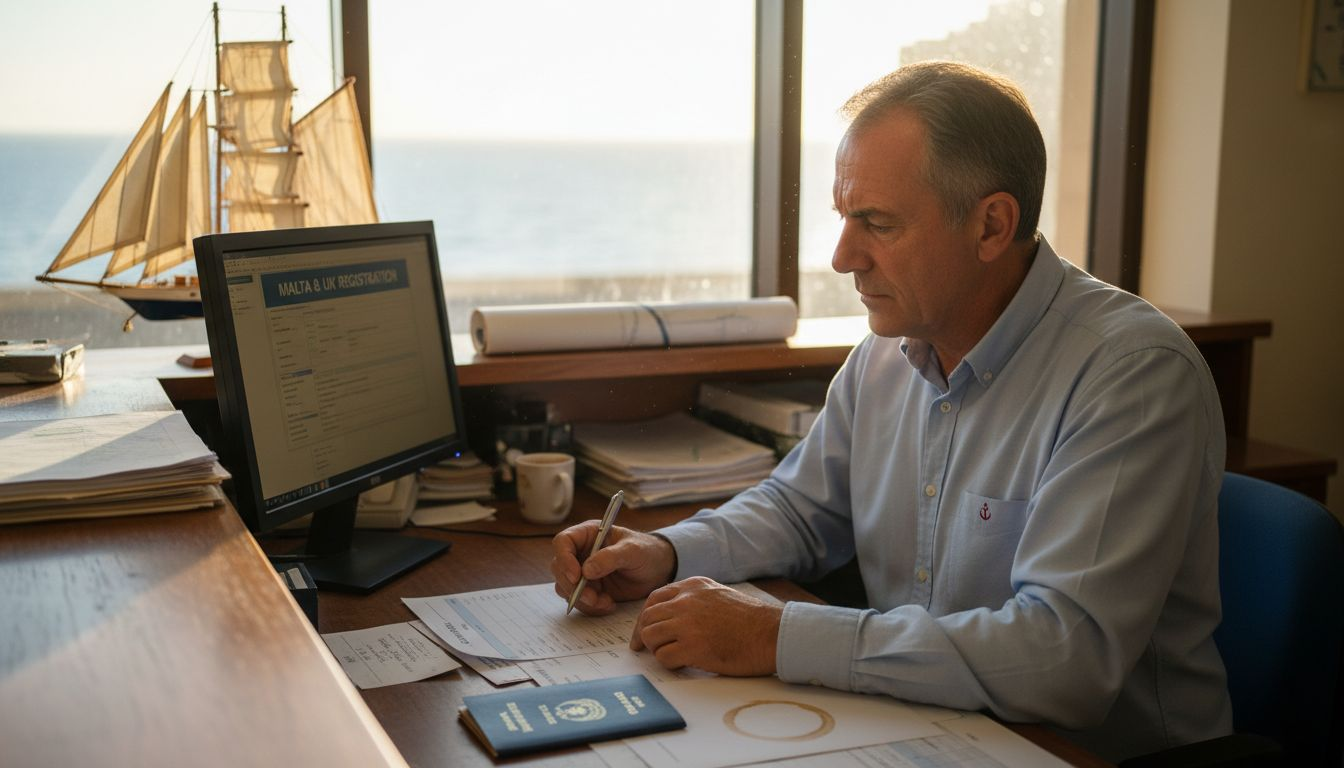
Many yacht owners mistakenly believe Malta’s boat registration involves minimal scrutiny, only to face delays due to rigorous documentation checks and VAT compliance demands. Understanding the precise requirements in Malta and the UK is essential to avoid costly setbacks. This guide clarifies the legal obligations, procedural differences, and compliance steps to ensure your vessel registration proceeds smoothly and efficiently.
Inhaltsübersicht
- Introduction To Boat Registration Requirements
- Understanding Malta’s Boat Registration Process And Compliance
- Vat Compliance And Tax Considerations For Malta Registered Yachts
- Boat Registration Legal Framework And Options In The Uk
- Common Misconceptions About Yacht And Boat Registration
- Comparison Framework: Malta Vs Uk Boat Registration Requirements
- Practical Guidance For A Smooth Registration Experience
- Get Expert Help For Hassle-Free Yacht Registration
- Boat Registration Requirements Frequently Asked Questions
Key takeaways
| Punkt | Einzelheiten |
|---|---|
| Registration proves legal ownership | Boat registration legally establishes ownership and compliance, with requirements varying significantly between Malta and the UK. |
| Malta requires resident agents for non-residents | Non-EU or non-Maltese owners must appoint a resident agent to manage legal filings and ensure compliance with registration procedures. |
| Inspection rules depend on vessel age | Vessels over 10 years old typically require mandatory safety inspections before or shortly after provisional registration in Malta. |
| VAT compliance affects Malta registration | Malta applies an 18% standard VAT on yacht imports, with reduced rates and reclaim options available under specific commercial conditions. |
| Provisional registration accelerates operation | Malta’s provisional registration grants temporary legal status for 6 to 12 months, allowing faster vessel operation while permanent registration processes. |
Introduction to boat registration requirements
Boat registration legally establishes ownership and ensures your vessel complies with maritime laws, protecting you from operational disputes and penalties. Without proper registration, you cannot legally operate in most international or territorial waters, limiting your vessel’s functionality and value. Malta allows registration of all vessels without nationality restrictions but requires proof of ownership and international safety compliance. The UK mandates registration primarily for sea-going vessels and those with marine mortgages, while smaller inland boats may register voluntarily.
The differences between Malta and UK registration systems directly affect your operational rights, tax obligations, and administrative responsibilities. Malta’s system accommodates commercial and private yachts globally, offering provisional registration for faster legal operation. The UK provides two distinct registers: the UK Ship Register for larger sea-going vessels and the Small Ships Register for smaller boats and inland use. Each jurisdiction imposes unique documentation standards, inspection protocols, and fee structures.
Proper documentation is critical to avoid registration delays or rejections. Key documents include:
- Proof of ownership such as bills of sale or builder’s certificates
- Vessel specifications including tonnage, dimensions, and construction details
- International safety compliance certificates for Malta registrations
- Valid identification and residency documentation for all owners
Understanding these foundational requirements positions you to navigate the registration process confidently. For comprehensive guidance on preparing your documentation, review our yacht documentation requirements for 2026. The Transport Malta registration process provides official procedural details directly from the authority.
Understanding Malta’s boat registration process and compliance
Malta’s registration process involves several clearly defined steps designed to verify ownership, ensure vessel safety, and maintain regulatory compliance. Eligibility extends to all vessel types regardless of owner nationality, but non-EU and non-Maltese owners face additional requirements. You must provide complete ownership documentation, including bills of sale tracing the vessel’s ownership history, builder’s certificates for new vessels, and deletion certificates from previous registries.
Provisional registration grants temporary legal status for 6 to 12 months, allowing you to operate your vessel while permanent registration processes. This expedited option is valuable for owners needing immediate legal standing for chartering, cruising, or relocating vessels. Permanent registration follows once all documentation, inspections, and compliance checks conclude successfully.
Inspection is required for vessels over 10 years old depending on exact age, before or shortly after provisional registration. These inspections verify structural integrity, safety equipment, and compliance with international maritime standards. Inspections typically occur in Malta or at approved international locations, with surveyors assessing hull condition, navigation systems, life-saving equipment, and fire prevention measures.
Non-resident owners must appoint a resident agent who legally represents them and manages all filings. The resident agent acts as your local liaison with Transport Malta, handling document submissions, correspondence, and regulatory updates. This requirement ensures Malta’s registry maintains direct communication channels and accountability for all registered vessels.
Common documentation rejection causes include:
- Incomplete ownership chains with missing bills of sale or transfer documents
- Expired or invalid deletion certificates from previous registries
- Insufficient vessel specification details or conflicting measurements
- Unsigned or improperly notarized legal documents
Pro Tip: Engage your resident agent early in the process to review all documentation before submission, significantly reducing rejection risk and processing delays.
For step-by-step guidance, consult our Malta yacht registration guide und how to register a yacht guide. Official details on resident agent roles and vessel inspection requirements are available from BDO Malta.
VAT compliance and tax considerations for Malta registered yachts
VAT compliance significantly impacts your registration timeline and overall costs when registering a yacht in Malta. Malta applies an 18% standard VAT on yacht importation, but a reduced 12% rate for short-term yacht hires up to 5 weeks and allows VAT reclaim for qualifying commercial owners. These rates apply at importation and during the registration process, directly affecting your financial planning.
The reduced 12% VAT rate for short-term yacht hires became effective in 2024, providing cost relief for charter operators and short-term rental businesses. This rate applies specifically to hire agreements lasting up to five weeks, encouraging Malta’s yacht charter industry. Standard 18% VAT continues to apply for longer-term hires, private use, and vessel purchases.
Commercial yacht owners operating qualifying charter businesses can reclaim VAT under specific conditions. To qualify, you must:
- Operate a legitimate commercial yacht charter business registered in Malta
- Maintain detailed records of charter income and VAT paid
- Ensure the yacht is used predominantly for commercial purposes
- Comply with all commercial licensing and operational requirements
Non-compliance with VAT obligations can delay or prevent registration approval, as Transport Malta coordinates with Malta’s tax authorities to verify VAT clearance before issuing permanent registration. Unpaid VAT liabilities or incomplete VAT documentation trigger administrative holds, extending processing times significantly.
Pro Tip: Consult a Maltese tax advisor before starting registration to clarify your VAT obligations and reclaim eligibility, avoiding costly errors and ensuring smooth financial compliance.
Understanding VAT is vital for accurate cost planning and regulatory compliance. For broader context on Malta’s advantages, explore why Malta for yacht registration und yacht registration tax rules and costs. Review 6 key yacht compliance requirements to ensure full regulatory readiness. The Malta VAT yacht registration guide offers comprehensive tax details.
Boat registration legal framework and options in the UK
The UK’s boat registration system operates under distinct legal frameworks depending on vessel type, size, and intended use. Registration is mandatory for boats used in international waters or with marine mortgages but not all inland or private boats. This distinction means recreational vessels used exclusively on inland waterways may register voluntarily, while sea-going vessels and those with financing require formal registration.
There are two UK boat registers: the UK Ship Register for sea-going vessels, and the Small Ships Register for smaller vessels and inland waterways. The UK Ship Register, also known as Part I, provides full international recognition and is required for commercial vessels, yachts over 24 meters operating internationally, and any vessel with a marine mortgage. The Small Ships Register, or Part III, serves smaller pleasure vessels under 24 meters used primarily in UK waters or inland.
Registration validates ownership legally and facilitates marine mortgages, protecting lenders and owners through formal documentation of ownership interests. It provides official proof of ownership recognized by maritime authorities worldwide, essential for insurance claims, sales transactions, and legal disputes. The UK Ship Register also enables vessels to fly the British Red Ensign, granting rights and protections under UK maritime law.
Documentation requirements include:
- Proof of ownership such as bills of sale or builder’s certificates
- Vessel specifications including length, tonnage, and construction materials
- Identification documents for all registered owners
- Evidence of eligible UK residency or corporate registration
Registration impact differs significantly by register and usage. Commercial operators and vessels with mortgages benefit from the UK Ship Register’s international standing, while recreational inland boat owners find the Small Ships Register sufficient and more cost-effective.
| Feature | UK Ship Register | Small Ships Register |
|---|---|---|
| Vessel eligibility | Sea-going vessels, commercial yachts | Pleasure craft under 24m |
| International recognition | Full global recognition | Limited to UK waters |
| Mortgage capability | Required for marine mortgages | Not available |
| Registration fees | Higher, based on tonnage | Lower, fixed fees |
| Renewal period | Continuous, subject to fees | Five-year renewal |
For detailed guidance, visit our UK Part I yacht registration page and review yacht documentation requirements for the UK. Official information is available from the UK Ship Register official guide and UK boat registration overview.
Common misconceptions about yacht and boat registration
Several persistent myths about boat registration in Malta and the UK create confusion and lead to registration errors or delays. Correcting these misconceptions ensures you approach registration with accurate expectations and proper preparation.
Malta’s registration is often perceived as low-scrutiny or lenient, but this is false. Transport Malta enforces rigorous documentation checks, VAT compliance verification, and safety inspections. The jurisdiction’s reputation for efficiency stems from streamlined processes and professional resident agents, not relaxed standards. Incomplete or inaccurate submissions face rejection just as in any jurisdiction with high regulatory standards.
Not all UK boats require registration, contrary to common belief. Registration depends on usage and location. Recreational vessels used exclusively on inland waterways or private waters may operate without registration. However, sea-going vessels, boats with marine mortgages, and commercial craft must register. This flexibility allows small boat owners to avoid unnecessary administrative burdens while ensuring accountability for vessels operating in broader maritime contexts.
VAT is not always reclaimable in Malta. Only commercial yacht owners meeting specific criteria qualify for VAT reclaim. Private yacht owners cannot reclaim VAT paid on importation or registration, regardless of vessel value or usage patterns. Misunderstanding this distinction leads to financial miscalculations and disappointment.
Age and inspection exemptions exist but must be verified carefully. Vessels under 10 years old may bypass certain inspections in Malta, but this depends on construction standards, previous registry compliance, and Transport Malta’s assessment. Assuming automatic exemption without confirmation risks last-minute inspection requirements that delay registration.
Misunderstanding these realities can cause registration delays or legal issues. For accurate information, explore why choose Malta flag und yacht registration best practices.
Comparison framework: Malta vs UK boat registration requirements
A side-by-side comparison of Malta and UK registration requirements clarifies the practical differences affecting your decision and preparation.
| Requirement | Malta | UK |
|---|---|---|
| Documentation complexity | High, requires ownership chain, deletion certificates, and safety compliance | Moderate, proof of ownership and vessel specifications sufficient |
| Inspection requirements | Mandatory for vessels over 10 years old | Not typically required for registration |
| Resident agent | Required for non-EU/non-Maltese owners | Not required |
| VAT application | 18% standard, 12% for short-term hires, reclaim available for commercial use | No VAT on registration |
| Processing time | 6-12 months provisional, 12-18 months permanent | 2-8 weeks depending on register |
| International recognition | Full global recognition | Full for Ship Register, limited for Small Ships Register |
| Eigentumsbeschränkungen | None, all nationalities eligible | UK residency or corporate registration required |
Documentation requirements differ significantly in complexity and proof needed. Malta demands comprehensive ownership histories and deletion certificates from previous registries, while the UK accepts simpler ownership documentation for most vessels. This difference reflects Malta’s role as an international registry serving vessels transitioning between multiple jurisdictions, compared to the UK’s focus on national vessel oversight.
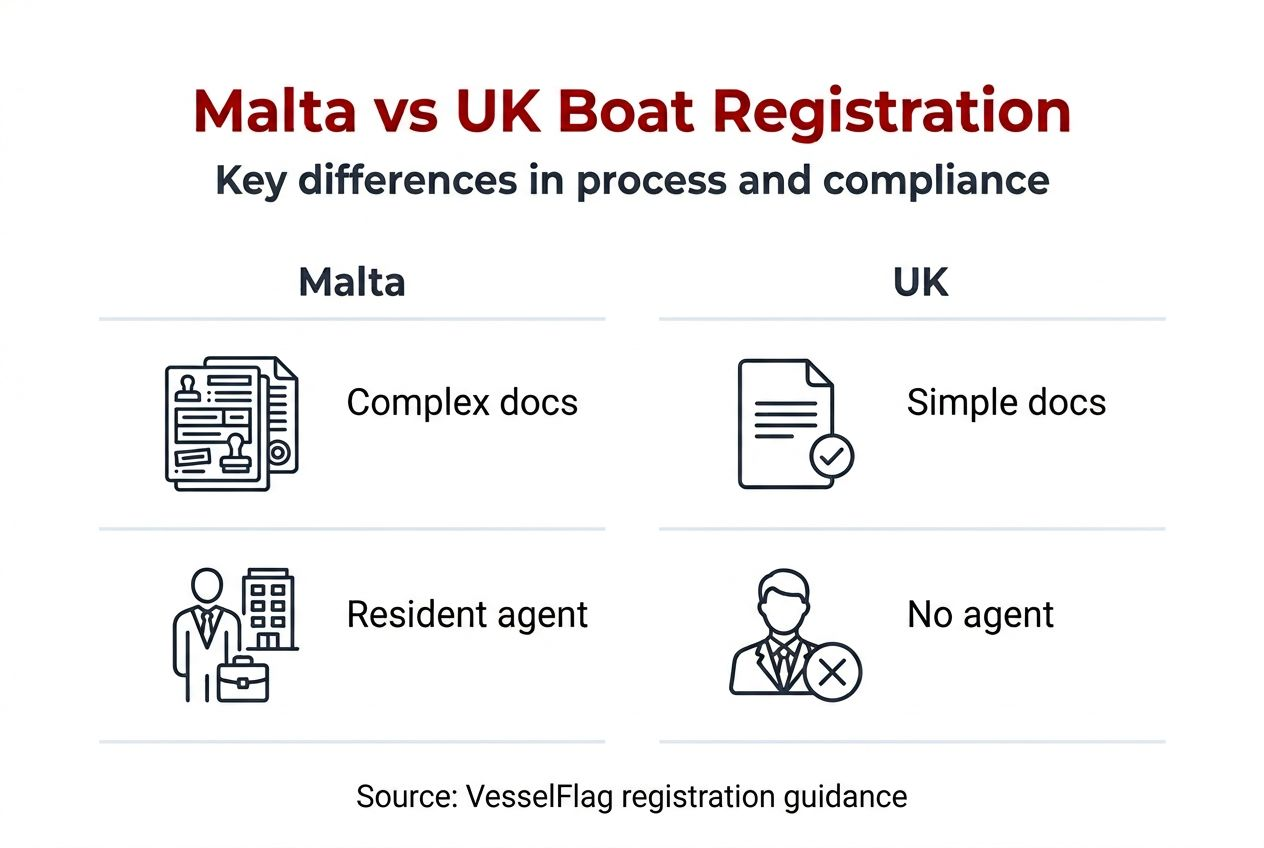
Inspection and vessel age rules are stricter in Malta, where vessels over 10 years old face mandatory safety inspections. The UK does not require inspections for registration purposes, although vessels must comply with separate safety and survey requirements for operational licensing.
Resident agent requirements distinguish the two jurisdictions sharply. Malta mandates resident agents for non-EU and non-Maltese owners, adding cost but ensuring local legal representation. The UK imposes no such requirement, simplifying the process for eligible British residents and corporations.
VAT applies in Malta but is absent from UK registration. Malta’s 18% standard VAT on importation represents a significant cost, though reduced rates and commercial reclaims offer relief under qualifying conditions. The UK imposes no registration-related VAT, making upfront costs more predictable.
Processing times favor Malta’s provisional registration, granting legal operation within weeks, while permanent registration takes longer. UK registration completes faster overall for most vessels, particularly under the Small Ships Register.
For strategic insights, review choose Malta flag advantages, Malta yacht registration details, and UK registration options.
Practical guidance for a smooth registration experience
Achieving efficient yacht registration requires strategic preparation and proactive management of documentation, inspections, and compliance obligations.
- Prepare all ownership and inspection documents in advance, including bills of sale, builder’s certificates, deletion certificates, and safety compliance records. Organize documents chronologically to trace ownership history clearly.
- Appoint a qualified resident agent promptly for Malta registrations, ideally before submitting initial applications. Timely appointment of a resident agent in Malta and precise, complete documentation submission reduces rejection risk significantly.
- Utilize provisional registration to legally operate faster while permanent registration processes. Provisional status allows chartering, cruising, and relocation activities without waiting for final approval.
- Schedule and pass mandatory inspections proactively, booking surveyors early to avoid delays caused by scheduling conflicts or failed inspections requiring remedial work.
- Check VAT obligations carefully to avoid financial setbacks, consulting Maltese tax advisors to determine your liability, reclaim eligibility, and documentation requirements.
- Maintain detailed records of all correspondence, submissions, and compliance actions, creating an audit trail that simplifies queries and accelerates approvals.
Pro Tip: Request pre-submission document reviews from your resident agent or registry consultants to catch errors before official submission, saving weeks of processing time.
Common pitfalls to avoid include:
- Submitting incomplete ownership chains with gaps in bills of sale
- Failing to obtain deletion certificates from previous registries
- Underestimating VAT costs and reclaim eligibility
- Delaying resident agent appointments until after submission
- Ignoring inspection scheduling, causing last-minute rushes
For comprehensive preparation, use our Checkliste für die Registrierung von Yachten and review key yacht compliance requirements. Explore why choose Malta flag to understand strategic benefits. Official guidance is available from BDO Malta registration tips.
Get expert help for hassle-free yacht registration
Navigating boat registration in Malta and the UK becomes significantly easier with professional guidance. VesselFlag specializes in streamlining yacht and boat registration across multiple jurisdictions, reducing processing time and minimizing errors through deep regulatory expertise.
Our comprehensive flag registration services cover all documentation preparation, resident agent appointments, VAT compliance, and inspection coordination. Whether you need Malta yacht registration services or UK boat registration services, we provide customized support tailored to your vessel type, ownership structure, and operational needs. Our team handles the administrative complexity, allowing you to focus on enjoying your vessel.
Boat registration requirements frequently asked questions
How long does Malta provisional and permanent registration take?
Provisional registration typically completes within 6 to 12 months, granting temporary legal status for vessel operation. Permanent registration follows within 12 to 18 months once all documentation, inspections, and compliance checks conclude. Processing times vary based on documentation completeness and inspection scheduling.
How often must older vessels undergo inspections in Malta?
Vessels over 10 years old require an initial mandatory inspection before or shortly after provisional registration. Subsequent inspections occur periodically based on vessel age, construction standards, and operational use, typically every few years. Transport Malta specifies exact schedules based on individual vessel assessments.
Under what conditions can I reclaim VAT in Malta?
VAT reclaim is available exclusively for commercial yacht owners operating legitimate charter businesses registered in Malta. You must maintain detailed records of charter income and VAT paid, ensure predominantly commercial use, and comply with all commercial licensing requirements. Private yacht owners cannot reclaim VAT regardless of vessel value. For detailed guidance, see our yacht registration tax rules and costs.
What are resident agent responsibilities for non-resident owners?
Resident agents legally represent non-resident owners in all dealings with Transport Malta, managing document submissions, correspondence, regulatory updates, and compliance filings. They ensure timely responses to registry queries and maintain accurate records on your behalf. Appointing a qualified agent early reduces rejection risk and processing delays. Explore our Malta yacht registration guide for more details.
What key documents are required for registration applications?
Essential documents include proof of ownership such as bills of sale or builder’s certificates, vessel specifications detailing length, tonnage, and construction, deletion certificates from previous registries, owner identification, and international safety compliance certificates for Malta. Complete documentation prepared in advance significantly accelerates processing. Use our yacht registration checklist to ensure nothing is missed.