
Yes, you can renew an FCC ship station license, and you should do it through the Universal Licensing System during the renewal window that opens 90 days before your license expires. File before that expiration date and you’re authorized to keep operating while the FCC processes your paperwork. Miss the deadline entirely, though, and renewal is off the table. You’ll have to start over with a brand new license application.
TL;DR:
- The renewal window opens 90 days before license expiration, and filing on time allows continued operation during processing; missing it requires starting anew.
- Completing all filing steps carefully, including verifying equipment and voyage status, prevents rejection or mismatches during renewal.
- Gathering all necessary forms, vessel data, and payment information beforehand streamlines the application and reduces errors.
- License lapses can be avoided by setting reminders, maintaining current contact info, and tracking multiple vessels’ renewal dates with spreadsheets.
- Managing MMSI reprogramming and license cancellation separately from expiration avoids equipment issues and ensures smooth reactivation.
Índice
- What Is the Ship Station License Renewal Process?
- What Documents Do You Need for Ship Station License Renewal Application?
- How Long Do You Have to Renew a Ship Radio License?
- What Happens if Your Ship Station License Already Expired?
- Do You Need a Ship Station License for Your Boat?
- Ship Station License vs. Operator Permit: What’s the Difference?
- How Can You Avoid Ship Station License Lapses?
- Where to Find Official FCC and Maritime Resources
- Why Proactive License Tracking Beats Scrambling
- Let VesselFlag Handle Your Vessel Compliance Paperwork
- Sources
- FAQ
What Is the Ship Station License Renewal Process?
Renewing a ship station license means refiling FCC Form 605 in ULS before your current ten-year term runs out. The FCC opens that window 90 days before your license expires, and you can file any time between then and the actual expiration date. File on time and the FCC treats your operation as authorized while the renewal sits in the queue, so a slow processing time on their end doesn’t strand your vessel without legal radio coverage.
Here’s the exact sequence for filing in ULS.
- Confirm your FCC Registration Number (FRN) and account email are current. ULS does not send you a heads up if your contact information is stale, so treat the renewal window opening 90 days before expiration as a date you track yourself, not one the FCC will remind you about.
- Log into ULS at the FCC’s online licensing portal using your FRN and password.
- Navigate to “My Licenses” and locate the active call sign tied to your vessel.
- Select the renewal filing purpose. Most owners choose “RO, Renewal Only” if nothing about the vessel or equipment has changed and they want to keep the same call sign. If you’re also updating equipment details, you’ll use “RM” for renewal with modification instead.
- Complete Form 605, confirming Item 2 (purpose code) and Item 5 (call sign) match your existing license.
- Attach the correct schedule. Schedule B covers ship radio service particulars, while Schedule G applies if you’re claiming an exemption instead of a full license.
- Enter your MMSI, vessel official number, and voyage status (domestic versus international) in the appropriate fields.
- Pay the filing fee through Form 159 or directly in ULS, and save the confirmation.
- Download and keep your filing confirmation. This document is your proof that you filed on time, which matters if the FCC’s processing runs past your expiration date.
A few things trip people up during this process:
- The system won’t stop you from filing incomplete information, so double-check your call sign and MMSI before submitting.
- International voyage status affects which equipment schedules you need. Get it wrong and your renewal may bounce back for correction.
- Filing “RO” when you actually changed equipment can create a mismatch between your license and your gear, which becomes a problem during a Coast Guard inspection.
Pro Tip: Screenshot every screen as you go through the ULS filing, not just the final confirmation. If a field reverts or the session times out, having a record of what you entered saves you from redoing the whole process from memory.
What Documents Do You Need for Ship Station License Renewal Application?
Before you open ULS, gather the paperwork so you’re not hunting for numbers mid-filing.
- FCC Form 605 (Main Form). This is the base application for both new licenses and renewals, and it captures your identifying information, FRN, and license details.
- Schedule B. Required for ship radio service, this schedule records vessel particulars like radio equipment type, frequencies, and MMSI data.
- Schedule G. Use this instead of Schedule B if you’re filing under an exemption rather than a standard ship station license.
- MMSI number and DSC equipment details. If your vessel carries Digital Selective Calling equipment, you’ll need to list it along with your assigned MMSI.
- Voyage classification. Indicate whether your vessel operates domestically or takes international voyages, since this affects equipment and licensing requirements.
- Vessel identifiers. Have your USCG documentation number or state registration number on hand to confirm the license matches the correct vessel.
- Form 159 payment information. This is the fee remittance form tied to your ULS filing; you can pay directly within the system during submission.
- Your FRN. If you don’t already have one associated with your account, you’ll need to register for it before you can file anything in ULS.
Commercial operators managing multiple vessels often find the schedule requirements get tangled between boats, especially when some carry HF equipment and others don’t. Keeping a simple spreadsheet with call sign, MMSI, and equipment schedule for each vessel prevents cross-filing errors.
How Long Do You Have to Renew a Ship Radio License?
Timely renewal means filing within the 90-day window before your license expires, no earlier and no later than the expiration date itself. That’s the safe zone. Miss it, and the FCC gives you a narrow cushion, but it shrinks fast.
The 30-day window that decides everything: File within 30 days after your license expires and the FCC will generally grant your renewal if you request a waiver and show good cause, according to FCC guidance. File after that 30-day mark and your application faces stricter review, with no guarantee of approval.
A few practical points worth knowing before you’re staring down a deadline:
- Fees for renewal applications change periodically, so check the FCC’s fee schedule rather than relying on a number from an old filing.
- Payment happens through Form 159 or directly inside ULS during your renewal submission.
- An expired license isn’t just inactive. It’s treated as though it never existed for renewal purposes, meaning you’d be filing a new application, not a renewal.
- If your vessel carries an MMSI, letting the license lapse can trigger cancellation or reclaim steps before that number becomes usable again.
The math here is simple. Ninety days of advance filing room, plus a 30-day grace period if you slip. That’s a four-month margin most owners never need to test.
What Happens if Your Ship Station License Already Expired?
Once your license has expired, renewal is no longer an option. You have to file a brand new license application, and if you had an MMSI tied to the old license, reclaiming it takes a specific sequence.
- Cancel the expired license in ULS. This is the step that actually frees up your existing MMSI for reassignment. Skipping it or trying to work around it usually just creates confusion in the system.
- Wait roughly 24 hours for the FCC’s system to process the cancellation before attempting a new application.
- File a new license application using the same MMSI, assuming it’s now been released back to you.
- Reprogram your radio equipment only after the new license and MMSI assignment are confirmed, not before.
That third and fourth step is where owners run into the most friction. Reprogramming a VHF or AIS unit before the MMSI reassignment is finalized can wipe factory settings or create a mismatch between the radio and your FCC record. Fleet operators managing several vessels sometimes bring in a professional service to handle MMSI setup specifically to avoid that kind of equipment headache.
Pro Tip: Never cancel your expired license and reprogram your radio in the same sitting. Let the 24 hour processing window pass, confirm your new MMSI in ULS, then touch the equipment.
Waivers for late filings beyond 30 days are rare and reviewed case by case. If you’re in that position, contacting the FCC’s Mobility Division directly is a better use of time than repeated ULS submission attempts.
Do You Need a Ship Station License for Your Boat?
Not everyone does. The Telecommunications Act of 1996 exempts most recreational boaters from carrying a license if their vessel is limited to VHF radio, radar, and an EPIRB, and operates only in domestic waters.
You likely do need a license if any of the following apply:
- Your vessel takes international voyages, even occasionally.
- You operate HF radio equipment or a satellite communication terminal.
- Treaty obligations require licensing for your vessel class or route.
- You’re operating a commercial vessel subject to separate maritime communication rules.
Here’s the part a lot of exempt owners miss: even when you don’t need a license, renewing one anyway lets you retain a personalized call sign and keeps your emergency identification data active and current in FCC records. For a boater who’s had the same call sign for a decade, that continuity has real value during a search and rescue situation.
Ship Station License vs. Operator Permit: What’s the Difference?
These two documents get confused constantly, and mixing them up is one of the most common mistakes owners make when they think they’re “renewing” but aren’t renewing the thing that actually matters.
- The ship station license belongs to the vessel, not to you personally. It runs on a ten-year term and requires the renewal process described above.
- Operator permits belong to the person, and following rule changes after 2013, most operator credentials are issued for a lifetime term with no renewal cycle at all.
- Check which document you’re actually dealing with before you file anything. A vessel authorization and a personal operator permit are separate paperwork trails with separate rules, and treating them interchangeably is how owners end up filing the wrong form.
If you’re not sure which one you’re holding, look at whether the credential is tied to a call sign (that’s the vessel license) or to your name as an individual (that’s the operator permit).
How Can You Avoid Ship Station License Lapses?
License lapses often come down to one thing: nobody was watching the calendar.
Keep your FRN and account email current in ULS. That’s not optional housekeeping, it’s the only way you’ll actually see a renewal notice if the FCC sends one. Set your own 90-day reminder rather than counting on the system to flag it for you, and keep filing confirmations and screenshots in your vessel’s records folder, not just in your email inbox where they’ll get buried.
- For a single recreational vessel, a calendar reminder and a folder of confirmations is usually enough.
- For fleets or commercial operations juggling multiple ten-year cycles, professional monitoring keeps license and MMSI data aligned across every vessel.
- Consider bringing in help specifically for MMSI programming or a documentation audit if you’re managing more than two or three vessels at once.
Pro Tip: If you manage a fleet, build a single spreadsheet tracking each vessel’s license expiration, MMSI, and last renewal date. It sounds basic, but it’s the single most effective tool against a surprise lapse.
Where to Find Official FCC and Maritime Resources
Bookmark these before you need them, not after.
- FCC Ship Radio Stations Licensing for renewal rules, timelines, and the ULS login.
- FCC Form 605 instructions covering the main form and both Schedule B and Schedule G.
- FCC Licensing Fees page for current renewal charges.
- USCG Navigation Center’s FCC Radio Licenses guide for exemption rules under the Telecommunications Act.
- Vesselflag’s ship station license requirements page if you want a plain-language breakdown of who needs to file.
Why Proactive License Tracking Beats Scrambling
Most of the friction owners run into with ship station licenses is entirely avoidable, and it usually traces back to treating a ten-year renewal cycle like something that will take care of itself. It won’t. Ten years is long enough that owners forget which call sign is tied to which boat, let alone when the license actually expires.
Our take, watching owners go through this repeatedly: MMSI continuity is the piece that actually costs people time and money when it breaks. A lapsed license is an annoying paperwork problem. A lost MMSI tangled up with reprogrammed equipment is a multi-week headache that can leave a vessel without proper emergency identification during the gap. Track the calendar, protect the MMSI, and the renewal itself is genuinely simple.
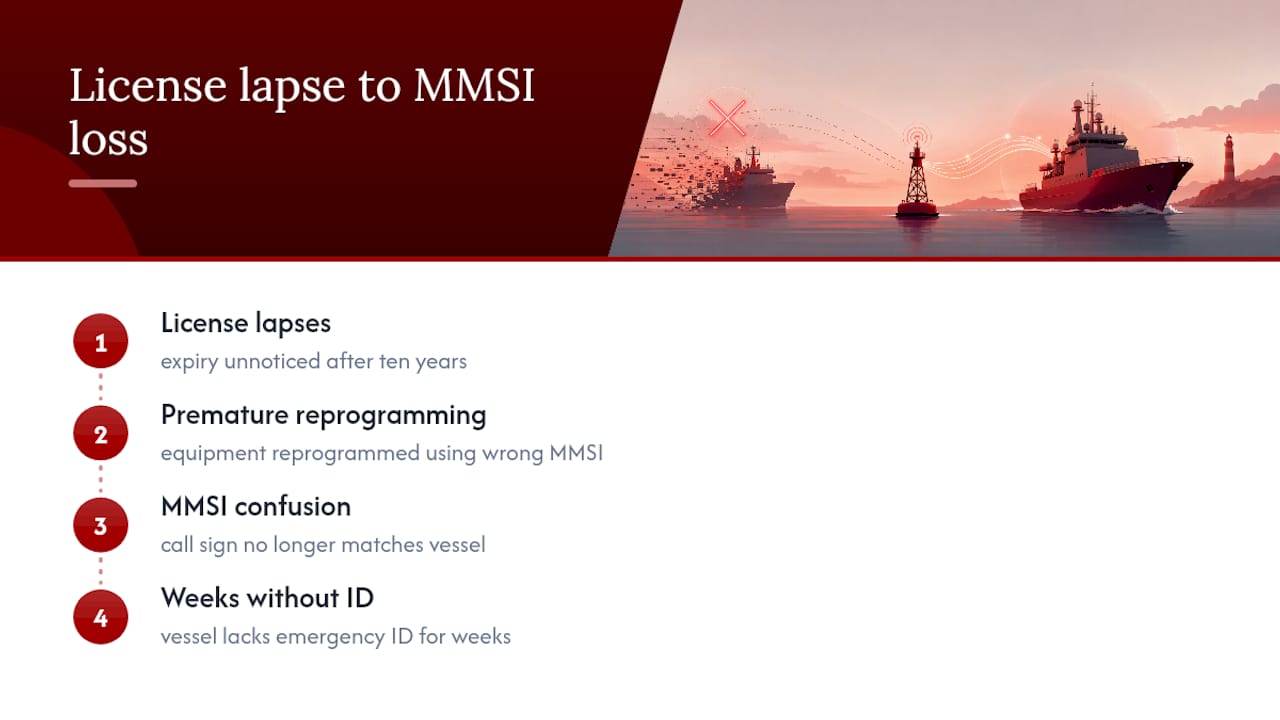
For a single boat, that’s manageable with a phone reminder. For a commercial fleet running several vessels on staggered ten-year cycles, it’s worth treating as an actual administrative function, not an afterthought squeezed in between other paperwork. That’s where professional help on the MMSI and compliance side tends to pay for itself.
Let VesselFlag Handle Your Vessel Compliance Paperwork
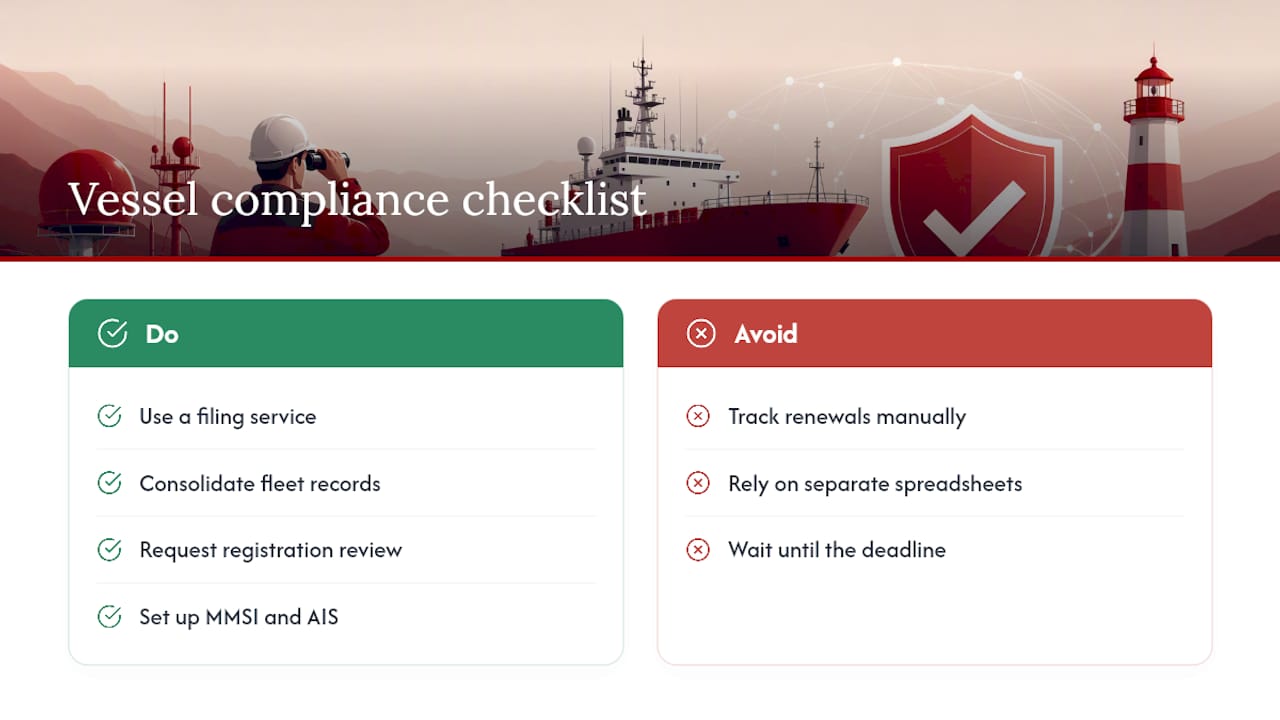
If you’d rather not track a ten-year renewal cycle yourself, or you’re managing MMSI setups across more than one vessel, services are available to handle filing in ULS. Instead of hunting through Form 605 fields and cross-checking schedules on your own, such services can handle document checks, MMSI and AIS setup, and full registration bundles so nothing falls through the cracks during a busy season.
This matters most for commercial operators and multi-vessel owners, where one missed deadline on one boat can mean reclaiming an MMSI and reprogramming radios under time pressure. Some compliance packages are built around exactly that problem: keeping documentation, call signs, and MMSI numbers aligned across an entire fleet instead of tracked boat by boat in separate spreadsheets.
If you’re evaluating your vessel’s registration and compliance status heading into a renewal cycle, start with a registration validity review to see where your paperwork actually stands before a deadline forces the question.
This article is general information, not a substitute for advice from a qualified lawyer. Consult a qualified legal professional about your own circumstances before acting on anything here.
Sources
- Ship Radio Stations Licensing
- FCC Form 605 instructions and schedules
- FCC licensing fees
- FCC Radio Licenses – USCG Navigation Center
FAQ
What Is a Ship Station License?
A ship station license is an FCC authorization tied to your vessel, not to you personally, that permits the use of marine radio equipment aboard the boat. It’s issued for a ten-year term and covers equipment like VHF, HF, and DSC radios depending on what’s installed.
How Much Does It Cost to Renew an FCC Ship Station License?
The FCC charges a fee for renewal applications, but the exact amount changes periodically, so check the FCC’s current fee schedule before filing rather than relying on a past figure.
Does a Ship Radio Station License Expire?
Yes, ship station licenses run on a ten-year term and expire on a fixed date. You can renew starting 90 days before that date, and filing before expiration lets you keep operating while the FCC processes your renewal.
Can You Renew an Expired Ship Station License?
No. Once a ship station license expires, renewal isn’t available, and you must file a new license application instead. If your vessel had an MMSI on the expired license, you’ll typically need to cancel that license first to free the MMSI for reuse.
Do I Need a License if I Only Have a VHF Radio on My Boat?
Most recreational boaters using only VHF, radar, or an EPIRB domestically are exempt under the Telecommunications Act of 1996. Many still renew voluntarily to keep a personalized call sign and maintain active emergency identification data.