
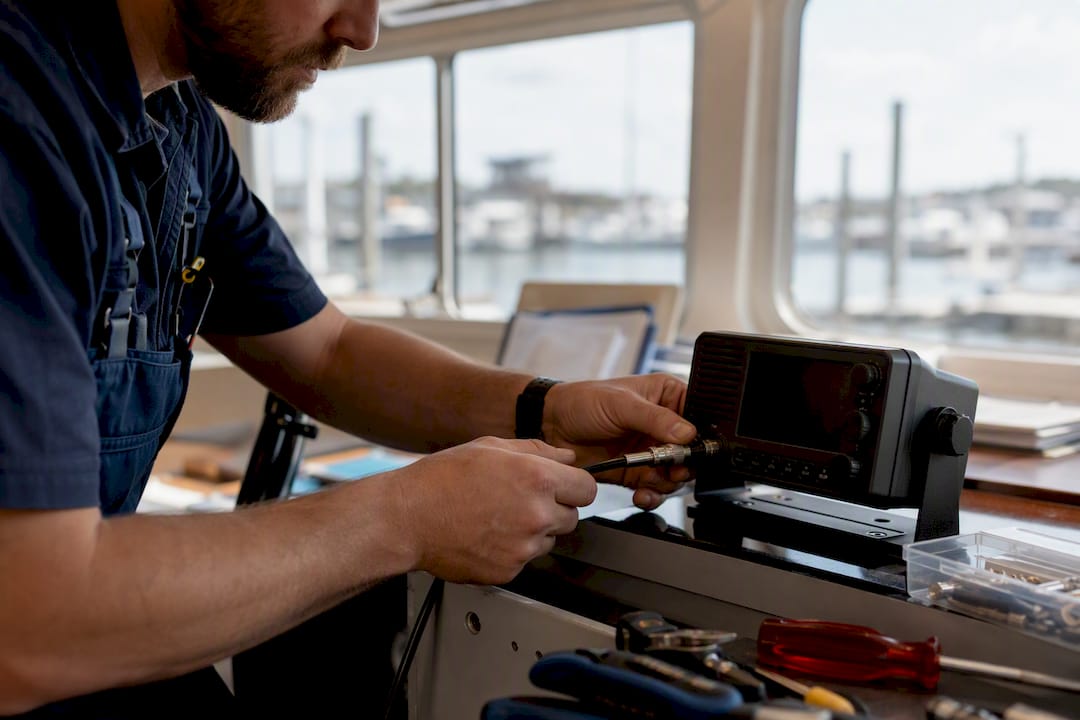
You need an FCC Ship Station License if your vessel will dock in foreign ports, run MF/HF single sideband, or carry a marine satellite terminal. If you’re strictly cruising U.S. domestic waters on VHF only, radar, and an EPIRB, you’re generally exempt, but see this helpful customs clearance checklist if you’re planning international travel.
If you fall into the “need it” camp, your next move is simple: file FCC Form 605 through the Universal Licensing System (ULS) and submit Form 159 to pay the fee.
- Domestic VHF-only cruising: no license needed
- Foreign ports, MF/HF, or satellite comms: license required
- Planning to hail foreign stations by radio? You’ll also want a Restricted Radiotelephone Operator Permit before you leave the dock.
Principais conclusões
Whether you need an FCC Ship Station License depends on where you travel and what radio equipment you install, not the size of your boat.
| Ponto | Detalhes |
|---|---|
| Domestic VHF-only exemption | No license needed if you stay in U.S. waters with only VHF, radar, and an EPIRB. |
| Foreign ports trigger licensing | Docking abroad or hailing foreign stations ends the domestic exemption immediately. |
| File Form 605 and Form 159 | Apply through ULS with Schedule B and pay the required fee to avoid dismissal. |
| MMSI must come from the FCC | Third-party MMSIs from BoatUS or Sea Tow get rejected in ULS applications. |
| Vesselflag handles the filing | Vesselflag’s MMSI and compliance services manage licensing paperwork for owners short on time. |
Índice
- What Triggers the FCC Ship Station License Requirement?
- How Do You Apply for an FCC Ship Station License?
- Who Needs a Restricted Radiotelephone Operator Permit?
- Why Your MMSI Has to Come From the FCC, Not a Retailer
- When Do You Need a Fleet License or Temporary Authority?
- Keeping Your License Current: Renewals, Transfers, and Records
- What Should You Budget for Fees and Timeline?
- How VesselFlag Helps With FCC Licensing and MMSI Setup
- Where Owners Usually Get Tripped Up
- Get Your License and MMSI Filed Without the ULS Guesswork
- Fontes
- Perguntas frequentes
What Triggers the FCC Ship Station License Requirement?
The FCC splits vessels into two buckets: voluntary ships and compulsory ships. Voluntary ships, mostly recreational boats, carry radios by choice rather than legal mandate. Compulsory ships, generally larger commercial vessels required to carry radio equipment under international safety treaties, don’t get the same leeway. Either way, the license question isn’t really about vessel size. It’s about where you go and what you install.
Stay in U.S. waters with nothing but VHF, radar, and an EPIRB, and the FCC doesn’t require a license. Cross into a foreign port, though, and that exemption disappears the moment you tie up or key the mic to a foreign coast station. This is the rule owners most often miss, especially those island-hopping to the Bahamas or running the Great Lakes into Canadian waters.
Equipment can trigger the requirement too, independent of where you travel:
- MF/HF single sideband radios
- Marine satellite communication terminals
- DSC (Digital Selective Calling) or AIS units requiring an MMSI assignment
Install any of those, and you need a license even if you never leave home waters.
How Do You Apply for an FCC Ship Station License?
Filing runs entirely through ULS, and the process is more predictable than most owners expect once you know the sequence.
- Get an FCC Registration Number (FRN). This is your identity in the FCC’s system and takes a few minutes to generate online.
- Log into ULS License Manager and start a new application.
- Complete FCC Form 605, Schedule B for ship radio service. Schedule B captures your vessel details, equipment list, and intended operating areas.
- Attach Form 159 and pay the fee. Skipping this step is the single most common reason applications get dismissed rather than denied outright.
- Submit and wait for grant, then download your authorization directly from ULS once it posts.
Your license, once granted, runs for a ten-year term, which is longer than most owners hold onto a boat.
Dica de profissional: You don’t have to sit at the dock waiting on a grant letter. Under most circumstances you can operate once your application is filed and pending, and if timing is truly tight, Form 605 Schedule F gives you temporary authority to bridge the gap.
Who Needs a Restricted Radiotelephone Operator Permit?
A ship station license covers the equipment. It doesn’t cover the person keying the mic. That’s where the Restricted Radiotelephone Operator Permit (RR) comes in, and it’s the one credential nearly every cruiser eventually needs.
- RR permit: lifetime validity, no exam required, needed anytime you’ll communicate with foreign stations or operate MF/HF and satellite gear
- MP and other commercial endorsements: apply to specific situations like Great Lakes operations, vessels over 300 gross tons, or passenger-for-hire commercial runs
- Filing: submitted through ULS alongside or separately from your station license application
Because the RR permit doesn’t expire and doesn’t require testing, there’s little reason to put it off if there’s any chance you’ll cross into foreign waters someday.
Why Your MMSI Has to Come From the FCC, Not a Retailer
This is where a lot of otherwise careful owners trip up. Many boaters already have an MMSI from BoatUS or Sea Tow for domestic VHF/DSC use, and they assume that number carries over into their FCC application. It doesn’t.
- Third-party MMSIs get rejected in ULS. Leave that field blank when applying, and the FCC issues an official MMSI during the grant process.
- DSC and AIS equipment require individual licensing. You can’t fold a DSC or AIS-equipped vessel into a group or fleet license; it needs its own station license and its own FCC-issued MMSI.
- Equipment needs FCC type-acceptance (FCC ID). Radios sold for U.S. marine use typically carry this certification already, but it’s worth confirming before you buy secondhand gear.
Getting this wrong doesn’t just create paperwork headaches. Search-and-rescue authorities pull vessel identity from the ITU MARS database, which is populated from your FCC license record, not your retailer’s customer file.
When Do You Need a Fleet License or Temporary Authority?
Fleet licenses make sense for owners or operators running multiple vessels under one authorization, but only when none of those vessels carry DSC or AIS. The moment a boat in your fleet needs an MMSI, it needs its own individual license.
- Portable ship station licenses cover handheld radios moved between vessels; keep a log recording which boat is using which unit and when.
- Special Temporary Authority (STA) covers urgent operational needs, granted for up to 180 days when you attach a written justification to your ULS filing.
- Schedule F temporary operator permits bridge the gap for up to 90 days when you can’t wait on a standard operator license to process.
Keeping Your License Current: Renewals, Transfers, and Records
Your ten-year license doesn’t renew itself, and ULS typically sends renewal reminders around 120 days out from expiration. Miss the window entirely, and you may need to request a waiver rather than a routine renewal.
- Selling your boat? File Form 603 to assign or transfer the license, and notify the FCC within 30 days of the closing date.
- Swapped radios or updated your MMSI? Update your ULS record promptly rather than letting it drift out of sync with your actual equipment.
- Keep your MARS entry accurate. Search-and-rescue teams rely on that data being current, not on whatever was true when you first filed.
Dica de profissional: Set a calendar reminder for year nine of your license term, not year ten. That gives you a buffer if a renewal gets flagged for missing information.
What Should You Budget for Fees and Timeline?
License fees change annually, so check the FCC’s current fee schedule before filing rather than relying on a number from last year. Skipping the Form 159 payment is the fastest way to get your application dismissed instead of processed.
Processing timelines vary, but most straightforward applications clear within a few weeks. If you’re departing sooner, Schedule F temporary authority lets you operate legally in the meantime.
Before you leave the dock, confirm:
- License on file and downloaded from ULS
- MMSI programmed into your radio, DSC, and AIS units
- RR permit secured if you’ll hail foreign stations
- Printed or digital authorization accessible aboard
How VesselFlag Helps With FCC Licensing and MMSI Setup
Vesselflag handles MMSI radio licensing and pairs it with broader vessel compliance work, which matters most for owners managing multiple flags, fleets, or an international cruising schedule. If your situation involves more than one vessel or a tight departure date, handing off the paperwork usually beats losing a weekend to ULS.
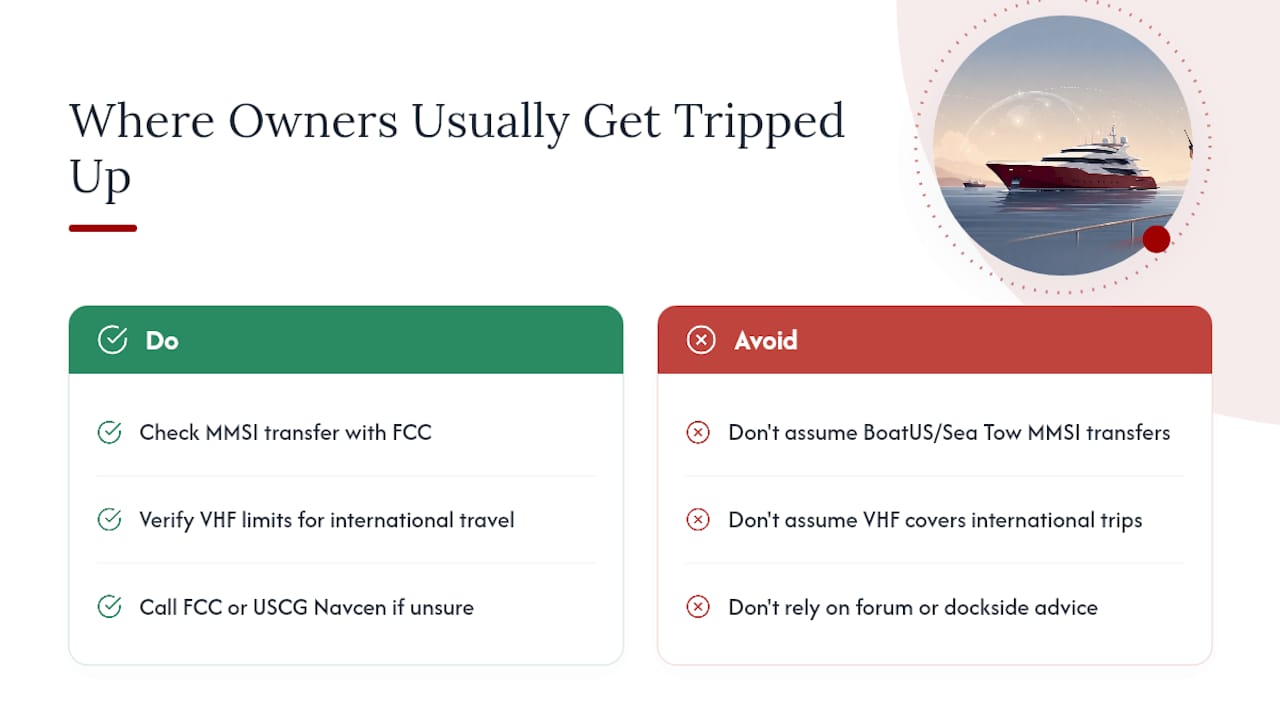
Where Owners Usually Get Tripped Up
Accurate license data isn’t just red tape. It’s what search-and-rescue crews pull up when something goes wrong offshore, so a stale MMSI record or a skipped filing can matter far more than it feels like on a calm afternoon at the dock.
The two mistakes we see most: owners assuming their BoatUS or Sea Tow MMSI transfers straight into an FCC application, and owners assuming VHF-only coverage extends to international trips. Neither assumption holds up. When your situation doesn’t fit neatly into these categories, the FCC and USCG Navcen are the right places to call, not a forum thread or a dockside guess.
— VesselFlag
Get Your License and MMSI Filed Without the ULS Guesswork
Vesselflag handles the paperwork side of FCC ship station licensing and MMSI assignment so you’re not decoding ULS schedules the week before a trip. That means faster turnaround and one less compliance gap to worry about before you cross into foreign waters.
If you’re already reviewing vessel documentation for an international voyage, it’s worth handling flag registration and radio licensing together rather than as separate errands. Vesselflag’s MMSI radio license service covers the FCC filing directly, and if you’re also weighing Como registar um iate under an international flag, that’s a natural next step to check before you finalize a departure date. Reach out for a document checklist and find out what’s actually required for your specific vessel and route.
Fontes
- Ship Radio Stations Licensing | Federal Communications Commission
- FCC Radio Licenses | Navigation Center
Perguntas frequentes
How Much Does It Cost to Get an FCC License?
Fees change annually and are paid through Form 159 at the time of filing, so check the FCC’s current fee schedule before you submit your application rather than budgeting from an old figure.
Can the FCC Pull a Broadcast License?
Ship station licenses can be revoked or suspended for violations of FCC rules, though routine enforcement typically starts with a notice rather than immediate revocation.
How Do I Obtain an FCC License?
File FCC Form 605 electronically through ULS, complete Schedule B for ship radio service, attach Form 159 for the fee, and submit; your authorization downloads from ULS once granted.
What Does an FCC License Allow You to Do?
It authorizes your vessel’s radio equipment, MF/HF, satellite terminals, and DSC/AIS units, for legal operation, and it assigns the official MMSI that search-and-rescue authorities use to identify your vessel.
Do I Need an Operator Permit in Addition to a Ship Station License?
Yes, if you’ll communicate with foreign stations or operate MF/HF and satellite equipment, you need a Restricted Radiotelephone Operator Permit, which is separate from the station license itself.

[…] the part a lot of exempt owners miss: even when you don’t need a license, renewing one anyway lets you retain a personalized call sign and keeps your emergency identification data active and […]