

Resumo:
- AIS is a vital marine technology that broadcasts vessel identity, position, speed, and course to nearby ships and shore stations in real time. Choosing the correct device class, registering your MMSI, and understanding its limitations are essential for effective and legal safety and navigation. AIS improves situational awareness but must be complemented with radar, visual watch, and proper registration for maximum safety on the water.
AIS, the Automatic Identification System, is a VHF radio transponder technology that broadcasts your vessel’s identity, position, speed, and course to nearby ships and shore stations in real time. Understanding what is AIS for boats is no longer optional. Whether you operate a 40-foot cruiser in the Caribbean or a commercial trawler in the Pacific Northwest, AIS is the single most effective tool for collision avoidance and situational awareness on the water today. This guide covers how AIS works, which device class fits your boat, what it costs, and what U.S. regulations require before you power one on.
How does AIS technology work on boats?
AIS transmits and receives vessel data over two dedicated VHF maritime frequencies: 161.975 MHz and 162.025 MHz. These two channels alternate transmissions so the system avoids congestion even in busy shipping lanes. Every AIS-equipped vessel broadcasts a data packet that nearby vessels and coastal receivers decode automatically.
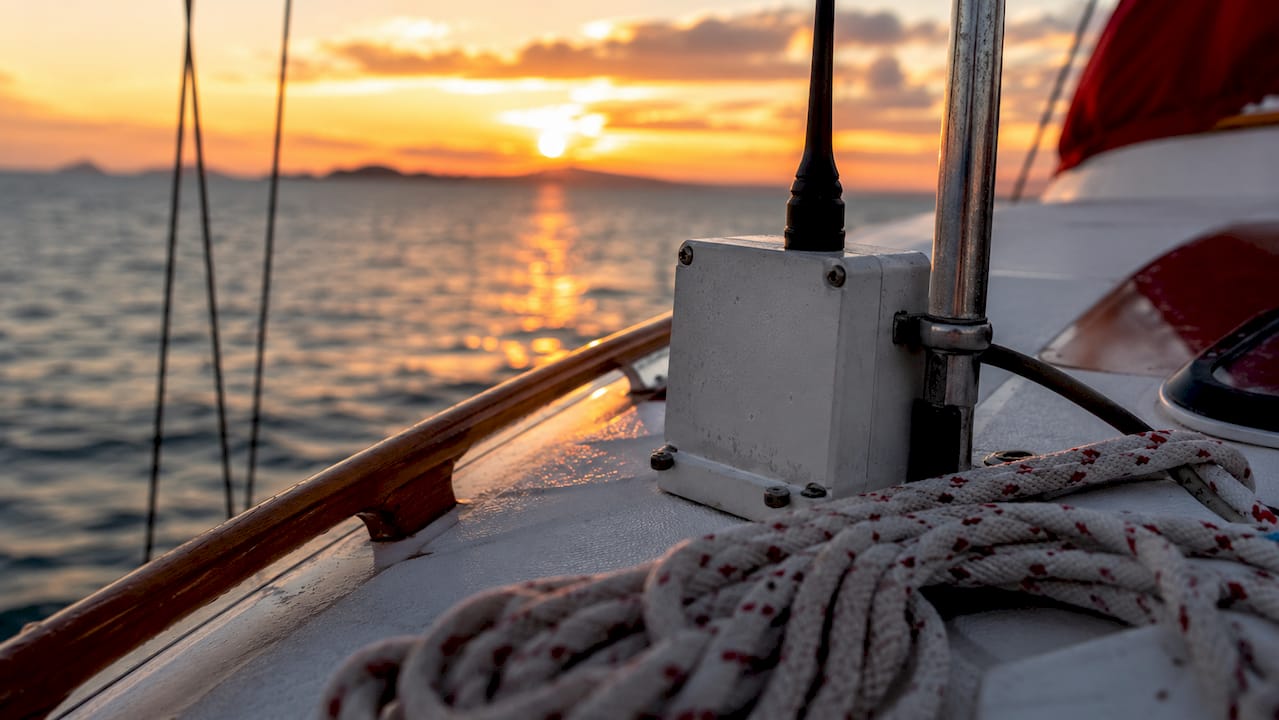
The system broadcasts two categories of data. Static data includes your vessel name, call sign, MMSI number, vessel type, and dimensions. Dynamic data includes GPS-derived position, speed over ground, course over ground, and heading. Dynamic data updates continuously, while static data updates less frequently.
AIS uses a protocol called SOTDMA, which stands for Self-Organizing Time Division Multiple Access. SOTDMA divides each VHF channel into 2,250 time slots per minute. Each vessel reserves its own slot, so transmissions do not collide with each other. The result is a self-managing network that scales well even in ports with hundreds of vessels.
The hardware on your boat consists of three components working together:
- A GPS receiver that feeds position, speed, and course data to the AIS unit
- A VHF transceiver that transmits and receives AIS signals on the two dedicated channels
- A display device such as a chartplotter, multifunction display (MFD), or dedicated AIS screen that plots nearby vessels visually
AIS range is limited by line-of-sight VHF propagation to roughly 20–40 nautical miles, depending on antenna height and gain. A masthead antenna on a sailing yacht will outperform a low deck-mounted antenna by a significant margin.
Dica de profissional: Share your VHF antenna with your AIS unit using a properly rated antenna splitter. This avoids running a second cable to the masthead and preserves signal quality on both systems.
What are the different types of AIS devices?
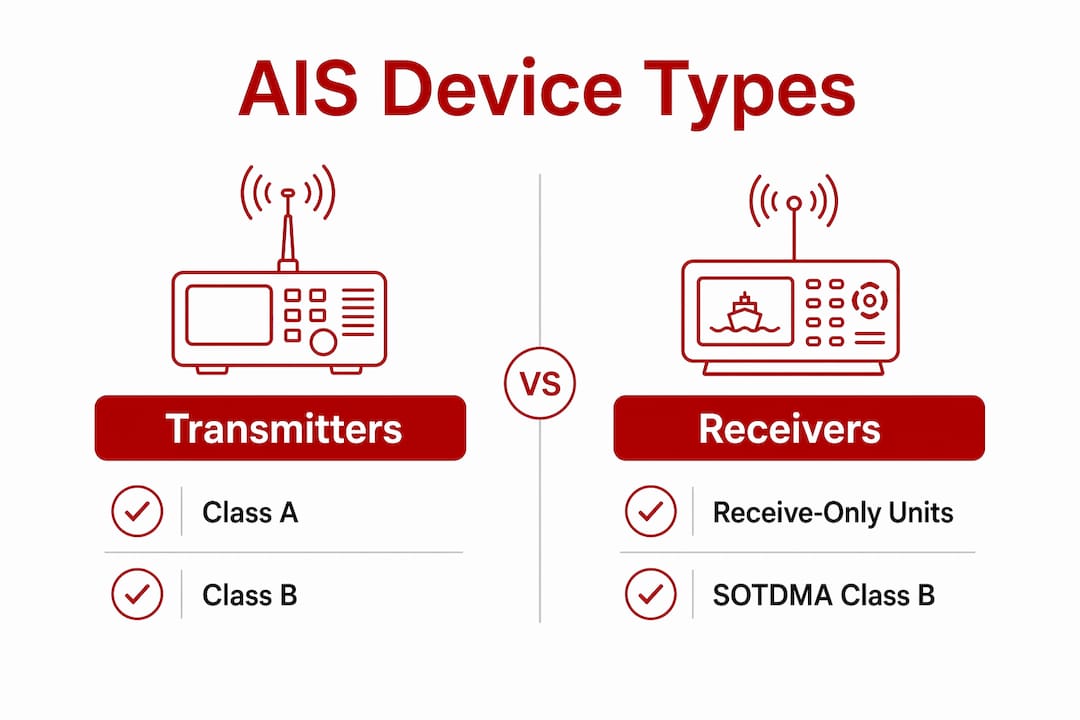
Three distinct AIS device classes exist, and choosing the wrong one for your vessel type is a common and costly mistake.
Class a AIS transponders
Class A is the commercial standard, mandated by the International Maritime Organization (IMO) under SOLAS for vessels over 300 gross tons on international voyages and all passenger ships. Class A transponders transmit at 12.5 watts and update position every 2–10 seconds depending on vessel speed. That update rate means a fast-moving container ship appears on your display almost in real time. Class A units are expensive, require professional installation, and are overkill for recreational use.
Class b AIS transponders
Class B is the recreational and small commercial vessel standard. Class B devices transmit at 2 watts and update position every 30 seconds. The lower power and slower update rate are acceptable trade-offs for a yacht or powerboat that moves far slower than a cargo ship. Modern Class B units using SOTDMA technology offer guaranteed transmission slots and higher reliability in congested waters compared to older CSTDMA units. If you are buying a Class B unit today, SOTDMA is the specification to request.
Receive-only AIS units
Receive-only AIS units show you all AIS traffic around your vessel but do not broadcast your own position. They cost $200–$400, roughly half the price of a Class B transponder. Privacy-conscious boaters favor them because your location never appears on public tracking platforms like MarineTraffic or VesselFinder. The trade-off is significant: commercial ships cannot see you on their displays, which removes a critical layer of collision protection.
| Device Class | Power Output | Update Rate | Typical Cost | Best For |
|---|---|---|---|---|
| Class A | 12.5 watts | 2–10 seconds | $2,000+ | Commercial vessels, SOLAS compliance |
| Class B (SOTDMA) | 2 watts | 30 seconds | $600–$1,500 | Recreational yachts, small commercial boats |
| Receive-Only | N/A | Receive only | $200–$400 | Privacy-focused boaters, budget installs |
Dica de profissional: If you cross busy shipping lanes or sail offshore, choose a Class B SOTDMA transponder over a receive-only unit. Being visible to a 900-foot container ship is worth more than location privacy.
What are the safety and navigation benefits of AIS?
The core value of AIS for boat navigation is the “see and be seen” principle. You see commercial traffic before it appears on the horizon. Commercial operators see you before radar picks you up. That mutual awareness creates time to act.
AIS integrates directly with chartplotters from Garmin, Raymarine, Simrad, and Furuno. When a vessel’s AIS signal arrives, its icon appears on your chart overlay with its name, speed, course, and vessel type displayed on demand. You can tap any target and immediately know whether it is a tanker doing 14 knots or a fishing vessel drifting at 2 knots. That specificity is something radar alone cannot provide.
The practical safety benefits break down into four areas:
- Collision avoidance: AIS calculates Closest Point of Approach (CPA) and Time to Closest Point of Approach (TCPA) automatically. Set an alarm threshold, and your chartplotter alerts you before a conflict develops.
- Identification in poor visibility: Fog, rain, and night passages make visual identification impossible. AIS delivers vessel name and type regardless of visibility.
- Communication: When you see a vessel on AIS, you know its name. Calling “Container ship Maersk Sealand on VHF Channel 16” gets a faster response than “vessel at position X.”
- Traffic monitoring: Anchoring near a shipping lane or entering a busy port is safer when you can see all traffic on your display before committing to a course.
AIS does have firm limits. AIS supplements but does not replace radar or a proper visual lookout. Fishing boats, kayaks, and small powerboats often carry no AIS at all. Some vessels turn off AIS for security reasons, which means the data you see is always incomplete. Treat AIS as one layer of awareness, not the only layer. Pair it with navigational systems like radar and a disciplined visual watch for maximum safety.
What does AIS cost and what are the regulations?
Cost is the most common barrier for recreational boaters considering AIS. The numbers are straightforward. Class B AIS transceivers cost $600–$1,500 for hardware alone. Full installation, including wiring, antenna work, and chartplotter integration, runs $1,500–$2,500 depending on vessel complexity. Receive-only units sit at $200–$400 and install in under an hour on most boats.
The total cost factors to budget for include:
| Cost Item | Estimated Range |
|---|---|
| Class B transponder hardware | $600–$1,500 |
| Professional installation labor | $300–$600 |
| Antenna splitter or dedicated antenna | $50–$200 |
| Chartplotter integration (if needed) | $0–$300 |
| Receive-only unit (hardware only) | $200–$400 |
On the regulatory side, U.S. rules are specific. FCC regulations require Class B AIS transponders to be programmed by a qualified technician before use. The technician embeds your vessel name, call sign, and MMSI number into the unit. You cannot legally activate a Class B transponder you programmed yourself. This is not a technicality. It protects the integrity of the AIS network by preventing duplicate or incorrect MMSI numbers from polluting vessel traffic data.
AIS is mandatory for U.S. commercial vessels over 65 feet operating on navigable waters, and for all vessels subject to SOLAS internationally. Recreational boats under 65 feet have no federal AIS mandate in the U.S., but the Coast Guard strongly recommends Class B transponders for offshore passages and operation near commercial shipping traffic.
Your MMSI number is the unique identifier embedded in every AIS transmission. Without a properly registered MMSI, your AIS broadcasts incomplete data and your vessel cannot be correctly identified in an emergency. Securing your Licença de rádio MMSI before installation is the correct sequence. Registration first, then programming, then activation.
Dica de profissional: Request your MMSI number through your vessel’s flag state registration authority or a recognized licensing body before purchasing your AIS unit. Some retailers can pre-program units at point of sale if you supply your MMSI in advance.
Pontos-chave
AIS is the most effective collision avoidance and situational awareness technology available to boat owners today, but it works best as one part of a complete navigation system.
| Ponto | Detalhes |
|---|---|
| AIS broadcasts vessel identity and position | Every transmission includes name, MMSI, GPS position, speed, and course over VHF radio. |
| Class B SOTDMA is the recreational standard | Choose SOTDMA over older CSTDMA units for reliable transmission in busy waters. |
| Receive-only units offer privacy at a cost | You see other vessels but remain invisible to commercial traffic, which reduces safety. |
| FCC requires technician programming in the U.S. | A qualified technician must embed your MMSI, call sign, and vessel name before activation. |
| AIS does not replace radar or visual lookout | Many vessels carry no AIS, so the picture is always incomplete without additional watch-keeping. |
The part most boaters get wrong about AIS
At Vesselflag, we work with vessel owners across dozens of flag states, and the same misconception comes up constantly. Boaters install AIS and immediately treat it as a complete safety solution. They stop maintaining a proper radar watch. They reduce their visual lookout frequency. That is the wrong approach, and it creates real risk.
AIS shows you the vessels that are transmitting. A fishing boat running dark, a kayak crossing your bow, or a vessel that switched off its transponder for privacy reasons will not appear on your display at all. The system is only as good as the data feeding it, and that data is never complete.
The second thing we see regularly is boaters skipping the MMSI registration step before installing a Class B unit. They buy the hardware, plug it in, and assume it works. Without a properly registered MMSI linked to your vessel’s flag state registration, your AIS transmissions are either incomplete or, in some cases, illegal. The registration and licensing steps are not bureaucratic overhead. They are what makes the system function correctly for everyone on the water.
Modern Class B SOTDMA units from manufacturers like Vesper Marine, Garmin, and Icom are genuinely excellent pieces of kit. They are reliable, integrate cleanly with most chartplotters, and the SOTDMA protocol means your transmission gets through even in a crowded anchorage. But the technology only delivers its full value when the paperwork behind it is correct.
The privacy trade-off with receive-only units is a personal decision, but we lean toward transponders for any boat that ventures offshore or crosses commercial shipping lanes. Being seen by a 300-meter bulk carrier at 3 a.m. in the Strait of Gibraltar is not a situation where privacy concerns should win the argument.
— Vessel Flag
Get your vessel registered and ais-ready
AIS technology delivers its full safety value only when your vessel registration and MMSI licensing are in order. Without a valid registration and correctly assigned MMSI, your AIS unit broadcasts incomplete data and your vessel cannot be properly identified by coast guards or rescue services.
Vesselflag handles vessel registration under multiple international flags including Malta, UK Part 1, San Marino, and Palau, with MMSI licensing included as part of the process. If you are equipping your boat with a Class B transponder and need the registration and licensing foundation to make it legal and functional, Vesselflag provides the complete compliance package. Explore MMSI and AIS compliance services or start your vessel registration today at Vesselflag.com.
Perguntas frequentes
What is AIS for boats, exactly?
AIS, or Automatic Identification System, is a VHF radio transponder technology that broadcasts a vessel’s identity, position, speed, and course to nearby ships and shore stations automatically. It is the maritime equivalent of a transponder on an aircraft.
Is AIS required on recreational boats in the u.s.?
AIS is not federally mandated for recreational vessels under 65 feet in the U.S., but the Coast Guard strongly recommends it for offshore passages and operation near commercial traffic.
What is the difference between class a and class b AIS?
Class A transmits at 12.5 watts with updates every 2–10 seconds and is required on commercial vessels. Class B transmits at 2 watts with 30-second updates and is the standard for recreational boats.
Do i need an MMSI number before installing AIS?
Yes. Your MMSI number must be registered and embedded in your AIS unit before activation. In the U.S., FCC rules require a qualified technician to program this data into any Class B transponder.
Can other boats see me if i use a receive-only AIS unit?
No. Receive-only units display surrounding AIS traffic but do not transmit your vessel’s position, meaning commercial ships and other AIS-equipped vessels cannot see you on their displays.