

En resumen:
- The yacht brokerage regulatory framework includes licensing, ethical standards, and legal compliance rules that govern professional transactions. Verifying broker credentials, understanding commission structures, and ensuring strict adherence to compliance steps protect owners from costly mistakes and disputes during yacht sales. A professional broker with recognized certification and thorough documentation practices is essential for a smooth and lawful transaction.
The yacht brokerage regulatory framework is defined as the combined set of licensing requirements, commission rules, ethical standards, and legal compliance obligations that govern professional yacht transactions. Florida’s Chapter 326, California’s Yacht and Ship Brokers Act, the Red Ensign Group Yacht Code, and the Yacht Brokers Association of America (YBAA) each shape how brokers operate and how your sale or purchase gets completed. Understanding this framework protects you from costly mistakes, disputed commissions, and invalid registrations before you sign anything.
What are the licensing and certification requirements for yacht brokers?
Yacht broker licensing is mandated by state statutes, and the rules vary significantly by jurisdiction. Florida Chapter 326 and California’s Yacht and Ship Brokers Act require brokers and salespersons who negotiate sales for compensation to hold active licenses, post a surety bond, and maintain dedicated escrow accounts. Most other U.S. states rely on general consumer protection and business laws rather than yacht-specific statutes. That gap creates real risk for yacht owners who assume every broker operates under the same legal obligations.
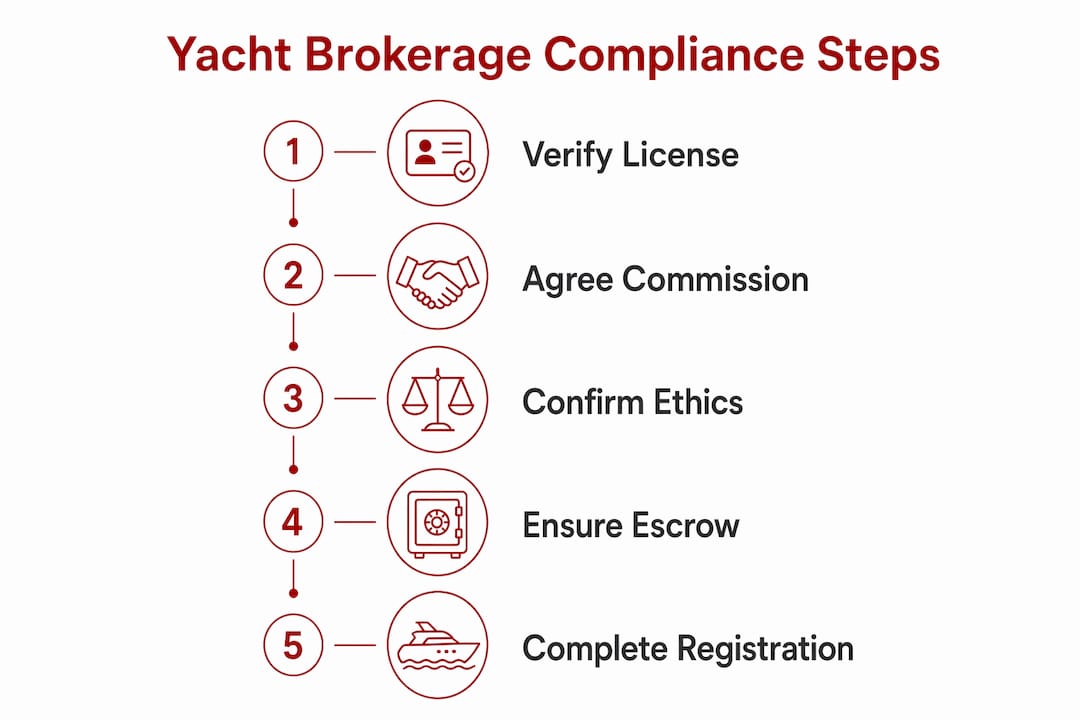
Only a handful of U.S. states impose specific yacht broker licensing requirements. This means you must verify your broker’s credentials directly, not assume state law has done it for you.
Beyond state licenses, the YBAA offers the Certified Professional Yacht Broker (CPYB) credential. The CPYB requires at least two years of experience and passing a three-hour exam. Adherence to a formal Code of Ethics is mandatory for certification. That credential signals fiduciary commitment in a market where licensing alone does not guarantee professional conduct.
One critical distinction yacht owners often miss is the difference between a vessel dealer and a yacht broker. Misclassifying your business model between dealer registration and broker licensing can trigger severe regulatory penalties. A dealer buys and resells vessels in their own name. A broker acts as an agent for the seller or buyer. The legal consequences of getting this wrong fall on both the broker and the parties they represent.
Key licensing requirements to verify before engaging a broker:
- Active state license where required (Florida, California)
- Surety bond coverage
- Dedicated escrow account for deposit funds
- CPYB credential or equivalent professional certification
- Documented recordkeeping practices for all transactions
Consejo de experto: Ask your broker for their license number and verify it directly with the issuing state agency before signing a listing agreement. A licensed broker in Florida will appear in the Department of Business and Professional Regulation’s public database.
How do yacht brokerage commission structures work and who pays?
Commission is the broker’s primary compensation, and the structure follows a tiered model based on sale price. The standard commission is 10% of the gross sale price on the first $10 million, 5% on the next $10 million, and 2.5% on any amount above that. Smaller vessels often carry a flat minimum fee between $5,000 and $10,000. That floor exists because the administrative and legal work of a transaction does not scale down proportionally with vessel price.

The seller pays the commission in the vast majority of yacht transactions. The broker’s fee comes out of the sale proceeds at closing, not from the buyer’s pocket. When a listing broker and a buyer’s broker are both involved, they split the commission, typically 50/50, though the exact split is negotiated in the listing agreement.
Commission is calculated on the final sale price, not the original listing price. If your yacht lists at $500,000 and sells at $450,000, the 10% commission applies to $450,000. That distinction matters when you are evaluating net proceeds before a sale.
| Vessel sale price | Commission rate | Estimated broker fee |
|---|---|---|
| Under $100,000 | 10% or flat minimum | $5,000–$10,000 minimum |
| $100,000–$1,000,000 | 10% | $10,000–$100,000 |
| $1,000,001–$10,000,000 | 10% | Up to $1,000,000 |
| $10,000,001–$20,000,000 | 5% on amount above $10M | Additional $500,000 |
| Above $20,000,000 | 2.5% on excess | Negotiated |
Listing agreements define commission terms and must be drafted carefully. An exclusive right-to-sell contract entitles the broker to commission regardless of who finds the buyer. Any exceptions, such as a buyer you have already been negotiating with independently, must be carved out in writing before you sign.
What are the professional standards and ethical responsibilities of yacht brokers?
Ethics underpin the broker’s fiduciary role and form the foundation of trust required for complex yacht transactions. The YBAA Code of Ethics requires brokers to act in their client’s best interest, disclose conflicts of interest, and handle all funds with strict accountability. Fiduciary duty means the broker cannot prioritize their own commission over your outcome. That obligation is enforceable, and violations can result in license revocation or civil liability.
“A broker’s entitlement to commission requires proving a causal connection between the broker’s efforts and the closing of the deal. Introduction alone is insufficient. The broker must document all communications and transaction milestones to claim commission.”
— PG Legal, Legal Risks and Best Practices for Brokers and Yacht Managers
Common pitfalls in broker ethics and contract management include:
- Vague commission trigger language in listing agreements
- Failure to document buyer introductions and negotiation steps
- Undisclosed dual agency (representing both buyer and seller)
- Incomplete or unsigned purchase and sale agreements
- Missing written carve-outs for pre-existing buyer relationships
Experienced brokers use carve-outs in listing agreements to exclude specific buyers from commission liability. This protects sellers who have ongoing conversations with known parties before engaging a broker. Without that written exclusion, you could owe commission on a sale you effectively arranged yourself.
Consejo de experto: Require your broker to provide written confirmation of every buyer introduction and every negotiation milestone. That paper trail protects both parties if a commission dispute reaches arbitration or court.
Maintaining a meticulous paper trail of communications and transaction authorizations is the single most effective way to protect commission rights and resolve disputes quickly. Brokers who cannot produce this documentation lose credibility with clients and in legal proceedings. As a yacht owner, you benefit from working with brokers who treat documentation as a professional standard, not an afterthought.
How do legal compliance requirements affect yacht brokerage transactions?
Legal compliance in yacht brokerage goes well beyond signing a purchase agreement. Every transaction in 2026 involves a structured set of regulatory steps that brokers must facilitate and owners must understand. Sanctions screening, title verification, and clear registration documentation are mandatory compliance steps. Brokers must confirm that neither party appears on OFAC (Office of Foreign Assets Control) sanctions lists before funds change hands. Skipping that step can void a transaction and expose both parties to federal penalties.
The compliance process for a standard brokerage transaction follows this sequence:
- Verify clean title and confirm no outstanding liens on the vessel
- Conduct OFAC sanctions screening on buyer and seller
- Collect deposit into a licensed escrow account
- Complete a marine survey and sea trial
- Confirm applicable sales tax obligations and reporting requirements
- Transfer registration and documentation to the new owner
- File required state or federal documentation within mandated timeframes
For larger vessels, international standards add another layer. Commercial yachts over 24 meters must meet Red Ensign Group Yacht Code standards covering safety, pollution prevention, and operational requirements. Brokers handling these transactions must coordinate compliance verification as part of the sale process, not as an afterthought after closing.
Registration and documentation are where many transactions stall. Brokers must facilitate vessel registration under the correct flag state and confirm that all documentation reflects the new ownership accurately. Errors in registration documents can delay closing, trigger tax complications, or invalidate the sale in certain jurisdictions. Platforms like Vesselflag specialize in resolving exactly these issues for international yacht owners navigating multiple flag state requirements.
FSBO sales limit seller access to broker-controlled buyer pools and reduce market reach. Beyond lost exposure, sellers who bypass professional brokers also lose the compliance infrastructure that licensed brokers provide. That includes escrow management, sanctions screening, and documentation filing. The cost of a compliance error typically exceeds the commission you saved.
Principales conclusiones
The yacht brokerage regulatory framework requires verified licensing, documented commission agreements, strict escrow handling, and full compliance screening before any transaction closes.
| Punto | Detalles |
|---|---|
| Licensing varies by state | Florida and California mandate specific broker licenses; verify credentials before signing any agreement. |
| Commission follows a tiered structure | Standard rate is 10% on the first $10M, calculated on final sale price, paid by the seller. |
| CPYB credential signals professionalism | The CPYB requires two years of experience, a three-hour exam, and mandatory ethics compliance. |
| Documentation protects all parties | Brokers must record every buyer introduction and negotiation step to support valid commission claims. |
| Compliance steps are non-negotiable | Sanctions screening, title verification, and correct registration filing are mandatory in every 2026 transaction. |
What I’ve learned from watching compliance failures in yacht transactions
The yacht owners who get burned in brokerage transactions almost always share one trait: they treated the broker relationship as informal. They skipped license verification, accepted verbal commission agreements, and assumed the broker handled compliance automatically. The regulatory framework exists precisely because those assumptions are wrong.
The most underrated protection in any yacht sale is the listing agreement. A well-drafted agreement defines commission triggers, carve-outs, escrow terms, and dispute resolution before any buyer appears. Owners who negotiate these terms carefully rarely end up in commission disputes. Those who sign boilerplate agreements without reading them often do.
Certification matters more than most owners realize. A CPYB-credentialed broker has passed a structured exam and committed to a formal ethics code. That is a meaningful filter in a market where licensing requirements are inconsistent across states. When you are selling a vessel worth hundreds of thousands of dollars, the broker’s professional accountability is not a minor detail.
My strongest recommendation: engage a broker who understands both local licensing requirements and international registration obligations. Yacht transactions increasingly cross jurisdictions, and a broker who only knows domestic rules will leave compliance gaps that cost you time and money at closing.
— Vessel Flag
Vesselflag’s registration services for brokerage transactions
Completing a yacht sale means more than finding a buyer. The registration and documentation work that follows closing determines whether the transaction is legally valid in the flag state you choose.
Vesselflag provides flag registration services across multiple international jurisdictions, including San Marino, Malta, Poland, UK Part 1, and Palau, with clear timelines and transparent costs. Whether you are registering under a new flag after a brokerage purchase or updating documentation to reflect new ownership, Vesselflag handles the compliance steps that brokers and owners often find most time-consuming. The platform also supports MMSI and AIS setup, vessel insurance, and corporate registration for commercially operated yachts. For owners completing a brokerage transaction in 2026, Vesselflag offers a direct path from signed purchase agreement to fully compliant registration.
Preguntas frecuentes
What is the yacht brokerage regulatory framework?
The yacht brokerage regulatory framework is the combined set of licensing laws, commission rules, ethical standards, and compliance obligations governing professional yacht transactions. Key authorities include Florida Chapter 326, the California Yacht and Ship Brokers Act, the YBAA, and the Red Ensign Group Yacht Code for larger vessels.
Who pays the broker’s commission in a yacht sale?
The seller pays the broker’s commission in the vast majority of yacht transactions. The standard commission rate is 10% of the final sale price, with tiered reductions for vessels selling above $10 million.
Do yacht brokers need a license in every U.S. state?
No. Only a handful of states, most notably Florida and California, require specific yacht broker licenses. Other states apply general business and consumer protection laws, which is why verifying a broker’s credentials directly remains the owner’s responsibility.
What does the CPYB credential require?
The CPYB credential requires at least two years of active brokerage experience, passing a three-hour written exam, and ongoing adherence to the YBAA Code of Ethics. It is a voluntary certification but widely recognized as the professional standard in U.S. yacht brokerage.
What compliance steps are mandatory in a 2026 yacht brokerage transaction?
Every 2026 transaction requires OFAC sanctions screening, clean title verification, licensed escrow handling of deposits, applicable tax reporting, and correct registration documentation transfer. Commercial yachts over 24 meters must also meet Red Ensign Group Yacht Code safety and environmental standards.
Recomendado
- Tendencias en el registro marítimo para 2026: lo que deben saber los propietarios de yates
- 2025 Proceso de registro de embarcaciones - Guía estratégica completa para propietarios de yates - Vessel Flag
- Corporate yacht registration: streamline ownership in 2026
- Boat registration process guide 2026: efficient global compliance