En resumen:
- The UK Part 1 Ship Register provides a legal proof of vessel ownership and allows registration of marine mortgages. U.S. owners must appoint a UK representative and complete a mandatory tonnage survey to register, enabling international recognition and extended overseas operation. Failure to register can lead to port delays, legal issues, and inability to secure financing.
The UK Part 1 Ship Register is the United Kingdom’s primary title register for commercial and pleasure vessels, giving your boat an Official Number, a Certificate of Registry, and the right to fly the Red Ensign internationally. For U.S. owners, it is the go-to flag choice when you need to register a marine mortgage, operate abroad for extended periods, or simply carry a flag that port authorities worldwide recognize without question. The UK Ship Register (UKSR), administered by the Maritime and Coastguard Agency (MCA), handles all Part 1 applications.
A few things to know before you go further:
- Part 1 covers both commercial and pleasure vessels — it is not limited to working ships.
- You can spend more than six months outside the UK and retain full registration benefits.
- Marine mortgages can be formally registered against a Part 1 vessel, which Part 3 cannot do.
- Non-UK residents, including U.S. owners, must appoint a UK representative person to hold the registration.
- A formal tonnage measurement survey is mandatory for every vessel, including pure pleasure craft.
The UKSR is administered by the MCA and consistently performs as a top-tier flag in the Paris and Tokyo Memoranda of Understanding (MoU) Port State Control regimes — meaning vessels flying the Red Ensign face lower inspection and detention risk at foreign ports.
Índice
- What is the UK Part 1 Ship Register, exactly?
- Who can register on Part 1? Eligibility rules U.S. owners must check
- What are the real benefits of Part 1 registration?
- Tonnage measurement surveys: what you need to know before you apply
- How to register on UK Part 1: a step-by-step process for U.S. owners
- How Part 1 handles ownership proof, mortgages, transfers, and deregistration
- How does Part 1 compare with Part 3 and other parts of the UK register?
- What happens if your vessel isn’t registered?
- Principales conclusiones
- Why the representative-person step is where most U.S. owners go wrong
- Vesselflag’s managed UK Part 1 registration service for U.S. owners
- Useful official sources, guides, and forms
- Preguntas frecuentes
What is the UK Part 1 Ship Register, exactly?
The UK Ship Register is divided into four parts under the Merchant Shipping (Registration of Ships) Regulations 1993: Part 1 (general merchant and pleasure vessels), Part 2 (fishing vessels), Part 3 (small ships), and Part 4 (bareboat charter). Part 1 is the principal register and the one most owners mean when they say “UK registration.”
What makes Part 1 legally distinct is its status as a title register. That means it does more than record that a vessel exists — it documents the chain of ownership, records bills of sale, and allows mortgages to be formally entered against the vessel. A Certificate of Registry issued under Part 1 is internationally recognized proof of a vessel’s nationality and ownership history.
The register covers:
- Merchant vessels of any size used in commercial operations.
- Pleasure vessels not restricted to the Small Ships Register.
- Vessels owned by qualifying corporations or individuals who meet eligibility criteria.
- Vessels owned by non-residents who appoint a UK representative person.
Part 1 is not just a certificate — it is a legal record of title. That distinction matters in every transaction where money changes hands: a sale, a refinancing, or a charter arrangement. Lenders and port authorities treat it differently from a simple certificate of registry precisely because the chain of ownership is documented and searchable.
The UKSR service portal handles online registration, renewals, and vessel record management, and assigns a customer account manager once a vessel is deemed suitable for registration.

Who can register on Part 1? Eligibility rules U.S. owners must check
Part 1 eligibility is broader than many U.S. owners expect, but there are specific hoops to clear. The core categories of eligible owners include:
- British citizens ordinarily resident in the UK.
- Qualifying corporations incorporated in the UK or another qualifying country, with a principal place of business in the UK or a designated representative.
- Non-resident individuals and foreign corporations — including U.S. citizens and U.S.-incorporated companies — who appoint a UK representative person.
The representative person requirement is the key hurdle for U.S. owners. If you are not ordinarily resident in the UK, you must appoint a representative who is resident there and who acts as the formal contact between the vessel’s owner and the registry. That person’s name and address appear on the registration record.
Ownership on Part 1 can be held in fractional shares. Historically, vessel ownership has been divided into 64 shares under UK maritime law, allowing multiple co-owners to hold defined fractions of title — a structure that also affects how transfers and mortgages are documented.
Before you start an application, confirm you have:
- Valid government-issued photo ID (passport for non-UK residents).
- Bill of sale or builder’s certificate proving how you acquired the vessel.
- Corporate documents if ownership is held through a company (articles of incorporation, certificate of good standing).
- Power of attorney or representative appointment paperwork for your UK representative.
- Certified translations of any document not in English.
Consejo de experto: The single most common delay for U.S. owners is missing or improperly certified representative-person paperwork. Get your UK representative formally appointed and their documentation notarized before you schedule the tonnage survey — not after. Registry rejections at the document-review stage reset your timeline entirely.
What are the real benefits of Part 1 registration?
The right to fly the Red Ensign is the most visible benefit, but it is far from the only one. Here is what Part 1 actually delivers in practice:
- Marine mortgage registration. Lenders can register a mortgage directly against the vessel on the Part 1 record. No other part of the UK register offers this, and most alternative flag registries that only issue certificates cannot match it either.
- International recognition. The Red Ensign is one of the most widely recognized national flags in global maritime operations. Port State Control officers in Paris MoU and Tokyo MoU ports treat UK-flagged vessels as low-risk, which translates to fewer inspections and faster port clearance.
- Extended overseas operation. Part 1 allows owners to spend more than six months outside the UK without losing registration benefits — a critical point for U.S. owners who keep their vessels in the Caribbean, Mediterranean, or Pacific.
- Official Number and Certificate of Registry. These are the vessel’s permanent legal identity documents, recognized under UNCLOS as evidence of nationality.
- Stronger resale position. Because Part 1 is a title register with a documented chain of ownership, buyers and their lawyers can verify the vessel’s history. That transparency supports higher valuations and cleaner transactions.
The UKSR’s performance in Port State Control regimes is a genuine commercial advantage. Vessels under flags with poor PSC records face more frequent inspections, longer port delays, and higher insurance premiums. The Red Ensign avoids all of that.
Tonnage measurement surveys: what you need to know before you apply
Every vessel applying for Part 1 registration must undergo a formal tonnage measurement survey. This applies even to pure pleasure craft that will never carry a single ton of cargo. The survey calculates the vessel’s gross and net tonnage — figures used for official records, port dues, and light dues.
What the survey process looks like in practice:
- A qualified surveyor, recognized by the registry, boards the vessel and takes measurements to calculate theoretical cargo capacity using the standard formula.
- The surveyor issues a Certificate of Survey for Tonnage and Measurement, which becomes a required document in your registration application.
- Common survey findings that trigger follow-up include structural modifications not reflected in original build documentation, or discrepancies between the builder’s certificate and the vessel’s actual dimensions.
Documents you should have on board for the survey:
- Original builder’s certificate or CE declaration of conformity.
- Any previous tonnage certificates (if the vessel was registered elsewhere).
- Vessel plans or drawings if available.
Consejo de experto: Book the tonnage survey as early as possible — ideally before you finalize the bill of sale timeline. Survey scheduling with an approved surveyor can take several weeks, and the Certificate of Survey for Tonnage and Measurement must be in hand before UKSR will process your application. Owners who treat the survey as an afterthought routinely add significant time to their registration timeline.

How to register on UK Part 1: a step-by-step process for U.S. owners
The registration process has a clear sequence. Skipping steps or submitting documents out of order is the fastest way to stall your application.
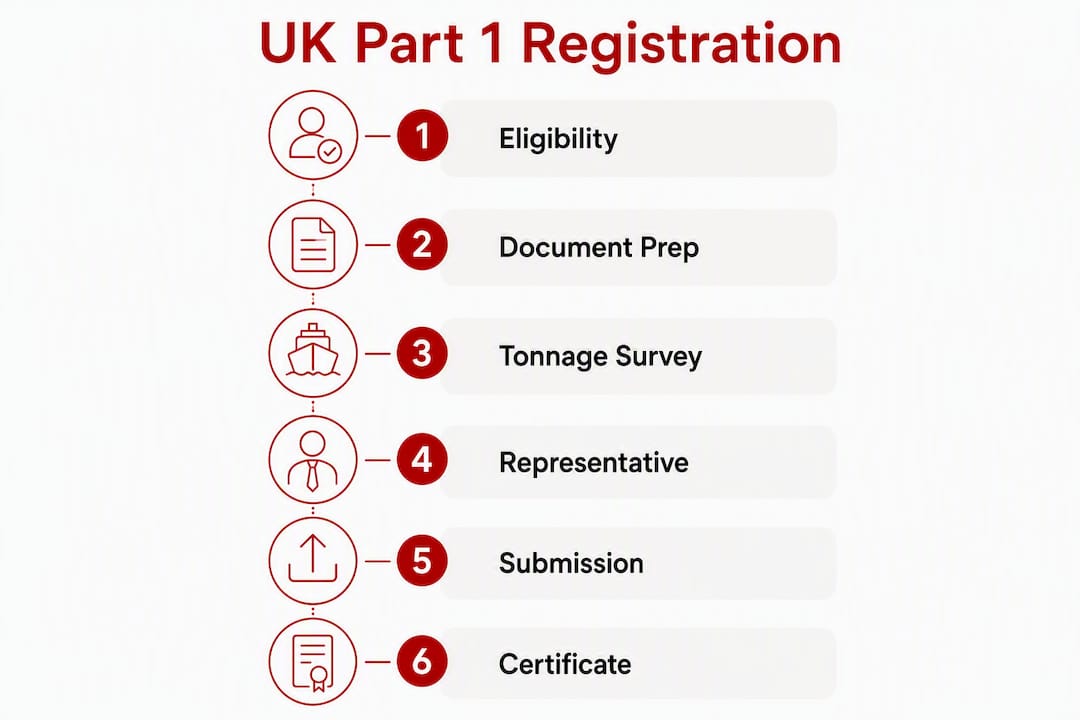
- Confirm eligibility. Verify you meet the ownership criteria and identify whether you need a UK representative person (U.S. residents always do).
- Appoint your UK representative. Get the representative formally appointed and their documentation certified before anything else moves.
- Order the tonnage survey. Contact a UKSR-recognized surveyor and schedule the measurement. Allow several weeks for scheduling and issuance of the certificate.
- Compile your ownership documents. Gather the bill of sale, builder’s certificate, ID, corporate documents (if applicable), and power of attorney.
- Complete MSF 5547. The Information required for UK ship registration (MSF 5547) is the pro-forma you submit to start the registration electronically or by post.
- Submit and pay fees. A standard Part 1 registration costs £153 for a five-year term; renewal for a further five years costs £72. Submit through the UKSR online portal or by returning completed forms directly.
- Receive your Certificate of Registry. Once UKSR approves the application, they issue the Certificate of Registry and assign the Official Number.
Documents checklist and where to get each one
| Documento | Why it’s needed | Where to get it | Typical lead time |
|---|---|---|---|
| Contrato de compraventa | Proves transfer of ownership | From the seller; notarized copy | Immediate if sale is complete |
| Builder’s certificate / CE declaration | Confirms vessel identity and original specs | From the builder or previous owner | Varies; request early |
| Certificate of Survey for Tonnage and Measurement | Mandatory for Part 1 application | UKSR-recognized surveyor | 2–6 weeks |
| Government-issued photo ID | Owner identity verification | Passport (U.S. owners) | Immediate |
| Representative person appointment | Required for non-UK residents | Drafted with your representative | 1–2 weeks for certification |
| Poder notarial (si procede) | Authorizes representative to act | Notarized by a U.S. notary | 1–2 weeks |
| MSF 5547 pro-forma | Initiates the registration | Download from GOV.UK | Immediate |
| Declaration of Eligibility (MSF 4727) | Confirms owner meets eligibility criteria | Download from GOV.UK | Immediate |
Common delay triggers: mismatched names across documents (the name on the bill of sale must match the ID exactly), missing certified translations, and survey certificates that arrive after the rest of the package is already submitted. Build your timeline around the survey, not around the paperwork.
How Part 1 handles ownership proof, mortgages, transfers, and deregistration
Part 1 functions as a running legal record of a vessel’s ownership history. Every transaction that affects title gets documented on the register.
Proving ownership is straightforward: the Official Number and Certificate of Registry are the primary evidence, backed by the bills of sale recorded on the register. A buyer’s solicitor can search the UKSR record and see every ownership change since the vessel was first registered.
Marine mortgage registration works by formally entering the mortgage against the vessel’s Part 1 record. The title register structure is what makes this possible — lenders can take security over the vessel because the ownership chain is legally documented and the mortgage is publicly recorded. This is the reason banks and marine finance companies consistently prefer Part 1 over any registry that only issues certificates.
Para un transfer of ownership on sale, the sequence runs:
- Buyer and seller execute a bill of sale.
- The bill of sale is submitted to UKSR along with the buyer’s eligibility documents.
- UKSR updates the register and issues a new Certificate of Registry in the buyer’s name.
- Any existing mortgage must be discharged or formally transferred at the same time.
Deregistration is required when a vessel is exported to another flag, sold to a non-qualifying owner, or permanently removed from service. The owner submits a deregistration request to UKSR, surrenders the Certificate of Registry, and receives a Deletion Certificate — the document needed to register under a new flag.
How does Part 1 compare with Part 3 and other parts of the UK register?
The choice between Part 1 and Part 3 (the Small Ships Register) comes down to what you need the registration to do.
| Característica | Part 1 | Part 3 (Small Ships Register) |
|---|---|---|
| Legal effect | Title register (full chain of ownership) | Certificate only (no title record) |
| Mortgage registration | Yes — mortgages registrable | No |
| Residency requirement | Non-residents eligible with UK representative | Simpler; some non-residents eligible without representative |
| Typical fees | £153 for 5 years; £72 renewal | Lower |
| Tonnage survey required | Yes, mandatory | No |
| Best for | Finance, international ops, commercial use | Simple pleasure use, UK-based owners |
For U.S. owners, the decision usually comes down to a short list of triggers:
- You need to register a marine mortgage or plan to finance the vessel. Part 1 is the only option.
- You plan to charter the vessel commercially. Part 1 provides the legal standing lenders and charterers expect.
- You will spend more than six months outside the UK. Part 1 explicitly covers this; Part 3 does not carry the same international weight.
- You want the strongest possible proof of ownership for a high-value vessel. Part 1’s title register is the answer.
Part 3 makes sense for a UK-based owner with a smaller pleasure vessel who has no financing needs and stays in UK waters. For most U.S. owners reading this, Part 1 is the correct register.
What happens if your vessel isn’t registered?
Operating without valid registration is not just a paperwork problem — it creates real operational and financial exposure.
- No recognized national flag. Under UNCLOS, every vessel on international waters must fly the flag of a state. Without registration, you have no legal nationality for your vessel, which can result in denial of port entry, seizure, or forced return to port.
- No marine mortgage. Without Part 1 registration, no lender can take formal security over the vessel. That closes off most marine finance options entirely.
- Insurance complications. Many marine insurers require valid flag documentation as a condition of coverage. An unregistered vessel may find its policy voided at the worst possible moment — a claim.
- Port State Control exposure. Port authorities in Paris MoU and Tokyo MoU countries can detain vessels that cannot produce valid registration documents. Detention means costs, delays, and reputational damage for commercial operators.
The three highest-consequence outcomes for owners who skip registration: inability to raise finance against the vessel, potential detention at a foreign port, and voided insurance coverage during a claim. None of these are recoverable quickly.
Principales conclusiones
The UK Part 1 Ship Register is the only part of the UK register that functions as a full title register, enabling mortgage registration, international recognition, and extended overseas operation for U.S. vessel owners.
| Punto | Detalles |
|---|---|
| Part 1 is a title register | It records ownership chains and allows marine mortgages — Part 3 cannot do either. |
| U.S. owners need a UK representative | Non-residents must formally appoint a UK representative person before applying. |
| Tonnage survey is mandatory | Every vessel needs a Certificate of Survey for Tonnage and Measurement, even pleasure craft. |
| Registration fees are fixed | A five-year registration costs £153; renewal for a further five years costs £72. |
| Vesselflag manages the full process | Vesselflag handles paperwork, survey coordination, and representative setup for U.S. owners. |
Why the representative-person step is where most U.S. owners go wrong
The conventional advice on UK Part 1 registration focuses on documents and fees. That is fine as far as it goes, but it misses where the real delays happen for U.S. owners: the representative-person appointment.
Most owners treat it as a formality to handle after the survey is booked. It is not. The representative must be formally appointed, their documentation must be certified, and UKSR must be satisfied with the appointment before the application can proceed. If that paperwork arrives late or is incorrectly certified, the entire application stalls — regardless of how clean the rest of the file is.
The second thing practitioners consistently see is name mismatches. The name on the bill of sale, the ID, and the corporate documents must be identical. A middle name on one document and not another, or a company name with “Ltd.” in one place and without it in another, triggers a request for clarification that adds weeks to the timeline.
The practical takeaway: treat the representative appointment and document consistency as your first two tasks, not your last. Everything else in the process is predictable once those two things are locked down. For owners with complex ownership structures — a U.S. LLC holding title, for example — the corporate documentation requirements add another layer that is worth getting right before submitting anything.
Vesselflag’s managed UK Part 1 registration service for U.S. owners
Gathering tonnage survey certificates, coordinating a UK representative, and keeping names consistent across six or seven documents is manageable — but it is also exactly the kind of process where one missed detail costs you a month.
Vesselflag handles the full UK Part 1 registration process for U.S. owners: end-to-end paperwork management, coordination with UKSR-recognized surveyors, representative-person setup, document certification, and submission to the registry. You get a single point of contact who knows where the process typically stalls and how to prevent it. For owners with corporate ownership structures, Vesselflag also handles the company documentation requirements that trip up first-time applicants.
Fees and timelines vary by vessel type and ownership structure — contact Vesselflag directly for an exact quote. To get started or review the full service scope, visit the UK Part 1 registration service page or the complete yacht registration guide for a walkthrough of what the managed process looks like from first contact to Certificate of Registry.
Useful official sources, guides, and forms
The sources below are the authoritative references for UK Part 1 registration. Always download forms directly from GOV.UK or the UKSR portal — third-party copies may be outdated.
- GOV.UK — Register a boat: The UK Ship Register: overview of all four parts, eligibility, fees, and links to application forms.
- UKSR Online Portal: submit applications, manage vessel records, and contact your UKSR account manager.
- Merchant Shipping (Registration of Ships) Regulations 1993: the statutory text that defines the four parts of the register and eligibility rules.
- GOV.UK — UK Ship Register for merchant ships and bareboat charter over 100GT: detailed guidance including MSF 5547 download and process steps.
- RYA — Boating Abroad: Paperwork: practical guidance on representative-person requirements and Part 1 vs Part 3 differences.
- Declaration of Eligibility (MSF 4727): the form confirming owner eligibility — download directly from GOV.UK.
| Resource | What it covers | Where to find it |
|---|---|---|
| MSF 5547 | Information required to start registration | GOV.UK / UKSR portal |
| MSF 4727 | Declaration of Eligibility | GOV.UK (direct PDF link above) |
| UKSR Online Portal | Application submission and account management | ukshipregister.service.mcga.gov.uk |
| 1993 Regulations | Statutory basis for the register | legislation.gov.uk |
These sources are updated by the MCA and GOV.UK. Always verify current fees and form versions before submitting — the figures in this article reflect published guidance but may change.
This article is general information, not legal or professional advice. Confirm current requirements, fees, and eligibility rules with the UKSR, GOV.UK, or a qualified maritime solicitor for your specific situation.
Preguntas frecuentes
What is Part 1 of the UK Ship Register?
Part 1 is the UK’s primary title register for commercial and pleasure vessels, administered by the Maritime and Coastguard Agency. It records ownership chains, issues an Official Number and Certificate of Registry, and allows marine mortgages to be formally registered against the vessel.
Do I need to register my boat in the UK?
UK registration is not mandatory for all vessels, but any boat used on international waters must fly a national flag under UNCLOS. Part 1 registration is required if you want to register a marine mortgage, fly the Red Ensign, or operate commercially under UK flag authority.
How do you prove ownership of a boat on Part 1?
Ownership is evidenced by the Official Number, the Certificate of Registry, and the bills of sale recorded on the Part 1 register. Because Part 1 is a title register, the full chain of ownership is searchable and legally documented — which is why lenders and buyers’ solicitors rely on it.
What happens if your boat is not registered?
An unregistered vessel has no recognized national flag, which can result in denial of port entry, detention by Port State Control authorities, and voided insurance coverage. Lenders will not register a marine mortgage against an unregistered vessel, effectively closing off most marine finance options.
Can a U.S. owner register on UK Part 1?
Yes. U.S. citizens and U.S.-incorporated companies can register on Part 1 by appointing a UK representative person who is ordinarily resident in the UK. Vesselflag manages the representative-person setup and the full application process for U.S.-based owners.