A tender does not always need an MMSI of its own, but it often does. The answer depends on the radio equipment on board and on the flag of the mother yacht. A handheld DSC VHF may be allowed to use the yacht’s number. An AIS unit generally needs a unique identity, and some flags want a dedicated number for every tender that carries electronics. This guide sets out the rules that matter to owners, brokers and operators, and the order in which to sort the paperwork. Vessel Flag prepares MMSI and ship radio licence applications for the parent yacht under Poland, the UK, San Marino and Malta, which is the foundation every tender number depends on.
TL;DR
- An MMSI (Maritime Mobile Service Identity) is the nine-digit number that identifies a radio station on VHF DSC and AIS. A tender is a “craft associated with a parent ship”, and the ITU has a special format for it.
- DSC radios on tenders may use the parent’s MMSI under US Coast Guard guidance. AIS equipment must have a unique identity.
- Malta and the Marshall Islands set their own tender rules: Malta’s extended-range tenders need a number different from the yacht’s, and the Marshall Islands requires a daughter-craft MMSI for tenders fitted with AIS or other radio equipment that needs programming.
- The parent yacht must have its own MMSI and licence first. The tender’s number is built on that foundation.
- Check the flag’s circular before you buy a radio or AIS unit for the tender, because the programming has to match the registry’s record.
Índice
- What a tender MMSI actually is
- Does the tender need its own MMSI?
- Tender rules by flag
- What you need before you apply
- How to apply, step by step
- Tarifas y plazos
- When the tender, yacht or flag changes
- How Vessel Flag helps
- Our view on tender MMSIs
- Preguntas frecuentes
- Fuentes
What a tender MMSI actually is
An MMSI is a unique nine-digit number assigned to a vessel’s radio station. It is entered into DSC (Digital Selective Calling) radios and AIS transponders, and it is what the coastguard sees when a distress alert comes in. It works like a telephone number for the boat.
For tenders, launches and other craft carried by a larger vessel, the ITU (the International Telecommunication Union, the UN body that sets radio rules) designated a special format: 9-1-8-2, then the three-digit Maritime Identification Digits (MID, the code of the country), then four further digits. The US Coast Guard’s navigation centre notes that most maritime countries have adopted this format, and that the US currently has no provision to assign it. The governing rule is ITU-R M.585-7, which feeds into Article 19 of the ITU Radio Regulations.
So a number starting 982 is generally a sign of a craft associated with a parent ship. A number starting with a three-digit country code such as 232 (UK), 255 (Portugal) or 256 (Malta) is a standard ship station number. Both can appear on a yacht’s equipment list.
Does the tender need its own MMSI?
The honest answer is: it depends on what you fit.
DSC VHF radio. According to the US Coast Guard, DSC-equipped radios on tenders and other craft associated with a parent ship may use the parent’s MMSI. The tender’s radio is covered by the parent ship’s licence. This is the simplest set-up for a handheld used within sight of the yacht.
AIS. The same guidance says AIS equipment must have a unique identity. Two transponders broadcasting the same number would make the yacht and tender indistinguishable on a chart plotter and could confuse a search and rescue operation. DSC equipment may also need its own identity in some cases.
EPIRB and PLB. An EPIRB (emergency position-indicating radio beacon) is programmed with an identity too. Malta’s tender guidelines, covered below, call for an additional EPIRB on the tender, programmed with the mother yacht’s details.
The IMO’s guidance on tenders and daughter craft takes a similar view for off-ship work. It says the MMSI of a Type 1 tender should be registered under that of the mother vessel. If the tender stays in visual range and within three miles of the mother vessel, it need not carry GMDSS equipment or an EPIRB, but it should have VHF equipment for continuous communication. Crew are recommended to wear personal locator beacons.
If you are buying equipment for the tender, a handheld VHF radio is the usual starting point. Decide first whether it will be DSC-capable, because that decides whether you need to programme a number into it.
Tender rules by flag
There is no single global procedure. The ITU sets the format, but the flag state (the country whose flag the yacht flies) or its radio authority decides how the number is requested and when it is mandatory. Three examples show how much the rules differ.
Malta: extended-range tenders
Malta’s Commercial Yachts Extended Range Tender Guidelines (Revision 2, applicable from 1 April 2024) state that, per ITU-R M.585-7, a craft associated with a parent ship needs a unique nine-digit identification number different from the parent’s. Key points for owners:
- The number is assigned by Malta’s Maritime Radio Communications Services (MRCS), requested by email.
- Yachts deploying extended-range tenders must have AIS installed, even if under 300 GT.
- The tender’s EPIRB must be an additional beacon programmed with the mother yacht’s MMSI, using the Maltese MID, the last six digits of the yacht’s MMSI and the beacon number.
- The guidelines apply to Malta-flag commercial yacht tenders of up to 24 m LOA operating under the mother yacht’s Registration Certificate. Rescue-boat tenders are limited to six nautical miles from the mother yacht.
If you charter a Malta-flag yacht commercially and run a tender beyond the usual short hop, these guidelines are the document to work from. Our guide to the Malta radio licence for yachts covers the yacht’s own licence and MMSI listing, which has to be in place first.
Marshall Islands: daughter-craft MMSI
The Marshall Islands registry’s Yacht Technical Circular 13 (6 September 2023) requires a daughter-craft MMSI for each tender fitted with AIS or other radio equipment that needs programming, provided the tender is not registered in another jurisdiction. The circular also asks for tenders to be marked with the number of persons they can safely carry and with the tender’s name plus the yacht’s name, with stated exceptions. If radio equipment is moved or changed, it must be reprogrammed with the correct Marshall Islands details.
The registry’s vessel registration document MI-100 (May 2024) adds a registration route. A tender to a Marshall Islands mother yacht of 7 m or more LOA may be voluntarily registered under the Marshall Islands flag. Smaller tenders and other appurtenances such as jet skis may be listed on the Official Record of Auxiliary Vessels as part of the yacht’s inventory.
United Kingdom and Ofcom
In the UK, Ofcom licenses ship radio. Its guidance notes for licensing (published 16 March 2020) say the Ship Radio Licence assigns the ship its call sign and MMSI. An MMSI is assigned with every new licence unless the ship already has one, and it can be requested through the Ofcom portal. For a UK Part 1 yacht, the licence for the parent is the starting point. Ask Ofcom or your adviser how your tender equipment should be covered before you programme anything.
United States and Canada
The US approach is different. The Coast Guard says tender radios are licensed under the parent ship’s FCC ship station licence, and that for US-registered craft associated with a parent ship, a unique ship station MMSI can be obtained using the same procedures as for recreational vessels. AIS stations using such numbers should enter the letter A plus the last six digits of the parent’s MMSI in the AIS call sign parameter in place of an official call sign.
In Canada, ISED says anyone with a Canadian-owned or Canadian-registered boat can apply for an MMSI. For craft with their own dedicated radios, you apply using Form C, and the parent ship must already have its own MMSI. There is no fee to apply. If you are a US owner looking at a foreign flag, our page on Registro de yates extranjeros para propietarios estadounidenses explains how the process differs.
What you need before you apply
The information asked for is similar everywhere, even if the form differs. Have these ready:
- The parent yacht’s MMSI and licence details. Canada states the parent must already have its own MMSI, and the other flags above work from the parent’s record.
- Tender particulars. Name, make, length, maximum persons carried, and how it is used.
- Equipment list. Which radios, AIS units and beacons are on the tender, with model and serial numbers where the authority asks.
- Evidence of ownership and flag. The yacht’s registration certificate or provisional papers. Our Lista de comprobación de los documentos de matriculación de un yate lists what a registry usually wants.
- Applicant details. The Ofcom form OFW347, for example, asks for vessel name, previous call sign and MMSI if previously licensed, intended use code (such as pleasure ship), type of vessel, gross tonnage or approximate weight for open boats, and maximum persons carried. Note that Ofcom cannot licence vessels registered in countries other than the UK, the Isle of Man and the Channel Islands, so the flag decides which authority you deal with.
A mistake in any of these usually means a rejected form or a number programmed against the wrong record, so a second pair of eyes before filing saves weeks.
How to apply, step by step
Step 1: Fix the yacht’s flag and licence. The tender’s number depends on the parent. If the yacht is not yet registered, finish that first. If the yacht is between flags, sort the radio position before you change anything on the tender. Vessel Flag handles registrations under eight flags, and MMSI and ship radio licences for the parent under Poland, the UK, San Marino and Malta, which keeps the paperwork in one place.
Step 2: Decide what the tender carries. DSC handheld only, or AIS and an EPIRB as well? That choice tells you whether the parent’s MMSI is enough or whether you need a separate identity.
Step 3: Read the flag’s rule. Malta wants a unique number from MRCS for extended-range tenders. The Marshall Islands wants a daughter-craft MMSI for tenders fitted with AIS or other radio equipment that needs programming. Other flags may follow the ITU format through their radio authority. Find the circular or guidance before you spend on equipment.
Step 4: Submit the request to the right authority. In the US it is Question 11 of FCC Form 605, Schedule B. For a handheld-formatted MMSI, select P for Portable in Question 4 and attach a specific request, as set out on the FCC’s MMSI page. In Malta it is an email to MRCS. In Canada it is Form C. In the UK it goes through the Ofcom licence.
Step 5: Programme the equipment and mark the tender. Enter the number exactly as issued. For AIS in a US set-up, add the call sign entry described above. Mark the tender as the flag requires, for example with the tender name, the yacht name and the persons-carried figure under the Marshall Islands circular.
Step 6: File the confirmation with the yacht’s records. Keep the number, the licence and the equipment list in the yacht’s compliance file, ready for surveys, charter checks and port inspections.
Tarifas y plazos
Fees vary widely, and some authorities charge nothing. Canada has no fee to apply for an MMSI. In the UK, Ofcom’s 2020 guidance says the licence is free through its portal and cost £20 by paper application, with changes free of charge. Check Ofcom’s current licensing page before you apply, as these are the published figures for that guidance.
For the yacht’s own MMSI and ship radio licence through Vessel Flag, the published one-off prices are below, each VAT included with no annual fees.
| Licence | Precio | Typical timing |
|---|---|---|
| Poland MMSI licence | EUR 149 | 4 to 6 weeks after registration |
| UK MMSI (Ofcom) licence | EUR 150 | 1 día |
| San Marino MMSI radio licence (valid 5 years) | EUR 200 | Confirmed on application |
| Malta MMSI application | EUR 649 | Confirmed on application |
For Poland, provisional registration papers take 2 to 5 days, and the radio licence follows once the registration is in place. San Marino’s provisional certificate takes 2 to 6 days and is not guaranteed. Details and current terms are on the MMSI number registration page and the Poland radio licence page, and the San Marino route is explained in our San Marino MMSI application guide.
When the tender, yacht or flag changes
Identities follow rules that catch owners out at resale or reflagging.
- The number stays with the ship. Ofcom says the MMSI remains with the ship through ownership or name changes, cannot be transferred between ships, and may be reassigned after five years without a live licence.
- Radio moved to another vessel must be reprogrammed. A DSC radio moved to another ship must carry that ship’s MMSI. The same logic applies to a handheld swapped between the yacht and a different tender.
- A flag change usually means a new number. The MID in the number reflects the flag. Moving a yacht from one flag to another normally means new radio details and reprogramming of everything on board, tenders included. The FCC makes a similar point: a number is for one vessel and may not be re-used, except in the special case of a vessel transfer.
- A tender sold with the yacht. Update the equipment list and confirm the flag’s record before the handover.
If you are planning a flag transfer, build the radio changes into the timetable from the start. Vessel Flag arranges transfers between flags as well as the MMSI and radio licence on the new flag.
How Vessel Flag helps
Tender numbers sit on top of the yacht’s own registration and radio licence. If those are wrong or late, everything below them waits. Vessel Flag is a private consultancy, not a registry: we prepare and file the applications, and the flag registries issue the certificates. We work fully remotely, with published one-off prices, for owners, companies and brokers.
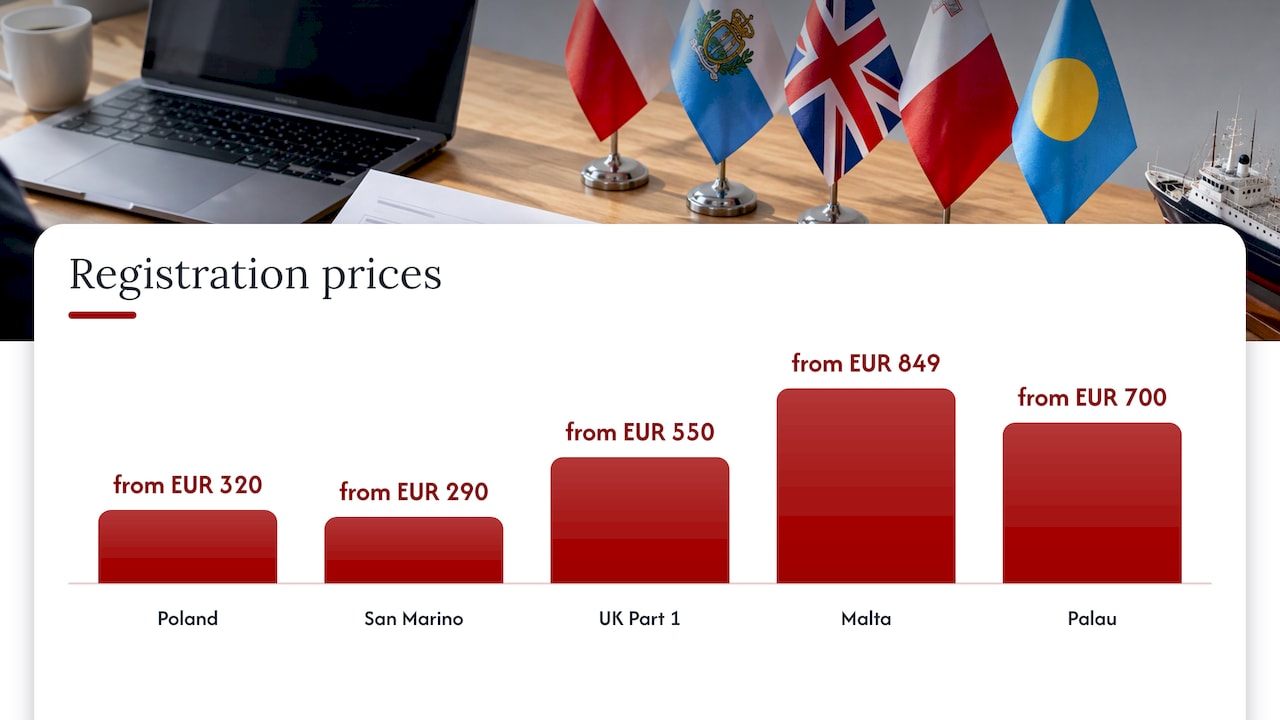
Our registration prices are: Poland from EUR 320, San Marino from EUR 290, UK Part 1 from EUR 550, Malta from EUR 849 and Palau from EUR 700. Marshall Islands registration is a EUR 250 service fee plus registry fees, and Cayman Islands is a EUR 450 service fee plus registry fees. For UK Part 1, owners can register personally if eligible, through an existing company (UK or an eligible foreign company, such as a Delaware corporation) or through a new UK LTD. See the Malta yacht registration page if your tender plans involve a Malta-flag commercial yacht, or the MMSI and ship radio licence service for the yacht’s licence.
Our view on tender MMSIs
Most tender problems we would expect owners to meet are sequencing problems, not technical ones. The tender’s identity depends on the yacht’s registration and radio licence, so the order matters: flag first, yacht MMSI and licence second, tender equipment third.
The second thing is that flag rules differ more than owners expect. A Malta-flag commercial yacht with an extended-range tender and a Marshall Islands yacht with an AIS-fitted tender each have a written procedure, and the two do not match. Reading the flag’s circular before buying equipment is cheaper than reprogramming afterwards.
That is why we work across eight flags and handle the whole ownership set-up in one place: registration, company formation, MMSI and radio licence, and transfers between flags. We are a listed agent with the San Marino and Palau registries, and we offer a UK local representative service. Our prices are published and one-off, so owners and brokers can plan costs before they instruct us.
VesselFlag
Preguntas frecuentes
Can a tender use the yacht’s MMSI?
For DSC radios, often yes. The US Coast Guard says DSC-equipped radios on tenders and other craft associated with a parent ship may use the parent’s MMSI. AIS equipment must have a unique identity, and some flags, such as Malta for extended-range tenders, require a separate number.
What does a 9182 number mean?
It is the ITU format for craft associated with a parent ship, followed by the three-digit country code (MID) and further digits. Most maritime countries have adopted it. The US currently has no provision to assign it.
Does a tender need a radio licence as well as an MMSI?
It depends on the country. In Canada, no radio licence is needed to apply for an MMSI if you stay in Canadian waters, but one is required if you leave them. In the US, a ship station licence is not needed for domestic voluntary vessels, but it is required if the vessel travels to a foreign port. Check the position for your flag before cruising abroad.
Can the MMSI move to another boat?
No. Ofcom says the number remains with the ship and cannot be transferred between ships. A DSC radio moved to another ship must be programmed with that ship’s own MMSI.
Who should I contact first?
Start with whoever handles the yacht’s registration and radio licence, because the tender’s number builds on it. To get the parent yacht’s papers moving, see the Polonia, San Marino o Reino Unido, 1.ª parte registration pages, or ask for a consultation and we will confirm the route for your flag.
Ready to put the yacht’s registration and radio licence in order? Choose your flag page above, then book a consultation with Vessel Flag.
Fuentes
- US Coast Guard: MMSIs for craft associated with a parent ship
- Malta: Commercial Yachts Extended Range Tender Guidelines, Revision 2
- Marshall Islands: Yacht Technical Circular 13
- Marshall Islands: MI-100 Vessel Registration and Instrument Recording
- IMO: Tenders and Daughter Craft
- Ofcom: Ship Radio Licences guidance notes
- Ofcom: Ship radio licence application form OFW347
- ISED Canada: Maritime Mobile Service Identities
- FCC: Maritime Mobile Service Identities
- UHF and VHF radio stations
Recomendado
VesselFlag is a private consultancy that prepares and files yacht registration applications for owners. We are not a government body or flag registry; certificates are issued by the relevant registry. This article is general information, not legal advice.