

Temporary Admission lets a non-EU registered yacht enter EU waters and stay there without paying import VAT or customs duty, provided the boat is intended for re-export and the owner is established outside the customs territory. The standard discharge period runs a limited time specified by EU customs law. Miss that window without re-exporting, extending, or otherwise satisfying customs, and the full VAT and duty bill becomes due retroactively. Get the eligibility test wrong at entry, and none of the rest matters.
En resumen:
- Yachts registered outside the EU and owned by individuals or entities established outside the customs territory qualify for Temporary Admission, provided they are for private use.
- The 18-month discharge period begins upon entry into EU waters and can often be restarted by re-entering after a non-EU port call, with extensions possible but at customs discretion.
- Owners must keep detailed, timestamped documentation of each foreign port visit, including port clearance and fuel receipts, to prove proper re-export and avoid retroactive VAT charges.
- Selling or chartering a yacht while under Temporary Admission without notifying customs triggers full tax liability and voids the relief.
- Proper initial documentation, ongoing record-keeping, and compliance with country-specific customs rules are crucial to maintaining a clean Temporary Admission status.
Índice
- What Are the Eligibility Rules for Temporary Admission Yachts?
- How Long Can a Yacht Stay Under Temporary Admission?
- What Customs Formalities Apply on Arrival?
- Can You Sell or Charter a Yacht Under Temporary Admission?
- How Do You Prove a Yacht Left EU Customs Territory?
- Do Temporary Admission Rules Differ by Country?
- VesselFlag’s Practical Checklist for Yacht Owners
- Insurance Considerations for Yachts Under Temporary Admission
- Why the Standard Advice on Temporary Admission Falls Short
- Let VesselFlag Handle the Paperwork While You Handle the Cruising
- Where to Verify the Legal Details Yourself
- Sources
- Preguntas frecuentes
What Are the Eligibility Rules for Temporary Admission Yachts?
Two tests decide whether your vessel qualifies for temporary admission yachts relief, and customs officers check both. Fail either one and the boat is treated as an EU import subject to VAT and duty, not a visitor passing through.
The first test is the flag. Your yacht must be registered outside the EU customs territory. A yacht flagged in the Cayman Islands, the Marshall Islands, or under a non-EU jurisdiction such as one of the flags Vesselflag arranges typically clears this test without issue. Confirm your registration certificate is current and matches the vessel’s actual details, because a lapsed or mismatched document is one of the fastest ways to get flagged for a secondary inspection. If your paperwork needs a refresh before you cross into EU waters, review how to ensure yacht registration validity before you rely on it at a border.
The second test concerns the owner, not just the vessel. Customs wants proof you are established outside the EU customs territory, meaning your habitual residence or, for a corporate owner, your registered office and effective management sit outside that territory. This is where things get complicated for owners who split time between an EU country and elsewhere, or who own through an offshore company with EU-resident directors. Customs authorities look past the paper structure toward who actually controls and uses the yacht.
There is a third, less discussed condition: private use. Temporary admission covers pleasure use by the owner and immediate guests, not commercial charter. Put the yacht into charter while claiming TA relief and you have effectively converted it to commercial use inside the customs territory, which typically disqualifies the exemption entirely.
Documents customs commonly expects at first entry include:
- Certificate of registration showing non-EU flag status
- Proof of the owner’s residence or corporate seat outside the EU
- Passports or identification for owner and crew
- Bill of sale or proof of ownership
- Valid insurance certificate
- MMSI and AIS documentation
How Long Can a Yacht Stay Under Temporary Admission?
The standard EU period is 18 months, set out under Article 217(e) of the UCC Delegated Act. That clock starts the moment the yacht enters EU customs territory and runs continuously unless something interrupts it.
Consejo de experto: Leaving EU waters and re-entering generally restarts the discharge period, and many implementations don’t impose a minimum time you need to spend outside before coming back. That single fact is why owners cruising the Mediterranean often plan a short hop to Montenegro, Albania, or Turkey rather than let the discharge deadline lapse.
A typical multi-season plan looks like this:
- Enter EU waters in April, flag noted at the marina or port of entry.
- Cruise through two seasons, tracking the 18-month deadline on a calendar, not a mental note.
- Around month 16 or 17, sail to a non-EU port (Montenegro, Turkey, Tunisia) for a documented call.
- Re-enter EU waters with fresh entry evidence, restarting the discharge period.
Some national customs authorities permit extensions in specific circumstances, such as a yacht laid up for repair, but extensions are discretionary and vary by country. Never assume one will be granted; apply well before the 18 months expire.
What Customs Formalities Apply on Arrival?
For most private yachts, simply crossing the EU customs frontier triggers Temporary Admission automatically. No paperwork, no queue, no declaration desk. But that default only holds when nothing about the vessel or its use raises a flag. EU guidance confirms customs can require an oral or written declaration, or ask for a formal entry using Annex 71-01, when the situation calls for closer scrutiny: unusual ownership structures, a yacht arriving from a higher-risk jurisdiction, or a vessel large enough to draw attention.
Carry these documents on board at all times, not just at first entry:
- Registration certificate and proof of flag state
- Evidence of owner residence or corporate domicile outside the EU
- Passports for owner, family, and crew
- Insurance certificate covering EU waters
- MMSI and AIS registration paperwork
- Bill of sale establishing ownership
- Crew list with nationalities and roles
Customs can request a guarantee or security deposit covering the potential VAT and duty liability, particularly where the vessel’s non-EU status or the owner’s residency isn’t immediately obvious from documents alone. This is standard practice, not a red flag against your specific case, and the guarantee is typically released once you re-export or otherwise properly discharge TA.
Consejo de experto: Keep a dedicated folder, physical or digital, with every entry stamp, fuel receipt, marina invoice, and port clearance from the moment you enter EU waters. Customs audits often happen years later, and reconstructing a timeline from memory rarely goes well. A maritime documentation checklist built before your first crossing saves real time when an inspector asks for proof on short notice.

Retain records for at least the full TA period plus a reasonable buffer, since customs authorities can and do request historical evidence well after the fact.
Can You Sell or Charter a Yacht Under Temporary Admission?
No. Selling, chartering, leasing, or otherwise transferring a yacht while it holds Temporary Admission status without notifying customs typically ends the relief immediately, and back VAT plus duty becomes payable on the full value of the vessel.
Maintenance and repair sit in different territory. Routine upkeep is permitted under TA, but substantial refit work sometimes falls under inward processing rules instead, a related but distinct customs regime designed specifically for repair and improvement work. Ask the shipyard whether they handle this paperwork; most established EU yards that service foreign-flagged yachts do this routinely.
Boat shows introduce another wrinkle. Exhibition admission is a separate TA variant with its own conditions, so don’t assume the rules for cruising apply identically to displaying a yacht at a show.
If you need to sell while the yacht sits in EU waters under TA, notify customs before the transaction closes, not after. Structuring the sale to happen outside the customs territory, or formally importing and paying VAT first, are the two clean paths; improvising rarely ends well.
How Do You Prove a Yacht Left EU Customs Territory?
Discharging Temporary Admission cleanly means proving the yacht actually re-exported, and that proof needs to hold up to scrutiny long after the crossing itself.
- Collect port clearance documents from the foreign port you sailed to, not just the EU port you left.
- Keep stamped manifests or entry logs where the local port authority records your arrival.
- Save fuel invoices and marina bills bearing the foreign port’s name and date.
- Retain pilot receipts where applicable, since these carry independent third-party timestamps.
A single stamped exit record from a recognized foreign port tends to carry more weight with customs than a pile of loosely related paperwork. Prioritize getting one solid, officially stamped document over collecting a dozen weaker ones.
Consejo de experto: If customs contacts you asking for proof of an exit you can’t immediately document, contact the marina or port authority at the foreign stop directly. Many keep arrival logs for years and will issue a retroactive confirmation letter on request.
Third-country calls do double duty: they discharge the current TA period and start a fresh one on re-entry. Treat each one as a formal event worth documenting properly, not a casual detour.
Do Temporary Admission Rules Differ by Country?
The 18-month baseline comes from EU-wide law, the Union Customs Code and its Delegated Act, but national customs authorities implement it with real variation in practice, documentation expectations, and enforcement style.
The United Kingdom illustrates this well. Gov on sailing a pleasure craft into the UK temporarily sets out its own eligibility tests and relief periods, and treatment differs between Great Britain and Northern Ireland given Northern Ireland’s continued alignment with EU customs rules. A yacht cleared under one set of assumptions in Great Britain can face different requirements crossing into Northern Ireland waters.
Spain has also recently simplified elements of its temporary importation procedures for non-EU vessels, including how offshore sailing can be used to renew TA status. Special territories add another layer: the Canary Islands sit outside the EU VAT area despite being Spanish territory, which changes tax treatment even though customs status can differ from VAT status. The general 12 nautical mile territorial sea boundary matters too, since it defines where customs territory begins for many purposes.
Given this patchwork, contact the customs authority at your first port of entry directly and get confirmation in writing whenever the rules for your specific situation aren’t crystal clear. A phone call now beats a dispute over back taxes later.
VesselFlag’s Practical Checklist for Yacht Owners
Getting Temporary Admission right starts well before you cross into EU waters, and most of the friction owners run into traces back to documentation gaps rather than the customs rules themselves.
Before departure, confirm:
- Flag registration is current, matches vessel details exactly, and clearly shows non-EU status
- MMSI and AIS setup is complete and documentation is on board
- Owner residency or corporate domicile evidence is organized and accessible
- Insurance covers EU cruising waters specifically, not just home waters
Asas para Vesselflag registro de banderas across multiple non-EU jurisdictions, sets up MMSI and AIS licensing, and supports the documentation pack customs expects at entry. For owners with layered corporate ownership or an upcoming sale, a paid consultation before you cross a border costs far less than untangling a VAT dispute afterward.
Insurance Considerations for Yachts Under Temporary Admission
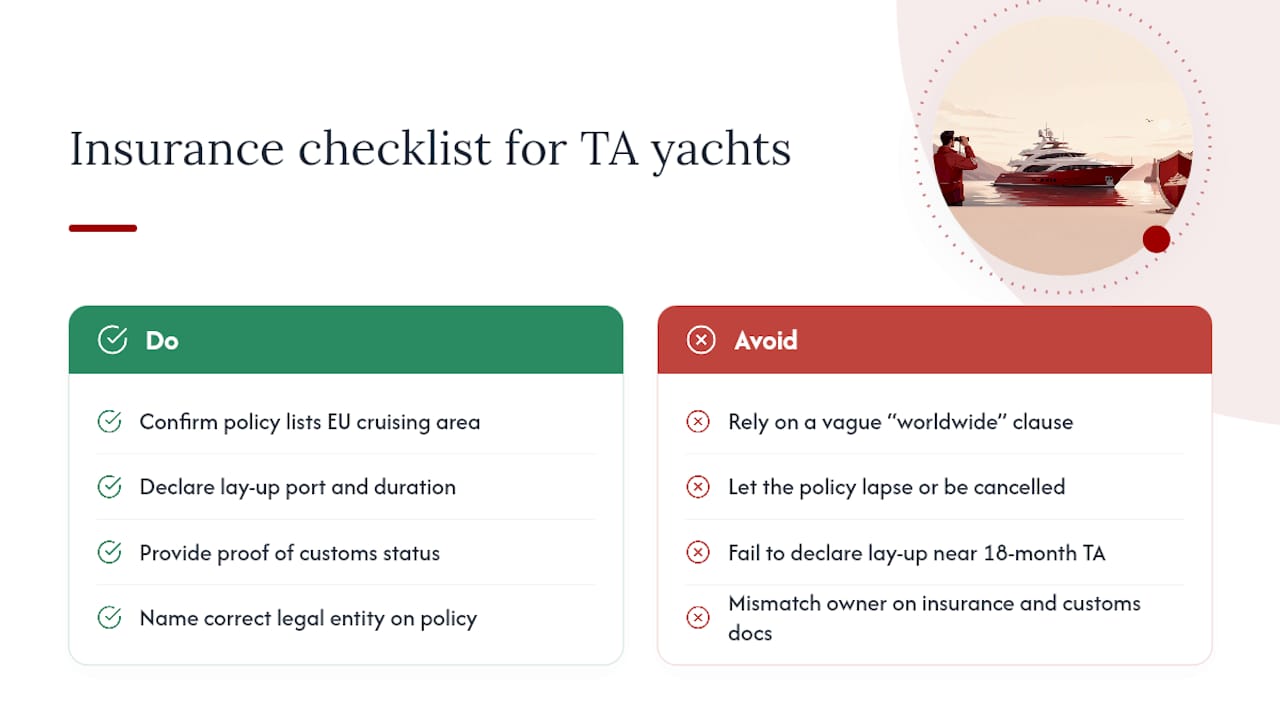
Standard yacht insurance policies don’t automatically address the customs status of the vessel, and that gap catches owners off guard more often than it should. Your policy needs to reflect where the yacht actually cruises, since many home-market policies exclude or limit coverage in EU waters unless specifically endorsed for it.
Check that your insurer explicitly lists the EU cruising area, not just a generic “worldwide” clause that carries hidden exclusions for certain territorial waters. If a yacht is laid up in an EU marina during winter, some insurers require the port and duration to be declared, particularly if the layup period runs close to the 18-month TA deadline.
Insurers may also ask for proof of the vessel’s customs status as part of underwriting, especially for higher-value yachts. A policy that lapses or gets cancelled while the yacht sits in EU waters under TA creates a second problem layered on top of any customs question, since operating an uninsured vessel is a separate legal issue in most EU jurisdictions regardless of customs standing.
If ownership sits inside a corporate structure, confirm the policy names the correct legal entity as insured. A mismatch between the registered owner on the insurance certificate and the owner named in customs documentation is exactly the kind of inconsistency that turns a routine inspection into a longer conversation. Review your coverage annually and specifically flag any planned change in cruising region or extended EU layup to your insurer before it happens, not after.
Why the Standard Advice on Temporary Admission Falls Short
Most guidance on Temporary Admission stops at explaining the 18-month rule and calling it a day. That’s the easy part. The harder part, the part that actually determines whether an owner avoids a five-figure VAT bill, is the evidence trail: proving residency status convincingly, documenting a re-export properly, and having paperwork ready before an inspector asks rather than scrambling afterward.
The conventional wisdom treats TA as a passive benefit that happens automatically once you clear the flag and residency tests. In practice, it rewards owners who treat it as an active compliance obligation. The single biggest mistake isn’t misunderstanding the rules; it’s assuming a border crossing without a paper trail counts as evidence. It doesn’t, not years later when a customs audit asks you to reconstruct a timeline from memory.
If you take one thing from this article, prioritize the exit evidence over everything else. Get your flag and residency documentation right once, then build a habit of collecting a stamped record every time you cross a border. That habit is what separates a clean TA discharge from an unwelcome VAT assessment.
— VesselFlag
Let VesselFlag Handle the Paperwork While You Handle the Cruising
Vesselflag exists for the moment where customs rules stop being theoretical and start requiring an actual, correctly filed document. Where a generic customs guide tells you what the law says, Vesselflag arranges the flag registration, MMSI licensing, and compliance paperwork that makes your Temporary Admission position defensible in the first place.
If your ownership sits inside a corporate structure, you’re planning a sale while the yacht is in EU waters, or you’re simply not confident your current flag documentation would survive a customs review, that’s exactly when a consultation is worth its cost. Vesselflag’s flag registration service covers the jurisdictions non-EU owners rely on for TA eligibility, and the team can walk through your specific residency and ownership situation before you’re standing in front of a customs officer explaining it for the first time. Start with a review of your current registration status and go from there.
Where to Verify the Legal Details Yourself
For binding answers, go to primary sources rather than blog summaries, including this one. The EU Customs FAQ on private boats covers the Union Customs Code framework directly, while GOV.UK’s guidance covers the UK-specific application. For a detailed operational walkthrough of importation timing, the step-by-step yacht importation guide from Yachts by Steve adds useful practical detail. When your situation involves real money at stake, confirm with a VAT advisor or your national customs authority before relying on any single source, including official guidance that may lag behind recent national updates.
Sources
- Frequently Asked Questions on: Rules for private boats – EU Customs
- EU Customs Rules for Pleasure Craft & Yachts: Official EU Guidance 2026
- Gov
Preguntas frecuentes
What Is the 18-Month Rule for Temporary Admission?
It’s the standard discharge period under EU customs law during which a non-EU flagged yacht can stay in EU waters VAT and duty free, provided the owner is established outside the EU and the yacht is used privately.
Can I Buy a Yacht Outside the EU and Bring It in Temporarily?
Yes. A non-EU flagged yacht owned by someone established outside the EU customs territory can enter under Temporary Admission without paying import VAT or duty, as long as it’s for private use and intended for eventual re-export.
Does Leaving and Re-Entering EU Waters Restart the TA Clock?
In most implementations, yes. Sailing to a non-EU port and returning generally restarts the 18-month period, and there’s often no required minimum time spent outside the customs territory before coming back.
What Happens if I Overstay the Temporary Admission Period?
Overstaying without re-exporting or securing an extension typically means the yacht is treated as imported, triggering VAT and customs duty on its value, sometimes with penalties added on top.
Does Chartering My Yacht Affect Its Temporary Admission Status?
Yes. Temporary Admission covers private use only, so putting the yacht into commercial charter while claiming TA relief generally voids the exemption and exposes the owner to back taxes.

[…] related resource on Temporary Admission and the 18-month rule walks through renewal mechanics and common timing mistakes in more […]