
En resumen:
- Registering a vessel under an international flag now requires thorough documentation verification due to stricter IMO transparency guidelines. Proper preparation of ownership, vessel identification, compliance certificates, and due diligence considerably reduces application delays and ensures compliance. Adhering to current standards enhances operational freedom, avoids detention risks, and benefits from expert support for a smooth, compliant registration process.
Registering a vessel under an international flag sounds straightforward until you’re standing at the edge of three conflicting sets of requirements, waiting on a document that nobody told you was mandatory, and watching your departure window close. The process has grown noticeably more demanding since the IMO’s new guidelines pushed flag states toward greater transparency and fraud prevention. This guide walks you through every stage, from gathering your first documents to maintaining long-term compliance, so that you arrive at registration approval with confidence and zero surprises.
Índice
- What you need before starting vessel registration
- Step-by-step vessel registration process
- How to avoid mistakes and delays
- Final verification and maintaining registration
- Why the old shortcuts no longer work: Compliance in 2026
- Streamline your vessel registration with expert support
- Preguntas frecuentes
Principales conclusiones
| Punto | Detalles |
|---|---|
| Verify before registering | Prepare all documents and confirm vessel ownership to avoid delays or compliance issues. |
| Follow step-by-step process | Adhering to each registration step helps prevent errors and ensures full compliance. |
| Stay current with regulations | New international guidelines require ongoing due diligence and information sharing. |
| Avoid shortcuts | Old registration shortcuts now increase risk due to tighter standards and verification. |
| Expert help saves time | Professional support simplifies complex registration and helps overcome regulatory challenges. |
What you need before starting vessel registration
Before you fill in a single form, you need the right materials in hand. Think of this stage as building a foundation. A shaky foundation means the entire structure collapses at the worst possible time, usually mid-application when a registry clerk asks for a document you didn’t know existed.
Core documents you must prepare:
- Proof of ownership. This means a bill of sale, builder’s certificate, or notarized transfer document showing an unbroken chain of title from the original builder or last registered owner to you.
- Vessel identification records. Hull identification number (HIN), engine serial numbers, and any existing registration certificates from previous flag states.
- Personal or corporate identification. Passport copies, corporate registration certificates, and beneficial ownership declarations are increasingly required.
- Compliance certificates. Safety equipment certificates, radio licenses, and, for larger vessels, SOLAS-related documentation.
- Vessel survey or valuation report. Many flag states require a recent survey, particularly for vessels over a certain length or age.
- Evidence of previous deregistration. If your vessel was registered elsewhere, you typically need a deletion certificate or a letter of no objection from the previous registry before a new flag will accept your application.
En required vessel documents list varies slightly by flag state, but this core set covers the vast majority of registries worldwide.
Beyond document collection, you need to verify your vessel’s history. A vessel with a lien, an outstanding mortgage, or an unresolved encumbrance in a foreign registry can be blocked from registration. Run a thorough maritime lien search and confirm that any prior mortgages are officially discharged.

The IMO’s updated guidelines place particular emphasis on due diligence on ownership and ship identification, meaning registries are now expected to actively verify beneficial ownership rather than simply accepting declarations at face value. This is not a formality. Flag states that ignore this standard risk losing their international standing.
| Document type | Required for | Notes |
|---|---|---|
| Bill of sale / builder’s certificate | All registrations | Notarization often required |
| Certificado de baja | Re-flagging | From previous registry |
| Survey report | Vessels over 24m or 20+ years old | May need flag-approved surveyor |
| Corporate registry extract | Corporate-owned vessels | Translated if non-English |
| Beneficial ownership declaration | All applications | New requirement under IMO guidance |
Pro Tip: Gather documents at least 30 days before you plan to apply. Apostilles, notarizations, and translated copies all take time, and rushing them is the single most common cause of application delays.
Step-by-step vessel registration process
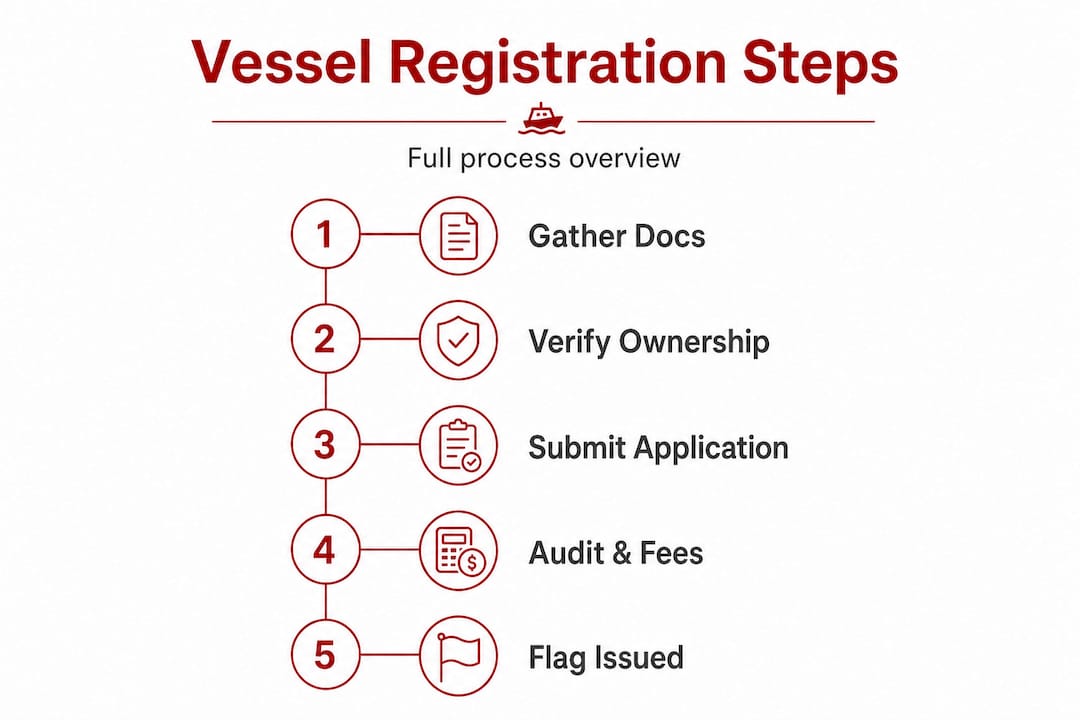
With all your documents prepared and verified, you’re ready to move through the actual registration process. This is where flag choice becomes critical, because each registry has its own timeline, fee structure, and documentation standards.
The registration process, step by step:
Elige tu Estado de abanderamiento. Consider where you intend to sail, the tax implications for your vessel’s use, the registry’s reputation with port state control, and the practical processing time. Popular options include Malta, the UK Part 1 registry, San Marino, Palau, Poland, and Langkawi, each with distinct advantages.
Confirm eligibility requirements. Some registries require the owner or company to have a connection to that jurisdiction. Others, known as open registries, accept applicants from any nationality.
Submit a pre-registration inquiry or application. Many registries offer a preliminary review of your documents before you pay the full registration fee. Use this step if it’s available.
Complete identity verification. Under current IMO guidelines, heightened documentation and identity checks are now standard. Expect to provide certified copies of identification and, in some cases, video verification or notarized affidavits.
Submit the full application package. This includes all core documents, completed registry-specific forms, and payment of registration fees.
Respond to registry queries. Almost every application generates at least one follow-up question. Respond quickly and completely to avoid delays.
Receive provisional or permanent certificate. Many registries issue a provisional certificate within days, with the permanent certificate following after full review.
Set up ancillary services. MMSI registration, AIS configuration, and radio licensing should be completed immediately after or alongside vessel registration.
Follow the detailed international boat registration steps for a full breakdown of each stage, including flag-specific variations.
Comparison of popular registration approaches:
| Flag / Registry | Typical processing time | Open registry? | Ventaja clave |
|---|---|---|---|
| Malta | 3 to 7 business days | Sí | EU flag, strong port recognition |
| Reino Unido, 1.ª parte | 5 to 10 business days | Limitado | Globally recognized, mortgage-friendly |
| San Marino | 3 to 5 business days | Sí | Fast, landlocked nation with maritime treaty |
| Palau | 2 to 5 business days | Sí | Fast processing, cost-effective |
| Polonia | 5 to 10 business days | Limitado | EU flag, strong legal framework |
| Langkawi | 3 to 7 business days | Sí | Southeast Asia access, competitive fees |
You can find a thorough breakdown of each option in our global registration process guide, which is updated annually.
“Selecting the wrong flag state at the outset is one of the most expensive mistakes a yacht owner can make. Once you’re mid-application, switching registries means restarting from scratch and potentially losing non-refundable fees.”
Pro Tip: If you frequently transit multiple regions, prioritize flags with strong port state control records. A vessel flagged with a registry that has a poor detention history will face more inspections in foreign ports, costing you time and money.
For a focused walkthrough on the full documentation sequence for matriculación de tu yate, see the dedicated guide that covers vessel type, tonnage thresholds, and ownership structure.
How to avoid mistakes and delays
Following the process carefully is essential, but knowing where things typically go wrong gives you an extra layer of protection. Registration delays almost always trace back to a handful of predictable errors.
The most common mistakes:
- Incomplete paperwork. Missing a single document, even something as seemingly minor as a translation or a notary seal, can freeze your entire application.
- Identity and ownership discrepancies. Any mismatch between the name on your bill of sale, your passport, and your application form triggers an automatic review.
- Selecting the wrong flag for your use case. A flag that is ideal for a private sailing yacht may be poorly suited for a vessel used in charter operations, where commercial certification and port state control records matter far more.
- Failing to obtain a deletion certificate. Submitting an application for a vessel that is still technically registered elsewhere is one of the fastest ways to get rejected.
- Underestimating processing times. Even fast registries can slow down when applications are incomplete or when they receive high volumes during peak season.
The IMO’s updated framework explicitly requires more stringent due diligence to deter fraudulent registrations, which means registries are now more likely to flag inconsistencies that would have been overlooked five years ago. A slightly different spelling of your name across documents is enough to trigger a manual review in some jurisdictions.
“Fraud prevention is no longer a background process. It’s now a primary function of every serious flag registry, and applications are reviewed with that lens.”
To fast-track your approval, consider these steps. Submit certified copies rather than originals where permitted, because this speeds up the administrative process. Use a qualified maritime consultant to review your package before submission. If your vessel is corporate-owned, confirm that the corporate structure documentation is current and reflects the actual beneficial owner. Review our lista de comprobación para la inscripción before submitting anything.
For vessels used commercially, the requirements are even more specific. The commercial vessel registration guide covers the additional layers of documentation required for charter operations, crew certifications, and commercial safety compliance.
Pro Tip: Create a physical and digital folder for each vessel, organized by document type, expiry date, and registry. When renewal or reregistration time comes, you’ll save hours of searching and significantly reduce the risk of missing something critical.
Final verification and maintaining registration
Getting registered is only the beginning. A certificate sitting in a drawer while your vessel changes details, adds equipment, or exceeds renewal deadlines is a ticking compliance problem.
Post-registration verification checklist:
- Confirm your certificate of registry matches the vessel’s current physical details, including length, tonnage, and engine specifications.
- Verify that your MMSI number is correctly linked to your vessel in the appropriate database.
- Check that your radio license reflects the registered flag state.
- Ensure all crew certificates are aligned with the flag state’s manning requirements.
- Store both physical and certified digital copies of your registration documents onboard.
Information sharing and ongoing due diligence are now central requirements under current IMO guidance, not optional practices. Registries are expected to maintain current ownership and vessel data and share it with port state control and other authorities when requested.
Ongoing compliance obligations:
| Obligation | Frequency | Consequence of lapse |
|---|---|---|
| Annual renewal fee | Yearly | Certificate invalidation |
| Ownership update notification | On any ownership change | Potential flag suspension |
| Survey renewal | Every 5 years (typical) | Certificate suspension |
| Radio license renewal | Every 10 years (varies) | Operating without valid license |
| Beneficial ownership update | Annually or on change | Regulatory non-compliance |
One striking reality in today’s maritime environment: port state control organizations detained over 5,000 vessels globally in a recent reporting year, with documentation deficiencies and registration irregularities accounting for a significant portion of those detentions. A lapsed certificate or an outdated ownership record is not just a paperwork problem. It can mean your vessel sits in a foreign port while you negotiate release.
Stay on top of your registration timelines by setting calendar reminders for every renewal date and building in a 60-day buffer before expiry. That buffer is your insurance against delays, lost mail, or processing backlogs at the registry.
When vessel details change, such as a refit that alters the vessel’s length, the addition of satellite communication equipment, or a change in ownership percentage, notify your registry promptly. Failing to update official records creates discrepancies that compound over time and become genuinely difficult to resolve.
Why the old shortcuts no longer work: Compliance in 2026
There was a time when vessel registration under some flags was treated more like a filing exercise than a serious compliance process. You sent in the paperwork, paid the fee, and received a certificate with minimal scrutiny. That era is effectively over.
The lack of a binding international framework historically made it easy for vessels to exploit gaps between jurisdictions, use nominee ownership structures to obscure beneficial owners, or simply re-flag whenever scrutiny increased. The IMO’s new push for transparency closes many of those gaps, and flag states that don’t comply risk being blacklisted by port state control memoranda of understanding.
What this means practically is that the old approach of “find the easiest registry and submit whatever documentation you have” now carries real operational risk. Vessels with questionable registration histories face increased detention rates, insurance complications, and in some cases, restrictions on entering specific ports or maritime zones.
The operators who thrive under the new rules are those who treat compliance as a competitive advantage rather than a burden. A vessel with a clean, well-documented registration history under a respected flag gets through port inspections faster, attracts better insurance terms, and creates fewer complications when it comes time to sell. The commercial registration benefits of a properly maintained registration extend well beyond legal compliance.
Our perspective, grounded in years of working with yacht owners across dozens of jurisdictions, is straightforward: the vessels that run into problems are almost never the ones that tried to cheat the system outright. They’re the ones that didn’t take the process seriously enough, cut corners on document preparation, or assumed their existing registration would carry over automatically. Systematic, transparent registration is not bureaucratic overhead. It is the foundation of your vessel’s operational freedom.
Streamline your vessel registration with expert support
As you prepare your application or manage an existing registration, having the right guidance in your corner makes a measurable difference in speed, accuracy, and outcomes.
VesselFlag.com gives yacht owners and vessel operators a single platform to manage the entire registration process, from choosing the right flag to maintaining compliance year after year. Whether you’re sorting out the differences in yacht vs boat registration, working through the specifics of how to register a yacht for the first time, or keeping your yacht registration compliance current across multiple jurisdictions, our team and resources are built specifically for your needs. Fast, transparent, and compliant registration is not a luxury. It is exactly what modern maritime operations require.
Preguntas frecuentes
What are the new IMO guidelines for vessel registration?
The new IMO guidelines focus on transparency, due diligence, and identity checks to prevent fraudulent registrations and flag misuse across international waters.
Which documents do I need to register a yacht internationally?
You typically need proof of ownership, vessel identification records, compliance certificates, and a beneficial ownership declaration; exact requirements vary by flag state, as IMO guidelines emphasize thorough documentation and ownership verification.
How long does vessel registration take under the new rules?
Timelines may be longer due to stricter identity verification, but thorough preparation and complete documentation can keep the process on the faster end; expect heightened checks as a standard part of the process.
What happens if my registration lapses or is flagged for non-compliance?
Your vessel may lose operating privileges, face port detentions, or be barred from certain maritime zones; information sharing and due diligence requirements mean that lapses are increasingly visible to port state control authorities worldwide.

[…] Step-by-step vessel registration: Global compliance made easy […]