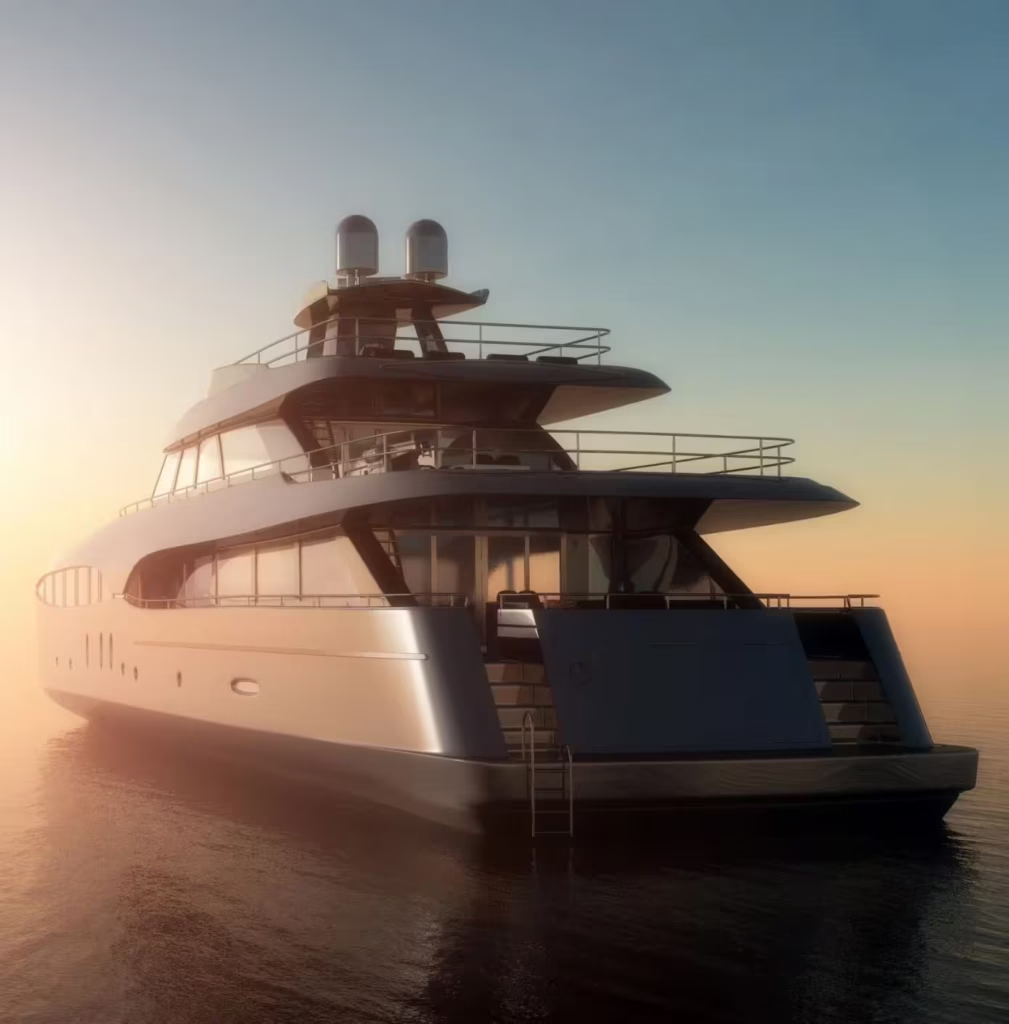
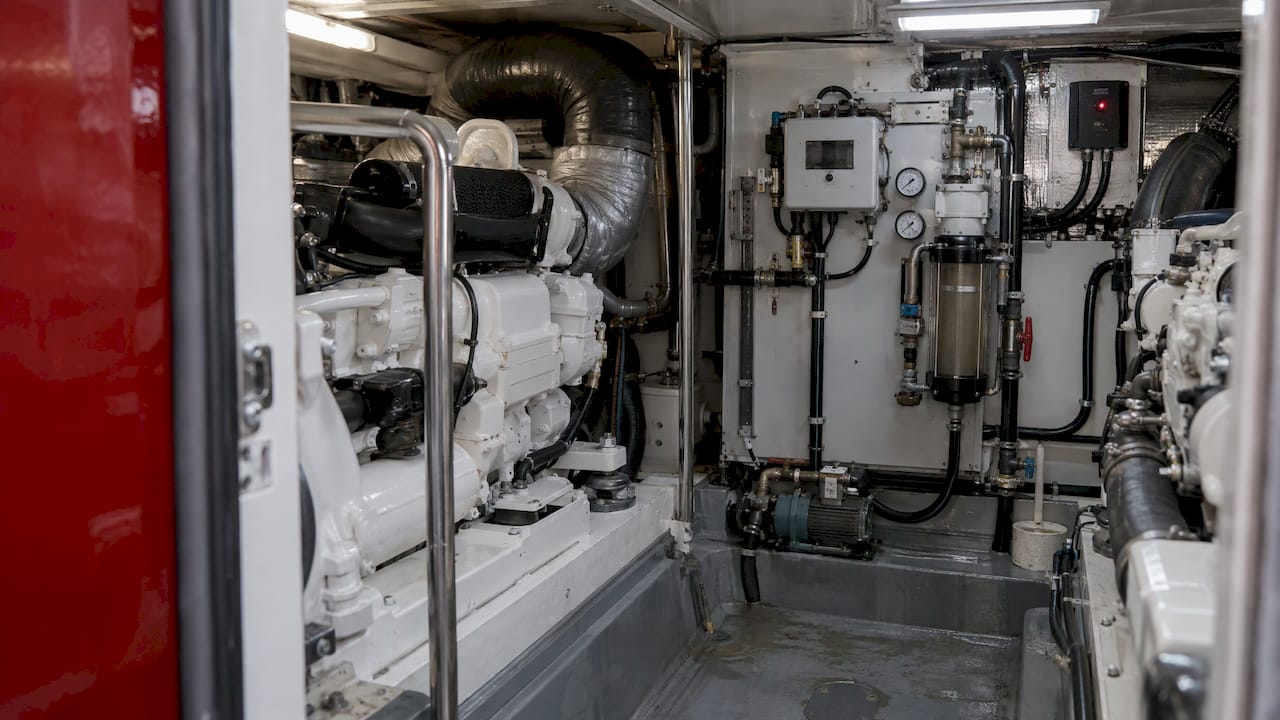
MARPOL applies to yachts, private and commercial, large and small. What changes with size is the paperwork. Yachts of 400 GT and above on international voyages need certificates and surveys. Smaller yachts, and yachts carrying 15 persons or fewer, still have to meet the operating rules, and your flag state decides how that compliance is proven. So the flag you register under shapes your MARPOL obligations from the first day. Vessel Flag prepares yacht registration applications under eight flags, and this guide sets out what owners, brokers and operators need to know before choosing one.
TL;DR
- MARPOL has six Annexes: oil (I), noxious liquids (II), packaged harmful substances (III), sewage (IV), garbage (V) and air pollution (VI). Four of them reach yachts in private and commercial service.
- The 400 GT threshold, and for sewage and garbage the “more than 15 persons” threshold, decides whether you need certificates, plans and record books.
- Under 400 GT you are not exempt: Annex VI and Annex V rules apply to all ships unless the text says otherwise, and flags ask for proof of compliance in their own way.
- Sewage: comminuted and disinfected discharge only beyond 3 nautical miles, untreated beyond 12, or through an approved treatment plant.
- Your flag state surveys, certifies and enforces, so the choice of flag is also a choice of how MARPOL compliance is evidenced.
Índice
- What MARPOL is and why it covers yachts
- The thresholds that decide what you need
- Annex I: oil
- Annex IV: sewage and the distance rules
- Annex V: garbage and plastics
- Annex VI: engines, fuel and air emissions
- Under 400 GT: how compliance is shown
- How your flag choice shapes MARPOL compliance
- A MARPOL checklist for a yacht owner
- Radio, MMSI and the rest of the paperwork
- How Vessel Flag can help
- Our view
- Preguntas frecuentes
- Fuentes
What MARPOL is and why it covers yachts
MARPOL is the International Convention for the Prevention of Pollution from Ships. The IMO describes it as the main international convention on pollution of the marine environment by ships from operational or accidental causes. It was adopted on 2 November 1973, modified by a 1978 Protocol, and the combined instrument has been in force since 2 October 1983. Annex VI on air pollution was added by a 1997 Protocol and entered into force on 19 May 2005.
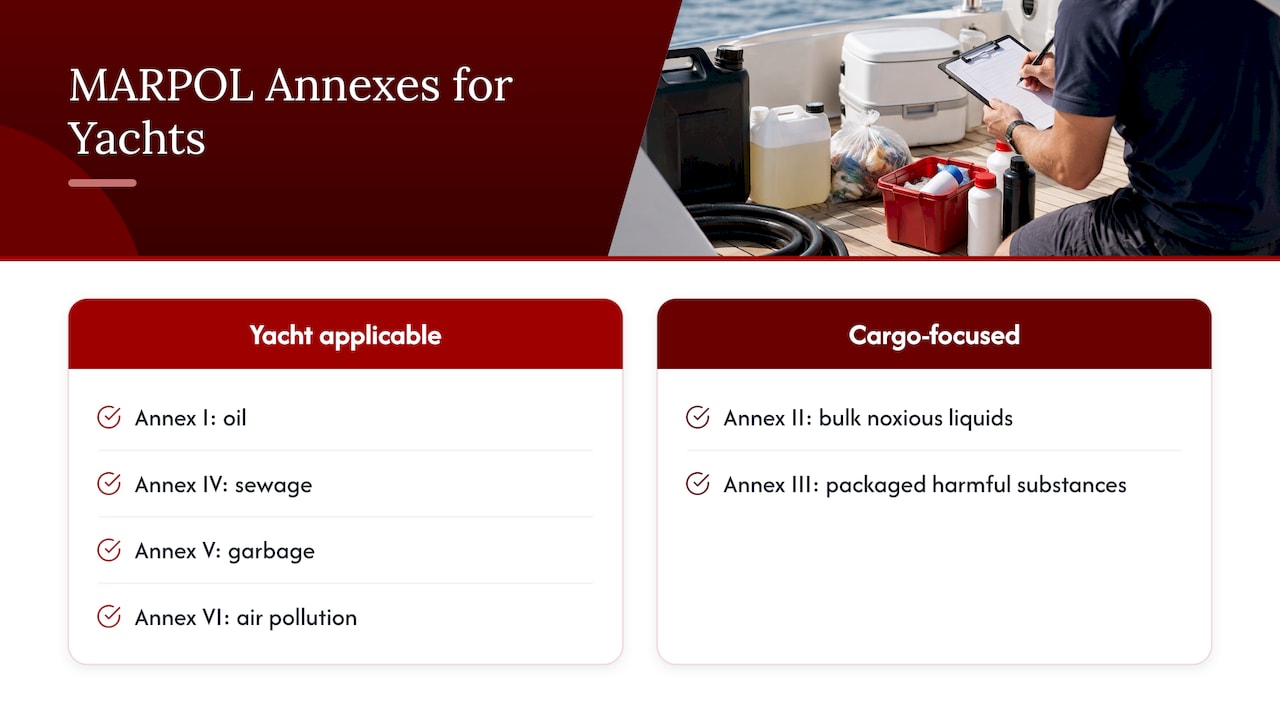
The word “ship” is wide in MARPOL. As RINA’s Paolo Moretti explains in Boat International, ships are vessels of any type operating in the marine environment, yachts included, and four of the six Annexes are applicable to yachts in private and commercial service. Those four are Annex I (oil), Annex IV (sewage), Annex V (garbage) and Annex VI (air pollution). Annex II (bulk noxious liquids) and Annex III (packaged harmful substances) are written around cargo, so they rarely matter on a yacht.
MARPOL is a convention, not a law you register under. Each state that has signed up turns it into national rules, and your flag state enforces those rules on your vessel wherever it sails. Port and coastal states can also inspect you. That is why the same yacht can face different paperwork depending on its flag.
The thresholds that decide what you need
Most of the confusion around yachts comes from three numbers: 400 GT, 15 persons and 130 kW.
| Annex | Subject | Where the main yacht thresholds sit |
|---|---|---|
| I | Oil | 400 GT and above on international voyages: oil pollution prevention certificate and emergency plan |
| IV | Sewage | 400 GT and above, or certified for more than 15 persons: approved treatment plant, comminuter and disinfecter, or holding tank |
| V | Garbage | Applies to all ships; garbage management plan and record book at 100 GT and above or 15 persons or more |
| VI | Air pollution | Applies to all ships; engine certification above 130 kW; fuel sulphur limits irrespective of tonnage |
En UK Maritime and Coastguard Agency guidance states that all commercial and private yachts must comply with MARPOL where it applies. For a UK-flagged yacht over 400 GT, that means an MCA-approved SOPEP (shipboard oil pollution emergency plan) under Annex I. Yachts over 400 GT or carrying 15 persons or more follow the UK’s marine guidance for Annexes IV and V, and yachts over 400 GT or with engine power over 130 kW follow separate guidance for Annex VI. Surveys and certification are delegated to recognised classification societies.
The 15-person test catches owners out. The Bahamas Maritime Authority’s Marine Notice 59 says explicitly that Annex IV covers private, non-commercial yachts, and that a yacht counts as carrying more than 15 persons when the total maximum number of persons on board exceeds 15. A 30 m charter yacht well under 400 GT can therefore still need approved sewage equipment if it is certified for a larger party.
Annex I: oil
Annex I governs oil from machinery spaces, bilges and fuel. On yachts of 400 GT and above engaged in international voyages, Moretti notes that an International Oil Pollution Prevention Certificate is required, valid for five years with annual, intermediate and renewal surveys. The same article notes that yachts delivered after 1 August 2010 with fuel tank capacity exceeding 30 cubic metres need double-hull protection under Annex I.
For owners, the practical questions are an oily-water separator and bilge alarm that work, an oil record book where required, and a SOPEP that matches the actual vessel. These are items surveyors check first. When you buy a used yacht, ask for the certificate history and survey dates before you commit to a flag, because a gap in surveys can delay registration under a flag that requires convention certificates.
Annex IV: sewage and the distance rules
The search question readers ask most often is how far from land a yacht can discharge sewage. The IMO’s amendments to Annex IV (MEPC.115(51)) set the rule in Regulation 11. Discharge into the sea is prohibited except in three cases:
- Comminuted and disinfected sewage, using an approved system, more than 3 nautical miles from the nearest land.
- Sewage that is not comminuted or disinfected, more than 12 nautical miles from the nearest land.
- Effluent from an approved sewage treatment plant that produces no visible floating solids and no discolouration of the surrounding water.
Sewage held in a tank must be discharged at a moderate rate while the ship is under way at not less than 4 knots, at a rate approved by the flag administration.
Who must comply? The IMO states that Annex IV applies to ships on international voyages of 400 GT and above, or certified to carry more than 15 persons. Those ships must have an approved sewage treatment plant, an approved comminuting and disinfecting system, or a holding tank.
Flags add their own detail. The Bahamas notice requires a yacht fitted with a comminuting and disinfecting system to also carry a holding tank for use within 3 nautical miles of land, and requires sewage sludge to go to shore reception facilities where available, be treated further on board, or be discharged at not less than 12 nautical miles from the nearest land. The IMO also records that since 1 January 2013 a sewage Special Area definition prohibits passenger ships from discharging sewage within a Special Area unless they use an approved plant meeting nitrogen and phosphorus removal standards. That provision is aimed at passenger ships, but charter operators near that size should know it exists.
Always check local rules where you cruise. Many harbours and marinas, and some national waters, apply stricter no-discharge rules than the convention minimum.
Annex V: garbage and plastics
Annex V is the one every yacht, however small, has to live with. The IMO’s garbage page confirms it applies to all ships operating in the marine environment, explicitly including pleasure craft and yachts. It imposes a complete ban on disposing of all forms of plastics into the sea. More than 150 countries have signed up, and it entered into force on 31 December 1988.
The paperwork depends on size and use. A Garbage Management Plan is required on ships of 100 GT and above and ships certified to carry 15 persons or more. A Garbage Record Book is required on ships of 100 GT and above, and on ships certified for 15 persons or more that make voyages to ports or offshore terminals under another party’s jurisdiction. Entries must give the date, time, position, description and estimated amount of garbage incinerated or discharged, and the book is kept for two years after the last entry.
The IMO adds a practical point: a well-kept Garbage Record Book can help a ship avoid being wrongly penalised when local officials trace the origin of discharged garbage, provided the crew can account for all of its garbage. If your yacht falls below the thresholds, keeping a simple log is still a sensible habit for a vessel that charters or crosses borders.
Annex VI: engines, fuel and air emissions
Annex VI is where smaller yachts are most often caught out, because it does not wait for 400 GT. RINA’s MARPOL guidance explains that Annex VI applies to all ships unless the text expressly provides otherwise, so even a yacht that does not need an IAPP certificate because of its tonnage must still comply with the regulations. It also notes that MARPOL amendments are often retroactive, depending on the keel-laying date.
En Marshall Islands flag guidance (MN-2-013-8), updated in September 2025, sets out the main points for yachts:
- Annex VI Chapter 3 applies to vessels of any type in the marine environment, yachts included.
- Each marine diesel engine over 130 kW installed or majorly converted on or after 1 January 2000 must be surveyed and certified under the NOx Technical Code 2008, irrespective of tonnage.
- NOx Tier III does not apply to recreational yachts under 24 m, nor to those over 24 m but under 500 GT constructed before 1 January 2021.
- Fuel oil used or carried on any ship, irrespective of tonnage, must not exceed 0.50% sulphur by mass globally, or 0.10% within a SOx Emission Control Area.
Moretti’s article confirms that the global sulphur cap was cut to 0.5% from 1 January 2020. For a yacht, this mostly means buying compliant marine diesel and keeping bunker delivery notes.
For yachts of 400 GT and above, the Cook Islands Large Yacht Code lists the full set: an International Air Pollution Prevention Certificate with an ODS Record Book, a SEEMP (ship energy efficiency management plan), and a technical file plus Engine IAPP for each marine diesel engine of 130 kW or more.
What is changing
The IMO’s list of upcoming and recent amendments shows two items relevant to yacht planning. MEPC.384(81) amendments to MARPOL Protocol I entered into force on 1 January 2026, and MEPC.392(82), designating the Canadian Arctic and Norwegian Sea as Emission Control Areas, entered into force on 1 March 2026. Bureau Veritas’ statutory brochure explains that the 0.10% sulphur limit in those two areas takes effect on 1 March 2027 for new and existing ships. If your itinerary includes high-latitude cruising, plan fuel purchases for that date. The IMO’s consolidated MARPOL edition page lists the supplements that carry each amendment, which is the reference to use for the current text.
Under 400 GT: how compliance is shown
Most private yachts and many charter yachts sit under 400 GT, so this is the situation most readers are in. There is no single answer, because convention certificates are mandatory only above the thresholds and flags fill the gap with their own equivalents.
The Cook Islands code states the approach clearly: standards come from the relevant international conventions, or from equivalent standards where direct compliance is not reasonable or practicable for non-convention yachts. Australia takes a similar route. Its national annex to the yacht code says that for vessels under 400 GT where MARPOL certification is not required, a Statement of Compliance from a recognised organisation is acceptable proof, or the owner may request full MARPOL certification.
What this means in practice:
- Know your numbers. Gross tonnage, maximum persons on board, engine kilowatts, fuel tank capacity and year of build decide which rules bite.
- Ask your flag what it accepts. Some flags want a class or recognised organisation statement, some accept a builder’s declaration, some rely on the survey done for registration.
- Keep the evidence together. Engine NOx documents, sewage equipment approvals, fuel delivery notes and any garbage log are what inspectors ask for.
- Consider the future buyer. Complete MARPOL documentation helps resale and charter licensing.
How your flag choice shapes MARPOL compliance
The flag is where the convention becomes a checklist. For a yacht under 24 m in private use, the practical load can be light. For a commercial yacht of 24 m or more, flag codes and surveys carry substantially more. The right flag is the one whose requirements fit how you use the yacht: private or charter, size, cruising area and where you want to be able to trade.
Vessel Flag works across Poland, San Marino, UK Part 1, Malta, Palau, the Marshall Islands, the Cayman Islands and the Cook Islands, so the comparison is built from experience of how each registry handles documents. Our published prices give the starting point for each:
| Bandera | Precio de Vessel Flag |
|---|---|
| San Marino | from €290, one-off |
| Polonia | from €320, one-off |
| Reino Unido, 1.ª parte | from €550, one-off |
| Palau | from €700, one-off |
| Malta (private yachts under 24 m) | service fee from €1,749, plus Transport Malta fees |
| Islas Marshall | €250 service fee plus registry fees |
| Islas Caimán | €450 service fee plus registry fees |
| Islas Cook | quoted per yacht |
The Poland, San Marino and UK Part 1 prices are the ones most private owners compare first. For UK Part 1, owners can register personally if eligible, through an existing company (UK or eligible foreign, such as a Delaware corporation), or through a new UK LTD. A UK company is not always required. The company route matters for liability and for how the yacht is held, and Vessel Flag also arranges company formation for yacht ownership when you need it.
Our wider guide to international maritime regulations affecting documentation explains how conventions feed into registration paperwork, and the section on flag state selection and its impact covers choosing between registries.
A MARPOL checklist for a yacht owner
- Confirm gross tonnage, maximum persons on board and each engine’s power output.
- Work out which Annexes apply: I, IV, V and VI for most yachts.
- Check whether your flag requires certificates (400 GT and above) or an equivalent statement (below 400 GT).
- Inspect sewage equipment: is it an approved treatment plant, a comminuter and disinfecter with a holding tank, or a holding tank alone?
- Check engines above 130 kW for NOx documentation and fuel supplies for the 0.50% and 0.10% sulphur limits.
- Set up a garbage log and a plastics ban on board, and keep records for at least two years.
- Brief the crew on discharge distances and local no-discharge areas before each passage.
- Diarise survey dates for any certificates you hold.
Radio, MMSI and the rest of the paperwork
MARPOL sits alongside the other documents an inspector may ask for: registry certificate, radio licence and MMSI, insurance and ownership evidence. Vessel Flag arranges MMSI numbers and ship radio licences: the Polish licence is €149, the UK licence is €150 and the San Marino licence is €200, each VAT included with no annual fees. The UK MMSI licence takes 1 day, and the Polish one takes 4 to 6 weeks after registration. Having these in order before your first port call avoids avoidable questions alongside any MARPOL check.
How Vessel Flag can help
Vessel Flag is a private consultancy that prepares and files yacht registration applications. We are not a registry or a government body, and certificates are issued by the flag registry. What we do is remove the paperwork load: choose the flag that suits how you use the yacht, assemble the application, file it remotely and, where you need it, set up the ownership company and radio licence around it. Poland provisional papers take 2 to 5 days, and San Marino provisional certificates take 2 to 6 days, not guaranteed.
If you are choosing a flag and want your MARPOL position clear from the start, see the Polonia, San Marino o Reino Unido, 1.ª parte registration pages, or book a consultation and tell us the yacht’s size, use and cruising area.
Our view
We see MARPOL discussed as if it were a large-yacht problem. It is not. The convention reaches every ship, and what separates a 15 m private yacht from a 60 m charter yacht is how compliance is shown, not whether it applies.
That is why we treat flag choice as the first compliance decision. The registry you choose decides whether you hold convention certificates or an equivalent statement, who surveys the yacht and how documents are kept. Owners who pick a flag on price alone sometimes find the paperwork does not match how they use the boat.
Our published one-off prices, fully remote process and experience across eight flags exist so that owners can compare registries on the facts. We prepare and file the application, and the registry issues the certificate. Where a yacht needs a company, an MMSI or a transfer between flags, we handle those alongside, so the documents agree with each other.
VesselFlag
Preguntas frecuentes
Does MARPOL apply to private yachts?
Yes. The IMO states that Annex V covers all ships of any type, including pleasure craft and yachts, and RINA confirms Annex VI applies to all ships unless the text says otherwise. Certificates and record books depend on tonnage and persons on board, but the underlying rules apply to private yachts too.
How far from land can a yacht discharge sewage?
Comminuted and disinfected sewage from an approved system may be discharged more than 3 nautical miles from land, and untreated sewage more than 12 nautical miles. An approved treatment plant with clean effluent is also permitted. Local and flag-state rules may be stricter, and Annex IV applies formally to ships of 400 GT and above or certified for more than 15 persons.
Do I need a MARPOL certificate for a yacht under 400 GT?
Convention certificates are generally required at 400 GT and above on international voyages. Below that, flags set their own requirements: for example, Australia accepts a recognised organisation’s Statement of Compliance, and the Cook Islands code applies equivalent standards. Ask your flag registry which evidence it accepts.
What are the fuel sulphur limits for yachts?
Fuel used or carried on any ship must not exceed 0.50% sulphur globally and 0.10% inside a SOx Emission Control Area, according to the Marshall Islands flag guidance. The Canadian Arctic and Norwegian Sea areas apply the 0.10% limit from 1 March 2027.
Can Vessel Flag issue my MARPOL or registration certificates?
No. Vessel Flag prepares and files registration applications as a consultancy, and certificates are issued by the flag registry. We can also arrange your MMSI and radio licence, and book a consultation will tell you which flag fits your yacht.
Fuentes
- IMO: International Convention for the Prevention of Pollution from Ships (MARPOL)
- Boat International: MARPOL environment protection regulations for yachts
- UK MCA: complying with MARPOL annexes
- Bahamas Maritime Authority: MARPOL Annex IV, Marine Notice 59
- IMO: Resolution MEPC.115(51)
- IMO: Prevention of pollution by sewage from ships
- IMO: Prevention of pollution by garbage from ships
- RINA: MARPOL
- Marshall Islands: MN-2-013-8
- Cook Islands Large Yacht Code
- IMO: amendments to IMO instruments
- Bureau Veritas: IMO statutory brochure 2025-2026
- IMO e-Publications: MARPOL consolidated edition
- AMSA: Australian National Annex to the Yacht Code
VesselFlag is a private consultancy that prepares and files yacht registration applications for owners. We are not a government body or flag registry; certificates are issued by the relevant registry. This article is general information, not legal advice.