
Yes, you can reclassify a private yacht as a commercial vessel, and the process runs through three core stages: registry changeover, technical surveys, and certification. You will need to work with your flag administration, a Recognised Organization or Appointed Government Surveyor, and typically an agent to secure your Certificate of Compliance to Trade. Specialized agents handle this coordination daily across multiple flag jurisdictions.
En resumen:
- Converting a yacht to commercial use requires confirming eligibility based on size and passenger limits, and may involve different thresholds depending on the flag jurisdiction.
- The process involves working with a recognized organization or surveyor to conduct or verify structural and safety surveys, which can be accepted via declarations if current.
- Obtaining a Certificate of Compliance to Trade and updating documentation, insurance, and radio licenses are critical steps, with provisional registration available to start limited operations early.
- Full certification typically takes several weeks, with costs varying depending on vessel complexity, survey status, and flag requirements, alongside ongoing annual or five-year renewal cycles.
- Employing an experienced registration agent speeds the process by coordinating paperwork, surveys, and licensing, especially when switching flags or handling complex vessel tonnage.
Índice
- What Are the Steps to Convert a Yacht to Commercial Use?
- What Documents and Certificates Does a Commercial Conversion Require?
- How Do Surveys and Recognised Organizations Work?
- How Long Does It Take and What Does It Cost?
- What Ongoing Compliance Does a Commercial Yacht Need?
- Why Working With a Registration Agent Changes the Math
- Get Your Yacht Commercially Registered Without the Runaround
- Sources
- Preguntas frecuentes
What Are the Steps to Convert a Yacht to Commercial Use?
Converting a yacht to commercial status follows a predictable sequence, but skipping a step almost always costs you time later. Here’s the order that actually works.
- Confirm eligibility first. Check your yacht’s length, passenger capacity, and prior commercial history against your target flag’s code. Malta’s Commercial Yacht Code, for instance, generally applies to yachts over 15 meters carrying no more than 12 passengers, though thresholds vary by jurisdiction and code version, as Transport Malta’s synopsis details.
- Contact a registry representative or agent. Request the changeover formally and ask what documentation your specific flag state requires. Requirements differ enough between registries that generic checklists found online often miss jurisdiction-specific quirks.
- Schedule or verify surveys. If your surveys and certificates are current, some registries will accept a surveyor’s declaration instead of a fresh inspection. If anything has lapsed, you will need to book an initial survey.
- Assemble your documentation packet. Bill of sale, tonnage certificate, ownership declarations, and proof of insurance all need to be ready before submission, not gathered piecemeal afterward.
- Apply for provisional registration if your flag state offers it. This lets you begin limited commercial operations while the full certification process finishes.
- Receive your Certificate of Compliance to Trade and statutory certificates. Update your onboard paperwork, insurance policy, and MMSI registration to reflect commercial status.
Consejo de experto: Start the insurance conversation before you start the paperwork. Commercial policies underwrite differently than pleasure craft coverage, and insurers sometimes want survey results in hand before quoting, which can add a week you didn’t budget for.
If you want a fuller walkthrough of what registries check at each stage, this guide to converting a yacht from pleasure to commercial status breaks down the registry-specific checks in more depth.
What Documents and Certificates Does a Commercial Conversion Require?
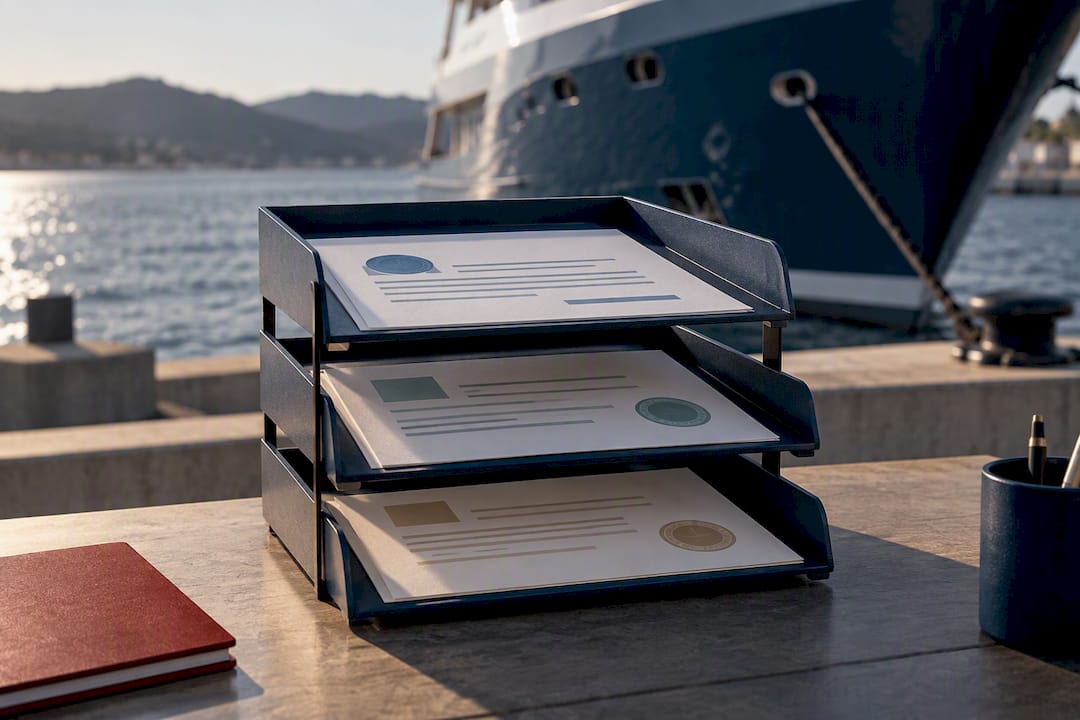
Every registry wants proof of who owns the vessel, what it weighs, and what it’s rated to carry, before it will even open a commercial file.
Your application packet typically includes:
- Bill of sale and proof of ownership, showing clear title with no encumbrances.
- Builder’s certificate or equivalent, particularly for older vessels without a clean paper trail.
- Tonnage certificate, since commercial fees and safety requirements often scale with gross tonnage.
- MARPOL, AFS, and BWM certificates where applicable, depending on vessel size and the waters it will operate in.
- Radio and MMSI licensing, updated to reflect commercial status rather than private use.
- A commercial insurance policy, replacing pleasure craft coverage, since insurers treat charter liability very differently from private use.
Once issued, your Certificate of Compliance to Trade and related statutory certificates need to stay onboard under the master’s responsibility, and the prior Certificate of Registry is typically withdrawn and returned to the administration once the new one arrives, according to Fenech Law’s changeover guidelines. Keep certificates organized in a dedicated onboard folder. Port state control inspectors will ask for them, and fumbling through loose paperwork during a boarding is a bad look for a vessel operating commercially. For a broader documentation reference, see this yacht documentation compliance guide.
How Do Surveys and Recognised Organizations Work?
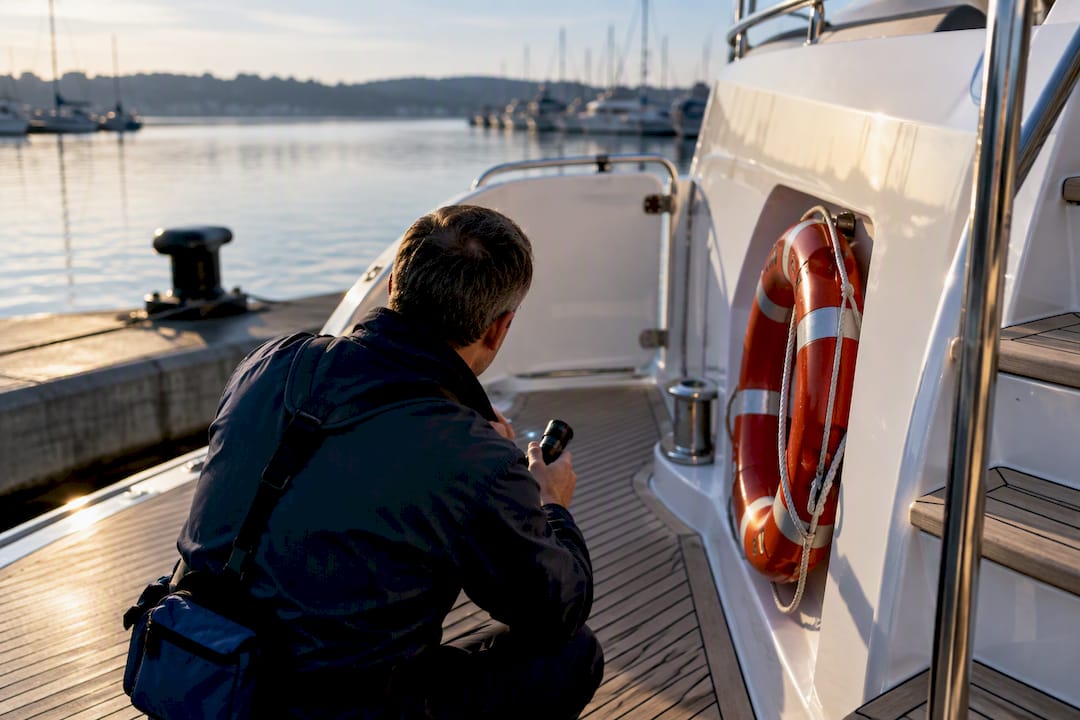
Flag administrations rarely run surveys themselves. They delegate that technical work to Recognised Organizations or Appointed Government Surveyors, who inspect the vessel and report findings the registry then relies on to issue certification, per Fenech Law’s guidance.
An initial survey is more thorough than the intermediate or annual surveys that follow once you’re operating commercially. It checks structural condition, safety equipment, and systems against the applicable code, not just whether things still work but whether they meet commercial thresholds.
- If your surveys and certificates are current, some registries accept a declaration from your RO or Appointed Surveyor in place of a full onboard inspection, according to Transport Malta’s small commercial yacht code.
- If anything is overdue, expect a physical attendance requirement before certification proceeds.
- Surveyors typically issue reports directly to the flag administration, not just to the owner, so the registry has its own documentation trail.
Consejo de experto: Have your survey scope and any corrective-action plan ready before the surveyor arrives. A well-prepared report speeds registry approval; a vague one generates follow-up queries that can stall your certificate by weeks.
How Long Does It Take and What Does It Cost?
Timelines vary more than most owners expect, largely because they depend on how current your existing surveys are and how quickly your registry processes paperwork.
Provisional registration, where offered, typically lets you begin limited commercial operations while outstanding surveys or formalities get finished. Malta’s Commercial Yacht Code, for example, describes provisional periods that usually last several months and may be extended if needed, per Transport Malta. Some flag states also run temporary programs, such as the Cayman Islands’ Yacht Engaged in Trade scheme, which permits limited chartering days under strict customs and VAT conditions, according to the YET program guidance.
- Full CoC issuance after satisfactory surveys typically takes several weeks, though complex tonnage cases run longer.
- Registries may apply an adjustment fee for changeovers and sometimes treat multiple changeovers within one year differently than a first-time application.
- Plan charter bookings around your survey window, not the other way around. A confirmed charter with an incomplete certificate is a problem nobody wants.
What Ongoing Compliance Does a Commercial Yacht Need?
Getting certified is the easy part. Staying certified is where owners get caught out.
Renewal cadence depends on your code and vessel size, but most commercial yachts operate on annual and intermediate survey cycles, with a full renewal around every five years. Miss a survey window and your certificate can lapse, which grounds your charter business until it’s resolved.
- Manning requirements shift once you’re commercial. Crew certification standards that didn’t apply under private use now do, and you need to document qualifications clearly.
- Statutory certificates must stay current onboard, with expired paperwork being one of the fastest ways to trigger a Port State Control detention.
- Major repairs, tonnage changes, or a change of use can all trigger additional surveys outside the normal cycle.
- Record retention matters more than owners assume. Inspectors move faster when your survey history and certificate trail are complete and organized.
A yacht that skips an intermediate survey doesn’t just risk a fine. It risks a certificate suspension that can shut down bookings mid-season, which is a far more expensive problem than the survey fee itself.
Why Working With a Registration Agent Changes the Math
Owners ask us why they can’t just handle changeover themselves. Sometimes you can, particularly if you own a straightforward vessel with current surveys and a single registry relationship. But once tonnage gets complicated, or you’re switching flags more than once, the coordination between ROs, surveyors, and flag administrations becomes a full-time job nobody budgeted for.
An agent who works these registries daily can arrange provisional registration faster and catch documentation gaps before a registry does. That’s not a sales pitch, it’s how the paperwork actually moves. We’ve seen owners lose charter weeks over a missing tonnage certificate that a second set of eyes would have flagged in an afternoon.
— Vessel Flag
Get Your Yacht Commercially Registered Without the Runaround
Agents handle the parts of this process that eat the most time: registry changeover paperwork, survey coordination with ROs, MMSI and radio licensing, and corporate setup for ownership structures. Working across multiple flag jurisdictions daily can often move provisional registration faster than an owner working a single registry cold for the first time.
For yachts headed toward commercial charter, Registro de yates en Malta is one of the most established routes, with MMSI applications handled as part of the same package. If your vessel fits a different jurisdiction better, our flag registration overview walks through the options, including Poland, the UK, and Langkawi. Insurance introductions and yacht transportation are also available through our services page if you need the full package assembled around your changeover. Reach out with your vessel’s tonnage and current flag, and we’ll tell you exactly what your changeover will require.
Sources
- Private-Commercial Yacht Changeover Guidelines (Fenech Law)
- Commercial Yacht Code synopsis (Transport Malta)
- sCYC 2024 (Transport Malta small commercial yacht code)
Preguntas frecuentes
Can Any Private Yacht Be Converted to Commercial Status?
Most yachts can convert, but eligibility depends on length, passenger capacity, and prior certification history under your target flag’s code. Commercial Yacht Codes commonly apply to vessels over 15 meters carrying up to 12 passengers, though exact thresholds vary by registry.
How Long Does the License for Commercial Yacht Status Take?
Timelines depend heavily on whether your surveys are current. Provisional registration can let you begin operating within weeks in some jurisdictions, while a full Certificate of Compliance to Trade may take longer if surveys or documentation need attention.
Do I Need a New Survey if My Yacht Was Recently Inspected?
Not always. Some registries accept a declaration from your Recognised Organization or Appointed Surveyor instead of a new inspection, provided no surveys or certificates are overdue, according to Transport Malta’s sCYC code.
Does Converting to Commercial Status Affect My Insurance?
Yes, significantly. Pleasure craft policies don’t cover commercial charter liability, so you’ll need a dedicated commercial policy before your first paying charter, ideally arranged alongside your survey and certification timeline.
Can Vesselflag Handle the Entire Conversion Process?
Vesselflag coordinates registry changeover, survey scheduling with ROs, MMSI licensing, and corporate setup across flag jurisdictions including Malta, Poland, and the UK. Pricing depends on the flag chosen. Malta Yacht Registration typically runs within a range of several hundred to a few thousand euros as a one-time fee, with current rates listed on each flag’s service page.