

TL;DR:
- Your vessel’s flag determines its charter eligibility, survey obligations, and insurance acceptance, influencing operational efficiency. Choosing a White List flag like Cayman or Malta reduces port inspections and streamlines financing, while a poor compliance record increases disruption risks. Proper registration and ownership structure are essential for smooth international charter operations and lender approval.
Your flag state determines far more than where your vessel is registered. It controls your charter eligibility, survey obligations, insurance acceptance, mortgage framework, crew certification rules, and VAT treatment — all at once. The right flag jurisdiction reduces port-state inspections, smooths charter operations, and gives lenders and insurers the confidence they need to move quickly. The wrong one creates friction at every turn.
Before you go further, run through this short checklist:
- Paris MoU White List status: Confirm your target flag appears on the Paris MoU White List — the baseline for EU, North Atlantic, and Mediterranean cruising.
- Charter permission rules: Verify whether the flag allows commercial charter, and under what scheme (Yacht Engaged in Trade, Temporary Admission, or full commercial categorization).
- Mortgage and finance friendliness: Check that your preferred lender recognizes the flag’s ship mortgage law.
- VAT interaction: Understand how the flag’s home jurisdiction interacts with EU VAT rules if you plan to charter in European waters.
- Ownership structure alignment: Decide whether a Special Purpose Vehicle (SPV) is needed before purchase, not after.
TL;DR next steps: Confirm your intended cruising grounds and charter model, verify the flag’s White List status and charter regime, align your ownership structure, and consult a registration specialist before you sign a purchase contract.
Índice
- What a flag state is and the legal authority it creates
- Why flag choice matters specifically for charter operations
- How different registry categories compare on key trade-offs
- Leading jurisdictions used for charter yachts and what each is typically chosen for
- How registration works for U.S. owners: documents, timelines, and costs
- How flag jurisdiction changes day-to-day charter operations
- How to choose the right flag for a charter vessel
- How Vesselflag implements the registration process in practice
- Principales conclusiones
- Flag choice is a structuring decision, not paperwork
- Vesselflag’s registration services for charter vessel owners
- Useful sources and recommended further reading
- PREGUNTAS FRECUENTES
What a flag state is and the legal authority it creates
A vessel’s flag is its nationality. The flag state is the country whose laws govern that vessel wherever it sails, covering safety standards, certification, crew requirements, and the legal framework for mortgages and disputes. This is not a technicality. As NOAA explains, jurisdiction over vessels at sea flows primarily from the flag state, not from the owner’s home country or the port the vessel happens to be visiting.
Under the United Nations Convention on the Law of the Sea (UNCLOS), the flag state bears primary responsibility for ensuring its registered vessels comply with international conventions, including SOLAS, MARPOL, and the Maritime Labour Convention. That means the flag state sets the survey cycle, issues the certificates, and is ultimately accountable when a vessel is boarded. Port-state control — enforced through regional bodies like the Paris MoU — supplements that oversight by inspecting visiting ships in foreign ports, but the flag state remains the first line of authority.
Three institutional names matter throughout this article. The Paris MoU is the regional port-state control agreement covering European and North Atlantic waters; its White List identifies flags with strong compliance records. The Red Ensign Group (REG) is the family of British Overseas Territory and Crown Dependency registries — including Cayman Islands, Isle of Man, and Gibraltar — that share UK maritime law standards. The IMO sets the international conventions that flag states are expected to enforce.
A practical example: if a lender wants to register a mortgage on your vessel, the mortgage must be recognized under the flag state’s ship mortgage law. If your flag state has no recognized mortgage statute, the lender has no enforceable security — and the deal does not close.
Why flag choice matters specifically for charter operations
Charter operations add a layer of complexity that private ownership does not face. The flag state determines whether your vessel can legally carry paying guests, under what conditions, and with what documentation. Get this wrong and you are not just facing a fine — you are facing an uninsured vessel operating outside its permitted category.
Here is where flag jurisdiction directly shapes charter economics:
- Charter eligibility: Many flags distinguish sharply between private and commercial categories. A vessel registered as a private yacht cannot legally charter without either a category change or a specific scheme (like the Cayman YET or Bahamas Temporary Admission). The commercial vessel registration path unlocks charter income but triggers additional survey and certification requirements.
- Insurance acceptance: Insurers maintain approved-flag lists. A White List flag signals predictable survey standards and legal frameworks, which translates to smoother underwriting and, often, better premium terms. Non-White-List flags can attract loading or outright refusal from major marine underwriters.
- Mortgage and finance: Lenders financing superyachts require a recognized ship mortgage. REG flags and major offshore registries provide well-established mortgage statutes that international banks accept. Domestic U.S. USCG documentation also provides a recognized preferred ship mortgage, but with constraints discussed later.
- Port-state control frequency: White List flags face fewer targeted inspections under Paris MoU protocols. A vessel flying a flag with a poor compliance record gets boarded more often, which disrupts charter schedules and creates reputational risk with charter clients.
- Resale and charter placement: Charter brokers and buyers notice the flag. A vessel on a recognized, reputable registry moves faster at sale and commands better charter placement because the due-diligence process is shorter.
En maritime flag role in luxury yacht charters is not abstract — it shows up in every contract, every insurance renewal, and every port call.
How different registry categories compare on key trade-offs
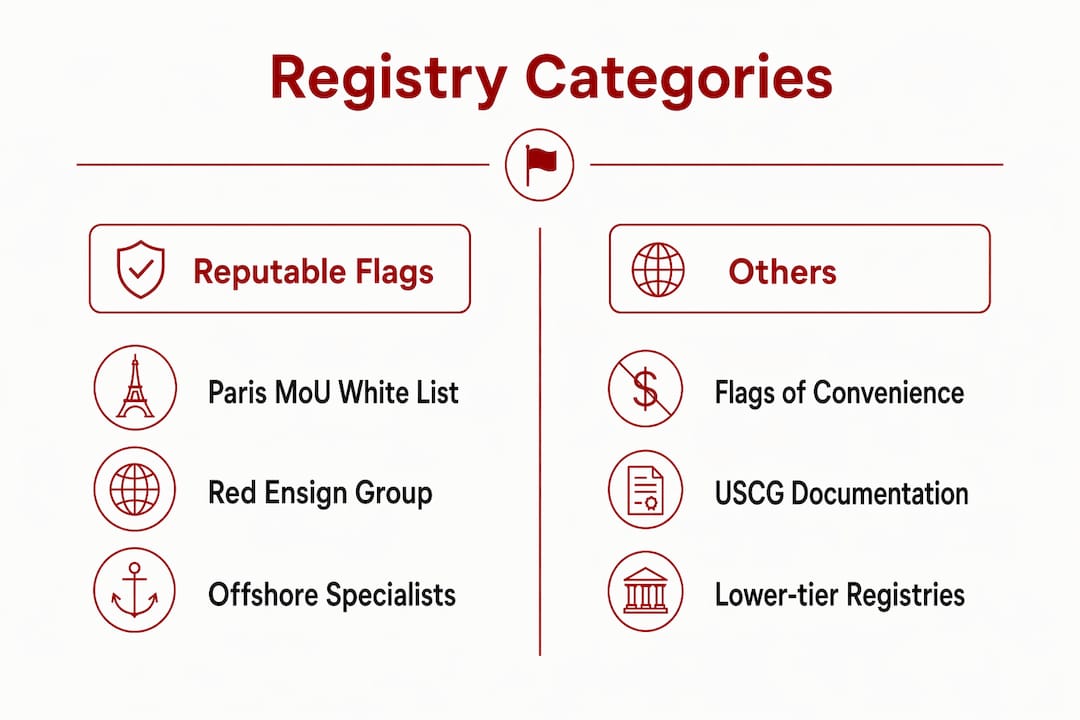
Not all registries are built the same, and the differences matter operationally. There are four broad categories to understand.

Paris MoU White List / reputable offshore registries are the gold standard for charter-capable vessels. These flags have demonstrated strong compliance records under port-state control audits. Vessels flying them face fewer targeted inspections in European and North Atlantic ports, which means fewer disruptions to charter itineraries. Insurers and lenders treat them as low-risk, which reduces friction at every transaction point.
Red Ensign Group (REG) flags — Cayman Islands, Isle of Man, Gibraltar, Bermuda, and others — operate under UK maritime law and share the legal infrastructure of a G7 jurisdiction. Mortgage law is well-established, dispute resolution is predictable, and the REG brand carries weight with insurers and charter brokers globally. Most REG flags appear on the Paris MoU White List, providing owners reputational and operational benefits.
Offshore specialist yacht registries like the Marshall Islands and Malta are engineered specifically for the complexity of superyacht ownership and charter. They offer flexible ownership structures, recognized mortgage law, and charter-permission frameworks. Malta adds EU membership, which creates specific VAT and fiscal scheme advantages for charter operations in European waters.
Flags of convenience can look attractive on paper because registration fees are low. In practice, lower-tier registries often attract higher insurance premiums, more frequent PSC boardings, and reputational friction that charter brokers and clients notice. The fee savings rarely survive contact with the real operating costs. For a deeper look at the risks, the flag of convenience meaning is worth understanding before ruling anything in or out.
U.S. flag (USCG documentation) is the right choice for vessels operating exclusively in U.S. domestic waters under the Jones Act. The Jones Act restricts coastwise trade — carrying passengers or cargo between U.S. ports — to U.S.-flagged, U.S.-built, and U.S.-crewed vessels. A foreign-flagged charter vessel cannot legally operate point-to-point charters between U.S. ports. However, USCG documentation does provide a recognized Preferred Ship Mortgage, which some U.S. lenders prefer. The trade-off is that USCG-documented vessels face more constraints on international charter operations and carry higher crew-certification costs.
Pro Tip: The Jones Act distinction is the single most common trap for U.S.-based owners. If your charter plan involves any domestic point-to-point itineraries — say, Miami to Key West with paying guests — you need U.S. flag and U.S. build. If your plan is international or “charter-in, charter-out” from a foreign port, an offshore flag almost always serves you better.
Leading jurisdictions used for charter yachts and what each is typically chosen for
Each of the major charter-flag jurisdictions has a distinct profile. Here is what actually drives owners toward each one.
-
Cayman Islands: The most popular flag for large private and charter yachts globally. Cayman is a Red Ensign Group member, Paris MoU White Listed, and offers the Yacht Engaged in Trade (YET) scheme, which allows a privately registered vessel to charter in certain EU waters for limited periods without full commercial re-categorization. Mortgage law is robust, lender acceptance is near-universal, and the registry’s administrative infrastructure is purpose-built for superyachts. Timeline for registration can be relatively quick for straightforward cases.
-
Isle of Man: Another REG flag with strong White List standing and a well-regarded survey regime. Isle of Man is often chosen by owners who want a European-adjacent jurisdiction with transparent ownership disclosure and solid mortgage law. It is particularly favored when the ownership structure involves UK or European entities. Charter permissions are available but require the vessel to meet commercial survey standards.
-
Malta: Malta’s EU membership is the differentiator. Owners chartering in EU waters can access Malta’s VAT leasing scheme and tonnage-based fiscal arrangements, which can materially reduce the effective VAT cost on the vessel and on charter income. Malta is Paris MoU White Listed and has a recognized mortgage statute. It is the flag of choice when EU charter economics are the primary driver, and Vesselflag handles Malta registration as part of its core offering.
-
Marshall Islands (RMI): The Marshall Islands registry is notably large and popular among U.S. owners. RMI-registered private yachts receive an automatic cruising permit for U.S. territorial waters, and private registration allows limited chartering under specific constraints. RMI is Paris MoU White Listed, has a recognized mortgage statute, and the registry’s U.S.-based administrative office makes communication straightforward for American owners. It is the most practical offshore flag for owners who split time between U.S. and international waters.
-
Bahamas: A well-established charter flag with a long track record in the Caribbean and Atlantic. The Bahamas offers a Temporary Admission (TA) scheme for EU charter, is Paris MoU White Listed, and has competitive registration costs relative to Cayman. It is a strong choice for owners whose primary charter market is the Caribbean, Bahamas, and U.S. East Coast, and who want a recognized flag without the premium cost of Cayman registration.
-
United States (USCG): As noted above, USCG documentation is the only path for vessels that must comply with Jones Act coastwise trade requirements. The Preferred Ship Mortgage is well-recognized by U.S. lenders. The constraints are significant: U.S. build requirement for coastwise trade, higher crew costs, and limited flexibility for international charter operations. For owners whose entire operation is domestic, it is the correct choice. For anyone with international ambitions, an offshore flag almost always wins on operational flexibility.
En examples of flag registries across these jurisdictions show how much the right match depends on your specific cruising plan and charter model.
How registration works for U.S. owners: documents, timelines, and costs
The paperwork for a charter-capable registration is more involved than a simple private registration. Here is what the process typically requires.
Core documents checklist
| Document | Notes |
|---|---|
| Proof of title / bill of sale | Certified copy; must show clean chain of title |
| Builder’s certificate or deletion certificate | Required if vessel was previously registered elsewhere |
| Proof of ownership vehicle | SPV incorporation documents if using a corporate owner |
| Completed registry application forms | Flag-specific; varies by jurisdiction |
| Safety certificates (SOLAS, Load Line, etc.) | Required for commercial/charter category |
| Tonnage measurement certificate | Issued by a recognized classification society |
| Radio license / MMSI assignment | Required before departure |
| Crew certification documentation | Flag-specific; STCW compliance for commercial vessels |
Ownership structure and the SPV question
Most owners of charter-capable yachts use a Special Purpose Vehicle to hold the vessel. The SPV separates the flag state (which governs safety and operations) from the ownership jurisdiction (which governs tax, VAT, and legal liability). This dual-layer structure is standard practice among experienced advisers because it lets you optimize charter economics and lender acceptance independently. A Cayman-flagged vessel owned by a BVI company, for example, gets Cayman’s operational and survey benefits while the BVI entity handles ownership privacy and tax efficiency. Choosing the right yacht ownership structure before purchase is far cheaper than restructuring after the fact.
Typical timeline
| Stage | Typical Duration |
|---|---|
| Pre-check and flag selection | a few days |
| SPV incorporation (if needed) | about one to two weeks |
| Document collection and preparation | typically one to two weeks |
| Registry submission and review | varies by flag but can take several weeks |
| Survey coordination and inspection | timing depends on vessel location and availability |
| Certificate issuance typically follows survey clearance within several days | |
| Charter license or YET endorsement may require some additional time for processing |
Main cost drivers
Registry fees vary significantly by flag and vessel size. Survey and classification costs depend on the vessel’s age, condition, and whether it is converting from private to commercial category. Annual compliance costs — renewal fees, survey cycles, and agent fees — add up over time and should be modeled before flag selection. VAT and leasing structures, particularly for EU-flagged or EU-operating vessels, can dwarf the registry fees themselves. Working with a specialist who handles the step-by-step registration process reduces errors that trigger re-surveys or delayed certificate issuance.
How flag jurisdiction changes day-to-day charter operations
The legal framework set by your flag state shows up in practical decisions every week of the charter season.

Port-State Control and boarding risk. Under the Paris MoU, vessels flying White List flags are subject to a lower targeting factor for inspections. A vessel on a flag with a history of PSC detentions gets boarded more frequently, and repeat detentions can trigger a ban from Paris MoU ports. For a charter vessel, a detention means a canceled charter, a stranded client, and a reputational hit that brokers remember. The flag vs. port state distinction matters here: the flag state sets the standard, but port-state control enforces it in every port you visit.
VAT and tax mechanics. For U.S. owners operating in EU waters, VAT is the most complex variable. EU Temporary Admission rules allow a non-EU-flagged vessel to cruise EU waters for up to 18 months without triggering EU VAT on the vessel itself, but charter income earned in EU waters may still be subject to VAT in the relevant member state. Malta’s leasing scheme and tonnage-based regime can reduce the effective VAT burden on the vessel and on charter revenue, but the structure must be set up correctly before the vessel enters EU waters. Getting this wrong is expensive.
Insurance and lender practicalities. Major marine insurers — Lloyd’s syndicates, specialist yacht underwriters — maintain approved-flag lists. A vessel on a recognized White List flag with a clean PSC record is straightforward to place. A vessel on a non-White-List flag may face exclusions, higher deductibles, or outright refusal from preferred underwriters. Lenders financing superyachts require a registered ship mortgage; the flag state’s mortgage law determines whether that mortgage is enforceable. REG flags and major offshore registries all provide recognized mortgage statutes.
Crew certification and nationality rules. Under STCW, crew on commercial vessels must hold certificates recognized by the flag state. Most major offshore registries accept STCW certificates from a wide range of issuing states, giving owners flexibility in crew recruitment. USCG-documented commercial vessels operating in U.S. waters face additional requirements: officers must hold USCG-issued licenses, which limits the international crew pool and increases payroll costs.
Pro Tip: The most common structural mistake U.S. owners make is registering the vessel under USCG documentation for the lender’s comfort, then discovering that the same vessel cannot legally charter internationally without reflagging. Confirm your entire charter plan before choosing a flag, not after.
How to choose the right flag for a charter vessel
Work through this checklist in order. Each question narrows the field.
- Where will the vessel primarily cruise? U.S. domestic waters only: USCG documentation is required for coastwise trade. International or mixed: an offshore flag is almost always more flexible.
- What is the charter model? Occasional charter income from a primarily private yacht: look at Cayman YET or Bahamas TA. Full commercial charter operation: you need a commercial survey regime and a flag with a recognized charter license pathway.
- What are the financing requirements? Identify your lender’s approved-flag list before selecting a registry. REG flags and major offshore registries are accepted by virtually all international yacht lenders.
- What is the VAT and tax exposure? If the vessel will operate in EU waters, model the VAT impact under each flag scenario before committing. Malta’s EU membership creates options that non-EU flags cannot replicate.
- Where will crew be sourced? If you need international crew flexibility, confirm the flag’s STCW certificate acceptance policy. USCG documentation restricts officer licensing to U.S.-issued certificates.
- What does your insurer require? Ask your broker for the approved-flag list before finalizing flag selection. A flag your insurer does not recognize is a problem you cannot solve after purchase.
- What is the ownership structure? Decide on SPV vs. direct ownership before registration. Changing the ownership vehicle after the vessel is registered triggers re-registration costs and potential tax events.
Questions to ask a registry or registration agent:
- Can this flag switch between private and commercial categories without a full re-registration?
- What is the survey cycle for a commercial charter vessel of this size and age?
- Is a ship mortgage registered under this flag recognized by major international lenders?
- What is the realistic timeline from application to first charter-ready certificate?
- Does the flag have a specific charter endorsement or YET/TA equivalent?
Red flags to avoid:
- Any registry not on the Paris MoU White List if you plan to cruise EU or North Atlantic waters.
- Registries with a pattern of PSC detentions — check the Paris MoU detention database before committing.
- Flags with opaque ownership disclosure rules that create problems with lender due diligence.
- Registries that cannot confirm mortgage recognition in writing.
When to reflag versus restructure: if your current flag is creating operational friction (PSC detentions, insurer loading, charter restrictions) but your ownership structure is sound, reflagging is usually the right move. If the problem is tax or VAT inefficiency, restructuring the ownership vehicle may solve it without a reflag. Often both are needed, and the reasons to change vessel flag are worth reviewing before deciding.
How Vesselflag implements the registration process in practice
Vesselflag handles the full registration workflow so owners and brokers do not have to manage multiple moving parts across different jurisdictions simultaneously.
The service flow runs in five stages:
- Pre-check and flag recommendation: Vesselflag reviews the vessel’s intended cruising grounds, charter model, ownership structure, and financing requirements, then recommends the flag or flags that best fit the specific situation.
- Documentation collection and preparation: Vesselflag manages the paperwork — title documents, SPV incorporation papers, flag-specific application forms, and safety certificates — and checks everything before submission to avoid delays.
- Registry submission and liaison: Submission is handled directly with the registry, with Vesselflag tracking status and responding to registry queries.
- Survey coordination: Vesselflag coordinates with recognized classification societies and flag-approved surveyors to schedule and complete the required inspections.
- Certificate management and ongoing compliance: Once certificates are issued, Vesselflag tracks renewal dates, annual compliance requirements, and any flag-specific reporting obligations.
For a typical case — say, a U.S. owner converting a Cayman-registered private yacht to charter-capable YET status — Vesselflag handles the YET application, coordinates the commercial survey, manages the registry correspondence, and delivers the completed certificate package. The owner’s responsibilities are limited to providing the original title documents and making the vessel available for survey.
Package components typically include:
- Legal review of title and ownership structure
- SPV setup assistance where needed
- Registry fee handling and submission
- Survey and inspector coordination
- Ongoing compliance reminders and renewal management
- Insurance liaison and MMSI/AIS setup
Proof points including team credentials, processing timelines, and case studies are available directly from Vesselflag on request.
Principales conclusiones
Choosing the right flag before purchase is the single decision that most directly determines charter eligibility, insurance terms, lender acceptance, and long-term operating costs for a charter vessel.
| Punto | Detalles |
|---|---|
| Flag state controls operations | Your flag determines charter eligibility, survey regime, crew rules, and mortgage law — not just nationality. |
| White List status is the baseline | Any flag used for EU, North Atlantic, or Mediterranean cruising should appear on the Paris MoU White List. |
| SPV structure matters | Decoupling flag and ownership jurisdiction lets you optimize VAT, charter permissions, and lender acceptance independently. |
| Jones Act is a U.S.-specific trap | Domestic point-to-point charters in U.S. waters require USCG documentation, U.S. build, and U.S. crew. |
| Vesselflag handles end-to-end registration | Vesselflag manages pre-check, documentation, registry submission, survey coordination, and ongoing compliance for charter-capable vessels. |
Flag choice is a structuring decision, not paperwork
The most expensive mistake in yacht ownership is treating flag registration as the last item on the closing checklist. By the time a purchase contract is signed, the ownership structure is often locked in, the lender’s preferred flag is already implied by the financing terms, and the charter plan is set. Changing any of those elements after the fact costs real money and real time.
The owners who get this right treat flag selection the same way they treat choosing a jurisdiction for a business entity: as a structuring decision that shapes everything downstream. Which flag you choose determines which surveys you face, which insurers will cover you, which lenders will finance you, and whether your charter guests can legally board. That is not paperwork. It is the legal architecture of the entire operation.
The practical counsel is simple: before you sign a purchase agreement, run the flag and ownership structure through a specialist. The cost of that conversation is trivial compared to the cost of reflagging, restructuring an SPV, or discovering that your vessel cannot legally charter in the waters you planned to use.
Vesselflag’s registration services for charter vessel owners
Charter vessel owners face a specific set of registration challenges that general maritime services rarely address well: the interaction between flag choice, charter permissions, VAT structure, and lender requirements has to be solved as a package, not piecemeal.
Vesselflag specializes in exactly this. The platform handles commercial vessel registration across multiple flag jurisdictions, including Cayman Islands, Malta, Marshall Islands, Bahamas, Isle of Man, and others, with end-to-end management of documentation, survey coordination, SPV setup, and ongoing compliance. For U.S. owners, Vesselflag’s pre-purchase flag review identifies the optimal flag and ownership structure before the purchase contract is signed, which is when the options are still open. The service includes MMSI and AIS setup, insurance liaison, and lender coordination so that all the pieces move together. To start a pre-purchase flag review or begin registration for a charter-capable vessel, visit Vesselflag’s flag registration page.
Useful sources and recommended further reading
These are the primary references used in this article, ranked by relevance for U.S. charter vessel owners:
- Paris MoU White List 2024: The definitive list of flags with strong PSC compliance records. Check this first when evaluating any flag for EU or North Atlantic cruising.
- IMO Port State Control: IMO’s overview of how port-state control works and its relationship to flag state responsibility.
- NOAA — Jurisdiction Over Vessels: U.S. government explanation of how vessel jurisdiction operates under international law.
- Maritime Institute of Technology — Flag vs. Port State: Clear explanation of the distinction between flag state and port state authority, useful for captains and managers.
- Paris MoU Memorandum: The full text of the Paris MoU agreement for owners who need the regulatory detail.
- Shipbreaking Platform — Flags of Convenience: Background on the flags-of-convenience system and its structural implications.
- Yacht Registries Guide for U.S. Owners: Independent primer on how yacht registries work, written with U.S. owner context.
For U.S. owners specifically, the Marshall Islands registry’s U.S. cruising permit guidance and the USCG documentation requirements are the two most important primary sources to review alongside the Paris MoU White List. Confirm your insurer’s and lender’s approved-flag lists as the final verification step before committing to a flag.
PREGUNTAS FRECUENTES
What is flag state jurisdiction?
Flag state jurisdiction is the legal authority a country holds over a vessel registered under its flag, covering safety standards, crew certification, survey obligations, and ship mortgage law wherever the vessel operates.
What are the disadvantages of a flag of convenience?
Flags of convenience typically carry higher insurance premiums, more frequent port-state control inspections, and reputational friction with charter brokers and lenders that can outweigh the lower registration fees.
What are the main flag state requirements for a charter vessel?
A flag state requires the vessel to meet its safety survey standards, carry valid certificates (SOLAS, Load Line, radio license), employ certified crew under STCW, and comply with any specific charter-permission or commercial endorsement rules the registry sets.
What is the difference between port state control and flag state control?
The flag state sets and enforces the vessel’s regulatory standards as its primary authority; port state control allows foreign ports to inspect visiting vessels and detain those that fall below international standards, acting as a secondary enforcement layer.
Which flag is best for a U.S. owner who wants to charter internationally?
Marshall Islands is the most practical offshore flag for U.S. owners because it provides an automatic U.S. cruising permit, Paris MoU White List status, and a recognized mortgage statute, while allowing limited charter operations under private registration.

[…] Charter Vessel Flag Jurisdiction Benefits: Owner’s Guide […]