

En resumen:
- Owners use multiple jurisdictions to structure vessel ownership for legal compliance and tax efficiency. A vessel can only be registered under one flag at a time, but its ownership entity can be registered across different jurisdictions to unlock benefits. Selecting the right flag state and ownership structure requires careful planning of legal, tax, and operational factors within international regulations.
Boat registration in multiple flags is the strategic use of different flag states and ownership jurisdictions for a single vessel, allowing owners to maximize legal compliance, tax efficiency, and operational flexibility. The industry term for this approach is multi-jurisdictional flag strategy. It does not mean flying two flags at once. A vessel holds one active flag state registration at any given time, but the ownership entity behind it can be structured across multiple jurisdictions to unlock distinct advantages. Vesselflag works with owners navigating exactly this complexity, from initial flag selection through full compliance management.
What are the legal frameworks for boat registration in multiple flags?
A vessel’s flag state is its legal nationality at sea. Under the United Nations Convention on the Law of the Sea (UNCLOS), every commercial and recreational vessel must be registered under one flag state, which then assumes responsibility for enforcing international maritime law aboard that vessel.

Dual flag registration of a single vessel is prohibited. Port authorities and insurers treat attempted double registration as a serious red flag, and the consequence is vessel detention. That outcome is expensive and operationally damaging, so compliance with the single-flag rule is non-negotiable.
The distinction that makes multi-flag strategies legal is the separation between the vessel’s flag state and its ownership structure. The flag state governs the boat. The ownership jurisdiction governs the company or individual that owns it. These are two separate legal relationships, and each can be optimized independently.
Key legal principles every owner must understand:
- One active flag at a time. A vessel cannot be simultaneously registered under two flags.
- Deletion certificate required. When changing flag states, the previous registry must issue a deletion certificate confirming the vessel is no longer registered there.
- Flag state duties. The flag state is responsible for safety inspections, certification, and enforcement of maritime regulations aboard the vessel.
- Ownership is separate. The legal owner can be a company registered in a different country from the flag state, and this separation is entirely lawful.
Consejo de experto: Keep your deletion certificate from the previous flag state on board during any transition period. Port authorities in some jurisdictions will request it as proof against double registration.
How does multi-jurisdictional ownership support multiple flag strategies?
Ownership structure and flag state registration are distinct but coordinated decisions. Getting both right is where the real financial and operational benefit comes from.
A common example: an owner holds a vessel through a Jersey company while registering it under the Marshall Islands flag. Jersey provides favorable tax treatment for the ownership entity. The Marshall Islands flag provides a well-recognized, commercially respected registry with straightforward compliance requirements. Neither decision interferes with the other.
Other popular ownership jurisdictions include the British Virgin Islands (BVI), the Isle of Man, and the Cayman Islands. Each offers different combinations of tax neutrality, legal certainty, and privacy. The choice depends on the owner’s tax residency, the vessel’s operational region, and the intended flag state.
Corporate ownership structures also provide a practical benefit: they allow owners to extend the vessel’s stay in territorial waters beyond the limits that apply to personally owned foreign-flagged boats. In some jurisdictions, a corporate-owned vessel registered under a foreign flag can remain in local waters longer without triggering tax liability.
Key ownership jurisdiction considerations:
- Tax neutrality. BVI and Cayman Islands entities typically pay no corporate tax on income earned outside those jurisdictions.
- Legal recognition. Jersey and Isle of Man structures are well understood by European maritime authorities and banks.
- Banking access. Some flag states require the owning entity to hold accounts in specific currencies or jurisdictions.
- Ongoing compliance. Corporate entities require annual filings, director appointments, and registered agent fees regardless of vessel activity.
Consejo de experto: Align your ownership jurisdiction with your flag state choice before signing any purchase agreement. Restructuring after the fact is possible but adds legal cost and delays registration.
What are the practical steps for registering a boat internationally?
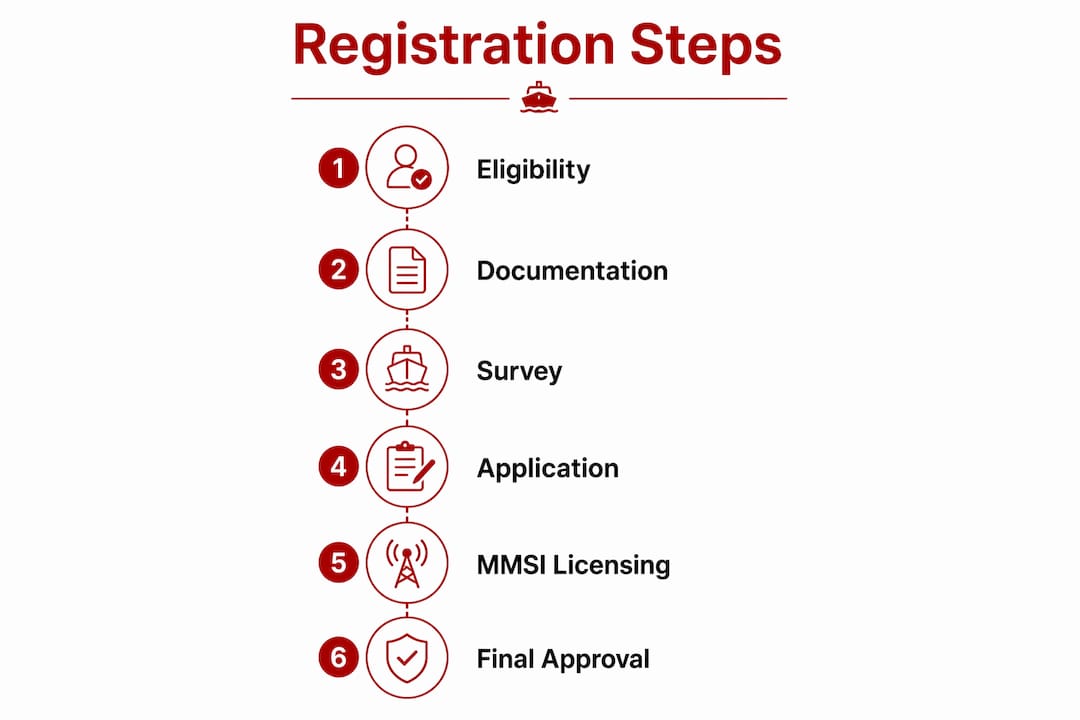
The registration process varies significantly by flag state, but the core sequence is consistent across most jurisdictions.
- Confirm eligibility. Survey requirements and flag eligibility differ by vessel size and age. Some registries exclude vessels over a certain age or require a full condition survey before accepting an application.
- Establish the ownership entity. If using a corporate structure, incorporate the holding company before beginning the registration application. Most flag states require proof of ownership at the time of application.
- Obtain a deletion certificate. If the vessel is currently registered elsewhere, request the deletion certificate from the existing registry. This document is mandatory for re-registration under a new flag.
- Prepare documentation. Standard documents include the bill of sale, builder’s certificate or previous registration certificate, proof of ownership entity, and a completed application form for the target registry.
- Submit and pay fees. Fees vary widely. In the Netherlands, obtaining a Certificate of Registry for a pleasure craft costs €221, with a separate €201 fee for a Tonnage Certificate. That total of €422 is typical for a mid-tier European registry.
- Apply for MMSI and radio licenses. MMSI number issuance depends on prior registration completion and can take 4–6 weeks depending on the jurisdiction. Plan this into your operational timeline.
| Step | Key document | Plazo habitual |
|---|---|---|
| Eligibility and survey | Survey report | 1–4 weeks |
| Ownership entity setup | Certificate of incorporation | 1–3 weeks |
| Certificado de baja | Issued by previous registry | 1–4 weeks |
| Flag state application | Full document package | 2–6 weeks |
| MMSI and radio license | Registry confirmation | 4–6 weeks |
The most common pitfall is underestimating the time required for MMSI issuance. Owners who plan a departure date before the MMSI is confirmed often face delays in safety equipment certification. Build at least six weeks of buffer after submitting the flag state application before planning any offshore passage.
What operational and compliance challenges arise for foreign-flagged vessels?
Foreign-flagged vessels face specific reporting and clearance requirements that domestically registered boats do not. These requirements directly affect how a multi-flag strategy works in practice.
Foreign-flagged vessels in U.S. waters must either clear customs at every individual port of entry or obtain a cruising license. The cruising license requires annual renewal and mandatory reporting to each local U.S. Coast Guard district and Customs office visited. Owners who skip this step risk fines and vessel detention.
Some foreign-registered yachts choose to pay Florida state sales tax and register locally, even while maintaining a foreign flag. This reflects the complex interaction between flag state registration and local tax law. It is not double registration. It is compliance with two separate legal systems that happen to overlap.
Key operational compliance points for foreign-flagged vessels:
- Port clearance. Each U.S. port entry requires either individual customs clearance or a valid cruising license.
- Annual renewal. Cruising licenses and many foreign flag registrations require annual renewal with updated documentation.
- Coast Guard reporting. Foreign-flagged vessels must report to each Coast Guard district they enter, not just the first port of call.
- Insurance implications. Some insurers apply different terms or premiums to foreign-flagged vessels operating in U.S. waters. Confirm coverage before departure.
Understanding global compliance requirements before you arrive in a new jurisdiction prevents costly surprises. The rules differ significantly between the U.S., the EU, and Southeast Asian waters.
How do owners select the right flag state for their vessel?
Flag state selection depends on vessel-specific and owner-specific factors. No single flag is optimal for every situation.
The primary evaluation criteria are registration fees and ongoing costs, survey requirements, the registry’s international reputation, the tax regime applicable to the vessel, and the flag state’s political stability. A flag with low fees but poor port state control performance will cause problems in European and U.S. ports, where inspectors target vessels from low-compliance registries.
Many countries maintain more than one ship register, including separate international registers designed to compete with open registries and attract foreign owners. This gives owners more options within a single country’s legal framework.
| Evaluation factor | Why it matters |
|---|---|
| Registry fees | Affects total cost of ownership annually |
| Survey requirements | Determines eligibility and upfront compliance cost |
| Registry reputation | Affects port state control inspection frequency |
| Tax regime | Impacts VAT, import duty, and income treatment |
| Operational geography | Some flags face restrictions in specific regions |
| Political stability | Affects long-term reliability of the registry |
For yacht registration cost factors, the total picture includes not just the initial registration fee but annual renewal costs, survey fees, and any agent or legal fees required to maintain the corporate ownership structure. Owners who focus only on the headline registration fee often underestimate the true annual cost by a significant margin.
Principales conclusiones
A vessel can only hold one active flag at a time, but a well-structured ownership entity across multiple jurisdictions gives owners the legal flexibility to switch flags efficiently and optimize both tax exposure and operational compliance.
| Punto | Detalles |
|---|---|
| One flag at a time | Dual registration is prohibited and leads to vessel detention by port authorities. |
| Ownership and flag are separate | A Jersey or BVI company can own a vessel registered under the Marshall Islands flag legally. |
| Deletion certificate is mandatory | Moving flags requires a deletion certificate from the previous registry before re-registration. |
| MMSI adds weeks to timelines | Plan 4–6 weeks after flag approval for MMSI and radio license issuance. |
| Flag choice affects port inspections | Registries with poor compliance records face higher inspection rates in U.S. and EU ports. |
The real complexity most owners underestimate
At Vesselflag, we see the same mistake repeatedly. Owners research flag states thoroughly, compare fees, and pick a registry. Then they discover the ownership structure they set up two years ago is incompatible with their chosen flag’s eligibility requirements. The flag state requires a locally incorporated entity. The owner has a BVI company. The fix takes months.
The uncomfortable truth about multi-flag strategies is that the legal and tax structure must come before the flag choice, not after. Most articles reverse this order because the flag is the visible, exciting part of the decision. The corporate structure is paperwork. But the paperwork determines what flags are even available to you.
We also see owners underestimate the ongoing compliance burden. Switching flags is not a one-time optimization. It creates annual renewal obligations, reporting requirements, and survey schedules that compound over time. A vessel that has changed flags three times in five years can carry documentation obligations from multiple jurisdictions simultaneously.
The owners who benefit most from multi-flag strategies are those who treat it as a long-term legal architecture, not a one-time registration decision. They work with advisors who understand both maritime law and international tax. They build the ownership structure before buying the vessel. And they budget for ongoing compliance, not just the initial registration fee.
— Vessel Flag
How Vesselflag supports multi-flag registration worldwide
Vesselflag specializes in vessel registration across multiple international flag states, including San Marino, Poland, UK Part 1, Palau, Malta, and others. Owners working through a multi-jurisdictional strategy need more than a registration form. They need accurate timelines, correct documentation sequences, and someone who knows what each registry actually requires in practice.
Vesselflag handles the full registration process, from initial flag selection through MMSI licensing, documentation filing, and annual renewals. For owners ready to register a yacht internationally or evaluate which flag fits their ownership structure, Vesselflag provides direct advisory support with no guesswork about what each jurisdiction requires. You can also review the Matriculación de yates frente a matriculación de embarcaciones distinctions that affect which registration pathway applies to your vessel.
Preguntas frecuentes
Can a vessel be registered under two flags at once?
No. A vessel can only hold one active flag state registration at any time. Attempted dual registration is treated as a serious violation by port authorities and insurers and can result in vessel detention.
What is a deletion certificate and when do I need one?
A deletion certificate is a document issued by a vessel’s current registry confirming it has been removed from that register. It is required before re-registering under a new flag to prove the vessel is not simultaneously registered elsewhere.
¿Cuánto tiempo tarda el registro internacional de una embarcación?
Timelines vary by jurisdiction. The flag state application typically takes 2–6 weeks, and MMSI and radio license processing adds another 4–6 weeks. Budget at least 10 weeks from application to full operational readiness.
Do foreign-flagged vessels need special permits in U.S. waters?
Yes. Foreign-flagged vessels must either clear customs at each U.S. port individually or obtain a cruising license with annual renewal and mandatory reporting to each Coast Guard district visited.
What factors determine which flag state is best for my vessel?
The right flag depends on vessel size, age, survey requirements, the registry’s reputation, applicable tax rates, and your intended cruising region. Owners should also align the flag choice with their ownership jurisdiction to avoid eligibility conflicts.