

En resumen:
- Bareboat registration allows a charterer to control and register a vessel temporarily under a different flag.
- A valid bareboat charter agreement explicitly transfers operational control and possession to the charterer.
- Proper compliance, accurate documentation, and advance planning are crucial to avoid registration delays and operational risks.
Bareboat Registration Explained: What Yacht Owners Need to Know
Most yacht owners assume that registration is a one-time, permanent decision tied directly to ownership. You buy the vessel, you register it under your name and flag, and that’s that. But that assumption breaks down the moment a long-term charterer needs full operational authority over a vessel, or when a fleet operator wants a yacht flying a different flag for a specific deployment. Bareboat registration exists precisely for these scenarios, and understanding it can open up significant operational flexibility for both owners and charterers. This guide covers what bareboat registration is, how the charter agreements work, the two main registration pathways, and the practical steps you need to stay fully compliant.
Índice
- What is bareboat registration?
- Bareboat charter agreements: The foundation of registration
- Types of bareboat registration: Bareboat-in and bareboat-out
- Practical steps, compliance, and best practices for yacht owners
- The bareboat registration reality: What most guides miss
- Get support for your yacht’s bareboat registration
- Preguntas frecuentes
Principales conclusiones
| Punto | Detalles |
|---|---|
| Bareboat registration defined | It allows the charterer of a yacht to gain operational control and a new flag for a limited period. |
| Charter agreement is essential | A valid, recognized bareboat (demise) charter is a non-negotiable requirement for registration. |
| Process is time-bound | Bareboat registration is temporary and ends once the charter period concludes. |
| Documentation and compliance | Owners need to provide recognized charter contracts and often consents from both the original and new flag states. |
| Flag-state specifics matter | Each flag state may have unique application documents, fees, and approval conditions for bareboat entries. |
What is bareboat registration?
At its core, bareboat registration is a specialized form of vessel registration designed for long-term charter arrangements where the charterer, not the owner, takes full operational control of the vessel. The registry reflects that temporary control and entitlement to fly the flag, meaning the charterer is the recognized operator for the duration of the charter period. This is a fundamentally different concept from standard registration, where the owner retains all legal responsibility and control.
In practical terms, bareboat registration allows a vessel to be formally recognized by a flag state under the authority of the charterer rather than the owner. The owner’s underlying ownership interest remains recorded, usually in the original registry, while the charterer gains the right to operate the vessel as if they owned it, including the right to hire crew, manage operations, and comply with the flag state’s requirements.
This arrangement matters enormously for registering a commercial vessel in international waters, especially for owners who lease their yachts on long-term contracts to operators in different jurisdictions. Without bareboat registration, the charterer would have no formal standing with the flag state, creating legal gray areas that can complicate port entries, insurance claims, and safety inspections.
Here’s a quick comparison of how bareboat registration stacks up against standard registration:
| Característica | Standard registration | Bareboat registration |
|---|---|---|
| Registered party | Owner | Charterer (with owner noted) |
| Duration | Ongoing / permanent | Time-bound to charter period |
| Flag entitlement | Owner’s flag state | Charterer’s chosen flag state |
| Operational control | Owner | Charterer |
| Crew hiring authority | Owner | Charterer |
| Re-registration required | No | Yes, after charter ends |
The typical charter period for a bareboat registration arrangement can range from a few months to several years, but most flag states impose maximum limits, often capped at two to three years, after which the arrangement must be renewed or terminated.
“Bareboat registration refers to registering a vessel in a flag state on a bareboat (demise) charter basis, so that the charterer obtains operational control for a defined period and the registry reflects that temporary control and entitlement to fly the flag.” — ILT Shipping
Countries like the Netherlands have well-developed frameworks for this. The Dutch bareboat-in process allows a foreign vessel to be registered under the Netherlands flag for the duration of a qualifying charter, giving the charterer full flag-state recognition without requiring them to purchase the vessel outright. This kind of flexibility is exactly why sophisticated operators worldwide pursue bareboat registration rather than conventional ownership-based registration.
Bareboat charter agreements: The foundation of registration
You cannot have bareboat registration without a valid bareboat charter agreement. This document is the legal backbone of the entire arrangement, and flag states will scrutinize it closely before granting registration. Understanding what makes a charter agreement qualify as a true bareboat (or demise) charter is essential before you start the registration process.
A bareboat charter is an arrangement where no crew or provisions are included, and the owner hands over full possession and operational control to the charterer for the agreed term. The word “demise” in demise charter comes from legal property law, meaning the transfer of possession. If the owner retains any meaningful operational control, such as supplying crew or managing the vessel’s day-to-day operations, the arrangement is no longer a bareboat charter and won’t qualify for bareboat registration.

It’s worth understanding how bareboat charters differ from the other common charter types:
| Charter type | Crew included | Operational control | Registration eligible |
|---|---|---|---|
| Bareboat (demise) | No | Charterer | Yes, for bareboat registration |
| Time charter | Sí | Owner retains | No |
| Voyage charter | Sí | Owner retains | No |
Only the bareboat structure transfers enough control to satisfy flag-state requirements for a change of registry entry. Time and voyage charters keep the owner in operational command, which means the flag state has no reason to recognize the charterer as the vessel’s responsible party.
To form a valid bareboat charter that flag states will recognize, you typically need to follow these steps:
- Negotiate and draft a charter agreement that explicitly transfers full possession and operational control to the charterer.
- Use a recognized standard form contract. BIMCO’s BARECON charter party form is the most widely accepted internationally.
- Confirm the charter term clearly, including start and end dates, with any renewal provisions specified.
- Include the vessel’s full details: IMO number, flag state, gross tonnage, and class.
- Obtain notarization or apostille if required by the target flag state.
En commercial vessel registration benefits of using a recognized charter form go beyond just passing the registry’s document check. Standardized agreements reduce disputes, simplify insurance claims, and make port state control inspections smoother because the charterer’s authority is clearly documented.
A common pitfall is using a bespoke charter agreement that doesn’t clearly articulate the transfer of possession and operational control. Registrars are trained to spot ambiguous language, and if your contract reads more like a management agreement than a true demise charter, your application may be rejected outright. When you explore boat registration overseas, having a compliant charter agreement already in place dramatically shortens your processing time.
Pro Tip: Always have your bareboat charter agreement reviewed by a maritime lawyer who is familiar with the target flag state’s requirements before submitting your registration application. A minor drafting issue can delay your registration by weeks or even months.
Types of bareboat registration: Bareboat-in and bareboat-out
Bareboat registration is not a single process. It has two distinct directions depending on which side of the arrangement you’re on, and each comes with its own documentation, fees, and administrative procedures.
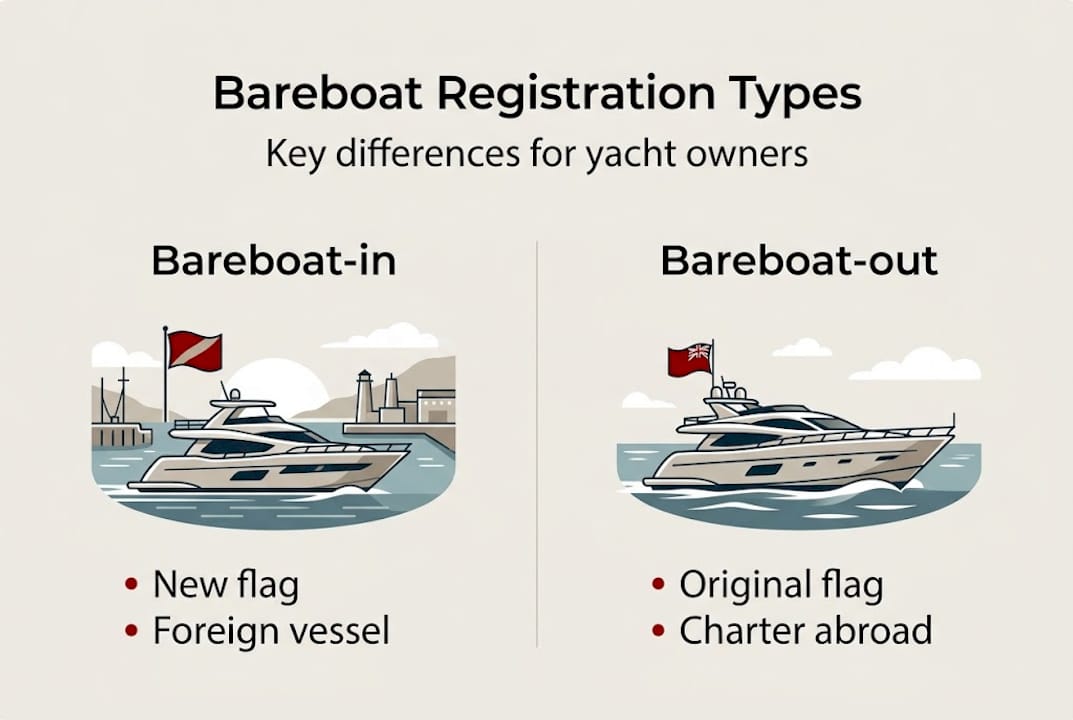
Bareboat-in registration means a foreign vessel is being registered under a new flag state for the duration of the charter. The vessel’s home registry suspends its registration (or issues a certificate of deletion or suspension), and the new flag state issues a provisional or full registration to the charterer. This is the route used when a charterer wants a yacht to fly a specific flag, perhaps for commercial reasons, tax considerations, or operational requirements in a particular region.
Bareboat-out registration takes the opposite approach. As the Netherlands bareboat-out process illustrates, a shipowner keeps the vessel registered as property in their home country (the Netherlands in this case) but temporarily registers it under another flag during the bareboat charter. The owner maintains the underlying ownership registration, while the charterer gains flag-state recognition elsewhere. This costs €201 for the Dutch bareboat-out declaration in 2026, a relatively modest administrative fee for the operational flexibility it provides.
Here is a breakdown of the key documents required for each type:
- Bareboat charter agreement (BIMCO BARECON or equivalent recognized form)
- Proof of ownership and underlying vessel registration
- No-objection letter or declaration from the home flag state (for bareboat-out)
- No-objection letter or acceptance from the new flag state (for bareboat-in)
- Vessel particulars: IMO number, gross tonnage, class certificates
- Evidence of compliance with the target flag state’s maritime regulations
- Proof of valid insurance under the charterer’s name
Navigating these requirements is where many owners trip up. Each flag state has its own forms and procedural variations. Understanding maritime regulations for yachts across different jurisdictions is critical because what’s acceptable in one country may not be sufficient in another.
The practical use cases differ significantly between the two types. Bareboat-in is common when a charterer wants to operate a foreign vessel under a preferred flag for commercial deployments. Bareboat-out suits owners who want to lease their vessel internationally without fully surrendering their home registry record. Both arrangements are fully reversible: once the charter period ends, the vessel returns to its original registration status, assuming all administrative steps are completed correctly. Review common challenges in yacht registration before you begin, since anticipating obstacles upfront saves significant time and cost.
Practical steps, compliance, and best practices for yacht owners
Knowing the theory is one thing. Actually executing a bareboat registration without errors is another. The compliance landscape is flag-state specific, meaning there is no single universal checklist, but the following framework applies to the vast majority of jurisdictions.
Step-by-step process for bareboat registration:
- Confirm your charter agreement meets the bareboat (demise) standard and is accepted by the target flag state.
- Obtain a certificate of suspension or deletion from the home registry, or a no-objection letter, depending on the flag state’s requirements.
- Gather all vessel documentation: class certificates, measurement certificates, safety certificates, and proof of ownership.
- Submit the application to the target flag state registry with all supporting documents, translated if required.
- Pay applicable administrative fees and await the bareboat registration certificate.
- Ensure the vessel’s insurance policy is updated to reflect the charterer as the insured party.
- Update MMSI and AIS records to reflect the new flag and operator details.
Flag-state compliance requirements can include explicit requirements for recognized charter forms like BIMCO, proof of no-objection from relevant parties, and time limits on the registration period, after which re-application is necessary.
Common documents you will typically need:
- Original or certified copy of the bareboat charter agreement
- Certificate of registry from the home flag state
- Proof of no-objection from the home flag state
- Builder’s certificate or bill of sale to establish ownership
- Current safety inspection and class certificates
- Proof of insurance naming the charterer
Pitfalls to avoid:
- Submitting a charter agreement that does not clearly transfer operational control
- Missing the no-objection documentation from either flag state
- Failing to update insurance and MMSI records after bareboat registration is granted
- Allowing the charter period to expire without renewing or formally ending the bareboat registration
Pro Tip: Build a compliance calendar from the start of the charter period. Mark the registration expiry date, insurance renewal date, and any flag-state reporting deadlines. Missing even one deadline can invalidate your bareboat registration mid-charter, causing serious operational disruptions.
Always review key yacht compliance requirements specific to your chosen flag state before you submit. Registries that see incomplete applications often delay the entire process rather than requesting missing documents promptly. Solid preparation upfront is the single biggest factor in smooth approvals. Additionally, global registration tips from experienced practitioners can help you sidestep jurisdiction-specific quirks that aren’t always obvious from reading the official guidance alone.
The bareboat registration reality: What most guides miss
Most articles about bareboat registration treat it as a purely administrative exercise, a paperwork checklist you complete and then forget. In our experience working with yacht owners and operators across multiple flag states, that mindset is where things go wrong.
The biggest overlooked risk is not the documents. It’s the operational control gap. Owners sometimes structure their charter arrangements informally, retaining de facto control over crew or management decisions while the charterer holds the registration certificate. If a port state control inspection uncovers that the operational reality doesn’t match the registered arrangement, the consequences can include vessel detention and insurance disputes.
Another underestimated issue is flag-state communication delays. Even well-prepared applications hit processing backlogs, especially around peak season. Experienced operators plan their bareboat registration well in advance of the intended charter start date, not in parallel with it.
Finally, registration challenges around dual registry suspensions are often glossed over. If the home registry’s suspension certificate doesn’t arrive before the charterer needs the vessel to be operational under the new flag, you can end up in a situation where neither flag state considers the vessel properly registered. That gap is a real commercial and legal risk that generic guides rarely address.
Get support for your yacht’s bareboat registration
Bareboat registration is one of the more nuanced processes in yacht compliance, and getting it right the first time saves weeks of delays and avoids costly re-applications. VesselFlag.com provides specialized guidance at every stage of the process.
Whether you need help confirming registration validity for global compliance or want to understand the yacht vs boat registration differences before you begin, our team brings hands-on expertise across multiple flag jurisdictions. Explore our full range of flag registration services and connect with specialists who know exactly what each registry needs, so your vessel gets properly registered without the guesswork.
Preguntas frecuentes
Can you change a vessel’s flag temporarily with bareboat registration?
Yes, bareboat registration allows a vessel to fly a different flag for the charter period, then revert to its original registry once the arrangement ends. The registry reflects that temporary entitlement to fly the new flag throughout the charter term.
What documents are needed to apply for bareboat registration?
You typically need a recognized bareboat charter agreement, proof of ownership, and no-objection documentation from the relevant flag states. Specifically, registries require proof of registry, a no-objection declaration, and a valid charter agreement uploaded with the application.
Is bareboat registration the same as permanent vessel registration?
No, bareboat registration is time-bound and contract-driven, linked to a charter arrangement, whereas permanent registration is ongoing and tied directly to the vessel’s owner.
What happens if my charter contract doesn’t meet bareboat criteria?
The flag state may refuse or invalidate the registration if the contract does not transfer sufficient possession and operational control. A deficient charter means a registry entry may be refused or later challenged during a port state control inspection.