Langkawi yacht registration costs RM 1,140 in official registry fees for a yacht up to 150 gross tons, plus annual tonnage dues from RM 380, according to the Malaysian Marine Department’s September 2025 fee schedule. Larger yachts pay more by gross-tonnage band. On top of the registry fees, most owners budget for an agent’s fee, which depends on the yacht and the case. At Vessel Flag we handle Langkawi on request and confirm the price for each yacht.
This guide is for yacht owners, brokers and operators who need a number they can put in a budget. It sets out the official fees, what drives them, the recurring charges and how to build a realistic total.
TL;DR
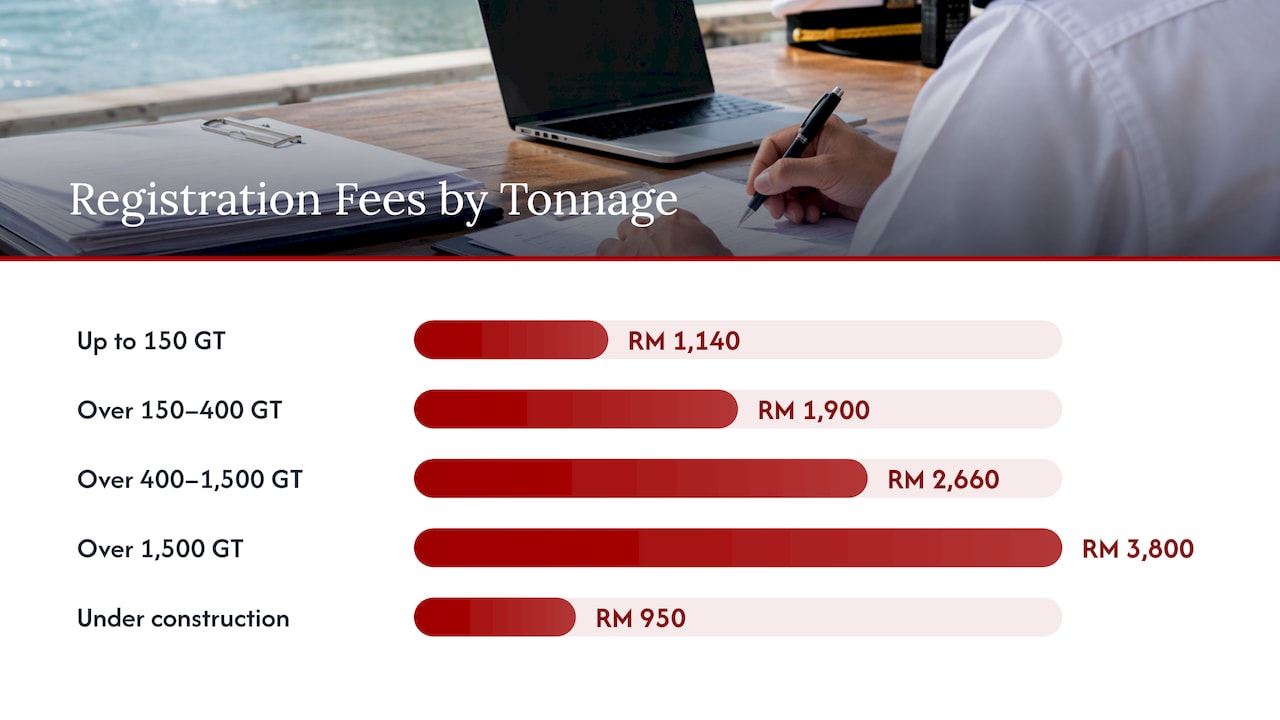
- First registration, re-registration, interim registration and bareboat charter registration are RM 1,140 up to 150 GT, RM 1,900 for 150–400 GT, RM 2,660 for 400–1,500 GT and RM 3,800 above 1,500 GT.
- Annual tonnage dues are a minimum of RM 380, plus RM 1.50 per GT for the first 1,000 GT and RM 0.50 per GT above that.
- Ownership transfers, mortgages, name changes, duplicate certificates and deletion each carry their own separate fee.
- The agent’s fee is separate from the registry’s and is not set by the Marine Department. Vessel Flag confirms Langkawi pricing per case.
Inhaltsübersicht
- What the Marine Department charges for first registration
- Annual tonnage dues: the recurring cost
- What else can add to the bill
- What determines your total
- Which yachts can and cannot be registered
- Building a realistic budget
- How Langkawi fits with other flags
- Our approach to Langkawi registration
- Registering your yacht with Vessel Flag
- FAQ
- Quellen
What the Marine Department charges for first registration
Langkawi is a Malaysian registry for foreign-owned yachts: the Langkawi International Yacht Registry (LIYR) is run by the Marine Department of Malaysia (Jabatan Laut Malaysia) under the Langkawi International Yacht Registration Act 2003. Its fees are published in Malaysian ringgit (RM) in a Standard Operating Procedure (SOP) dated September 2025.
The registration fee depends on one thing above all: the yacht’s gross tonnage (GT), a measure of internal volume, not weight. The same fee applies whether you are registering for the first time, re-registering, taking an interim registration or registering a bareboat charter yacht.
| Gross tonnage band | Registration fee (first, re-, interim or bareboat) |
|---|---|
| Up to 150 GT | RM 1,140 |
| Over 150 to 400 GT | RM 1,900 |
| Over 400 to 1,500 GT | RM 2,660 |
| Over 1,500 GT | RM 3,800 |
These figures come from the Marine Department’s LIYR SOP. The same document lists RM 950 for registering a yacht that is still under construction.
Most private motor yachts and sailing yachts fall in the first band. Superyachts and larger commercial vessels move into the upper bands, where the registration fee itself rises noticeably but is still modest against the value of the vessel.
A worked example
Take a 20-metre motor yacht of around 90 GT on a first registration. The registry fee is RM 1,140. Annual dues are the RM 380 minimum plus RM 1.50 for each of the 90 GT, which is RM 135, giving RM 515. Payable at registration, that is RM 1,655 in official charges before any agent fee, translations, notarisation or courier costs.
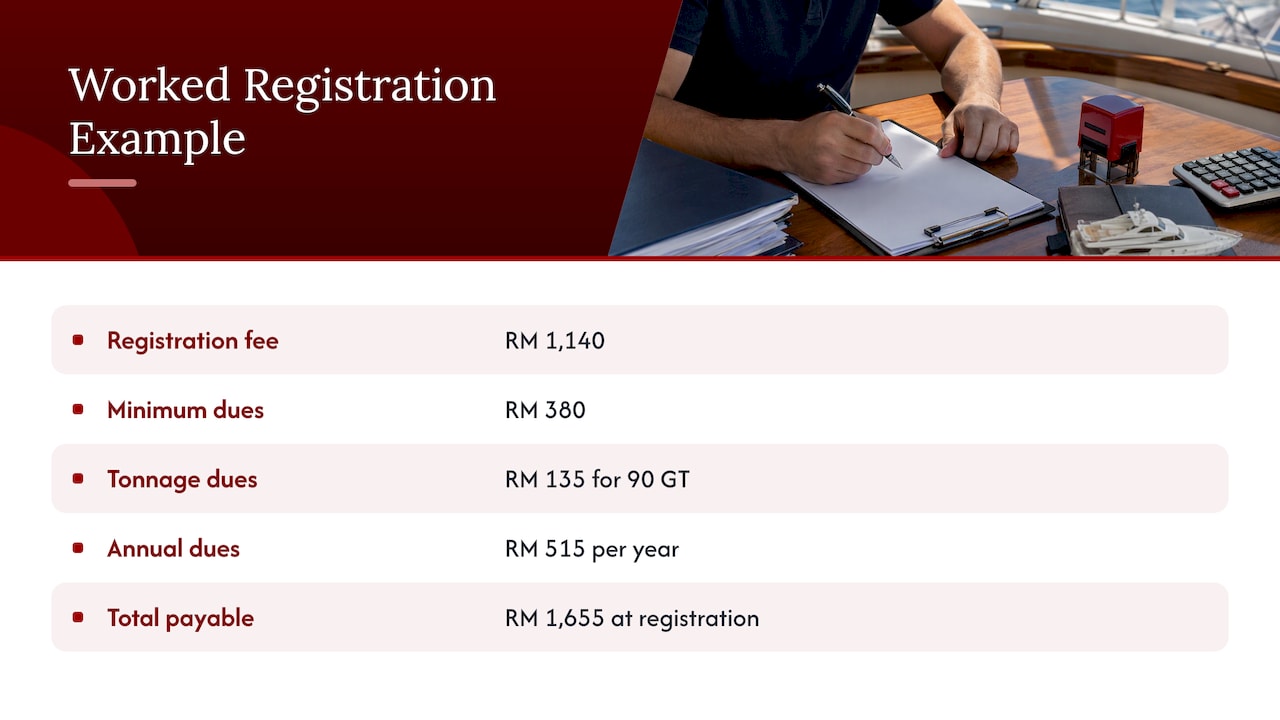
The annual dues figure is the one most budgets miss. Dues are not part of the one-off registration fee and recur every year.
Annual tonnage dues: the recurring cost
Annual tonnage dues are the ongoing price of keeping the registration alive. The SOP sets them at a minimum of RM 380, plus RM 1.50 per gross ton for the first 1,000 GT and RM 0.50 for each gross ton above 1,000 GT. All yachts are subject to annual renewal of the dues.
The Marine Department’s tonnage dues notice states that dues are payable at registration and then annually on or before the registration anniversary. It also says that if dues stay unpaid for more than one year, the Director General may terminate the registration under Section 17 of the LIYR Act 2003.
For budgeting, that means:
- Put the first year’s dues in the registration budget, because they fall due at registration.
- Diarise the anniversary date, not the calendar year end.
- Treat a lapse as a risk to the registration itself, not just a late fee.
Some owners and brokers manage this by having one party responsible for renewals across a fleet. If you hold several yachts, the anniversaries will all fall on different days, so a single calendar is worth the ten minutes it takes to build.
Dues by tonnage
Using the published formula, the dues for a few sample sizes come out as follows. The figures are calculated from the Marine Department’s rates and rounded to whole ringgit.
| Yacht size | Calculation | Annual dues |
|---|---|---|
| 50 GT | RM 380 minimum (50 × 1.50 = RM 75 is lower) | RM 380 |
| 300 GT | RM 380 + (300 × RM 1.50) | RM 830 |
| 1,000 GT | RM 380 + (1,000 × RM 1.50) | RM 1,880 |
| 1,500 GT | RM 380 + (1,000 × RM 1.50) + (500 × RM 0.50) | RM 2,130 |
This reading treats the RM 380 as a base to which the per-ton amounts are added, as the SOP wording “minimum RM 380 plus” suggests. The tables in the SOP are the authority for your own yacht, and your agent will confirm the figure on the invoice.
What else can add to the bill
The SOP also lists separate fees for events in a yacht’s life. These are official registry charges, set by the Marine Department, not by an agent. The figures below are from the same September 2025 schedule.
| Service | Fee |
|---|---|
| Ownership-transfer registration, up to 150 GT | RM 760 |
| Ownership transfer, 150–400 GT | RM 950 |
| Ownership transfer, 400–1,500 GT | RM 1,050 |
| Ownership transfer, over 1,500 GT | RM 1,520 |
| Mortgage registration, transfer or discharge, up to 150 GT | RM 760 |
| Mortgage registration, transfer or discharge, over 150 GT | RM 1,330 |
| Notice of intended mortgage | RM 190 |
| Priority notice | RM 290 |
| Register transcript | RM 290 |
| Name change | RM 230 |
| Amended or duplicate certificate | RM 120 |
| Deletion certificate | RM 120 |
| Certified copies | RM 120 |
The SOP also lists charges for probate, yacht entity registration, rush processing and name reservation. Ask for the current figure for any of these before you commit to a timetable.
Why these matter to brokers
If you are selling a yacht on, the transfer fee and any mortgage discharge become part of the transaction costs. A buyer financing the purchase will need the mortgage registered, which is a fee in its own right. Building these into the deal sheet early avoids last-minute surprises at completion.
What determines your total
Four things move the registry part of the bill:
- Gross tonnage. It sets both the registration fee band and the annual dues.
- Registration category. The Marine Department’s form distinguishes non-bareboat chartered yachts, bareboat chartered yachts and yachts under construction, and the under-construction fee is lower than the standard fee.
- Life events. Transfers, mortgages, name changes and deletion each have their own fee.
- Speed. The SOP lists a rush-processing fee for owners who need papers sooner.
Outside the registry, the other costs are the agent’s fee, any document preparation such as notarising or translating ownership papers, courier charges, and, where the yacht is owned through a company, the cost of setting that company up.
Which yachts can and cannot be registered
Cost is irrelevant if the vessel does not qualify. The SOP says certain categories cannot be registered as yachts at all. They include open boats without a cabin, wooden-hulled yachts, passenger boats and ferries, fishing boats, inflatables and rigid inflatables, personal watercraft such as jet skis, and houseboats. The SOP also says yachts must not be involved in illegal activities or pose safety or pollution risks.
Before paying for anything, check the hull material and vessel type against that list. A wooden classic or a tender-style rigid inflatable is a different conversation from a fibreglass or steel cruising yacht.
The application itself asks for the yacht’s approved name, builder details, country and year of build, length, hull material, IMO number where there is one, and details of any previous registration, as shown on the Marine Department’s application form. Having the builder’s certificate and the deletion certificate from the previous flag ready is what keeps the timeline, and so the agent’s time, down.
Building a realistic budget
A sound Langkawi budget has four lines:
- Registry registration fee: from the table above, by GT band.
- First-year tonnage dues: the formula above, payable at registration.
- Agent and document costs: confirmed per case, since they depend on the yacht, the owner structure and the paperwork.
- Annual dues in later years: the same formula, due by each anniversary.
Converting ringgit to your own currency adds one more variable: the exchange rate on the day you pay. Check the live rate at payment, as it moves daily.
For a yacht under 150 GT, the official charges on day one are RM 1,140 plus at least RM 380 in dues, so a minimum of RM 1,520. That is the floor for the registry side only. Anything quoted below the sum of these two for a yacht of that size is missing something.
How Langkawi fits with other flags
Langkawi is one option among many, and the cost per flag is only part of the decision. Owners weigh where the yacht will cruise, whether it will be chartered, who owns it, financing and insurer requirements. We compare the options in our guide to how Langkawi compares with other yacht registries, and the key takeaways give the short version. For the legal background, see what Langkawi registration is and its legal basis.
If you are still choosing a flag, it helps to see published figures side by side. Our one-off prices for the main flags we file are:
| Flagge | Vessel Flag price |
|---|---|
| Polen | from EUR 320 |
| San Marino | from EUR 290 |
| UK Part 1 | from EUR 550 |
| Malta | from EUR 849 |
| Palau | from EUR 700 |
| Marshallinseln | EUR 250 service fee plus registry fees |
| Kaimaninseln | EUR 450 service fee plus registry fees |
These are our service fees for preparing and filing the application. Registry fees are separate, and certificates are issued by each flag registry. Langkawi, like Dutch Zeebrief, Gibraltar and Panama, is handled on request with the price confirmed per case, so we do not publish a figure for it.
Our wider explainer on international yacht flag registration covers how flags differ in eligibility and process. US-based owners can read our page on Ausländische Yachtregistrierung für US-Eigentümer.
Our approach to Langkawi registration
Vessel Flag is a private yacht registration consultancy, run by BRN Enterprises in Warsaw and London. We prepare and file registration applications for private owners, companies and brokers, and the whole process is remote. We are not a registry or a government body: the flag registry issues the certificates.
How we help owners budget a Langkawi registration
Most cost surprises in yacht registration do not come from the registry. They come from missing paperwork, an ownership structure that was not ready, or recurring charges nobody diarised. That is why we start with the yacht’s tonnage and category, the owner’s structure and the previous flag’s deletion papers, then give a clear price for Langkawi before any work begins.
We work across eight flags, so we can tell you when another registry’s published one-off price fits your yacht better, and we can set up the rest of the ownership picture alongside it: company formation, an MMSI radio licence and transfers between flags. One consultancy handling the whole set-up means one timetable instead of several.
Langkawi is one of the flags we handle on request. Send us the yacht’s details and we confirm the price for your case.
Vessel Flag
Registering your yacht with Vessel Flag
If Langkawi is on your shortlist, we prepare and file the application remotely and confirm the price for your yacht. If another flag suits your cruising plans or ownership better, we can file for that instead, with published one-off prices for Poland, San Marino, UK Part 1, Malta, Palau, the Marshall Islands and the Cayman Islands.
We can also arrange the radio side of the set-up: an MMSI number and ship radio licence costs EUR 149 for Poland, EUR 150 for the UK and EUR 200 for San Marino, all VAT included and with no annual fees. Details are on our MMSI radio licence page. If the yacht will be held through a company, see our Firmengründungsservice. For everything else, start at vesselflag.com.
FAQ
How much does it cost to register a yacht in Langkawi?
The official registration fee is RM 1,140 for a yacht up to 150 GT, rising to RM 1,900, RM 2,660 and RM 3,800 for the larger bands. Annual tonnage dues of at least RM 380 apply on top. An agent’s fee is separate and depends on the case.
Are there annual fees after registration?
Yes. Annual tonnage dues are a minimum of RM 380, plus RM 1.50 per GT for the first 1,000 GT and RM 0.50 per GT above that. They are payable at registration and then on or before each anniversary. Unpaid dues for more than a year can lead to termination of the registration.
Is the fee the same for bareboat charter yachts?
According to the Marine Department’s schedule, bareboat registration carries the same fee as first registration, by gross-tonnage band. A yacht under construction has a lower registration fee of RM 950.
What does it cost to transfer ownership of a Langkawi-registered yacht?
The registry’s ownership-transfer fee is RM 760 up to 150 GT, RM 950 for 150–400 GT, RM 1,050 for 400–1,500 GT and RM 1,520 above 1,500 GT. A mortgage on the yacht carries its own separate registry fees.
Does Vessel Flag publish a price for Langkawi?
No. Langkawi is one of the flags we handle on request, and we confirm the price for each yacht. Our published one-off prices cover Poland, San Marino, UK Part 1, Malta, Palau, the Marshall Islands and the Cayman Islands.
Quellen
- Marine Department of Malaysia: LIYR Standard Operating Procedure, September 2025
- Marine Department of Malaysia: annual tonnage dues notice
- Marine Department of Malaysia: yacht registration application form
Ready to register? Talk to us about your yacht on our Vessel Flag home page or book a consultation.
Empfohlen
VesselFlag is a private consultancy that prepares and files yacht registration applications for owners. We are not a government body or flag registry; certificates are issued by the relevant registry. This article is general information, not legal advice.