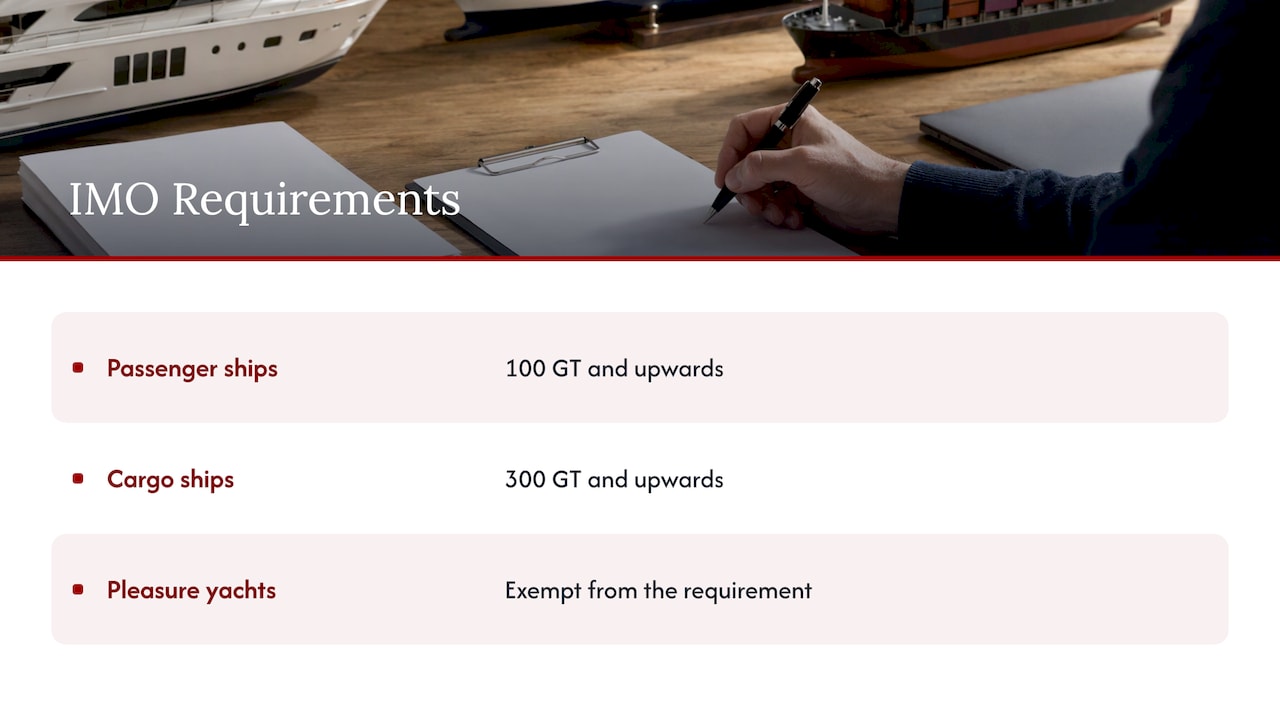
Most private yachts do not have an IMO number and are not required to. The IMO ship identification scheme is mandatory for passenger ships of 100 gross tonnage and above and cargo ships of 300 gross tonnage and above, and pleasure yachts are exempt. What a yacht does need is a valid registration under a flag, and, if it carries a VHF radio, an MMSI number and a ship radio licence. This guide explains what an IMO number is, where yachts fit, and which identifiers you will actually be asked for.
TL;DR
- An IMO number is a permanent seven-digit identifier for a ship, written “IMO” followed by the digits. It stays with the hull for life.
- Pleasure yachts are exempt from the mandatory scheme. It applies to passenger ships of 100 GT and over and cargo ships of 300 GT and over.
- The number is allocated free of charge by S&P Global Limited under the IMO scheme. You do not buy it from an agent.
- For a private yacht, the identifiers that matter day to day are flag registration (name, official number, certificate), an MMSI number and a ship radio licence.
- If you are reflagging, the IMO number (where one exists) stays, while the MMSI changes with the flag.
Inhaltsübersicht
- What an IMO number is
- Do private yachts need an IMO number?
- Who issues IMO numbers, and what do they cost?
- Where the number is displayed
- How to check an IMO number
- IMO number, MMSI, call sign and name: what is the difference?
- What a private yacht needs instead
- Choosing a flag when you do not need an IMO number
- Perspective
- Registering your yacht with Vessel Flag
- A short checklist before you register or reflag
- FAQ
- Sources
What an IMO number is
An IMO ship identification number is a permanent identifier used to identify a ship throughout its lifetime. The format is the letters “IMO” followed by seven digits, and the scheme is run by the International Maritime Organization.
Three properties make it useful:
- It is permanent. A vessel can change its name, owner, manager and flag, and the number stays the same. It is linked to the hull, not to the people or the paperwork around it.
- It is not reused. Under IMO Resolution A.1215(34), numbers are not reallocated once a ship is deleted from the scheme. One number points to one ship.
- It is the same everywhere. Port state control, insurers, charterers, banks and sanctions screening systems use it because a ship name alone is unreliable. Names are duplicated and changed all the time.
The seven digits are not a code you can decode like a postcode. Treat them as a serial number issued in sequence, with a final check digit. That is why you cannot tell the flag, size or age of a ship from the number itself.
Do private yachts need an IMO number?
In most cases, no. The scheme is mandatory under SOLAS regulation XI-1/3 for passenger ships of 100 gross tonnage and upwards and cargo ships of 300 gross tonnage and upwards, and the IMO states that pleasure yachts are exempt. A private motor yacht or sailing yacht used for the owner’s own leisure is outside the requirement, whatever its length.
There are a few situations worth understanding.
Large yachts in commercial use
If a yacht is operated commercially, for example in charter, the way its flag administration classifies it matters more than its marketing label. Some commercial vessels fall under rules for passenger ships or cargo ships and so under the scheme’s thresholds. Your flag registry and your classification arrangements are the people to confirm this with, because the answer depends on the vessel’s certified category and tonnage, not on its length alone.
Domestic voyages
The IMO resolution also notes that administrations may wish to assign numbers to ships engaged solely on domestic voyages. So a flag may choose to issue one to smaller or domestic craft even where the international rule does not demand it. That is a decision for the administration, not for the owner.
Voluntary identification of pleasure craft
Guidance in the maritime security field says authorities may encourage pleasure-craft operators to register with an administration or a suitable organisation that runs an online database, to help safety and security. In practice, that is exactly what flag registration and MMSI licensing do for a yacht.
Who issues IMO numbers, and what do they cost?
S&P Global Limited is responsible for allocating IMO numbers and managing the scheme. Requests can be completed online, or by downloading a form from the S&P Global website, and the Assembly resolution confirms that allocation is free of charge.
Two practical points follow:
- Be wary of anyone who sells an “IMO number” as a product. The allocation itself costs nothing.
- The request normally comes with ship particulars and proof of the vessel’s build and ownership, so a yacht with clean registration documents is in a much better position to apply than one with gaps in its paperwork.
As a private consultancy, Vessel Flag does not issue IMO numbers or any other identifier. We prepare and file yacht registration applications and arrange MMSI numbers and radio licences; certificates are issued by the flag registries.
Where the number is displayed
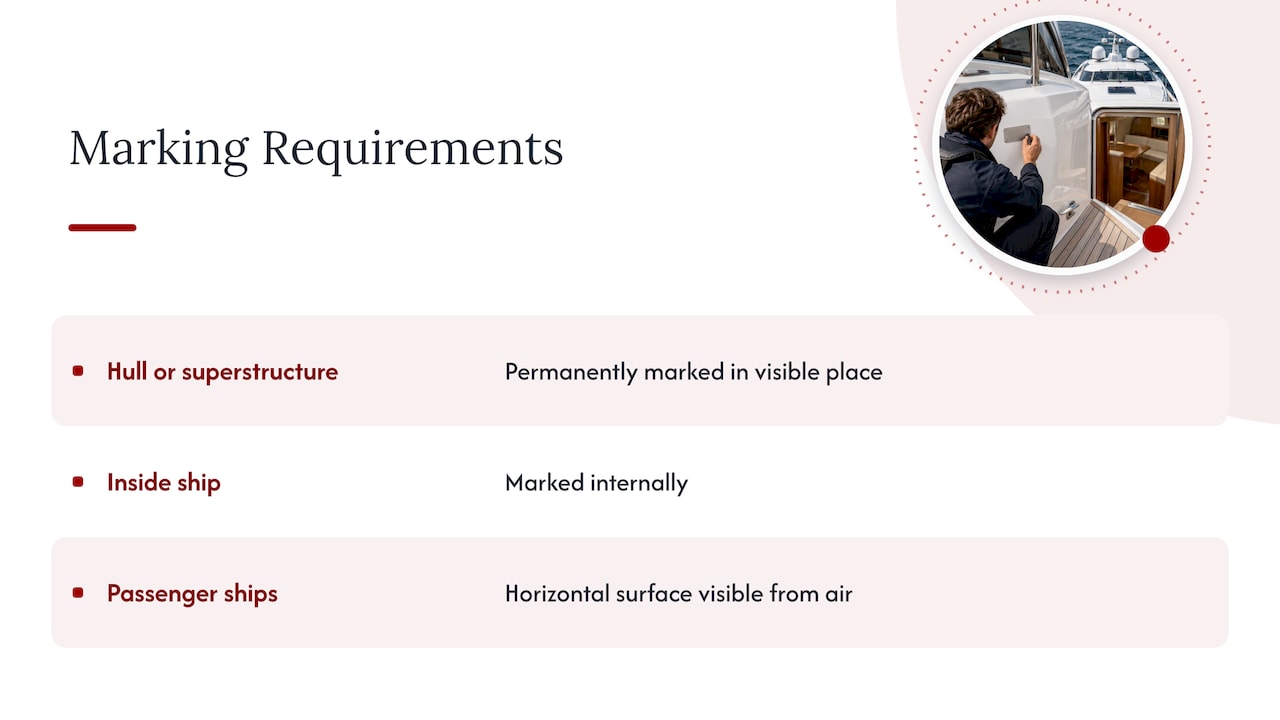
Where a ship has an IMO number, the scheme says it should be permanently marked in a visible place on the hull or superstructure. Ships should also be marked internally. Passenger ships should carry the number on a horizontal surface visible from the air.
For a yacht that holds a number, marking it properly is simple and cheap compared with the trouble of an inspection finding it missing. Mark it in a contrasting colour, in a location that stays visible when tenders, davits or awnings are in use, and keep a note of where the internal marking is.
How to check an IMO number
If you are buying a yacht, chartering one or screening a counterparty, you can look up numbers through the IMO’s GISIS module on “Ship and Company Particulars”, as described by the IMO. Check these points:
- The number is seven digits and the vessel name, type and tonnage match what the seller or broker says.
- The registered owner and manager match the documents you have been shown.
- The flag shown is the flag on the registration certificate.
A yacht that has no IMO number will not appear in these databases, and that is normal for a private pleasure yacht. In that case you verify the vessel through its flag registration: the certificate, the official number or registry number, the hull identification number or builder’s number, and the registry’s own records.
IMO number, MMSI, call sign and name: what is the difference?
This is where most yacht owners get confused. Four identifiers sit side by side, and each answers a different question.
| Identifier | What it identifies | Who issues it | Changes with flag? | Typical on a private yacht |
|---|---|---|---|---|
| Vessel name | What the ship is called | The owner, approved by the registry | Can change | Always |
| IMO number | The hull, for life | S&P Global Limited under the IMO scheme | Nein | Usually not held |
| Official number or registry number | The registration entry | The flag registry | Ja | Yes, once registered |
| MMSI | The radio and AIS identity | The flag state or its licensing authority | Ja | Yes, if VHF DSC or AIS is fitted |
A simple way to remember it: the IMO number says which ship this is for life, while the MMSI says how to reach it by radio today.
The MMSI is a nine-digit number. According to the ITU-based description, it is issued by the object’s current flag state, unlike an IMO number, which is a permanent global identifier. The first three digits are the Maritime Identification Digits that show the country, and when a vessel is reflagged a new MMSI has to be assigned for the new state.
So a yacht that switches from, say, one flag to another keeps its hull identity but needs a new MMSI, a new radio licence and a reprogrammed VHF DSC radio and AIS transponder. Forgetting this is one of the commonest reflagging mistakes, and a wrong MMSI in a distress alert can delay a response.
What a private yacht needs instead
For a pleasure yacht, the working set of identity and compliance documents looks like this.
- Flag registration. The registry issues a certificate of registry, or provisional papers while the full certificate is processed. This proves nationality, ownership and the right to fly the flag.
- MMSI number. Required for DSC-equipped VHF radios and AIS.
- Ship radio licence. The legal permission to operate radio equipment on board, issued by the national authority linked to your flag.
- Insurance. Most marinas and many coastal states expect valid cover, and a registered vessel is far easier to insure.
- Ownership structure. Many owners hold the yacht through a company, which affects which flags are open to them.
Die overview of international yacht flag registration explains how these pieces fit together and how flags compare.
MMSI and radio licences by flag
The owner-facing details differ from flag to flag. These are our published one-off prices, VAT included, with no annual fees:
| Flagge | MMSI radio licence price | Timing |
|---|---|---|
| Polen | EUR 149 | 4-6 weeks after registration |
| UK | EUR 150 | 1 Tag |
| San Marino | EUR 200 (valid 5 years) | Confirmed at order |
Our MMSI and ship radio licence service covers the full range of options and what you need to supply. Flag-specific pages are also available for the Polish radio licence and the Maltese radio licence for yachts, and US owners can read about the radio operator licence for a yacht.
Choosing a flag when you do not need an IMO number
Because pleasure yachts sit outside the mandatory IMO scheme, your flag choice rests on other factors: your eligibility, how the yacht is used, cost, speed, cruising area and the structure you own it through. Here are our published starting prices for registration, all one-off and shown as we publish them:
| Flagge | Registration price | Anmerkungen |
|---|---|---|
| Polen | from EUR 320 | Provisional papers take 2-5 days |
| San Marino | from EUR 290 | Provisional certificate takes 2-6 days, not guaranteed; a lifetime registration until 2050 costs EUR 1,290, including 5 years of registered agent fee |
| UK Part 1 | from EUR 550 | Personal, existing company or new UK LTD route |
| Malta | from EUR 849 | |
| Palau | from EUR 700 | |
| Marshallinseln | EUR 250 service fee plus registry fees | |
| Kaimaninseln | EUR 450 service fee plus registry fees | |
| Cookinseln | Quoted per yacht |
Some points on how these routes work for owners:
- UK Part 1. If you are eligible, you can register personally. You can also register through your existing company, either a UK company or an eligible foreign one such as a Delaware corporation, or through a new UK LTD. A UK company is not always required.
- Marshall Islands and Cayman Islands. The service fee is ours; the registry fees are charged by the registry on top, so ask for the current schedule before you budget.
- Cook Islands. We quote per yacht, because the right route depends on the vessel and its ownership.
- Other flags. Vessel Flag also handles Langkawi, Dutch Zeebrief, Gibraltar, Panama and other flags on request. Those are confirmed case by case, so we do not publish prices for them.
If you are considering an ownership company, our company formation for yacht ownership covers UK LTD, Delaware LLC and Marshall Islands entities.
Perspective
We hear the same question every month: “Do I need an IMO number before I can register my yacht?” For a private pleasure yacht, the answer is no. What owners need, and what brokers and buyers will ask to see, is a clean registration, a correct MMSI and a matching radio licence.
The mistakes we see are rarely about the IMO number. They are about mismatches: a name on the hull that differs from the certificate, an MMSI still programmed from a previous flag, a radio licence that was never transferred, or an ownership company that does not fit the flag chosen. Each one is avoidable when the whole set-up is planned together.
That is why we handle the file end to end: the registration application, the MMSI and radio licence, the ownership company if one is needed, and flag transfers and deletion certificates when a yacht moves. Everything is remote, with published one-off prices, across eight flags. We prepare and file the applications; the flag registry issues the certificates.
If a vessel is going into commercial use or has grown large enough to be near the tonnage thresholds, we recommend you ask the intended flag early how it will classify the yacht. It costs a conversation and saves a surprise.
Vessel Flag
Registering your yacht with Vessel Flag
If you are comparing flags or planning a reflag, we can prepare the whole application remotely and tell you the cost before you start. We are a private consultancy, not a registry or government body, and we are a listed agent with the San Marino and Palau registries and offer a UK local representative service.
A good starting point is the flag that fits your eligibility and cruising plans. See our Yachtregistrierung in San Marino from EUR 290, Poland flag registration from EUR 320 or UK Part 1 yacht registration from EUR 550. We do not promise approval rates or speed beyond the typical timings published on each page, because the registries set their own processing.
A short checklist before you register or reflag
- Confirm the yacht’s use: private pleasure, or commercial. This decides which rules apply.
- Confirm tonnage and length from the builder’s or surveyor’s documents.
- Collect proof of ownership, such as the bill of sale, and the deletion certificate from any previous flag.
- Decide the ownership structure, personal or company, before choosing the flag.
- Plan the MMSI and radio licence at the same time, so the radio is reprogrammed when the new papers arrive.
- Update the name and markings on the hull to match the certificate.
- Tell your insurer about the change of flag.
FAQ
What is an IMO number on a yacht?
It is a permanent seven-digit identifier, written as “IMO” plus the digits, that follows a ship’s hull for its whole life. Most private pleasure yachts do not have one because they are exempt from the mandatory scheme. Their identity rests on flag registration and an MMSI instead.
How can I check an IMO number?
Use the IMO’s GISIS module on “Ship and Company Particulars” to look up ships that hold a number. Compare the name, type, flag and owner with the documents you have been given. If the yacht has no IMO number, check the flag registry’s records and the registration certificate instead.
How much does an IMO number cost?
Nothing. Allocation of IMO numbers is provided free of charge by S&P Global Limited under the IMO scheme. Anyone charging for the number itself is selling something else, so ask exactly what the fee covers.
What is the difference between an IMO number and an MMSI?
The IMO number identifies the hull and never changes. The MMSI is a nine-digit radio identity issued through the flag state, so it changes when the yacht changes flag. A yacht can have an MMSI without an IMO number, and most pleasure yachts do.
Will my IMO number change if I reflag my yacht?
No. The number stays with the ship for life, and numbers are not reallocated. What changes is the registration, the MMSI, the radio licence and the documents tied to the new flag.
Sources
- IMO Identification Number Scheme, International Maritime Organization
- IMO Resolution A.1215(34), Integrated IMO identification number scheme
- Using available means of vessel identification, pleasure craft guidance
- Maritime Mobile Service Identity, Wikipedia
Ready to register? Choose your flag page above or book a consultation with Vessel Flag and we will confirm the right route and price for your yacht.
Empfohlen
- MMSI Number Registration for Yachts – From €149
- Radio Operator License for a Yacht: What US Owners Need
VesselFlag is a private consultancy that prepares and files yacht registration applications for owners. We are not a government body or flag registry; certificates are issued by the relevant registry. This article is general information, not legal advice.