

Ready to register under the Malta flag? Vessel Flag handles everything – private yachts from €849, commercial from €2,500, provisional certificate in 2–3 days. See Malta yacht registration prices and requirements →
Form a Malta company, then register the yacht in that company’s name with Transport Malta. That single move is what separates a smooth registration from one stuck in resident-agent paperwork for months.
A Malta-registered special purpose vehicle (SPV) becomes the legal owner of the vessel, and the yacht flags under that company rather than under you personally. This is the structure most brokers and repeat owners default to, because it sidesteps a rule that trips up first-timers: non-resident individuals must appoint a resident agent, but a Maltese company doesn’t.
Here’s what to do first:
- Reserve the vessel name with Transport Malta before anything else moves forward.
- Incorporate the Malta company (this becomes the registered owner on record).
- File for provisional registration once the company exists.
- Book the survey and Carving & Marking Note appointment immediately, not later.
Pro Tip: Don’t wait for the provisional certificate to arrive before booking your surveyor. Slots fill up, and the six-month provisional window starts ticking the moment registration is granted, not when you get around to scheduling inspections.
Wichtigste Erkenntnisse
Forming a Malta company as the yacht’s legal owner removes the resident-agent requirement and keeps the six-month provisional registration window from becoming a scramble.
| Punkt | Einzelheiten |
|---|---|
| Form the company first | Incorporation must complete before Transport Malta accepts a provisional registration filing. |
| Six-month clock is firm | Provisional registration must convert to permanent status within six months, with extensions uncommon. |
| Match structure to use | Pick an SPV for private ownership or a Malta Shipping Company if charter operations are planned. |
| Documents come in two sets | Company paperwork (incorporation, Memorandum & Articles) and vessel paperwork (Bill of Sale, survey, tonnage certificate) run in parallel. |
| Vesselflag manages the full sequence | Company formation, Transport Malta filings, surveys, and MMSI/AIS setup handled under one process. |
Where to Verify the Official Requirements
Transport Malta’s own registration process page and superyacht registration procedure page carry the current forms and requirements. Keep certified originals ready before filing, and cross-check document lists against these pages directly.
This article is general information, not a substitute for advice from a qualified lawyer. Consult a qualified legal professional about your own circumstances before acting on anything here.
Inhaltsübersicht
- How Do You Register a Yacht Under a Malta Company?
- Which Malta Company Structure Fits Your Yacht?
- What Documents Do You Need to Register a Yacht in Malta?
- What Does It Cost to Register a Yacht Under a Malta Company?
- Do You Need a Resident Agent If You Use a Malta Company?
- What Ongoing Compliance Does a Malta-Registered Yacht Require?
- Get Your Malta Company and Yacht Registration Handled in One Move
- Sources
- FAQ
How Do You Register a Yacht Under a Malta Company?
The process runs in a fixed sequence, and skipping ahead rarely works because each stage depends on paperwork from the last one.
- Incorporate the Malta company. You need a Certificate of Incorporation and a Memorandum and Articles of Association before Transport Malta will accept any registration filing tied to that entity.
- Apply for provisional registration. With the company formed, you submit an application to Transport Malta along with proof of ownership (Bill of Sale or Builder’s Certificate) and evidence of the company’s legal standing, as outlined in Malta flag registration guidance.
- Schedule survey and tonnage measurement. This produces the International Tonnage Certificate, one of the documents required before permanent registration can proceed.
- Complete Carving & Marking. The vessel’s official number and tonnage get physically marked on the hull, a statutory step that generates the Carving & Marking Note.
- Submit the permanent registration file. Everything, the survey certificate, tonnage certificate, marking note, and any deletion certificate from a prior registry, goes to Transport Malta before the provisional period runs out.
Provisional registration is valid for six months, and Transport Malta expects conversion to permanent status before that window closes. Extensions exist but aren’t something to plan around.
Realistic timing looks like this:
- Company incorporation: a few business days to two weeks, depending on document readiness.
- Provisional registration: often granted within days once the application file is complete.
- Survey and Carving & Marking: two to six weeks, largely dictated by surveyor availability.
- Permanent registration filing: submitted well before month five to leave buffer for corrections.
Pro Tip: Treat the six-month clock as a hard deadline, not a cushion. Practitioners who handle this regularly recommend booking your classification society survey the same week provisional registration comes through, because surveyor backlogs are the single most common reason owners miss the conversion window. A detailed VesselFlag walkthrough of Malta registration procedures covers the document flow in more depth if you want to see the paperwork sequence mapped out.
Which Malta Company Structure Fits Your Yacht?
Most owners land on a Malta SPV, a single-purpose limited company that exists to hold the yacht and nothing else. It’s not the only option, and the right pick depends on how you plan to use the vessel.
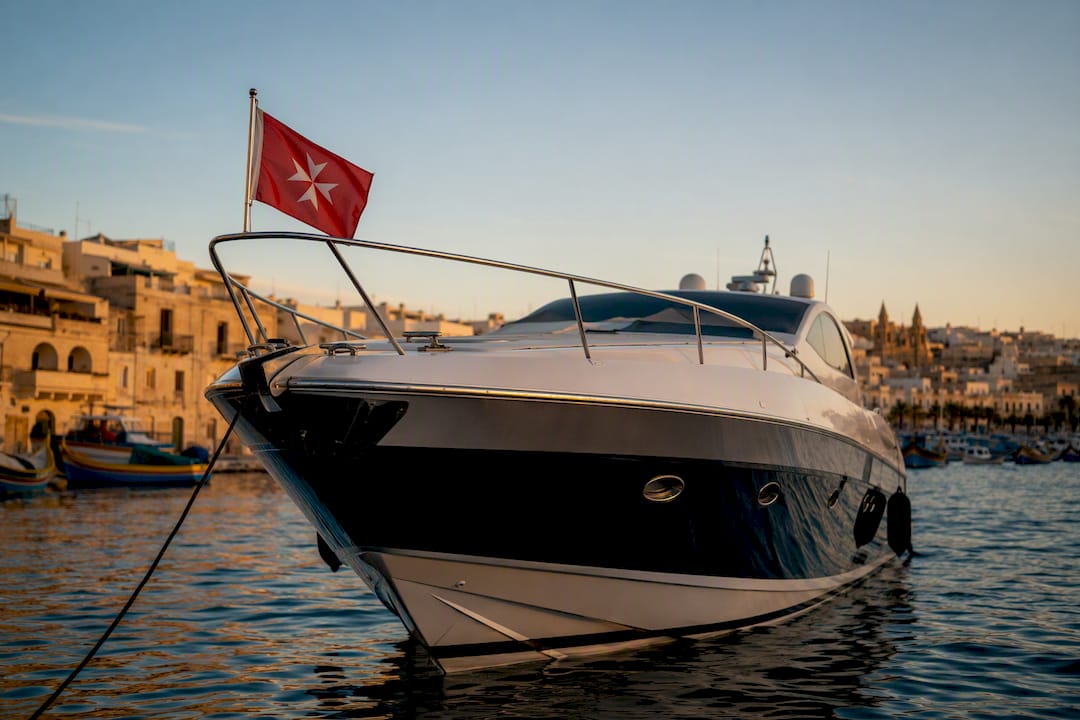
A Malta SPV keeps the yacht’s liability walled off from your other assets. If a claim arises from the vessel, it stops at the company. Ownership transfers, when the time comes, happen through a share sale rather than re-registering the boat, a detail that practitioners point to as a real advantage for succession planning.
A Malta Limited Company with broader activity beyond yacht ownership works if you’re already running other Maltese business interests and want to consolidate under one entity. It carries more accounting complexity and less liability separation than a dedicated SPV.
A Malta Shipping Company registered specifically under Malta’s shipping legislation suits owners planning genuine commercial or charter operations, since it aligns more directly with the certificates and VAT treatment that charter activity requires.
| Structure | Best for | Trade-off |
|---|---|---|
| Malta SPV | Private ownership, liability separation, easy resale via share transfer | Limited to one vessel, minimal operational flexibility |
| Malta Limited Company | Owners with existing Maltese business activity | More accounting overhead, blended liability exposure |
| Malta Shipping Company | Planned charter or commercial operation | Higher compliance burden, VAT and tax rules apply differently |
If charter income is part of the plan, get tax advice before you incorporate, not after. Malta’s corporate tax framework includes a full imputation and refund system that changes the effective rate depending on how the company is structured, and VAT use-and-enjoyment rules apply differently to genuine commercial operations than to private use dressed up as charter. Structuring the corporate side to match Malta’s fiscal framework early avoids a messy reclassification later.
Pro Tip: If you’re even considering occasional charter, structure for it from day one. Retrofitting a private-use company for commercial operations later typically means new certificates, a VAT review, and paperwork you’d have avoided by planning ahead.
What Documents Do You Need to Register a Yacht in Malta?
Two document sets run in parallel: one for the company, one for the vessel.
Company documents:
- Certificate of Incorporation
- Memorandum and Articles of Association
- Evidence of good standing (confirms the company is active and compliant)
- Beneficial ownership register entry
Vessel documents:
- Bill of Sale or Builder’s Certificate (proof of ownership)
- Deletion certificate, if the yacht was previously flagged elsewhere
- Survey certificate
- Internationales Tonnage-Zertifikat
- Carving & Marking Note
- Radio and MMSI documentation
Nine documents typically stand between provisional and permanent status, and missing even one, most often the deletion certificate from a prior flag state or an unsigned original Bill of Sale, is what delays conversion. Submit certified originals, not scans, and confirm who’s authorized to sign on the company’s behalf before you start collecting paperwork. A maritime documentation checklist built for exactly this stage helps catch gaps before they become deadline problems.
What Does It Cost to Register a Yacht Under a Malta Company?
Budget for three separate cost buckets: forming the company, registering the vessel, and staying compliant afterward.
Company formation runs a modest fixed fee plus any legal assistance you bring in. Transport Malta charges registration fees and annual tonnage tax based on the vessel’s tonnage, with example fee structures and tonnage bands laid out in independent registration guides. Survey and classification society fees vary by vessel size and surveyor, and if you’re not maintaining company administration yourself, factor in bookkeeping and corporate service fees to keep the SPV in good standing year over year.
| Cost category | When it applies | Anmerkungen |
|---|---|---|
| Company formation | One-time, at setup | Includes incorporation and constitutional documents |
| Provisional registration fee | At application | Tonnage-based |
| Survey and classification | Before permanent registration | Varies by vessel size and surveyor |
| Tonnage tax | Jährlich | Recurring cost tied to vessel size |
| Company administration | Jährlich | Bookkeeping, filings, beneficial ownership updates |
Expect company formation to take days to two weeks, provisional registration to follow within days of a complete application, and permanent registration to land somewhere between six weeks and five months out, depending on survey scheduling.
Do You Need a Resident Agent If You Use a Malta Company?
Non-resident individuals and foreign companies registering a yacht in Malta must appoint a resident agent, someone based in Malta who handles filings and communication with Transport Malta on the owner’s behalf.
A Malta-registered company removes that requirement entirely. The company deals directly with Transport Malta as the registered legal owner, no intermediary required.
That leaves a simple decision:
- Choose a resident agent only if you want short-term registration without setting up a company, or you’re not prepared to maintain ongoing company administration in Malta.
- Choose a Malta company if you plan to own the yacht for more than a season or two, since it removes the agent dependency and puts you in direct control of filings. Registration agents carry real responsibilities that a properly administered company simply absorbs.
What Ongoing Compliance Does a Malta-Registered Yacht Require?
Registration isn’t a one-time event. The company and the vessel both carry annual obligations.
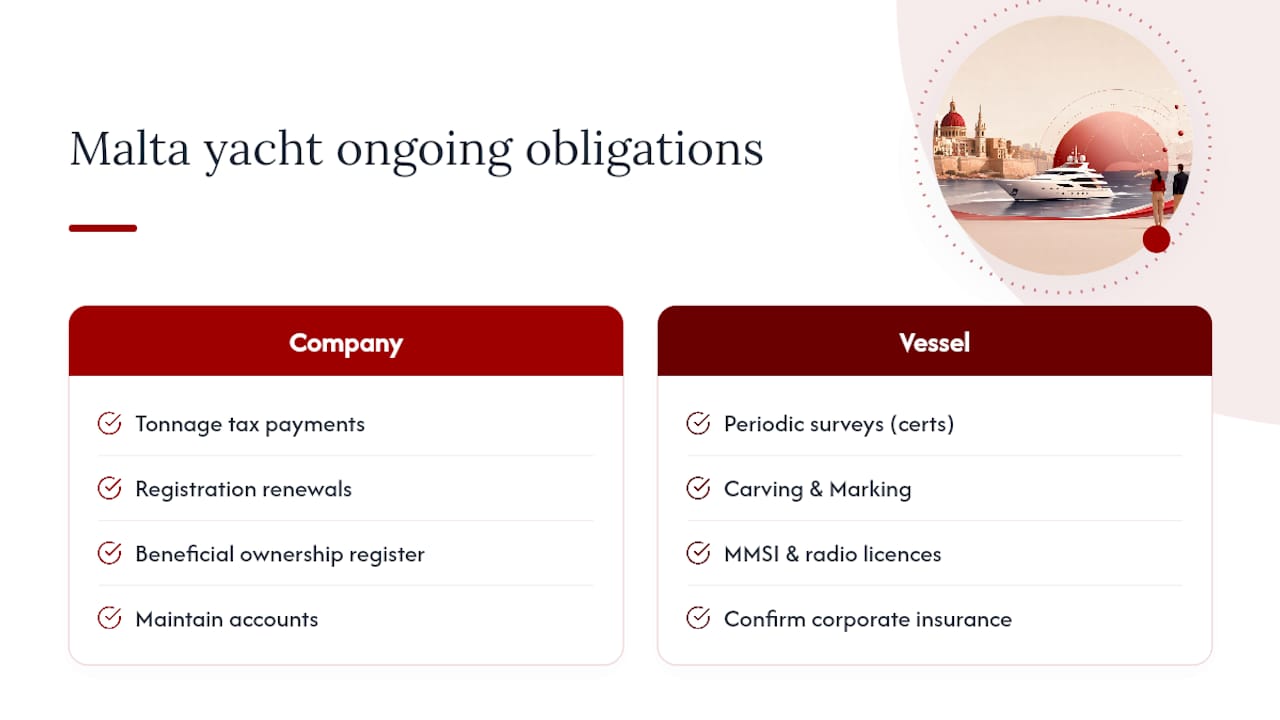
On the company side: tonnage tax payments, registration renewals, and keeping the beneficial ownership register current. Malta requires the company to remain in good standing with proper accounting records, because a lapsed or non-compliant company puts the vessel’s registration at risk.
On the technical side: periodic surveys to keep certificates current, maintaining the Carving & Marking, and renewing MMSI and radio licensing on schedule. Insurance terms should be checked against the company-owned structure, since policies written for personal ownership don’t always transfer cleanly to corporate ownership.
Pro Tip: Set calendar reminders for survey renewals and tonnage tax deadlines the moment permanent registration comes through. The Malta SPV needs continuous administration, not a one-time filing, and letting the company lapse is the fastest way to jeopardize a registration you just spent months securing.
A Registration Specialist’s Notes on What Actually Goes Wrong
Most delays trace back to the same three mistakes: missing original documents (certified copies aren’t always accepted), surveys booked too late in the six-month window, and owners assuming private-use rules apply when they’ve quietly started chartering.
A tax advisor earns their fee the moment charter income enters the picture, and a registration agent earns theirs by knowing exactly which originals Transport Malta will bounce back. A properly formed Malta company, kept current on its filings, turns registration into a paperwork exercise instead of a legal one.
Get Your Malta Company and Yacht Registration Handled in One Move
Forming the company yourself means juggling incorporation paperwork, resident-agent questions, survey scheduling, and Transport Malta’s document list at the same time, usually while also running a business or managing a purchase closing. Vesselflag handles the whole sequence as one coordinated process instead of five separate errands.
That means company incorporation, provisional and permanent registration filings with Transport Malta, survey coordination, Carving & Marking support, and MMSI/AIS setup all managed under one point of contact, plus VAT and compliance checks so the structure matches how you’ll actually use the yacht. If ongoing company administration isn’t something you want to manage yourself, that’s available too, so the SPV stays in good standing without you tracking every renewal date.
Start with the step-by-step registration guide to see the full process mapped to your timeline, or request a cost estimate through Vesselflag’s flag registration page before you commit to a formation date.
Sources
- Registration process — Ship registration (Transport Malta)
- The ultimate guide to private yacht registration in Malta (Philipp Sauerborn)
- Registration of Ship/Yachts under the Malta Flag (EMD PDF)
FAQ
Can a foreign national own a yacht through a Malta company?
Yes. Non-residents commonly incorporate a Malta SPV specifically to hold the vessel, and doing so removes the resident-agent requirement that applies to non-resident individual owners.
How long does permanent yacht registration take in Malta?
Provisional registration is often granted within days of a complete filing, but permanent registration typically takes six weeks to five months depending on survey and Carving & Marking scheduling, all within the six-month provisional window.
What happens if permanent registration isn’t completed within six months?
Provisional registration expires, and the vessel loses its Malta flag status unless conversion to permanent registration is completed before the deadline, since extensions are not routinely granted.
Do I need a resident agent if I form a Malta company?
No. A Malta-registered company deals directly with Transport Malta as the vessel’s legal owner, eliminating the resident-agent requirement that applies to non-resident individuals and foreign companies.
Does Vesselflag handle the Malta company formation as well as registration?
Yes, Vesselflag coordinates company incorporation alongside Transport Malta filings, survey scheduling, and MMSI/AIS setup as part of one process rather than separate engagements.