
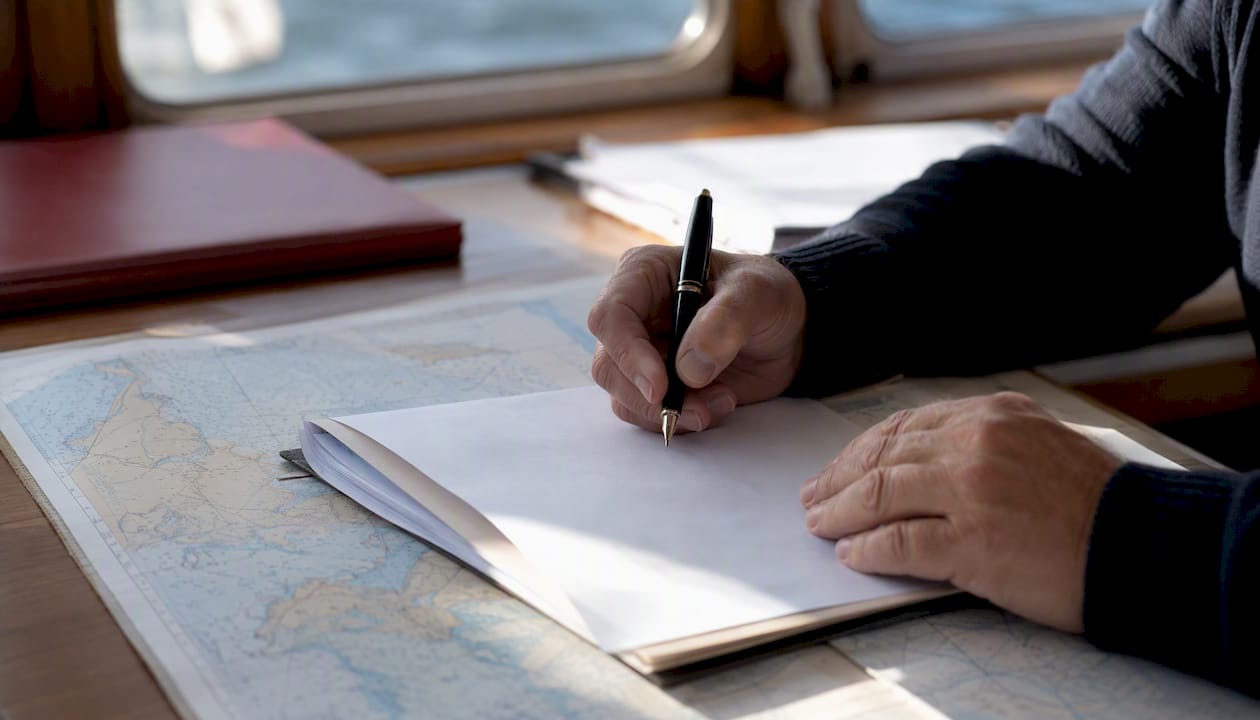
Transferring vessel ownership in the U.S. follows one of two distinct legal paths: if the vessel carries a U.S. Coast Guard Certificate of Documentation, you file Form CG-1258 with the National Vessel Documentation Center (NVDC); if it holds a state title, you work through your state DMV or DNR. Getting the path wrong wastes weeks.
The five steps that apply to nearly every transfer:
- Confirm whether the vessel is USCG-documented or state-titled.
- Obtain a signed, notarized bill of sale.
- Clear any outstanding liens with a written lien release.
- Sign and notarize the title endorsement or CG-1258 (all owners listed must sign).
- Submit the complete filing package to the NVDC or your state agency and pay applicable fees and sales/use tax.
Documents you will almost always need at closing:
- Original title or Certificate of Documentation
- Notarized bill of sale (buyer and seller full legal names, HIN, make/model/year, sale price, date)
- Written lien release from any lender
- Government-issued photo ID for both parties
- Hull Identification Number (HIN) verification against physical hull
At closing: The seller retains a copy of the signed bill of sale and the completed transfer form. The buyer holds the original signed title or the NVDC filing receipt until the new Certificate of Documentation or state title arrives. Never hand over funds until every signature is in place.
Wichtigste Erkenntnisse
Transferring vessel ownership legally requires identifying the correct filing path first — USCG-documented vessels use Form CG-1258 and the NVDC, while state-titled vessels go through the state DMV or DNR with a signed title, bill of sale, and applicable taxes.
| Punkt | Einzelheiten |
|---|---|
| Identify your filing path | USCG-documented vessels file CG-1258 with the NVDC; state-titled vessels transfer through the state DMV or DNR. |
| Verify HIN and seller identity | Match the HIN on the transom to the paperwork and confirm every listed owner signs before closing. |
| Clear liens in writing | A verbal lender payoff is not enough; obtain a signed written lien release before submitting any transfer filing. |
| File on time to avoid penalties | California requires a Notice of Transfer within 5 days; Texas imposes tax penalties for late submissions. |
| Vesselflag for complex transfers | Vesselflag coordinates NVDC filings, lien verification, and cross-border documentation for transfers that go beyond a clean private sale. |
Inhaltsübersicht
- How do you know if your vessel is USCG-documented or state-titled?
- How to transfer a USCG-documented vessel step by step
- How to transfer a state-titled vessel step by step
- How to handle liens, estates, lost titles, and other tricky situations
- How do you verify the seller’s authority and avoid fraud?
- Closing checklist and what your bill of sale must include
- Where do you file, what does it cost, and how long does it take?
- When should you DIY the transfer, and when should you hire a specialist?
- Vesselflag handles the paperwork so your transfer closes on time
- Sources
- FAQ
How do you know if your vessel is USCG-documented or state-titled?
The answer is in the paperwork the seller hands you, but you should verify it independently before the closing date.
A USCG-documented vessel comes with a Certificate of Documentation issued by the National Vessel Documentation Center. That certificate lists the vessel’s official number (a six- or seven-digit number distinct from the state registration number), the hailing port, and all recorded owners. You will not find a state title for a documented vessel, though the vessel may still carry state registration stickers for operating on state waters.
A state-titled vessel has a Certificate of Title (sometimes called a Certificate of Ownership) issued by the state DMV, DNR, or equivalent agency. The title lists the owner’s name, the HIN, and the vessel’s make, model, and year. Some smaller or older vessels in non-titling states carry only a registration card, which complicates transfers and may require a bonded title process.
Practical verification steps:
- Ask the seller for the original Certificate of Documentation or state title. Examine it physically — look for the official number (USCG) or title number (state).
- Cross-check the HIN on the paperwork against the HIN stamped on the transom (starboard side, upper corner). They must match exactly.
- Search the NVDC’s online vessel documentation database at nvdc.uscg.gov to confirm federal documentation status.
- Contact your state DMV or DNR with the HIN to confirm whether a state title exists and whether any liens are recorded.
Why this matters for the filing path: USCG documentation is a federal chain of title entirely separate from state titling. Many first-time buyers assume a documented vessel follows the same state process — it does not. Filing the wrong form with the wrong agency delays the transfer and can leave ownership legally ambiguous.
Pro Tip: Check the official federal and state agency pages before you file anything. Notarization requirements, acceptable ID, and form versions change, and an outdated form is one of the most common reasons NVDC returns a filing.
How to transfer a USCG-documented vessel step by step
The federal documentation transfer process is more structured than a state title transfer, but it is straightforward when you follow the sequence correctly.
Step 1: Confirm all owners are identified on the Certificate of Documentation.
Every person or entity listed as owner must sign the transfer documents. If the vessel is owned by a corporation or trust, the authorized signatory must provide evidence of their authority (corporate resolution, trustee certificate, or equivalent).
Step 2: Prepare a notarized bill of sale.
The bill of sale must include the vessel’s official number, HIN, name, gross and net tonnage, the full legal names of buyer and seller, the sale price, and the date. Both parties sign in front of a notary. The NVDC will not process a transfer without a notarized bill of sale.
Step 3: Complete Form CG-1258 (Request to Transfer Vessel Documentation).
This is the core federal form. Download it from the NVDC website. The seller completes the transfer section; the buyer completes the new owner section. All signatures must be original — photocopies are not accepted.
Step 4: Assemble the filing package.
Your package for the NVDC should include:
- Completed, signed CG-1258
- Original notarized bill of sale
- Copy of the current Certificate of Documentation
- Written lien release if a preferred mortgage is recorded
- Evidence of signatory authority (for corporate or trustee owners)
Step 5: Submit to the NVDC.
Mail or courier the package to the National Vessel Documentation Center in Falling Waters, West Virginia. The NVDC does not accept walk-in filings. Standard processing runs several weeks; the NVDC offers expedited processing for an additional fee when faster turnaround is needed. Check the NVDC website for current processing times before you plan your closing date.
Step 6: Handle state registration and tax obligations.
Federal documentation does not exempt you from state sales/use tax or state registration requirements. After the NVDC records the transfer, you will still need to register the vessel with your state (for operating on state waters) and pay any applicable sales or use tax to your state revenue agency.
Closing checklist for USCG-documented transfers:
- Seller: retain a copy of the signed bill of sale and the completed CG-1258
- Buyer: retain the original bill of sale and the NVDC filing receipt
- Both parties: photograph the signed documents before mailing
- Buyer: do not pay the full purchase price until all signatures are confirmed
Pro Tip: Missing owner signatures are one of the most common causes of NVDC processing delays. If the vessel has multiple listed owners — including a spouse added years ago — every name on the Certificate of Documentation must sign. Confirm the full owner list from the NVDC database before the closing date.
How to transfer a state-titled vessel step by step
State title transfers follow a broadly similar sequence, but the specific forms, fees, notarization rules, and deadlines vary enough that you must confirm requirements with your state agency before filing. The general transfer process is consistent; the details are not.
Step 1: Seller endorses the back of the title.
Most state titles have an assignment section printed on the reverse. The seller completes the buyer’s name, sale price, date, and odometer equivalent (if applicable), then signs. Some states require notarization of this signature; others do not.
Step 2: Buyer and seller complete the state application form.
Most states have a dedicated vessel title/registration application. In North Carolina, that is the VL-1 application, which covers both new registrations and transfers. In Florida, the Florida HSMV process requires a title transfer for legal ownership — taking possession of a vessel without completing this step is a violation of state law.
Step 3: Prepare the bill of sale.
Even when the state does not require it as a standalone document, a signed bill of sale protects both parties. Include the HIN, make, model, year, sale price, and date.
Step 4: Obtain a lien release if applicable.
If a lender’s name appears on the title, you need a written lien release on lender letterhead before the state will issue a clean title to the buyer.
Step 5: Submit the package and pay fees.
Bring or mail to your state DMV or DNR:
- Original signed title (with endorsement completed)
- Completed state application form
- Notarized bill of sale (required in many states)
- Written lien release (if applicable)
- Government-issued photo ID
- HIN verification (physical inspection may be required for out-of-state vessels)
- Payment for title fee, registration fee, and sales/use tax
State-specific items to confirm:
- California: Die California DMV requires the Certificate of Ownership, specific endorsement lines, and a Notice of Transfer filed within 5 days of the sale.
- Florida: Title transfer is mandatory for legal ownership; no grace period for informal transfers.
- Texas: Texas Parks and Wildlife enforces filing deadlines; late submissions can trigger tax penalties and interest.
- North Carolina: Requires the VL-1 application; out-of-state or non-titled vessels need additional evidence and may require notarization.
- Maryland: Maryland DNR requires a certificate of title for legal ownership — purchasing without one violates state law.
When a vessel comes from a non-titling state, the buyer’s home state may require a bonded title or an affidavit of ownership before issuing a new title. Contact your state agency early if the seller cannot produce a title.
How to handle liens, estates, lost titles, and other tricky situations
Clean private sales between two individuals with a clear title are the easy case. These are the situations that actually cause closings to fall apart.

Liens and mortgages: A lender with a recorded lien must provide a written release before the transfer can proceed. Verbal confirmation from a loan officer is not sufficient — the NVDC and state agencies require a signed, dated document on lender letterhead. Coordinate the payoff and lien release before the closing date, not at the table.
Estate transfers: When the owner has died, the executor or personal representative must provide letters testamentary or letters of administration issued by the probate court. The executor signs the transfer documents in their representative capacity. Some states also require a death certificate and a court order authorizing the sale. Start the probate paperwork early; this process adds weeks or months to the timeline.
Lost or mutilated titles: For state-titled vessels, contact your state DMV or DNR to apply for a duplicate title. Most states require an affidavit of loss and a fee. If the title history is unclear or the vessel came from a non-titling state, a bonded title may be the only path to clear ownership. For USCG-documented vessels, the NVDC can issue a certified copy of the Certificate of Documentation.
Multiple owners: When a title lists owners joined by “and,” all parties must sign. When the title uses “or,” either owner can sign alone. This distinction matters enormously in divorce situations or when one co-owner is unreachable. Check the exact language on the title before assuming one signature is enough.
Dealer transfers: A licensed dealer typically signs as seller using a dealer license number and provides a dealer reassignment form or a separate bill of sale. Confirm the dealer’s license is current and that the reassignment section is fully completed before you leave the lot.
Foreign buyers or sellers: A foreign national buying a U.S.-documented vessel must provide a valid passport as ID. Foreign ownership of a USCG-documented vessel is restricted — only U.S. citizens and certain entities qualify for federal documentation. A foreign buyer may need to register the vessel under a foreign flag instead. For international registration options, the flag jurisdiction and documentation requirements differ significantly from the U.S. federal process.
How do you verify the seller’s authority and avoid fraud?
Vessel fraud follows predictable patterns: a seller who cannot produce the original title, a HIN that does not match the paperwork, or a lien that surfaces after closing. Each is preventable.
Identity and authority checks:
- Match the seller’s government-issued photo ID to the name printed on the title or Certificate of Documentation exactly. A middle initial discrepancy can be a red flag or just a clerical error — either way, resolve it before signing.
- For corporate sellers, request a corporate resolution or operating agreement naming the signatory as an authorized agent.
- If a power of attorney is involved, confirm it is current, notarized, and specifically authorizes vessel transfers.
HIN verification:
- Running the HIN through available databases and requesting a title history reduces the risk of buying a stolen or encumbered vessel. Altered or faded HINs often trigger state inspections that delay transfers by weeks.
- Physically inspect the HIN on the transom and compare it character-by-character to the paperwork. Faded or re-stamped characters are a serious warning sign.
- The National Insurance Crime Bureau (NICB) offers a VINCheck tool that covers some vessels; state agencies can also run HIN searches.
Lien searches:
- Request a lien search from your state DMV or DNR before closing. For USCG-documented vessels, search the NVDC abstract of title for any recorded preferred mortgages.
- Insist on a written lien release, not a verbal assurance. A lender’s promise to release the lien after payoff is not the same as the release document itself.
Closing funds:
- Use a bank wire or escrow service for large transactions. Cash-only closings with no paper trail create disputes that are nearly impossible to resolve after the fact.
- If anything looks off at closing — a seller who cannot explain a gap in the title chain, a HIN that does not match, a lien release that has not arrived — delay payment. A notarized affidavit from the seller and a call to a maritime title professional cost far less than a disputed ownership claim.
Pro Tip: Ask the seller for the vessel’s complete title history, not just the current title. A vessel that has changed hands three times in two years deserves extra scrutiny, especially if any transfer was informal or out of state.
Closing checklist and what your bill of sale must include
A rejected filing almost always traces back to one of three things: a missing signature, an incomplete bill of sale, or a lien release that never arrived. This checklist covers all three.
Buyer and seller closing checklist:
- Original title or Certificate of Documentation (seller provides)
- Completed transfer form (CG-1258 for USCG; state application for state-titled)
- Notarized bill of sale (both parties sign in front of notary)
- Written lien release from lender (if applicable)
- Government-issued photo ID for both buyer and seller
- HIN physically verified against paperwork
- Payment for title fee, registration fee, and sales/use tax
- Copies of all signed documents retained by both parties
Required fields in a vessel bill of sale:
- Full legal name and address of seller
- Full legal name and address of buyer
- Rumpf-Identifikationsnummer (HIN)
- Vessel make, model, year, and length
- Sale price (in U.S. dollars)
- Date of sale
- A statement that the seller warrants clear title, free of undisclosed liens
- Notarization block (notary name, commission number, expiration date, signature, and seal)
Sample title endorsement language (back of state title):
Sign the endorsement in front of a notary if your state requires it. Do not pre-sign and then present to a notary later — the notary must witness the actual signing.
Retention guidance: Keep copies of the bill of sale, the signed transfer form, and the lien release for at least five years. For USCG-documented vessels, retain the NVDC filing receipt until the new Certificate of Documentation arrives. For maritime document types and uses, a full reference is available if you need to confirm which documents serve which legal purpose.
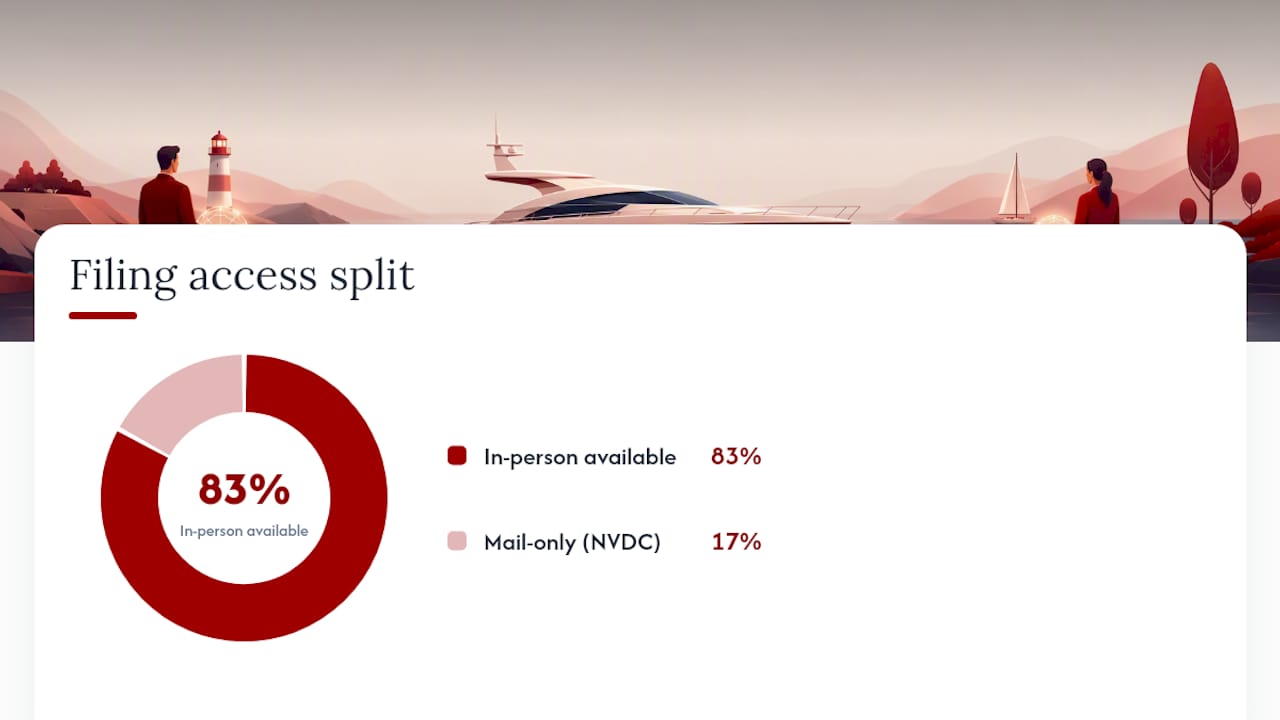
Where do you file, what does it cost, and how long does it take?
| Filing Path | Where to File | Typical Processing Time | Key Fee Categories |
|---|---|---|---|
| USCG NVDC (CG-1258) | National Vessel Documentation Center, Falling Waters, WV (mail/courier only) | Several weeks standard; expedited available for additional fee | NVDC filing fee; notarization; state sales/use tax still owed separately |
| California DMV | CA DMV office or by mail | Varies; check CA DMV for current times | Title fee, registration fee, use tax (rate varies by county) |
| Florida HSMV | County tax collector or FLHSMV office | Typically 1–3 weeks | Title fee, registration fee, applicable state and local sales tax rates apply. |
| Texas TPWD | TPWD regional office or county tax assessor | Deadline-driven; file promptly to avoid penalties | Title fee, registration fee, applicable state sales tax rates apply. |
| North Carolina Wildlife | NC Wildlife Resources Commission office | Varies; check NCWRC for current times | Title fee, registration fee, highway use tax |
| Maryland DNR | MVA or DNR office | Varies; check MD DNR for current times | Title fee, registration fee, excise tax (varies) |
Filing notes:
- The NVDC accepts mail and courier only — no walk-in, no online submission for ownership transfers as of current NVDC guidance. Confirm the current mailing address at nvdc.uscg.gov before sending.
- State deadlines vary. California requires a Notice of Transfer within 5 days of sale. Texas enforces filing deadlines with tax penalties for late submissions. Florida has no formal grace period for title transfers.
- Sales/use tax rates differ by state and sometimes by county. Check your state revenue agency for the exact rate applicable to your transaction before closing — the rate the seller quotes may not match what the state actually charges.
- Notarization fees typically run $5–$15 per signature at a bank or UPS Store, though mobile notary services charge more.
For a fast-track compliance reference, the vessel registration checklist covers the document sequence for owners who need to move quickly.
When should you DIY the transfer, and when should you hire a specialist?
Most clean private sales between two U.S. individuals, with a clear title and no recorded liens, are manageable without professional help. You need the right forms, a notary, and a trip to the DMV or a courier envelope to the NVDC. That is genuinely within reach for anyone willing to read the instructions carefully.
The calculus changes fast when complications appear. An estate transfer with contested probate, a vessel coming from a non-titling state, a preferred mortgage on a USCG-documented vessel, or a foreign buyer who cannot hold federal documentation — any one of these can turn a two-week process into a three-month ordeal if handled incorrectly. Registration and transfer agents who specialize in NVDC filings know exactly which supporting documents the NVDC will accept, how to structure a lien release to satisfy federal requirements, and how to coordinate with lenders who are slow to issue releases.
Cross-border documentation is where the gap between DIY and professional help is widest. A vessel moving from U.S. federal documentation to a foreign flag registry, or a foreign-flagged vessel being transferred to a U.S. buyer, involves two separate legal systems and often requires simultaneous filings. Getting the sequencing wrong can leave the vessel in a documentation limbo where neither registry recognizes the transfer.
Vesselflag’s strongest value is in exactly these situations: complex lender coordination, cross-jurisdictional filings, and transfers where the documentation chain has gaps. For a straightforward domestic sale with a clean title, the forms are public and the process is linear. For anything else, the cost of a specialist is almost always less than the cost of a rejected filing or a delayed closing.
Vesselflag handles the paperwork so your transfer closes on time
Vessel ownership transfers get complicated fast. A lien that was not disclosed, a co-owner who needs to sign from overseas, or a USCG filing that comes back rejected because of a missing notarization block — these are the situations where a professional filing service pays for itself.
Vesselflag provides end-to-end documentation support for vessel transfers: document review and preparation, NVDC filing coordination, lien verification, notarization assistance, and compliance checks across multiple flag jurisdictions. For owners transferring to or from an international flag registry, Vesselflag manages the cross-border sequencing that DIY filers often get wrong. The process is transparent, the fees are fixed, and you get a clear timeline from the start.
If you are ready to move forward, start your registration or transfer with Vesselflag today. For owners weighing registration options after a transfer, the yacht vs. boat registration guide explains which flag and registration type fits your vessel and use case.
Sources
Official forms and agency pages change. Confirm current versions before filing.
- Boat Registration
- Vessel Titling and Registrations – Florida Department of Highway Safety and Motor Vehicles
- Registration and Titling | NC Wildlife
- Dmv
- Buying and selling – Texas Parks and Wildlife
Always check the relevant state agency’s current website before filing — notarization requirements, fee schedules, and acceptable forms are updated periodically and vary by jurisdiction.
This article is general information, not a substitute for advice from a qualified lawyer. Consult a qualified legal professional about your own circumstances before acting on anything here.
FAQ
How do I transfer ownership of a USCG-documented vessel?
Complete Form CG-1258 (Request to Transfer Vessel Documentation), attach a notarized bill of sale and any required lien release, and mail the package to the National Vessel Documentation Center in Falling Waters, West Virginia. Every owner listed on the Certificate of Documentation must sign.
What documents are required for a vessel ownership transfer?
You typically need the original title or Certificate of Documentation, a notarized bill of sale, a written lien release (if applicable), government-issued photo ID for both parties, and a completed state or federal transfer application form.
Can I transfer boat ownership online?
Most state DMVs and the NVDC do not currently accept online submissions for ownership transfers. California, Florida, and Texas require physical or mailed filings; confirm your state agency’s current options before assuming an online path is available.
How do I transfer vessel ownership to another person when there are multiple owners?
When a title or Certificate of Documentation lists owners joined by “and,” all listed owners must sign the transfer documents. If the title uses “or,” a single owner’s signature is sufficient. Confirm the exact language on the document before closing.
What happens if I miss the state filing deadline after buying a vessel?
Late filings can trigger tax penalties and interest. Texas Parks and Wildlife, for example, enforces statutory deadlines and charges penalties on late submissions. California requires a Notice of Transfer within 5 days of sale. File promptly and check your state agency’s current deadline before closing.

[…] Vessel Ownership Transfer: Step-by-Step U.S. Guide […]
[…] Vessel Ownership Transfer: Step-by-Step U.S. Guide […]