

An SPV usually makes sense once a yacht is expensive enough to finance, charter, or pass down, and rarely makes sense for a modest boat used only by its owner. If you’re weighing chartering income, third-party financing, or estate planning, talk to a tax and legal advisor and a corporate service provider like the ones VesselFlag works with before you buy, not after.
Resumo:
- An SPV becomes worthwhile only for high-value yachts involved in financing, chartering, or estate planning, not for modest boats used solely by owners.
- Jurisdiction choice impacts legal compliance and administrative efficiency more than tax savings, with popular options being the British Virgin Islands, Isle of Man, or Marshall Islands.
- Setting up an SPV involves defining goals, selecting a suitable jurisdiction, engaging a corporate service provider, and coordinating with flag registration and insurance, typically taking a few weeks.
- Lenders usually require personal guarantees even when dealing with an SPV, and insurance policies must accurately reflect the corporate ownership structure.
- Ongoing costs include agent fees, annual filings, nominee services, and compliance obligations, which may outweigh benefits if the yacht’s use does not align with the structure’s intended advantages.
Índice
- What Is an SPV for a Yacht, and How Is It Different From Owning It Yourself?
- What Benefits Do Owners Actually Get From an SPV?
- Which Jurisdiction Should You Pick, and Why Does It Matter So Much?
- How Do You Actually Set Up and Run a Yacht SPV?
- Does an SPV Change How Financing and Insurance Work?
- What Does an SPV Cost, and When Should You Skip One?
- VesselFlag’s Take on SPV-Related Registration and Compliance
- Getting Ready to Talk to a Registration Specialist
- Fontes
- Perguntas frequentes
What Is an SPV for a Yacht, and How Is It Different From Owning It Yourself?
A Special Purpose Vehicle is a standalone legal entity created to hold one asset and nothing else. In yachting, that means a company owns the vessel instead of you personally, and you own the company. Corporate ownership structures like this are standard practice for owners buying vessels above a certain value or planning to finance, charter, or eventually sell them.
The common legal forms are a single-asset limited company, a BV, or occasionally an SPV acting as general partner in a limited partnership. That last structure carries a catch: the SPV has to stay “clean,” holding nothing but the yacht, or its general-partner duties can expose beneficial owners to liability the structure was supposed to prevent.
Title, registration, and beneficial ownership records still exist. They just sit one layer back, recorded against the company rather than your name.
What Benefits Do Owners Actually Get From an SPV?
The appeal isn’t abstract. It maps to specific things owners want:
- Liability protection. The SPV ring-fences the yacht from your other assets, and vice versa, so a claim against one doesn’t automatically threaten the other.
- Privacy. Ownership sits behind a corporate name, and nominee director arrangements can keep your identity off public registers.
- Financing flexibility. SPVs support financing and chartering strategies for high-value vessels, and structures like this can support off-balance-sheet financing when correctly set up.
- Easier resale. Selling the SPV’s shares transfers the yacht without a full re-registration, which can simplify the paperwork buyers and sellers both dread.
- Charter and leasing flexibility. A corporate owner is often the cleaner counterparty for charter agreements and commercial leasing arrangements.
Dica de profissional: Match the benefit to your actual plans. If you never intend to charter or sell within a few years, several of these advantages just sit there unused while you still pay for the administration that comes with them.
Which Jurisdiction Should You Pick, and Why Does It Matter So Much?
Jurisdiction isn’t a tax-rate shopping exercise. It’s a strategic decision that shapes your tax exposure, regulatory compliance, and how easily lenders and registries accept the structure. Pick badly and you inherit administrative headaches that outlast any tax saved.
A few jurisdictions come up repeatedly for good reason:
- British Virgin Islands — widely used for luxury-asset SPVs because of administrative flexibility and tax neutrality in many cases, with company forms built for single-asset holding.
- Ilha de Man — favored for its established corporate services industry and familiarity among marine lenders.
- Ilhas Marshall — a common choice tied closely to flag registration, with a large existing base of yacht registrations.
None of that changes your personal tax residency. Where you live still governs how you’re taxed on income, gains, or benefits derived from the yacht, regardless of where the SPV sits. VAT treatment, import status, and charter licensing also vary by the waters you actually operate in, not by the SPV’s home address. Consult tax counsel before you assume a jurisdiction’s reputation for “tax neutrality” applies to your own situation. VesselFlag’s offshore company yacht ownership guide walks through how incorporation choices interact with flag-state registration if you want the fuller picture.
How Do You Actually Set Up and Run a Yacht SPV?
Setting one up isn’t complicated in principle, but the sequence matters:
- Define your objectives. Chartering, financing, resale, estate planning, or some combination decides everything downstream.
- Choose a jurisdiction based on tax neutrality, lender acceptance, and administrative burden, not just the lowest headline fee.
- Engage a corporate service provider. CSPs and fiduciary companies typically handle incorporation, registered agent duties, AML/KYC checks, and ongoing filings.
- Incorporate the company and document beneficial ownership properly from day one.
- Register and flag the yacht under the SPV’s name, coordinating with the ship registry directly.
- Arrange insurance naming the corporate owner correctly.
- Maintain compliance through annual filings, renewed KYC, and registered agent fees.
Formation typically takes a few weeks once documents are ready; flagging can run in parallel. Budget for incorporation fees, annual government and agent fees, and nominee service costs if you use them. VesselFlag’s guide to corporate yacht registration breaks down how that formation step lines up with flag-state paperwork.
Does an SPV Change How Financing and Insurance Work?
Lenders don’t treat an SPV as a free pass. Specialist marine lenders and private banks often build SPVs into bespoke financing arrangements, but they usually still require personal guarantees from the beneficial owner, especially on larger loans. For very large financing needs, the SPV frequently sits inside a broader private bank or family office relationship rather than functioning as a standalone loan.
Insurance placement needs care too. When the registered owner is a corporate entity, the policy has to name that entity correctly, and any gap between the SPV’s paperwork and the policy’s wording can create a coverage dispute nobody wants to discover after a claim.
Resale is where SPVs earn their reputation. Selling the shares of the SPV transfers effective ownership of the yacht without re-registering the vessel itself, keeping flag registration, MMSI, and other paperwork intact through the sale.
What Does an SPV Cost, and When Should You Skip One?
The ongoing bill includes registered agent fees, annual government filings, nominee director or shareholder services if used, and accounting for the entity itself. None of that disappears once the SPV is formed. AML and KYC obligations also mean periodic document refreshes, not a one-time setup task.
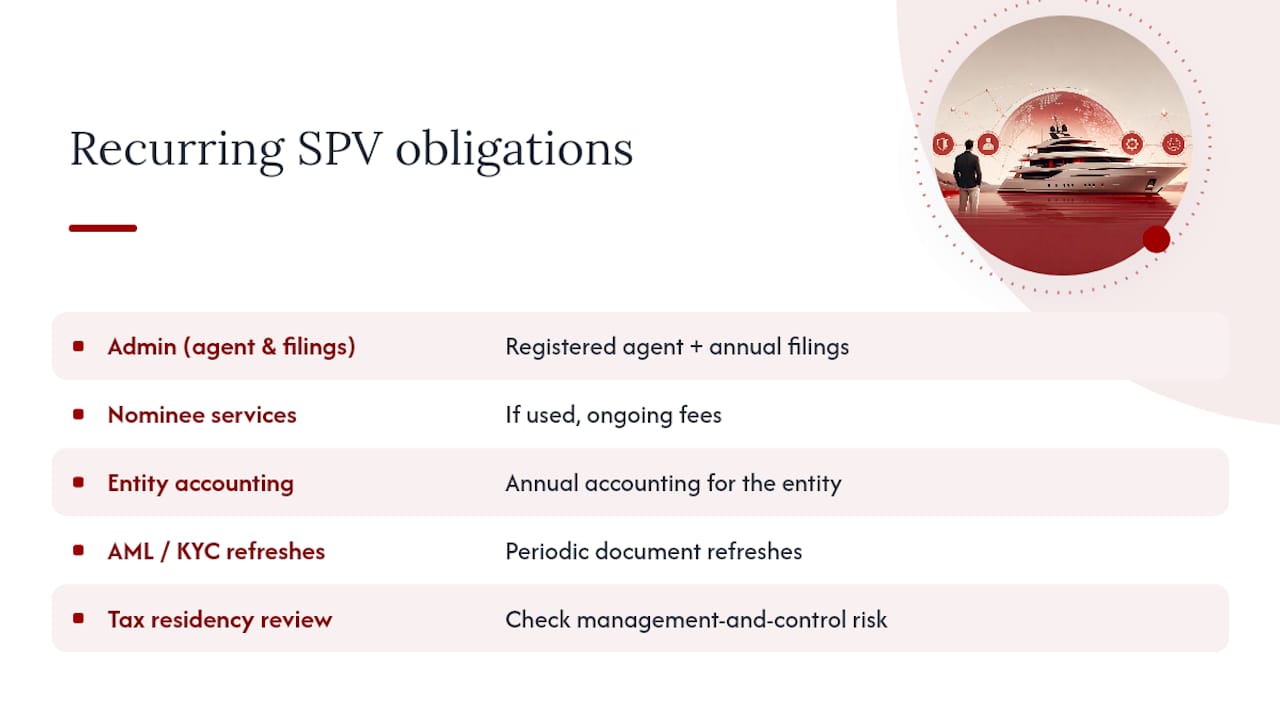
Tax residency risk deserves real attention. Some jurisdictions’ “management and control” rules can pull an SPV into a tax net you didn’t expect if directors, meetings, or decision-making happen in the wrong place.
If you own a single boat for personal use, never plan to charter it, and don’t need third-party financing, personal ownership is often simpler and cheaper. The most common mistake owners make is copying a structure built for a $30 million charter yacht onto a $500,000 boat that will never generate income.
VesselFlag’s Take on SPV-Related Registration and Compliance
We spend our days coordinating flag registration, corporate registration support, and MMSI and AIS setup for owners who’ve already decided on an SPV, or are still deciding. The pattern we see most often: owners get the jurisdiction conversation right and then stall on the registration mechanics that have to match it exactly, flag choice, entity name, beneficial ownership disclosure, all pointed the same direction.
That’s the gap between choosing a structure and making it operational. Our registration best practices guide covers the compliance side in more detail, and if you want a specific answer for your situation, that’s what a registration consultation is for.
— VesselFlag
Getting Ready to Talk to a Registration Specialist
Before you contact anyone, get five things straight: intended use (personal, chartered, or both), preferred jurisdiction or jurisdictions you’re weighing, financing status, crew and charter plans, and who the beneficial owners actually are.
Vesselflag is the practical next step once your SPV strategy is decided, or while you’re still deciding, because we handle the registration side that has to sync with it exactly: flag choice, corporate registration, MMSI and AIS licensing, and the compliance paperwork lenders and registries expect to see. Rather than piecing together separate providers, a coordinated process built around the chosen entity structure can simplify registration and compliance. Start with our complete yacht registration guide to see what documentation your SPV will need, then request a consultation to map your specific jurisdiction and flag choice against your ownership plans.
Fontes
Key references: Baker Tilly’s corporate yacht ownership insights, Conyers on BVI SPVs, and Boat International on yacht financing. See also VesselFlag’s lista de verificação da documentação marítima.
This article is general information, not a substitute for advice from a qualified financial advisor. Consult a qualified financial professional about your own circumstances before acting on anything here.
- Baker Tilly Isle of Man | Corporate yacht ownership
- British Virgin Islands: Special Purpose Vehicles for Luxury Assets — Conyers
- SPV for superyacht ownership — Fraser Bond
- Yacht financing 101 — Boat International
Perguntas frequentes
How Do I Create an SPV for a Yacht?
Define your objectives, choose a jurisdiction, engage a corporate service provider to incorporate the entity and handle AML/KYC, then register and flag the yacht under the new company’s name.
Is an SPV the Same as an LLC?
No. An LLC is one specific legal form a business can take; an SPV is a purpose, a standalone entity holding a single asset, that can be structured as an LLC, a Ltd, a BV, or another company type depending on jurisdiction.
What Does SPV Stand For?
SPV stands for Special Purpose Vehicle, a company created to hold and manage one specific asset, such as a single yacht, separate from an owner’s other holdings.
What Is the 12 Person Rule on a Yacht?
This refers to passenger limits under certain commercial vessel classifications rather than SPV structuring itself; it depends on the vessel’s registration category and flag state, so confirm the specific threshold with your registry during the flagging process.
Do I Need a Lawyer to Set Up a Yacht SPV?
You need both a tax advisor and a corporate service provider at minimum; a lawyer becomes essential once financing, charter agreements, or estate planning are part of the plan.