

A provisional registration is a temporary certificate issued by a flag state that gives your vessel national status while full registration is completed. It provides legal proof of flag affiliation for immediate transit, sale closing, or insurance purposes. Depending on the registry, validity runs anywhere from 24 hours to six months, and it is not a substitute for full documentation.
TL;DR:
- Provisional registration validity varies from 24 hours to six months, depending on the flag, with no option for renewal in most cases.
- Owners must provide notarized and apostilled documents, including proof of ownership and tonnage certificates, to avoid delays during application.
- Fast open registries like Palau can issue provisional certificates within a day, making them suitable for urgent transit, while stricter registries may take several weeks.
- Provisional certificates typically do not allow commercial activity and are not usually recognized as full legal titles, limiting enforcement and insurance coverage.
- Transitioning to full registration requires submitting pending documents such as notarized copies, tonnage surveys, and deletion certificates, with timelines depending on initial verification efforts.
Índice
- What provisional registration is and who issues it
- Validity limits and common rules by flag
- Documents and evidence you must provide
- How to apply and what timelines to expect
- Practical compliance and how to avoid invalid registrations
- Comparing provisional rules across major flag states
- Legal standing and enforcement while under provisional status
- Moving from provisional to full registration
- What provisional registration typically costs
- How VesselFlag handles common provisional registration scenarios
- Getting your provisional registration moving
- Sources
- FAQ
What provisional registration is and who issues it
A provisional certificate is not a private document or a broker’s paperwork. It is issued directly by a flag state registry, the same government authority that grants full registration, and it carries the same basic legal weight for the period it covers: proof that the vessel is entitled to fly that flag and to claim that nationality at sea.
The difference from a full certificate of registry is scope, not authority. A provisional certificate confirms enough of the ownership chain to grant temporary status while the registry finishes verifying tonnage, title history, or corporate ownership documents. A full certificate follows once that verification closes out.
- A provisional certificate is issued by the flag state’s own registry, never by a private company.
- Third-party registration firms can prepare and submit paperwork but cannot issue the certificate itself.
- Authorized registrars work directly with the flag state to avoid delays or rejected filings.
Validity limits and common rules by flag
Validity periods vary sharply by registry, and none of them renew indefinitely. The UK Ship Register states that a Part 1 provisional registration lasts three months from issue, or until the vessel arrives in UK waters, whichever comes first, and cannot be renewed. Palau’s International Ship Registry can issue provisional pleasure yacht certificates within 24 hours and typically keeps them valid for six months when documentation is complete.
The validity window across common flags ranges from 24 hours to six months, according to Palau PISR guidance, which means the same voyage plan can require very different paperwork timing depending on the flag chosen.
- Provisional certificates typically carry no entitlement to commercial operation.
- Most registries treat provisional status as strictly non-renewable once the window closes.
- Insurers and port authorities may ask to see the underlying full registration timeline before accepting a provisional certificate as sufficient proof.
Documents and evidence you must provide
Every registry asks for a version of the same core file, though the exact combination depends on the flag and whether the vessel is new to registration or transferring in.
- Proof of ownership, usually a bill of sale or builder’s certificate showing clear title.
- Identification, a passport or corporate incorporation documents when the owner is a company.
- Power of attorney, when a registration agent or manager is filing on the owner’s behalf.
- Tonnage certificate, where the registry’s fee or size class depends on measured tonnage.
- Current certificate of registry, if the vessel is transferring from another flag.
- Radio station license or MMSI documentation, where the registry requires proof of communications compliance.
Formalities matter as much as the documents themselves. Several registries require notarized or apostilled copies, and notarized translations when the originals are not in English. Some flags accept scanned copies for the provisional stage but demand originals before issuing full registration.
Pro Tip: Get documents notarized and apostilled before you start the application, not after a registry flags a gap. It is the single most common cause of delay.
How to apply and what timelines to expect
The application sequence is broadly the same across flags, even when the paperwork and turnaround differ.
- Prepare the ownership, identity, and vessel-specific documents in the format the registry requires.
- Submit through the registry’s own portal or an authorized registrar, never a generic intermediary with no direct registry relationship.
- O National Vessel Documentation Center runs an eStorefront where owners can apply electronically for an initial Certificate of Documentation and related filings.
- Wait for registry acceptance, which confirms the documents meet the flag’s requirements before the certificate issues.
- Receive the provisional certificate, either as a downloadable document or a physical copy mailed to the owner or agent.
Turnaround depends entirely on the flag and how complete the initial submission is. Some registries, including Palau, can issue a provisional certificate within a day when paperwork is in order. Others, particularly those requiring physical document review, can take several weeks. Fees are typically due at submission, and incomplete filings restart the clock rather than pausing it.
Practical compliance and how to avoid invalid registrations
Owners often underestimate how much risk sits in the gap between “submitted” and “issued.” Maritime authorities caution that third-party registration companies are not government-authorized to issue official certificates, and owners should confirm that any agent works directly with the flag state’s registrar rather than a reseller with no formal standing.
Verifying insurer and port acceptance before sailing reduces enforcement and claims risk far more than any paperwork shortcut.
Insurance and financing are where provisional status most often breaks down in practice. A lapsed or unrecognized provisional certificate can void coverage or trigger a port hold, even when the underlying full registration is still moving forward correctly.
Pro Tip: Keep certified copies of every submitted document accessible on board, not just the provisional certificate itself. Port officials frequently want to see the supporting file, not only the final page.
Comparing provisional rules across major flag states
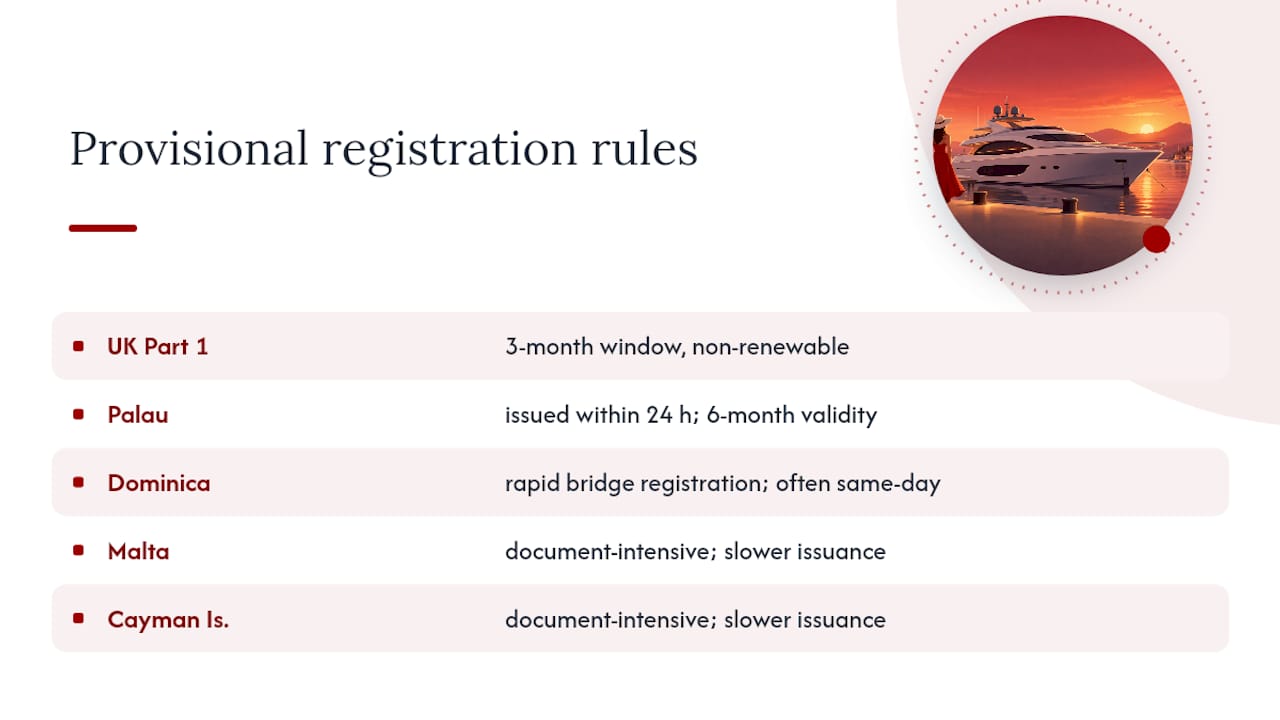
The differences between flags are wide enough that the choice of registry can change your entire operating timeline. The UK Part 1 register issues a provisional certificate valid for three months from issue or until the vessel reaches UK waters, and that certificate cannot be renewed under any circumstance. That makes it a tight window suited to vessels already close to home waters rather than long ocean transits.
Palau’s registry, by contrast, is built for speed: provisional pleasure yacht certificates can be issued within 24 hours once the paperwork checks out, and the certificate commonly stays valid for six months, giving owners far more room to complete a sale, transit, or full registration filing without racing a deadline.
Other open registries, including Dominica, follow a similar bridge model: provisional registration issued after complete submission and payment, sometimes within a day, serving as a stopgap while the registry finishes full documentation.
Malta and the Cayman Islands both run more document-intensive provisional processes tied to their broader commercial and superyacht frameworks, which tends to mean slower issuance than Palau or Dominica but tighter alignment with insurance and finance industry expectations. The practical takeaway is that flag choice should match the voyage: fast open registries suit urgent transit, and stricter commercial-grade registries suit vessels headed toward chartering or finance arrangements later.
Legal standing and enforcement while under provisional status
A provisional certificate gives a vessel the right to fly a flag and claim that nation’s protection at sea, but the legal weight of that right varies by what the certificate is actually for. Several international registries state that provisional registration typically conveys no entitlement to full registration until the statutory conditions are met, and it may restrict commercial operation while the certificate is still provisional.
That restriction matters most at the moment of enforcement, port inspection, insurance claim, or dispute over ownership. A port authority checking papers wants proof the vessel is validly flagged; a provisional certificate satisfies that in most jurisdictions, but only for the window it covers. Once that window lapses, the vessel’s legal status reverts to undocumented until the registry either issues the full certificate or a new provisional term.

Commercial use is the sharpest line. Nearly every registry treats provisional status as a private, non-commercial certificate: chartering, carrying passengers for hire, or other commercial activity typically falls outside what the certificate authorizes. Operating commercially on a provisional certificate risks fines, detention, or invalidated insurance, since most marine insurers write commercial cover contingent on full, not provisional, registration.
Jurisdictional enforcement style differs too. Registries tied to strict flag-state oversight, such as the UK, tend to apply the non-renewal rule literally, meaning a vessel still under provisional status past its window is treated as unregistered rather than automatically extended. Open registries built for speed are generally just as strict on the paper rule, but the shorter path to full registration means owners rarely test the boundary in practice.
Moving from provisional to full registration
The transition from provisional to full registration is less a separate process than the completion of the one already underway. Registries use the provisional period specifically to let a vessel operate legally while the underlying ownership, tonnage, and title verification finishes.
Full registration typically requires the same core documents already submitted for the provisional certificate, plus anything the registry flagged as pending: original notarized copies where only scans were accepted provisionally, a completed tonnage survey, or confirmation of deletion from a prior registry. Owners transferring flags in particular need a deletion certificate from the outgoing registry before the new flag will finalize full registration.
Timelines for the transition depend on how much was already verified during the provisional stage. Registries that front-load document checks, like Palau, tend to move from provisional to full registration quickly once the outstanding items arrive. Registries with a shorter provisional window, like the UK’s three-month Part 1 certificate, effectively force the full application to complete before that window closes, since there is no renewal option to fall back on.
Where a change of flag is involved, owners commonly need a deletion certificate from the prior registry and a transfer of ownership filing before the new flag state will convert provisional status into a permanent certificate. Missing either document is one of the most common reasons a full registration stalls even after the provisional certificate has already issued.
What provisional registration typically costs
Fees for provisional registration are usually bundled into the flag state’s overall registration fee rather than charged as a separate line item, though the total varies widely by jurisdiction and vessel size. San Marino registration runs 290 to 2,990 EUR one-off depending on the vessel, while Poland flag registration is priced between 320 and 550 EUR one-off.
Larger or more document-intensive registries carry higher fees. UK Part 1 registration costs 550 to 1,050 EUR one-off, and Malta registration ranges from 780 to 2,420 EUR one-off, reflecting Malta’s more commercial-grade documentation requirements. Palau registration spans 705 to 4,600 EUR one-off, and Langkawi registration sits between 870 and 1,320 EUR one-off.
A few flags publish a starting price rather than a range: Dutch Zeebrief registration starts from 1,525 EUR one-off, Gibraltar registration starts from 1,100 EUR one-off, and Panama registration starts from 800 EUR one-off. On top of the base registration fee, owners frequently need an MMSI license, which runs 149 EUR for Poland, 150 EUR for UK Part 1 through OFCOM, or 649 EUR for a Malta MMSI application. Owners setting up a corporate ownership structure alongside registration should budget separately: a UK LTD. costs 349 EUR and a USA LLC costs 499 EUR.
How VesselFlag handles common provisional registration scenarios
Most requests fall into a handful of patterns: a vessel moving between flags mid-sale, an owner closing a purchase before full registration completes, or an urgent transit that needs proof of flag within days. The paperwork gap is almost always the same, missing notarizations, an unconverted tonnage certificate, or no deletion certificate from the prior flag.
Reviewing the document set against the target registry’s checklist before submission helps keep provisional filings moving on the flag’s stated timeline rather than stalling on avoidable rejections.
— VesselFlag
Getting your provisional registration moving
Choosing the right flag for a provisional certificate is largely a matter of matching the registry’s speed and rules to your timeline, and that is where most owners lose time they did not need to lose. VesselFlag handles the registry relationship directly across São Marinho, Poland, UK Part 1, Malta, Palau, Langkawi, and other flags, so document gaps get caught before submission rather than after a registry sends back a rejection.
- Flag selection and provisional registration filing across multiple jurisdictions.
- Document preparation, notarization coordination, and tonnage or title verification.
- MMSI and AIS setup alongside the registration filing.
- Corporate structure setup, including UK LTD. and USA LLC formation, for owners registering through a company.
If you already know which flag fits your timeline, start with the flag registration page to see document requirements and current fees for that jurisdiction, or get a quote for the fastest option available for your vessel.
Sources
FAQ
Can you get a title for a boat with just a registration?
A registration and a title serve different purposes: registration establishes flag nationality and right to operate, while title proves ownership. Some jurisdictions issue both together, but a registration certificate alone, provisional or full, does not automatically function as a legal title document.
What are the requirements to be considered a yacht?
Definitions vary by registry and country, and there is no single global threshold. Most flag states classify vessels by length, tonnage, or intended use (private pleasure versus commercial), so the requirements to register as a yacht depend on the specific registry you choose.
Which country is the cheapest to register a yacht in?
Costs vary widely across flag states and depend heavily on vessel size and category. Among common options, Poland flag registration runs 320 to 550 EUR one-off, one of the lower ranges among the flags VesselFlag offers.
How do I get paperwork for a boat that has no title?
A boat with no clear title typically needs a bill of sale, a builder’s certificate, or a notarized affidavit of ownership history, depending on what the registry accepts. Registries like Palau list their accepted alternative ownership documents directly in their registration checklists.