

The Maritime Labour Convention 2006 (MLC) applies to yachts that are ordinarily engaged in commercial activities and employ paid crew. Whether your yacht is in scope is decided by her use and by the law of her flag State, so the flag you register under shapes your crew obligations from day one. This guide sets out what the MLC requires, how certification works below and above 500 GT, and how the main yacht flags treat it.
Resumindo:
- The MLC is the ILO’s “seafarers’ bill of rights”. It covers commercially used yachts and everyone working aboard, including interior and galley crew.
- Private yachts that are not ordinarily engaged in commercial activity such as chartering are treated as outside the MLC by several flag States. The flag State’s own determination is what counts.
- Certification is mandatory from 500 GT on international voyages. Smaller commercial yachts are still inspected against the same requirements.
- Core rules: written employment agreements, wages at least monthly, maximum hours or minimum rest, 2.5 days of paid leave per month, repatriation and a complaints procedure.
- Choose the flag with your intended use in mind, before you register, not after the first charter.
Índice
- What the MLC is and why yachts are affected
- Does the MLC apply to your yacht?
- What the MLC requires for yacht crew
- Certification: the 500 GT line
- How the main yacht flags treat the MLC
- What is changing
- A practical routine for owners and brokers
- Registering under the right flag with Vessel Flag
- Our view: choose the flag for the use, then build the crew file
- Perguntas frequentes
- Fontes
What the MLC is and why yachts are affected
MLC stands for Maritime Labour Convention. The International Labour Organization adopted it in February 2006 and it entered into force on 20 August 2013. It sets out seafarers’ rights to decent working and living conditions: minimum age, employment agreements, hours of work and rest, wages, paid leave, repatriation, medical care, accommodation, food and catering, health and safety, and complaint handling. The ILO describes it as the fourth pillar of international shipping regulation, alongside the IMO conventions.
It is widely ratified. According to the ILO’s sixth-edition FAQ, 112 countries representing more than 96% of world gross tonnage had ratified it as of 31 May 2026. For a yacht that crosses borders, that means port State inspectors in most of the places you visit can check your crew conditions.
The convention sets the standard, but the detail comes from each flag State’s national law. The same ILO FAQ states that the precise requirements are those in the national implementing laws, so two yachts of identical size can face different paperwork depending on where they are registered.
Does the MLC apply to your yacht?
The ILO FAQ says that, unless a yacht is of traditional build, falls outside the definition of a “ship” or is not ordinarily engaged in commercial activities, she is covered by the MLC. In practice the question is about use.
The phrase “ordinarily engaged in commercial activities” is not defined in the convention. The ILO Compendium describes it as a matter for the flag State to determine in good faith, with the national authority deciding doubtful cases after consulting shipowners’ and seafarers’ organisations. The Marshall Islands, for example, defines commercial activity as any endeavour undertaken for the primary purpose of generating revenue, such as chartering, and treats private yachts of any size not ordinarily engaged in such activity as not being ships for MLC purposes.
Three practical points follow:
- Use, not payment of crew, decides. A yacht with paid crew is not automatically commercial. Our article on how use, not payment, decides private or commercial registration explains the distinction.
- Charter changes the picture. Once a yacht is chartered, she normally moves into the commercial category, and the MLC and related codes follow.
- Everyone on board counts. The ILO FAQ says the MLC applies to all persons employed, engaged or working in any capacity on board a covered ship, including hotel personnel such as interior and galley crew.
What the MLC requires for yacht crew
The convention is long, but owners and brokers repeatedly meet the same core obligations. These figures come from the MLC text as amended.
Employment agreements
Every seafarer needs a written, legally enforceable employment agreement signed by the seafarer and the shipowner or the owner’s representative. It must state the seafarer’s name, the owner’s name and address, the capacity in which they are employed, wages or the formula for calculating them, paid annual leave, conditions for termination, health and social security benefits, and repatriation entitlement. Early termination requires a minimum notice period of seven days.
Wages and leave
Wages must be paid regularly and in full, at intervals no longer than a month, with a monthly account. Paid annual leave accrues at a minimum of 2.5 calendar days per month of employment.
Hours of work and rest
The limits are expressed in two alternative ways:
| Measure | Maximum hours of work | Minimum hours of rest |
|---|---|---|
| Any 24-hour period | 14 hours | 10 hours |
| Any 7-day period | 72 hours | 77 hours |
Rest may be split into no more than two periods, one of which must be at least six hours, and the interval between rest periods must not exceed 14 hours. Daily hours must be recorded and a standardised table of working arrangements posted on board.
Accommodation, medical care, complaints and repatriation
Accommodation must be safe and decent. Malta’s flag State inspection guidelines list room size, heating and ventilation, noise and vibration, sanitary facilities, lighting and recreational facilities among the matters checked, with frequent recorded inspections by the master. Seafarers must have prompt access to medical care, and must be repatriated at no cost to themselves when their agreement ends, backed by financial security.
An onboard complaints procedure is also required. The Australian Maritime Safety Authority’s implementation guide says it must allow confidential complaints without fear of reprisal and be posted where every seafarer can reach it. The same guide notes that port State inspectors may detain a vessel where conditions are clearly hazardous or a serious breach of seafarers’ rights is found.
Crew cabin standards are where many yacht projects meet the MLC. If you are designing or refitting, see our guide to crew cabin design standards for yachts and our note on interior refit compliance.
Certification: the 500 GT line
The ILO FAQ states that certification is mandatory for ships of 500 GT or over engaged in international voyages, or operating from or between ports in another country. The evidence is a Maritime Labour Certificate with a Declaration of Maritime Labour Compliance (DMLC) in two parts:
- Part I is drawn up by the flag State’s competent authority.
- Part II is drawn up by the shipowner and describes the measures taken to keep complying.
The certificate covers 16 areas, including minimum age, medical certification, qualifications, employment agreements, hours of work and rest, manning levels, accommodation, food and catering, medical care, complaint procedures, payment of wages, and financial security for repatriation and for shipowners’ liability.
Yachts under 500 GT do not have to be certified, but the ILO FAQ states they must still be inspected against all the same requirements, and owners may ask for voluntary certification. Many commercial yachts sit below 500 GT, so this is the position most charter owners are in.
For a sense of how this works in a registry, the Isle of Man handbook says commercial yachts of any tonnage must comply with its MLC legislation, with a five-year inspection cycle of interim, initial, intermediate and renewal inspections. Yachts under 500 GT receive DMLC Parts I and II and a letter confirming the next inspection date, which they can show to port State officers.
What the paperwork changes: your employment agreements, hours-of-rest records and DMLC Part II are the documents an inspector asks for first. Keep them current and aboard.
How the main yacht flags treat the MLC
This is the part that most affects the choice of flag. Using the ILO FAQ and each registry’s own notices:
| Bandeira | Private (non-commercial) yachts | Commercial yachts | Certification |
|---|---|---|---|
| Ilhas Marshall | Private yachts not ordinarily engaged in commercial activity are not ships for MLC purposes | MLC applies to all commercial yachts regardless of size | DMLC and certificate mandatory from 500 GT; smaller yachts fully inspected, voluntary certification available |
| Malta | Yachts in non-commercial use of any size excluded | MLC applies to yachts in commercial use | Under 500 GT: inspected at intervals of up to three years, no certificate, voluntary certification strongly recommended |
| Ilhas Caimão | Not applied to non-trading yachts | MLC applies to all vessels engaged in trade regardless of size | DMLC required from 500 GT; SEAs reviewed by the registry for yachts engaged in trade |
| The Bahamas (for reference) | Excluded, but 14 residual crew-protection requirements remain | Charter yachts under 24 m excluded, with the same residual requirements | Voluntary compliance recommended |
Sources for the table: the Marshall Islands Yacht Technical Circular 17, Malta’s MS Notice 105 Rev 2, the Cayman Islands Manning Policy Manual and the Bahamas Marine Notice 031.
A few details worth knowing:
- Malta says certificates are issued for up to five years, and it recommends voluntary certification for yachts under 500 GT to simplify port State control and avoid delays.
- Ilhas Caimão requires every seafarer on a yacht engaged in trade to have a Seafarers’ Employment Agreement reviewed by the registry. Its Guidance Note 02/2025 asks for the agreement and DMLC Part II to be submitted for review before the initial inspection, with annual confirmatory inspections for Large Commercial Yacht Code yachts under 500 GT.
- Cayman crew accommodation: the registry accepts the UK Large Commercial Yacht Code and Red Ensign Group yacht code standards as equivalent to MLC Standard A3.1 for large commercial yachts.
For other flags, including Poland, San Marino, UK Part 1 and Palau, the same logic holds: the registry’s own notices set the position for your yacht, and it is worth settling that before you file. Our overview of flag State selection and its impact shows how the choice feeds through to documentation.
What is changing
Four sets of MLC amendments are already in force and are incorporated in the convention text. According to the ILO Compendium (fifth revised edition, June 2026), the latest set, approved by the International Labour Conference in June 2025, is expected to enter into force on 23 December 2027. Flag States usually publish an updated notice as an amendment approaches, so check your registry’s current notices when you plan crew contracts that run past that date.
A practical routine for owners and brokers
Use this sequence when buying, registering or putting a yacht into charter:
- Decide the use. Private only, occasional charter, or full commercial operation. This determines whether the yacht is a “ship” for MLC purposes under her flag.
- Pick the flag with that use in mind. Compare how each registry treats your size and use, and what it requires before the first inspection.
- Measure gross tonnage. The 500 GT line decides whether a certificate is mandatory or whether inspection alone applies.
- Draft compliant crew agreements. Include every item listed under the employment agreement rules above, for interior and galley crew as well as deck and engineering.
- Set up hours-of-rest records and a complaints procedure. Inspectors look for the posted table and the complaints process.
- Check accommodation against the standard your flag accepts. This matters most for refits and new builds.
- Prepare DMLC Part II if your flag requires or recommends it. Submit what the registry asks for before the inspection.
- Diarise the inspection cycle. Three-year, annual or five-year, depending on flag and size.
Registration documents also feed into this routine. Our guide to yacht documentation for compliance and registration covers why the paperwork matters legally, and the RCD compliance checklist covers the product-safety side that owners and brokers often handle at the same time.
Registering under the right flag with Vessel Flag
Vessel Flag is a private yacht registration consultancy. We prepare and file registration applications for private owners, companies and brokers under the flags of Poland, San Marino, UK Part 1, Malta, Palau, the Marshall Islands, the Cayman Islands and the Cook Islands. The certificates are issued by the flag registries, not by us, and the whole process is remote with published one-off prices.
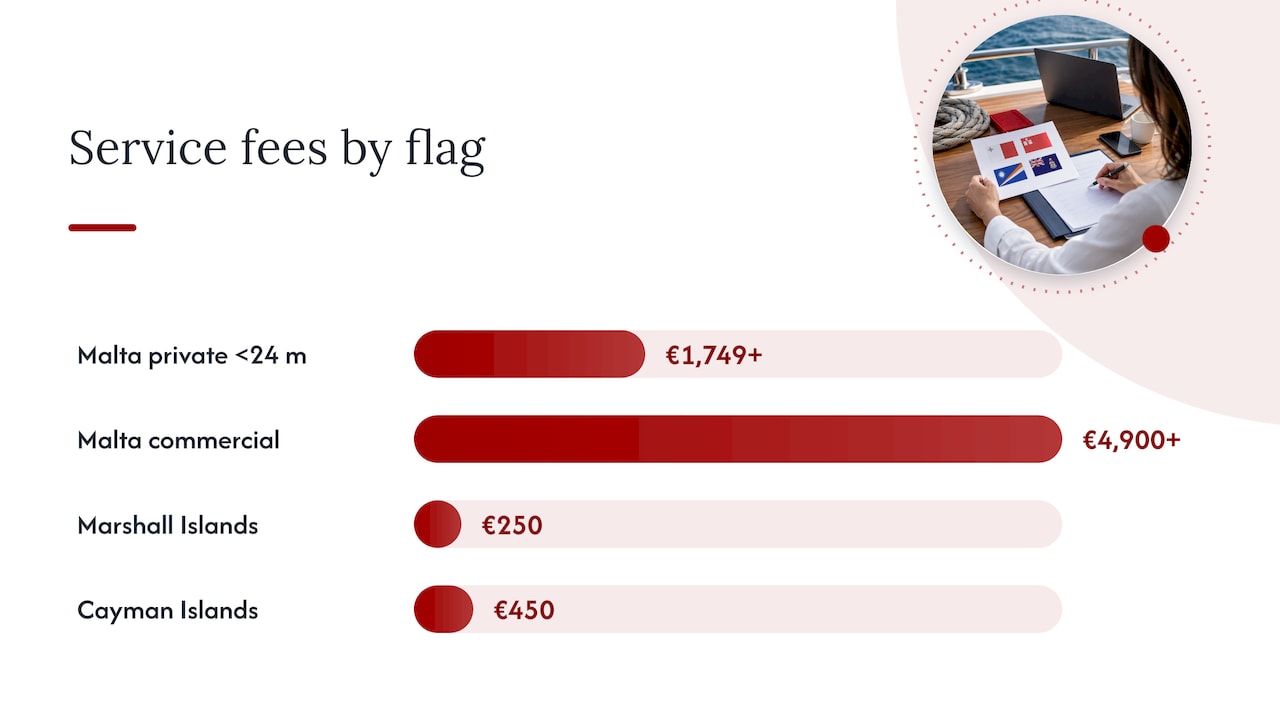
For a commercial yacht, the flag decision above is the one that matters most. Published prices include:
- Malta: our service fee starts from EUR 1,749 for private yachts under 24 m and from EUR 4,900 for commercial yachts, plus Transport Malta government fees. See Registro de iates em Malta.
- Marshall Islands: EUR 250 service fee plus registry fees. See Registro das Ilhas Marshall.
- Cayman Islands: EUR 450 service fee plus registry fees. See Cayman Islands registration.
If the yacht will be owned through a company, we also handle company formation for yacht ownership, and we arrange MMSI radio licences for the vessel.
We also handle Langkawi, Dutch Zeebrief, Gibraltar, Panama and other flags on request, with prices confirmed per case.
Our view: choose the flag for the use, then build the crew file
We see the MLC as a question owners should answer before registration, not after the first charter enquiry. The convention itself leaves “ordinarily engaged in commercial activities” to each flag State, so the registry you choose decides how your yacht is classed and what the inspector will ask for.
Our approach is to start with the intended use and size, then match them to the flags we file for. A private yacht under Malta or the Marshall Islands is treated as outside the MLC when she is not in commercial use, while a charter yacht under the same flags is inside it. Knowing that at the outset avoids re-registering or re-papering later.
We also think of registration as the start of ownership set-up, not a stand-alone form. Company formation, MMSI radio licence and flag transfers all sit around the same decision, and we handle them together so the owner or broker deals with one team. Registry certificates are issued by the registries, and we prepare and file the application that gets you there.
Vessel Flag
Perguntas frequentes
What does MLC stand for on a yacht?
MLC stands for Maritime Labour Convention 2006, an ILO treaty setting minimum working and living conditions for seafarers. On a yacht it governs crew contracts, hours of rest, wages, leave, accommodation and repatriation, where the yacht is in scope.
Does the MLC apply to private yachts?
That depends on the flag State. The MLC covers ships ordinarily engaged in commercial activities, and flags such as the Marshall Islands, Malta and the Bahamas treat private yachts not in commercial use as outside it. Chartering normally brings a yacht into scope, so confirm your use against your registry’s notice.
Do yachts under 500 GT need an MLC certificate?
Not as a mandatory requirement. The ILO FAQ states that certification is mandatory from 500 GT on international voyages, while smaller ships must still be inspected against the same requirements. Voluntary certification is available, and Malta strongly recommends it to ease port State control.
What are the working hour limits for yacht crew?
The MLC allows a maximum of 14 hours of work in any 24 hours and 72 hours in any seven days, or a minimum of 10 hours of rest in 24 hours and 77 hours in seven days. Rest can be split into no more than two periods, one at least six hours long.
Does Vessel Flag issue the MLC certificate?
No. Vessel Flag is a private consultancy and not a registry or government body. MLC certificates and inspections come from the flag State or its authorised organisations, and we prepare and file your registration application under the flag you choose.
Fontes
- MLC, 2006: What it is and what it does (ILO)
- Frequently Asked Questions, MLC 2006, sixth edition (ILO, 2026)
- Compendium of maritime labour instruments, fifth revised edition (ILO, 2026)
- Maritime Labour Convention, 2006, as amended
- Malta flag State inspection guidelines under MLC 2006
- Malta MS Notice 105 Rev 2
- AMSA guide to the implementation of the MLC
- Isle of Man Yacht Master’s Handbook
- Marshall Islands Yacht Technical Circular 17
- Marshall Islands Marine Notice 2-011-33
- Cayman Islands Guidance Note 02/2025
- Cayman Islands crew accommodation notice
- Cayman Islands Manning Policy Manual
- Bahamas Marine Notice 031
Ready to register? See the flag page that fits your yacht, such as Registro de iates em Malta, then book a consultation with Vessel Flag.
Recomendado
A VesselFlag é uma consultoria privada que prepara e protocola pedidos de registro de iates para proprietários. Não somos um órgão governamental nem um registro de bandeira; os certificados são emitidos pelo registro competente. Este artigo contém informações gerais e não constitui aconselhamento jurídico.